
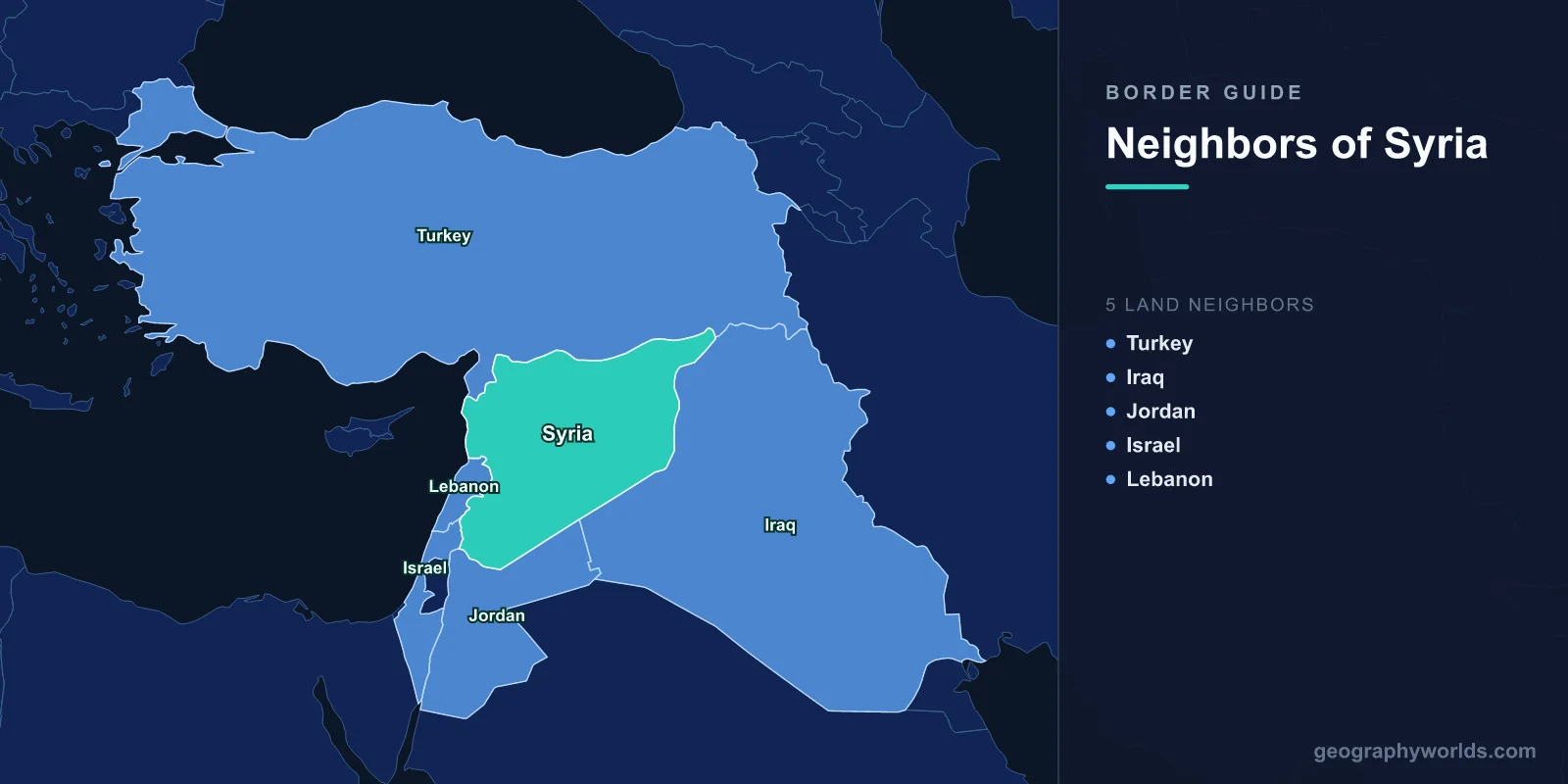
Syria shares land borders with five countries: Turkey to the north, Iraq to the east, Jordan to the south, Israel to the southwest, and Lebanon to the west.
Introduction
Syria's borders define the northern heart of the Levant, the historical crossroads between Europe, Asia, and Africa. Most of these borders were drawn by the French and British mandates after World War I, dividing what had been Ottoman provinces into new nation-states. The Syrian Civil War, beginning in 2011, has transformed all five borders into zones of displacement, conflict, and international intervention.

Overview of Syria's Borders
- Total Land Borders: 2,363 km
- Number of Neighbors: 5 countries
- Longest Border: Turkey (899 km)
- Shortest Border: Israel (76 km, Golan Heights)
Syria's borders are predominantly the product of the 1916 Sykes-Picot Agreement and subsequent French Mandate boundaries. The Turkish border is the longest and runs in an almost straight east-west line across northern Syria. The Iraqi border extends southeast through the Euphrates Valley. Natural features play a limited role, with the Anti-Lebanon Mountains forming the main natural boundary with Lebanon.
The Syrian Civil War has fragmented the country, with different factions and foreign powers controlling various border regions. Turkey controls a buffer zone in the north, Kurdish forces hold much of the northeast, and various groups have contested the borders with Iraq, Jordan, and Israel at different points during the conflict.
Northern Neighbor: Turkey
- Border Length: 899 km
- Key Features: Euphrates River crossing, Syrian Kurdish region
- Military Presence: Turkish buffer zone in northern Syria
Turkey's 899 km border is Syria's longest and most consequential. This border largely follows an arbitrary line drawn during the French Mandate period, though the Hatay Province (Alexandretta) was transferred from Syria to Turkey in 1939, a move Syria long refused to recognize. The Euphrates River crosses this border, and Turkey's GAP dam project upstream has reduced water flow to Syria.
Since the Syrian Civil War, Turkey has conducted multiple military operations into northern Syria to combat Kurdish forces and ISIS. Turkey controls a buffer zone along the border and hosts approximately 3.6 million Syrian refugees, the largest refugee population in the world. The border is heavily fortified with walls, fences, and military positions.
Eastern and Southern Neighbors: Iraq and Jordan
- Iraq Border: 599 km
- Jordan Border: 379 km
- Key Features: Euphrates Valley, desert terrain
The Iraqi border at 599 km crosses the Euphrates River valley and extends into the Syrian Desert. This border was effectively erased when ISIS controlled territory on both sides in 2014-2017. The border town of Abu Kamal/Al-Qa'im became a key ISIS stronghold. Today, Iranian-backed militias operate on both sides of parts of this border.
Jordan's 379 km border crosses desert terrain in the south. The Nasib/Jaber border crossing connecting Damascus to Amman was closed for years during the civil war before reopening in 2018. Jordan hosts approximately 670,000 registered Syrian refugees. The border region includes the strategically important Daraa province, where the Syrian uprising began in 2011.
Western and Southwestern Neighbors: Lebanon and Israel
- Lebanon Border: 403 km
- Israel Border: 76 km (Golan Heights)
- Key Features: Anti-Lebanon Mountains, Golan Heights, Bekaa Valley
The Lebanese border at 403 km follows the Anti-Lebanon Mountains and crosses the northern plains. Syria maintained a military presence in Lebanon from 1976 to 2005 and continues to exert political influence through Hezbollah, which has fought in the Syrian Civil War in support of the Assad government. The border region has seen cross-border shelling and Hezbollah operations throughout the conflict.
Israel's 76 km border runs through the Golan Heights, which Israel captured from Syria in 1967 and annexed in 1981 (a move not recognized by most of the international community). A UN-monitored demilitarized zone separates the two sides. The Golan Heights provide strategic high ground overlooking both countries and are a major water source for the Sea of Galilee.
Cross-Border Relations and Displacement
- Refugees: Over 6 million Syrians displaced externally
- Turkey Hosts: ~3.6 million Syrian refugees
- Golan Heights: Israeli-occupied since 1967
The Syrian Civil War has created one of the largest displacement crises in modern history. Over 6 million Syrians have fled to neighboring countries, with Turkey hosting the largest share (3.6 million), followed by Lebanon (1.5 million), Jordan (670,000), and Iraq (260,000). These refugee populations have transformed border regions and strained neighboring economies.
Every Syrian border is affected by foreign military presence. Turkey, Russia, the United States, Iran, Israel, and various non-state actors operate in Syrian border regions. The complexity of the conflict means that Syria's borders function differently in each section, from Turkish-controlled zones to Kurdish autonomous regions to Iranian-influenced corridors.
Key Facts
- Syria borders 5 countries: Turkey, Iraq, Jordan, Israel, and Lebanon.
- Turkey hosts approximately 3.6 million Syrian refugees, the largest refugee population in any country.
- The Golan Heights, captured by Israel in 1967, define the Syrian-Israeli border.
- Many of Syria's borders were drawn by the Sykes-Picot Agreement of 1916.
- Over 6 million Syrians have fled across borders since the civil war began in 2011.
Fun Facts
- Syria never officially recognized the transfer of Hatay Province (Alexandretta) to Turkey in 1939.
- The Euphrates River crosses from Turkey into Syria, making water rights a major border issue.
- The ancient city of Palmyra, near the Iraqi border, was one of the greatest trading cities of the ancient world.
- The Golan Heights provide approximately one-third of Israel's water supply.
Final Thoughts
Syria's five borders tell the story of a nation shaped by colonial-era line-drawing, Cold War rivalries, and the devastating civil war that began in 2011. From the Turkish buffer zone to the Israeli-occupied Golan Heights to the refugee-strained Jordanian and Lebanese frontiers, Syria's borders remain among the most consequential and contested in the world.
Test Your Knowledge!
Think you know which countries share borders? Try our geography games!
Play Geography Games →