
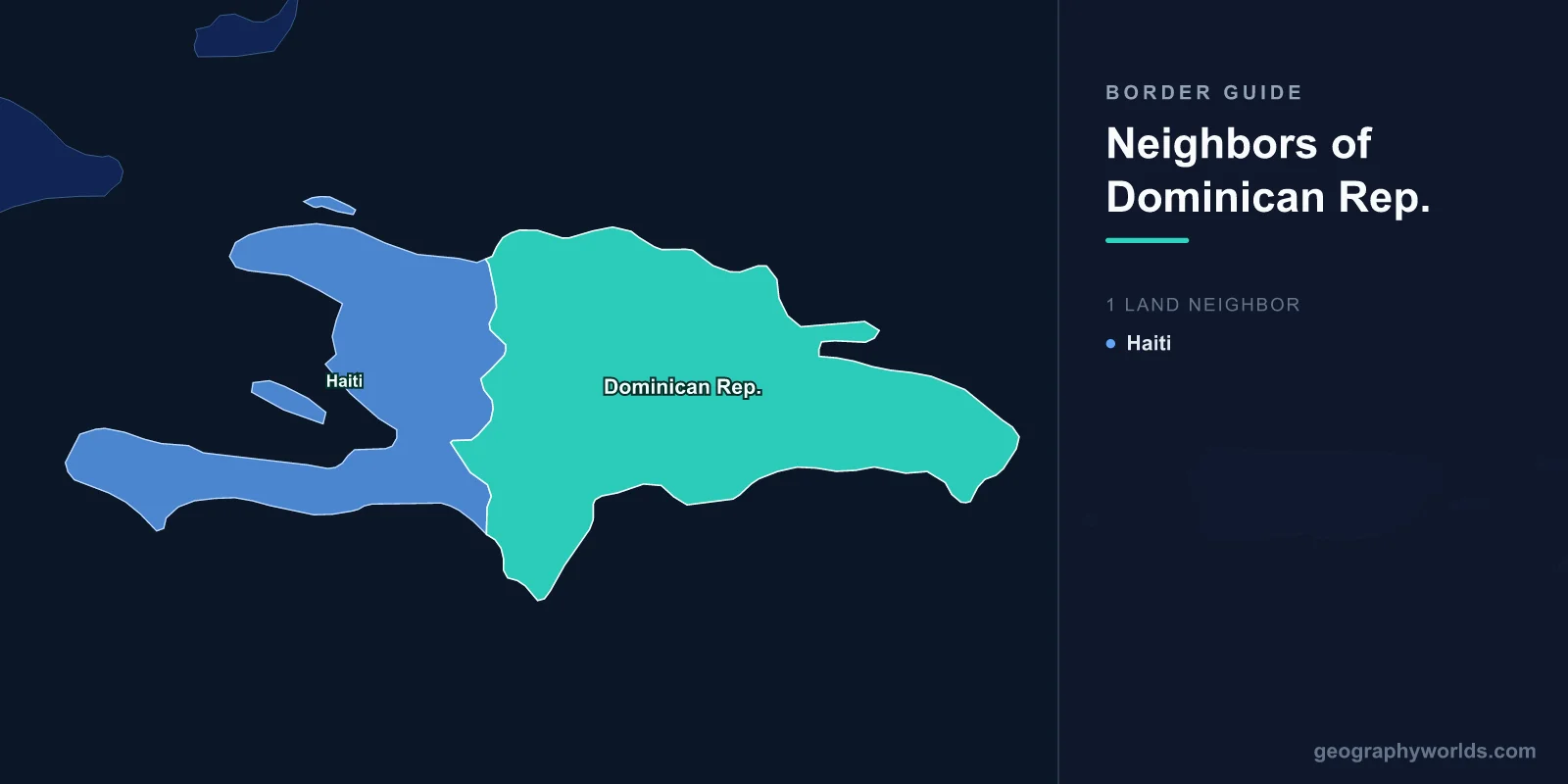
The Dominican Republic shares a land border with exactly one country: Haiti, which occupies the western third of Hispaniola. The frontier runs about 376 kilometres from the Atlantic coast near Dajabón and Pepillo Salcedo to the Caribbean at Pedernales. The Dominican Republic holds roughly two-thirds of the island and has the larger economy by a very wide margin, and both of those facts determine how it treats the line.
The Boundary Was Only Fixed in the Twentieth Century
For most of the island's history the frontier was vague. Spanish and French colonial claims overlapped, the line shifted with the fortunes of each colony, and after independence neither state had the administrative reach to define it.
It was settled by treaty in 1929, with a revision in 1936, negotiated between Rafael Trujillo and the Haitian government and drawing on earlier arbitration. That agreement produced the boundary that exists today, including the provisions on shared rivers that are still being argued about.
The 1929 treaty is barely a century old, which is worth holding in mind: this is not an ancient frontier but a modern administrative settlement laid over a much older pattern of movement.
Dominicanisation of the Frontier
Having fixed the line, Trujillo set about making the land behind it Dominican in character. The policy, explicitly named dominicanización de la frontera, involved settling Dominicans from elsewhere in the border provinces, building schools and churches, promoting Spanish over Creole, and encouraging European immigration — including, notably, the admission of Jewish refugees at Sosúa in 1940, offered in part as a whitening measure.
Its violent extreme was the massacre of October 1937, in which Trujillo ordered the killing of Haitians in the borderlands; estimates of the dead range from several thousand to tens of thousands. The state then paid a small indemnity and the episode largely disappeared from Dominican textbooks for two generations.
The ideology that justified it — that the Dominican nation is Hispanic and Catholic and defined against its neighbour — did not disappear, and it remains an identifiable current in Dominican politics.
The Labour the Economy Runs On
Alongside the hostility runs a dependence. Haitian labour has underpinned Dominican sugar production for a century, housed in company settlements known as bateyes, many under conditions that international bodies have described as forced labour. Recruitment was organised state-to-state for decades.
As sugar declined, the labour moved into construction, agriculture and tourism. Estimates of the Haitian-born population in the Dominican Republic run to several hundred thousand, and their share of the construction workforce in particular is very large. Dominican employers in these sectors have consistently lobbied against the strictest enforcement proposals.
This is the structural tension in Dominican border policy: the political incentive is to restrict and the economic incentive is to admit, and successive governments have tried to do both at once by tolerating an undocumented workforce with no rights.
The Ruling That Removed a Citizenship
In September 2013 the Dominican Constitutional Court issued judgment TC 168-13, holding that children born in the country to parents without regular migration status had never been entitled to Dominican nationality, and applying the reasoning retroactively to births from 1929.
The effect was to strip nationality from people who had been Dominican citizens all their lives, overwhelmingly of Haitian descent, by some estimates well over 100,000 of them. Many had never been to Haiti, spoke only Spanish, and had no claim to any other nationality.
The Inter-American Court of Human Rights ruled against the decision in 2014. The Dominican Republic responded by declaring that court's jurisdiction invalid and passed a naturalisation law creating a registration process, which restored documents to some and left a substantial group stateless. It is among the largest denationalisation events anywhere in the modern era.
The Wall
Construction of a border barrier began in 2022: a concrete base with mesh above, topped with wire, accompanied by watchtowers, sensors, cameras and patrol roads, covering roughly half the boundary in its planned extent.
The government's justification is control of irregular migration, smuggling and the movement of weapons, in the context of Haiti's collapse into gang control. Critics point out that the great majority of Haitians in the country arrived through official crossings and overstayed, which a fence does not address, and that the barrier has not prevented the trade in Dominican-sourced weapons flowing the other way.
The four formal crossings — Dajabón, Elías Piña, Jimaní and Pedernales — remain the funnels for everything legal, and they are where the twice-weekly binational markets operate.
Markets That Both Sides Need
The binational markets are the working part of the border. At Dajabón in particular, tens of thousands cross on market days, and the trade is heavily in the Dominican Republic's favour: Haiti is among the largest export destinations for Dominican goods, taking food, plastics, cement, textiles and metal products.
That imbalance is why border closures are not costless for Santo Domingo. When the entire frontier was shut in September 2023 over the Massacre River canal dispute, Dominican exporters and border-province traders were among the loudest voices for reopening, and the land border was partially restored within weeks.
The Canal Dispute
The 2023 closure was triggered by Haitian construction of an irrigation canal drawing from the Massacre River, which forms the northern section of the boundary. The Dominican position is that the works breach the 1929 treaty's provisions on shared waters and would reduce flow to Dominican farmers in the Dajabón valley.
Haiti's position is that the treaty grants both states just use of boundary rivers and that Dominican irrigation from the same river has long been extensive. Construction continued through the closure, financed substantially by public subscription and diaspora donations.
The episode demonstrated the limits of the Dominican Republic's leverage. Closing the border imposed real costs on a country whose state had already collapsed, and the project it was meant to stop went ahead anyway.
Two Very Different Economies
The gap across the line is among the widest between any two adjacent countries. The Dominican Republic has a diversified economy built on tourism, free-trade-zone manufacturing, mining, agriculture and remittances, and has recorded some of the strongest sustained growth in the Americas.
Punta Cana alone receives millions of visitors a year. Haiti's tourism industry is effectively non-existent. The two countries began the twentieth century with Haiti the wealthier of the pair.
That divergence, on one island with one border, is why the frontier functions as it does — and why Dominican governments have argued consistently at the United Nations that Haiti's crisis requires an international response rather than a bilateral one, while resisting proposals that they lead it.
Sosúa, and a Border That Once Opened
The Dominican Republic's border history contains one episode that runs against the rest. At the Évian Conference in 1938, called to address the flight of Jews from Nazi Germany, delegation after delegation declined to raise its immigration quotas. The Dominican Republic offered to accept up to 100,000 refugees.
The motives were not humanitarian. Trujillo was seeking to repair his international reputation after the 1937 massacre and pursuing a policy of whitening the population. In the event the numbers were small — several hundred settlers reached the north-coast town of Sosúa, where they were given land and established a dairy cooperative that still operates.
The offer is nonetheless a fact of the record: at a moment when almost every country in the world closed its borders, the one government that opened them was doing so for reasons bound up with the same racial ideology that had produced a massacre on its western frontier the year before.
Baseball, and a Border Crossed by Talent
One flow across the Dominican Republic's frontiers is entirely voluntary and extremely lucrative. The country supplies more foreign-born Major League Baseball players than any other, by a wide margin, and academies run by American clubs operate across the island recruiting teenagers.
San Pedro de Macorís, a sugar town east of the capital, has produced an improbable number of major leaguers, and the sport's economics run back the other way as remittances and investment. Haitian-descended players from the bateyes have featured prominently, which makes baseball one of the few Dominican institutions where the border's labour history is publicly celebrated rather than disputed.
Two Coasts and Many Sea Borders
Beyond Haiti, the Dominican Republic's frontiers are all maritime, and it has delimited several of them by agreement, including with Venezuela, the Netherlands for the Caribbean islands, the United Kingdom for the Turks and Caicos, and the United States for Puerto Rico. The Mona Passage between Hispaniola and Puerto Rico is a busy and dangerous route for unauthorised migration toward United States territory.
Those sea boundaries are settled and uncontroversial, which throws the land border into sharper relief. A country with half a dozen negotiated maritime frontiers and one contested land one puts nearly all of its border policy into the single line it shares with a state in collapse.
One Border, No Escape From It
The Dominican Republic's other frontiers are maritime — with Cuba, the Bahamas, the Turks and Caicos, Puerto Rico and Venezuela across open water — and none of them generates anything comparable.
Everything in Dominican border policy therefore concentrates on a single line, drawn in 1929, dividing an island whose two halves have been diverging since 1697. The wall is the most visible expression of a strategy of separation; the markets, the bateyes and the construction sites are the evidence that separation is not actually on offer. A broader account is in our Dominican Republic country guide, and our Caribbean countries guide places Hispaniola among its neighbours.
