
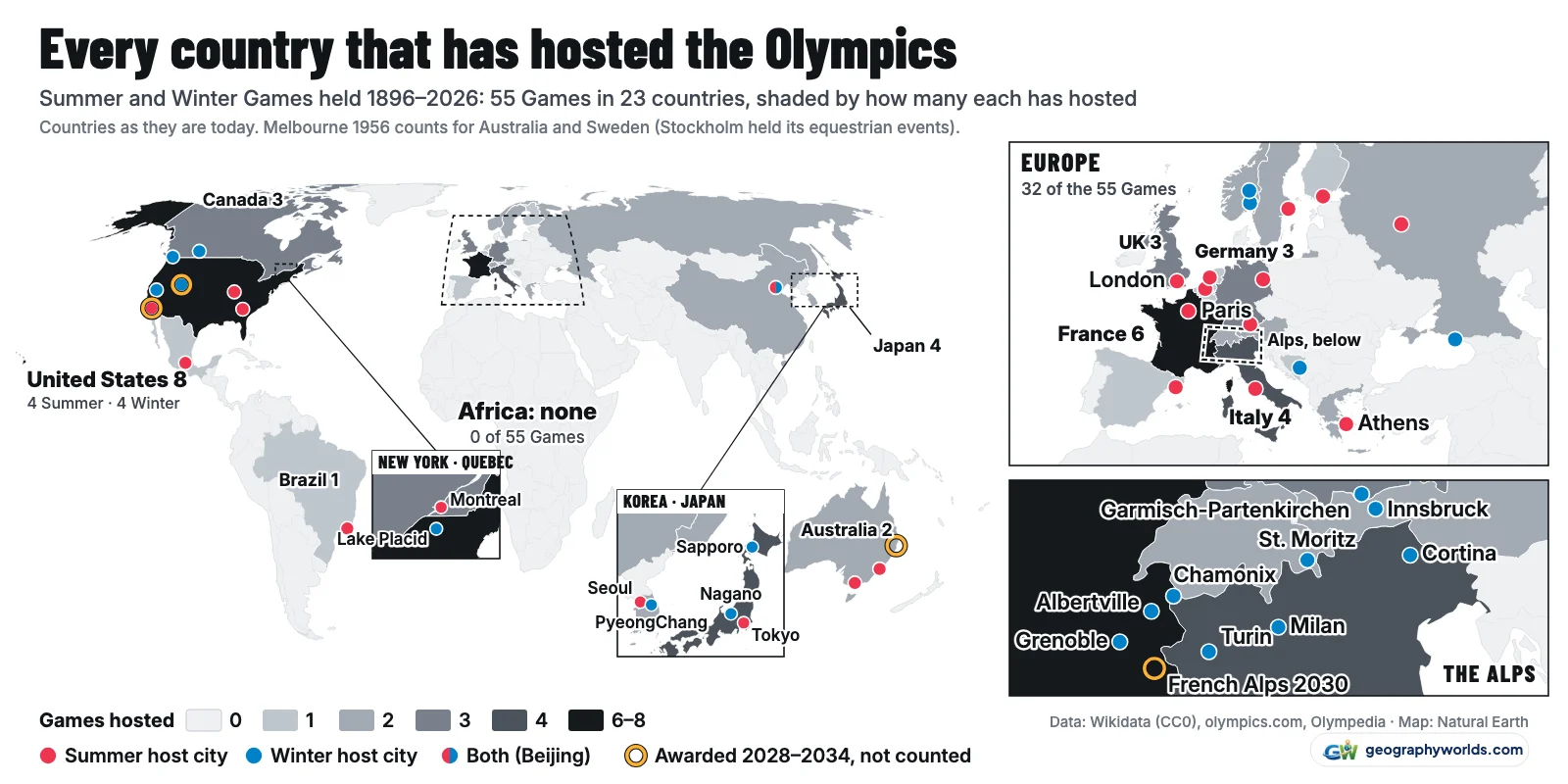
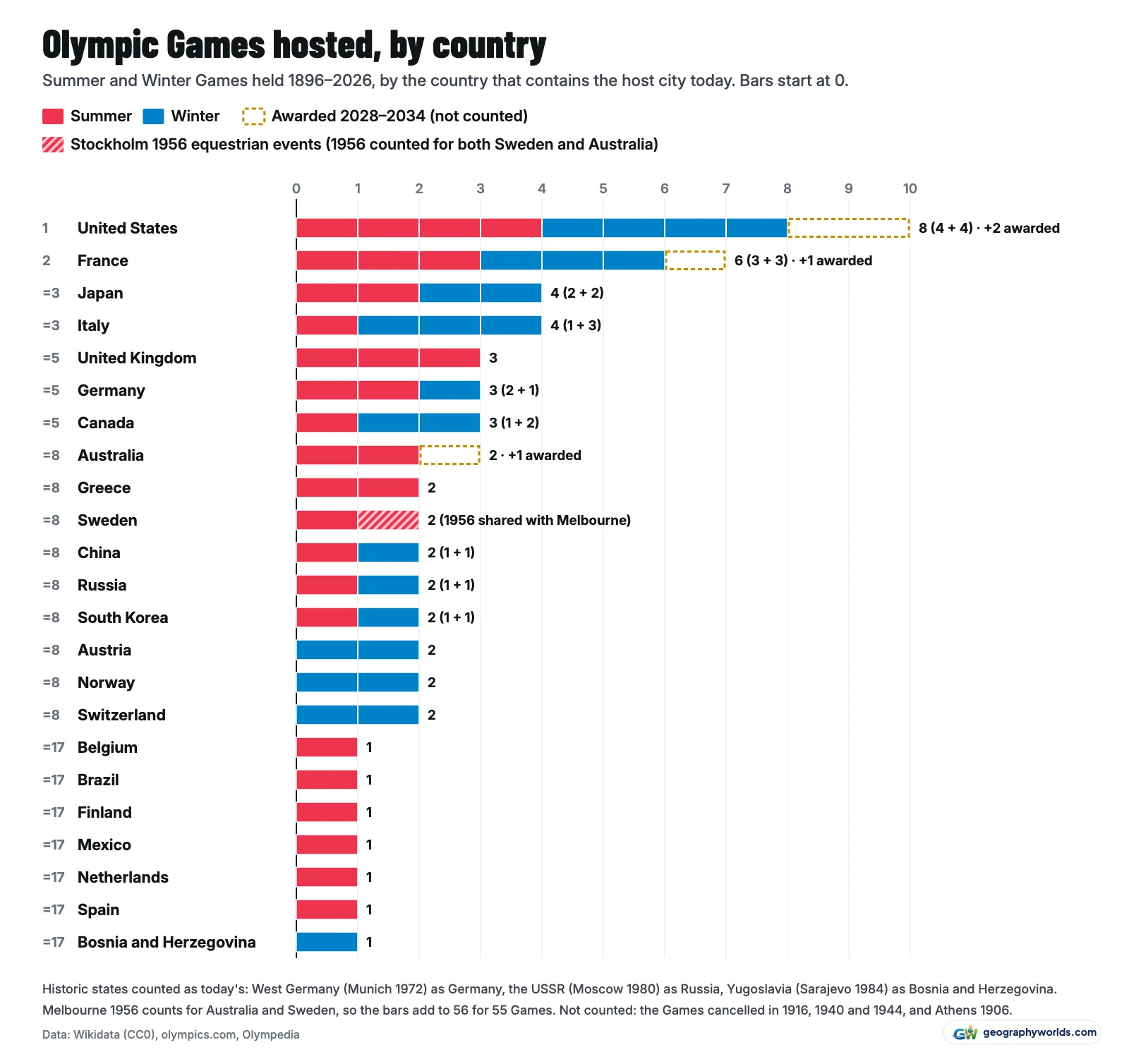
In all, 23 countries have hosted the Olympic Games. The United States has hosted the most, eight Games: St. Louis 1904, Los Angeles 1932, Los Angeles 1984 and Atlanta 1996 in summer, and Lake Placid 1932, Squaw Valley 1960, Lake Placid 1980 and Salt Lake City 2002 in winter. France is second with six (three Summer, three Winter), Japan and Italy have hosted four each, and the United Kingdom, Germany and Canada three each. In all, 55 Summer and Winter Olympics have been held between Athens 1896 and Milano Cortina 2026, 30 Summer and 25 Winter, in 44 cities. Europe has staged 32 of them. Africa has staged none.
Four more are awarded: Los Angeles 2028, the French Alps in 2030, Brisbane 2032 and Salt Lake City, Utah, in 2034. They go to countries that have hosted before, and they are counted separately here, so the United States will reach 10 and France 7 if all four go ahead. Every edition comes from Wikidata, checked against two independent lists: the International Olympic Committee's own list of Games on olympics.com, and the editions table kept by the historians at Olympedia. Countries are counted as they are today, so Moscow 1980 belongs to Russia and Sarajevo 1984 to Bosnia and Herzegovina; the last section explains that rule and the other edge cases.
The United States: eight Games, split evenly between summer and winter
No other country has hosted as many Summer Games or as many Winter Games as the United States. Its four Summer Olympics are St. Louis 1904, Los Angeles 1932, Los Angeles 1984 and Atlanta 1996; its four Winter Olympics are Lake Placid 1932, Squaw Valley 1960, Lake Placid 1980 and Salt Lake City 2002. Los Angeles is the only American city to host twice in summer, and both times the centre of the Games was the Memorial Coliseum, where, Olympedia records, the 1932 crowd sang "Aloha" as the sun set on the closing day. In 2028 it becomes the third city to host three Summer Games. Lake Placid, a village in New York State, has held the Winter Games twice, in 1932 and 1980.

The eight are spread over six cities, and the next two Games return to two of them, Los Angeles and Salt Lake City, taking the United States to 10.
France: three in Paris, three in the Alps
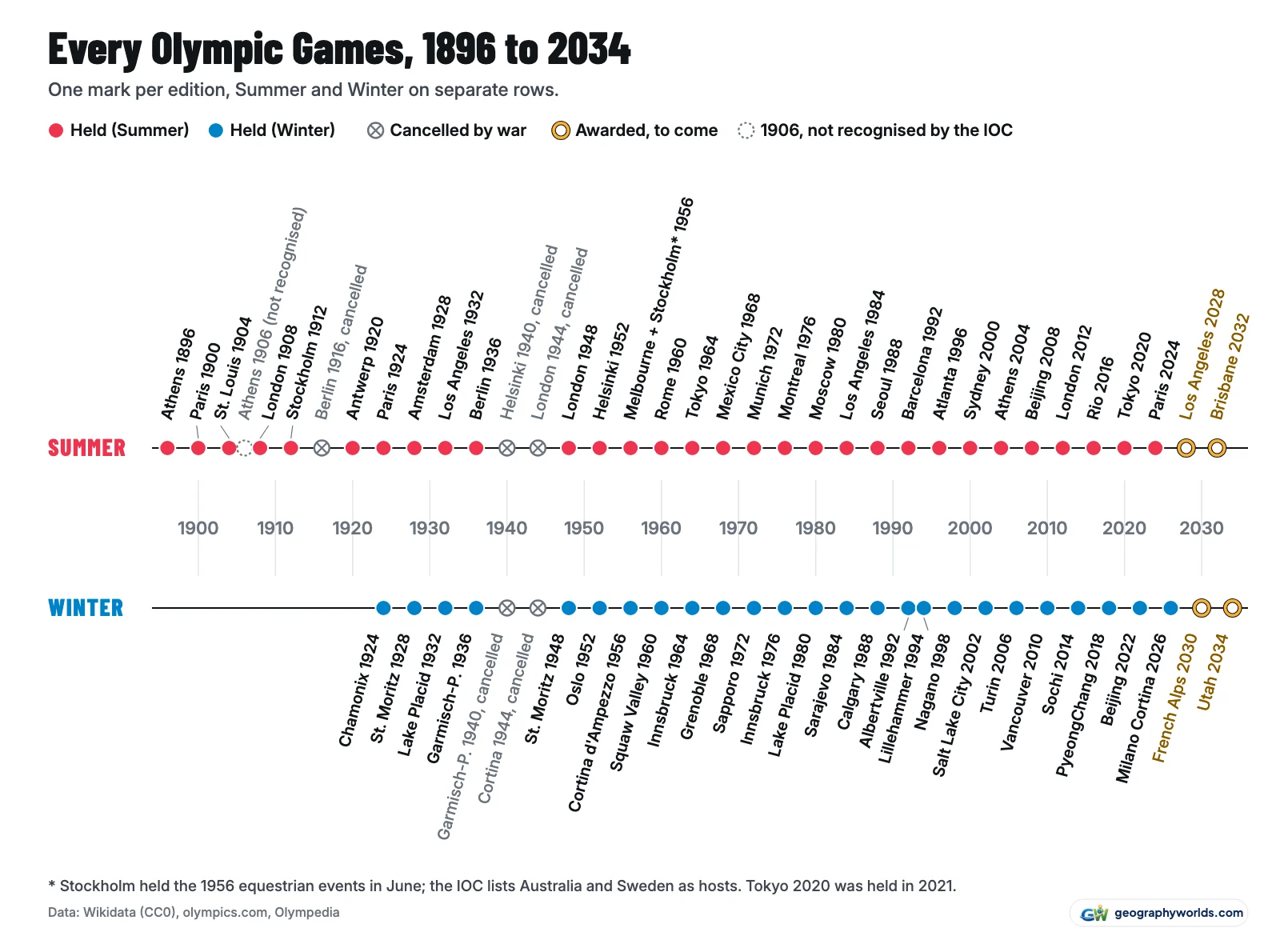
France's six divide neatly. In summer it hosted Paris 1900, Paris 1924 and Paris 2024, every one in Paris; in winter, Chamonix 1924, Grenoble 1968 and Albertville 1992, all in the French Alps. Paris and London are the only cities to have held three Games each. Paris 2024 came exactly a century after Paris 1924, the year France also staged the first Winter Olympics at Chamonix. France hosted both Games in 1924, the United States in 1932 and Germany in 1936, and the two Games kept sharing a year until 1992, when Albertville and Barcelona were the last pair.
France's seventh, Alpes 2030, is a region rather than a city, and on our map it is marked inside the French Alps, the range covered in our guide to the Alps. That will make four French Winter Games, all of them in the Alps.
Japan and Italy: four each, built in different ways
Japan's four are split evenly: Tokyo 1964 and Tokyo 2020 (held in 2021) in summer, Sapporo 1972 and Nagano 1998 in winter. It could have been six. Tokyo and Sapporo were awarded the 1940 Summer and Winter Games, and both withdrew on 16 July 1938 after the government stopped funding them during the war with China, according to Olympedia. Tokyo 2020 was held in 2021 but kept its name, and it counts as the 2020 edition here, as it does for the IOC.
Italy reached four almost entirely in winter. Its only Summer Games is Rome 1960; its Winter Games are Cortina d'Ampezzo 1956, Turin 2006 and Milano Cortina 2026. Cortina d'Ampezzo had been chosen for the 1944 Winter Olympics, which the war cancelled, before it hosted in 1956 and then shared the 2026 Games with Milan. Italy also gave up the Games once: Rome was the original choice for 1908 and relinquished them in 1906, which is how London came to host its first.
Britain, Germany and Canada: three apiece
All three of the United Kingdom's Games were in London: London 1908, London 1948 and London 2012. The 1948 Games were the first Summer Olympics after the Second World War, and London had already been awarded the cancelled 1944 Games. The UK is the only country with three or more Games that has never hosted a Winter Olympics.
Germany's three are Berlin 1936 and Munich 1972 in summer and Garmisch-Partenkirchen 1936 in winter. Berlin was also chosen for 1916, the first Games lost to war, and Garmisch-Partenkirchen was handed the 1940 Winter Games after the IOC removed St. Moritz as host, the only time it has done so, as Olympedia's account of 1940 explains. Munich 1972 was held in West Germany, which the IOC's own page names as the Federal Republic of Germany; it is counted for today's Germany.
Canada leans the other way, with Montreal 1976 in summer and Calgary 1988 and Vancouver 2010 in winter, three Games in three different cities.
Two-time and one-time hosts
Nine countries have hosted twice: Australia, Greece, Sweden, China, Russia, South Korea, Austria, Norway and Switzerland. Greece waited longest between Games, 108 years from the first modern Olympics in Athens in 1896 to Athens 2004. Sweden's second is shared: Stockholm hosted in 1912 and then held the equestrian events of the 1956 Games, which could not go to Melbourne because Australia required a six-month quarantine for horses, as Olympedia sets out. Australia's own two, Melbourne 1956 and Sydney 2000, will become three with Brisbane 2032.
Seven countries have hosted once: Belgium, Brazil, Finland, Mexico, Netherlands, Spain and Bosnia and Herzegovina. Bosnia and Herzegovina's one is Sarajevo 1984, held when the city was in Yugoslavia. Four countries have only ever hosted the Winter Games (Austria, Bosnia and Herzegovina, Norway and Switzerland), and nine have hosted both: United States, France, Japan, Italy, Germany, Canada, China, Russia and South Korea. Beijing is the only city to have held both, in 2008 and 2022.
| Rank | Country | Summer | Winter | Total | Summer Games | Winter Games | Awarded |
|---|---|---|---|---|---|---|---|
| 1 | United States | 4 | 4 | 8 | St. Louis 1904, Los Angeles 1932, Los Angeles 1984, Atlanta 1996 | Lake Placid 1932, Squaw Valley 1960, Lake Placid 1980, Salt Lake City 2002 | Los Angeles 2028, Utah 2034 |
| 2 | France | 3 | 3 | 6 | Paris 1900, Paris 1924, Paris 2024 | Chamonix 1924, Grenoble 1968, Albertville 1992 | Alpes 2030 |
| 3 | Japan | 2 | 2 | 4 | Tokyo 1964, Tokyo 2020 | Sapporo 1972, Nagano 1998 | |
| 3 | Italy | 1 | 3 | 4 | Rome 1960 | Cortina d'Ampezzo 1956, Turin 2006, Milano Cortina 2026 | |
| 5 | United Kingdom | 3 | 0 | 3 | London 1908, London 1948, London 2012 | — | |
| 5 | Germany | 2 | 1 | 3 | Berlin 1936, Munich 1972 | Garmisch-Partenkirchen 1936 | |
| 5 | Canada | 1 | 2 | 3 | Montreal 1976 | Calgary 1988, Vancouver 2010 | |
| 8 | Australia | 2 | 0 | 2 | Melbourne 1956, Sydney 2000 | — | Brisbane 2032 |
| 8 | Greece | 2 | 0 | 2 | Athens 1896, Athens 2004 | — | |
| 8 | Sweden | 2 | 0 | 2 | Stockholm 1912, Stockholm 1956 (equestrian) | — | |
| 8 | China | 1 | 1 | 2 | Beijing 2008 | Beijing 2022 | |
| 8 | Russia | 1 | 1 | 2 | Moscow 1980 | Sochi 2014 | |
| 8 | South Korea | 1 | 1 | 2 | Seoul 1988 | PyeongChang 2018 | |
| 8 | Austria | 0 | 2 | 2 | — | Innsbruck 1964, Innsbruck 1976 | |
| 8 | Norway | 0 | 2 | 2 | — | Oslo 1952, Lillehammer 1994 | |
| 8 | Switzerland | 0 | 2 | 2 | — | St. Moritz 1928, St. Moritz 1948 | |
| 17 | Belgium | 1 | 0 | 1 | Antwerp 1920 | — | |
| 17 | Brazil | 1 | 0 | 1 | Rio de Janeiro 2016 | — | |
| 17 | Finland | 1 | 0 | 1 | Helsinki 1952 | — | |
| 17 | Mexico | 1 | 0 | 1 | Mexico City 1968 | — | |
| 17 | Netherlands | 1 | 0 | 1 | Amsterdam 1928 | — | |
| 17 | Spain | 1 | 0 | 1 | Barcelona 1992 | — | |
| 17 | Bosnia and Herzegovina | 0 | 1 | 1 | — | Sarajevo 1984 |
Africa, still waiting after 130 years
The map has one large gap. Of the 55 Games, Europe has held 32 (17 Summer, 15 Winter, in 15 countries), North America 12, Asia 8, Oceania 2 and South America 1, Rio de Janeiro in 2016. Africa has held none. Only three Games, Melbourne 1956, Sydney 2000 and Rio 2016, have taken place south of the equator, all of them in summer, and every Winter Games so far has been in Europe, North America or East Asia.
It is not for want of trying. Alexandria was among the cities interested in the 1916 and 1940 Games, Olympedia notes, and Cape Town came closest, reaching the third round of voting for 2004 before it was eliminated with 20 votes, according to the record of bids for the Olympic Games. Africa has hosted football's biggest event, South Africa's 2010 World Cup, as our list of World Cup host countries shows, but never the Olympics.
That changes in a smaller way this autumn. Dakar, Senegal, opens the Youth Olympic Games on 31 October 2026, an event then-IOC President Thomas Bach described in 2024 as the first Olympic event on African soil. The Youth Games are a separate competition for young athletes and are not counted in this ranking, which covers only the Summer and Winter Olympics. The IOC's list names no host for 2036 yet, so the earliest an African country could stage a Summer Games is still open.
How the Games were counted
A Games counts once, for the country that contains its host city today, and only if it was held. That rule settles the historic states: Berlin 1936 (the German Reich) and Munich 1972 (West Germany) count for Germany, Moscow 1980 (the Soviet Union) for Russia, and Sarajevo 1984 (Yugoslavia) for Bosnia and Herzegovina. The one exception follows the IOC itself: its page for Melbourne 1956 names both Australia and Sweden as hosts, so that edition counts for both, and the country totals add to one more than the number of Games. Counting it for Australia alone would leave Sweden on one and move no one else.
The five Games cancelled by the two world wars (Summer 1916, 1940 and 1944, Winter 1940 and 1944) are not counted. Nor are the 1906 Games in Athens, which Olympedia lists separately as the Intercalated Games and notes the IOC does not consider official; counting them would give Greece three. Milano Cortina 2026 had two host cities in one country and counts once for Italy. Youth Olympics and Paralympics are outside the scope.
Every one of the 55 held editions matched the IOC's list by name and year, and the host country matched on all 50 IOC edition pages we could read and in Olympedia's table. Dates did not always agree. The IOC gives a different span from Wikidata for 12 of 50 editions, for example Amsterdam 1928 (17 May to 12 August on olympics.com, 28 July to 12 August on Wikidata) and Melbourne 1956 (21 November to 8 December on olympics.com, 22 November to 8 December on Wikidata), In some cases competition began before the opening ceremony; others are a day apart for reasons the sources do not give. No count here depends on a date, and the CSV gives Wikidata's dates.
You can download the data as a CSV with every edition, held, cancelled or awarded, its host city and coordinates, the country then and now, and its dates. If you would like to see how hosting tracks with medals, put it next to a medal table in Parity and chart the two side by side.
- Wikidata: every Summer and Winter Olympic Games edition (classes Q135976384 and Q137592217) with dates and country, and each host city's coordinates and present-day country: queried 12 October 2026 through the SPARQL endpoint; CC0 (public domain dedication)
- International Olympic Committee: the list of Olympic Games on olympics.com, and each edition's page (dates, host country): read 12 October 2026; used to check every edition, not republished
- Olympedia: the editions table (Olympic Games, cancelled Games, the 1956 equestrian Games and the 1906 Intercalated Games): read 12 October 2026; used to check every edition's host country, not republished
- Natural Earth country outlines (via world-atlas): public domain; hero map
For the other side of the story, the countries that have taken home the most podium places, turn to our ranking of the countries with the most Olympic medals.