
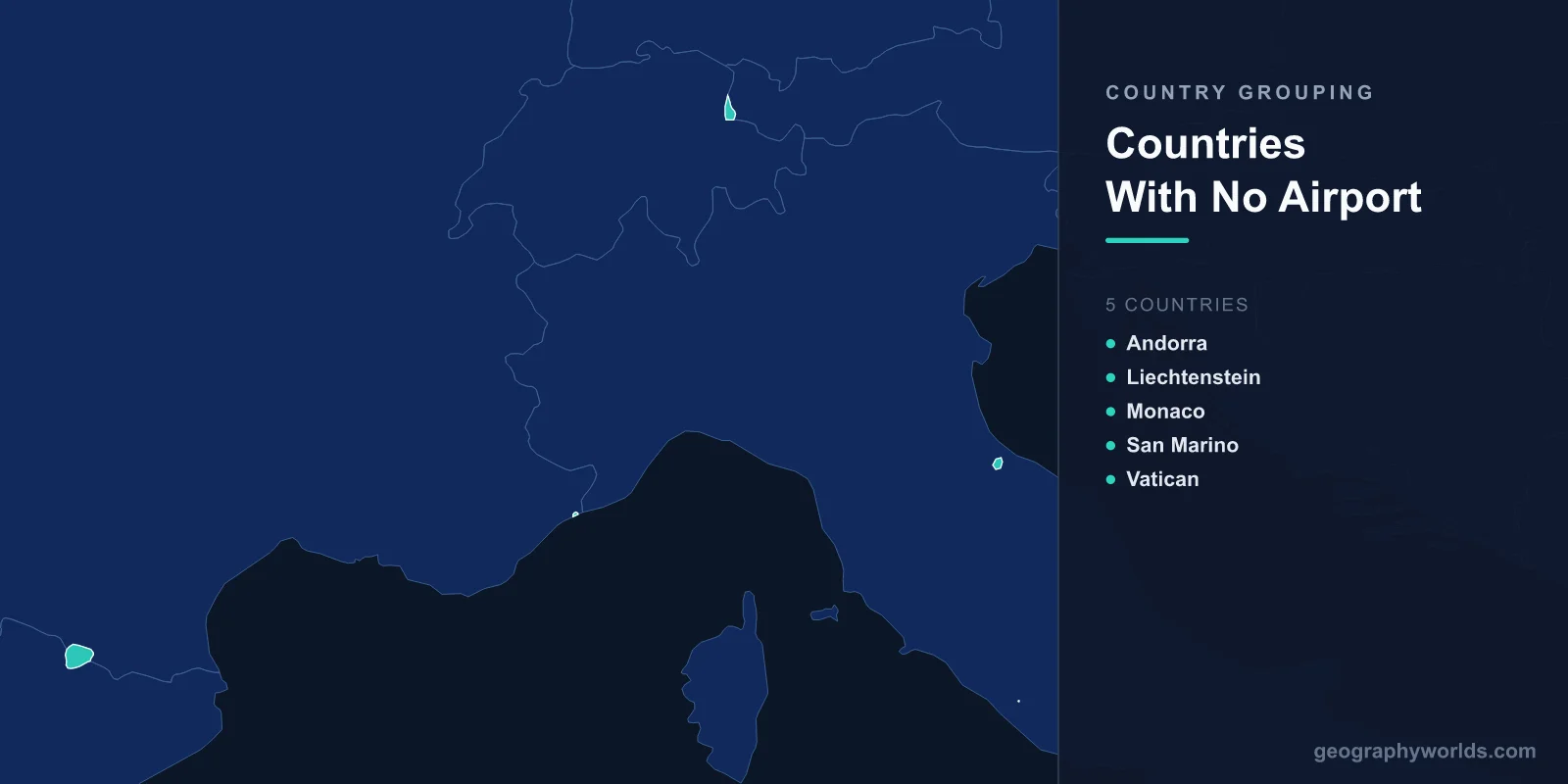
Five sovereign countries have no airport at all: Andorra, Liechtenstein, Monaco, San Marino and Vatican City. Every one of them is in Europe, every one is small, and every one is reached overland from a neighbour. A sixth country, Palestine, has an airport that no longer operates. Nowhere else on earth is a recognised state entirely without one.
Why the List Is So Short
An airport is a low bar. A grass strip with a windsock counts in most national inventories, which is why the global total runs into the tens of thousands and why countries with tiny populations and almost no infrastructure still appear on the list. Nauru has one. Tuvalu has one. Both have populations under 12,000.
What actually excludes a country is not poverty or remoteness but the absence of flat ground. Four of these five states sit in mountains or on a coastal cliff, and the fifth is 0.49 square kilometres of walled city inside another capital. In each case there is physically nowhere to put a runway.
The shortest commercial runways in regular use run to a few hundred metres — Saba in the Caribbean operates at around 400 metres, Courchevel in the French Alps at about 537 metres with a pronounced gradient. None of the five could accommodate even that.
Andorra
Andorra sits in the eastern Pyrenees between France and Spain, covering 468 km² with no land under about 800 metres and peaks approaching 3,000. There is no valley floor long enough or level enough for a runway.
The nearest airport with scheduled flights is Andorra-La Seu d'Urgell, a few kilometres inside Spain, which handles seasonal regional services. In practice most visitors fly into Barcelona or Toulouse and take a bus, a journey of roughly three hours from either. The country also has heliports at Andorra la Vella, Arinsal and La Massana.
Andorra is landlocked, has no railway station within its borders, and has a single road corridor running through it. For a country of around 80,000 people receiving several million visitors a year, almost all of them arriving for skiing or duty-free shopping, that is a remarkable transport bottleneck.
Liechtenstein
Liechtenstein occupies 160 km² of the upper Rhine valley between Switzerland and Austria, and it is doubly landlocked — both its neighbours are themselves landlocked, so reaching the sea requires crossing two international borders.
The valley floor is flat and would physically permit a short strip, but the country is only a few kilometres wide at that point and the Rhine forms the western boundary. The nearest airport is Zürich, about 120 kilometres away, and the usual route is a train to Sargans or Buchs in Switzerland followed by a short bus.
Liechtenstein has a single heliport at Balzers, used for charter and mountain rescue. It also has no railway station of its own that is operated by the country — the line through it is run by Austrian Federal Railways.
Monaco
Monaco is 2.08 km², the second-smallest country in the world, wedged between the Mediterranean and the Alpes-Maritimes with France on every landward side. Roughly a fifth of its present area has been reclaimed from the sea, and none of it is available for a runway.
The nearest airport is Nice Côte d'Azur, around 22 kilometres west. The distinctive Monégasque solution is the helicopter: a scheduled service shuttles between Nice airport and the Monaco Heliport at Fontvieille in about seven minutes, one of the busiest commercial helicopter routes in Europe.
Monaco is also the one country on this list with a functioning railway station, Monaco-Monte-Carlo, which is underground — the line runs in tunnel beneath the principality, because there is no room for it on the surface either.
San Marino
San Marino covers 61 km² on and around Monte Titano in the Apennines, entirely surrounded by Italy. It claims to be the oldest surviving sovereign state and the oldest republic in the world, dating its foundation to 301.
The terrain is steep and the country has no flat expanse at all. The nearest airport is Federico Fellini International at Rimini, about 20 kilometres away on the Adriatic coast, and Bologna is the usual long-haul gateway. San Marino has a heliport at Borgo Maggiore.
It once had a railway — an electric line from Rimini opened in 1932 and was destroyed during the Second World War. A short restored section operates as a heritage attraction, and proposals to rebuild the whole line resurface periodically.
Vatican City
Vatican City is 0.49 km², the smallest country in the world by both area and population, entirely within Rome. It has no airport, and the question barely arises: the entire state is smaller than many single airport terminals.
It does have a heliport, built in the 1970s in the western corner of the gardens, used by the pope and visiting heads of state. Popes travelling abroad are driven to Rome Fiumicino or Ciampino and fly from there, traditionally on a chartered aircraft that acquires the callsign Shepherd One for the outbound leg.
The Vatican also has a railway station, Città del Vaticano, opened in 1933 and connected to the Italian network by a short spur through the wall. It is used for occasional freight and ceremonial services rather than scheduled passenger trains, and it is sometimes described as the least-used station in the world.
The Sixth Case: Palestine
Palestine is a partial exception rather than a member of the list. Yasser Arafat International Airport opened at Rafah in the Gaza Strip in 1998, with a runway of around 3,000 metres, and operated scheduled flights for roughly three years.
It was closed in 2001, its radar station bombed and its runway bulldozed, and it has not reopened. The West Bank has no civil airport, and Palestinians travelling internationally generally cross into Jordan and fly from Amman.
So Palestine has airport infrastructure and no functioning airport, which is a different condition from never having had one at all.
The Near Misses
A few countries are frequently but wrongly included on lists like this one.
- Bhutan has Paro International, one of the most demanding approaches in commercial aviation, flanked by peaks above 5,000 metres and flyable by a small number of certified pilots.
- Nauru, at 21 km², has Nauru International, whose runway takes up a substantial share of the island's width.
- Tuvalu has Funafuti International, whose runway doubles as a public space — children play football on it between the handful of weekly flights, cleared by a siren before each movement.
- Vatican City aside, every other microstate — Malta, Singapore, Bahrain, the Marshall Islands, Palau — has at least one.
How Many Airports Are There Anyway
To see how unusual these five are, it helps to know the denominator. The CIA World Factbook counts something over 40,000 airports worldwide, using a definition that includes any recognisable runway, paved or not, with or without any facilities.
The United States alone accounts for well over 13,000 of them, more than the next dozen countries combined, because American general aviation includes an enormous number of private and municipal strips. Brazil is a distant second with several thousand.
At the other end, dozens of countries have between one and five. Every inhabited island nation has at least one, because for them aviation is not a convenience but the only alternative to a boat. That is precisely why the five countries on this list are so anomalous: they are not isolated, they are embedded. Andorra's problem is not that it is far from anywhere but that it is inside a mountain range, and its neighbours' airports are close enough that building one was never worth the engineering.
What the Five Have in Common
Look at the list and a pattern appears that has nothing to do with wealth. Monaco, Liechtenstein, San Marino and Andorra are among the richest places on earth per head, and Vatican City is the seat of a global institution. Their problem is that they are remnants.
All five survived as sovereign entities precisely because they occupied terrain nobody thought worth conquering — a mountain, a gorge, a rock above a harbour, a fortified hill. San Marino kept its independence through the unification of Italy partly because Garibaldi had sheltered there. Andorra's co-principality arrangement dates to a thirteenth-century settlement between a French count and a Spanish bishop.
The same geography that made them defensible makes them unbuildable. A country that exists because it sits on a mountain will not have a runway.
Getting There
For a traveller, the practical summary is that all five are day trips from a larger neighbour's airport, and all five are unusually easy to reach despite having no aviation of their own.
Barcelona or Toulouse for Andorra; Zürich for Liechtenstein; Nice for Monaco, with the option of the seven-minute helicopter; Bologna or Rimini for San Marino; and for Vatican City, any flight to Rome and then a walk. Four of the five have no passport control at the border at all, because they sit inside or alongside the Schengen Area without being formal members of it.
If small states interest you, our guide to the smallest countries in the world ranks them by area, and Europe's microstates covers the political history that left these five on the map.
