
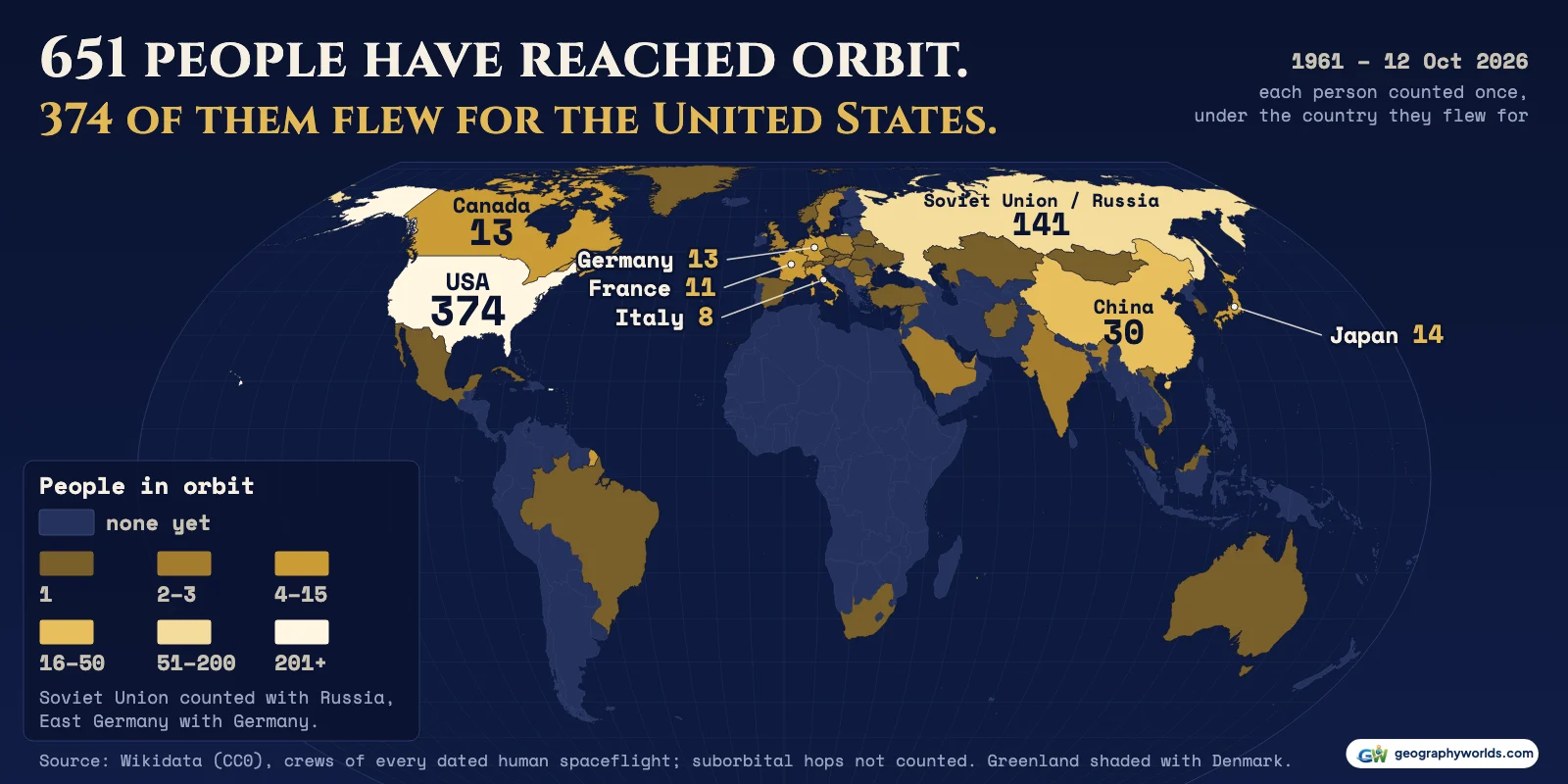
The United States has sent the most people to space: 374 of the 651 people who have reached Earth orbit or beyond since 1961, or 57%, more than every other country combined. The Soviet Union and Russia come second with 141, China third with 30, then Japan (14), Germany and Canada (13 each), France (11) and Italy (8). In all, citizens of 43 countries have reached orbit, and 24 of those countries have sent exactly one person. Suborbital-only flyers, such as X-15 pilots and New Shepard or Virgin Galactic passengers, are not counted.
Those figures come from Wikidata, the open database behind Wikipedia, which lists the crew of every crewed spaceflight. We kept everyone whose flight reached orbit, up to 12 October 2026, and counted each person once, under the country they flew for. The ranking below follows the story in order, because the list was built in waves: two rival programmes, then guest seats, then the Space Shuttle, then capsules sold by the seat.
1961–1977: two countries, 85 people
Yuri Gagarin opened the list on 12 April 1961 with a flight of 108 minutes, as NASA's own history of the flight records. Gherman Titov followed in August. The first American in orbit was John Glenn, on 20 February 1962. Alan Shepard and Gus Grissom had both flown before him, on 5 May 1961 and 21 July 1961, but those Mercury-Redstone flights were suborbital hops, so in this count Shepard enters with Apollo 14 and Grissom with Gemini 3.
For the next sixteen years no third country flew anyone. It was a two-player contest between the rival blocs of the Cold War, and in headcount it was nearly a tie. By the end of 1977 the United States had put 43 people into orbit and the Soviet Union 42, which is why the two lines on the chart further down run almost together for the first two decades.
1978–1991: guest seats on Soviet ships
The third country arrived on 2 March 1978, when Vladimír Remek of Czechoslovakia launched to the Salyut 6 station. He was the first guest cosmonaut of Interkosmos, the Soviet programme of space cooperation with socialist countries. Within four years it had flown one citizen each from Czechoslovakia (1978), Poland (1978), East Germany (1978), Bulgaria (1979), Hungary (1980), Vietnam (1980), Cuba (1980), Mongolia (1981) and Romania (1981).

East Germany's Sigmund Jähn, launched on 26 August 1978, is why Germany's first entry predates its first West German, Ulf Merbold, by five years. After the first nine guests, the seats opened wider: France (1982), India (1984), Syria (1987), Afghanistan (1988), Japan (1990), United Kingdom (1991) and Austria (1991) each sent a first citizen up on a Soviet ship. Japan's and Britain's were joint commercial flights. Helen Sharman (1991) is one of only two people counted under the United Kingdom; the other is Tim Peake (2015), because several other people Wikidata lists as British flew for other countries' programmes and are counted there. Altogether, sixteen countries reached orbit for the first time aboard a Soviet spacecraft before the USSR dissolved.
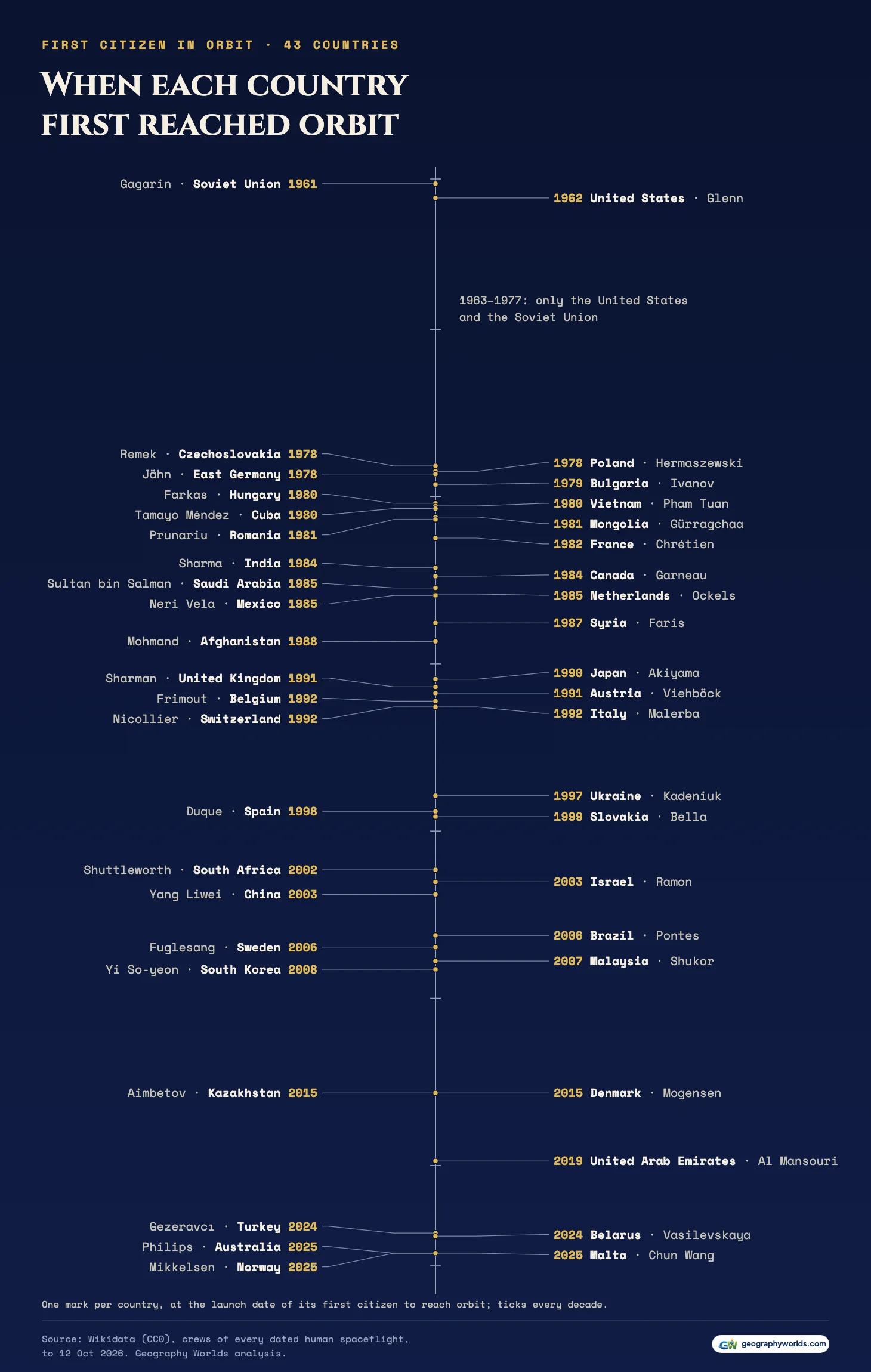
The timeline shows how crowded those years were. Between 1978 and 1992 a new country joined in twelve of the fifteen years, and in some years three did. Since 2000 only 15 more have joined.
1981–2011: the Shuttle's 326 newcomers
The American lead was built by one vehicle. The Space Shuttle first flew in April 1981 and last flew in July 2011, launching from the pads described in our Kennedy Space Center guide. Of the 651 people on our list, 326 made their first orbital flight on a Shuttle, and 280 of those, 86%, were American.
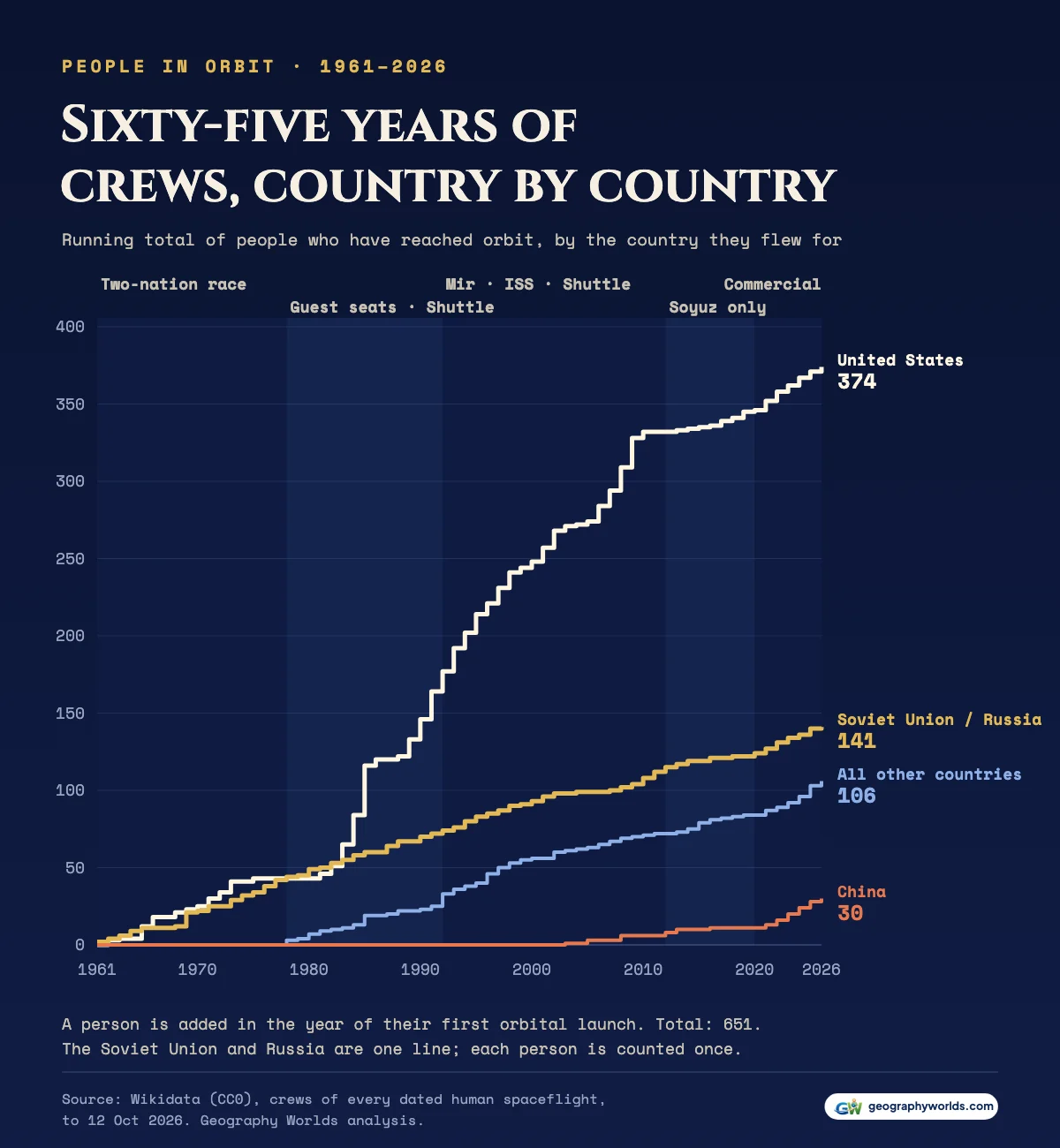
The step in the white line is the Shuttle at full pace. At the end of 1982 the Soviet Union was still ahead, 53 people to 51; from 1983 onward the United States led every year, and the gap only widened. Between 1992 and 2011, the years of Mir and the International Space Station, 261 people reached orbit for the first time, and 168 of them were American.
The Shuttle also carried eleven countries' first citizens into orbit: Canada (1984), Saudi Arabia (1985), Netherlands (1985), Mexico (1985), Belgium (1992), Italy (1992), Switzerland (1992), Ukraine (1997), Spain (1998), Israel (2003) and Sweden (2006). Canada's Marc Garneau was the first of them. Ukraine's place on the list rests on this era too: Leonid Kadeniuk, chosen by the National Space Agency of Ukraine, flew as a payload specialist on STS-87 in 1997, according to his NASA biography; he is the only person we count under Ukraine.
Not every Shuttle crew member reached orbit. Challenger was lost during launch on 28 January 1986, and three of its crew, Christa McAuliffe, Gregory Jarvis and Michael J. Smith, had never flown before; they are not in the count.
2012–2019: one way up
After the Shuttle retired, every newcomer outside China reached orbit on a Russian Soyuz. Only 40 people flew for the first time in those eight years: 13 Americans, 10 Russians, 5 Chinese and 12 from Germany, France, Canada, Japan, the United Kingdom, Italy, Kazakhstan, Denmark and the United Arab Emirates. Hazza Al Mansouri of the United Arab Emirates, in 2019, was the last country's debut before the commercial era.
China's programme had begun earlier, with Yang Liwei on 15 October 2003. It flew 11 people in its first eighteen years and 19 in the six years since 2021. All 30 people on China's line made their first flight in a Shenzhou spacecraft, a figure that matches the total Xinhua reported at the Shenzhou-23 launch in May 2026.
Since 2020: capsules for hire
SpaceX's Crew Dragon began carrying crews in May 2020, and the newcomer count picked up again: 89 people have reached orbit for the first time since the start of 2020. Of those, 29 were American, 19 Chinese and 19 Russian, so China and Russia have added newcomers at the same pace in the 2020s. The other 22 came from everywhere else. Crew Dragon carried 50 of the newcomers, and 23 of those flew on privately organised missions (Inspiration4, Polaris Dawn, Fram2 and the four Axiom flights to the station).
Those private missions changed the long tail of the list. After 2019, five countries made their debut: Turkey, Belarus, Australia, Malta and Norway. Turkey's came on Axiom's third mission in January 2024; Malta, Norway and Australia's all came on one flight, Fram2, in April 2025. Belarus's came on a Soyuz.
Axiom flights also ended some of the longest waits in the table. Poland's second person in orbit, Sławosz Uznański-Wiśniewski, flew 47 years after its first. Hungary waited 45 years for Tibor Kapu, and India 41 years for Shubhanshu Shukla, all three on the same mission, Axiom 4, in June 2025. Saudi Arabia's second and third flew 38 years after its first, on Axiom 2 in 2023.
The ranking in full
| # | Country | People in orbit | First to reach orbit | Date | Flight |
|---|---|---|---|---|---|
| 1 | United States | 374 | John Glenn | 20 February 1962 | Mercury-Atlas 6 (NASA capsule) |
| 2 | Soviet Union / Russia | 141 | Yuri Gagarin | 12 April 1961 | Vostok 1 (Soviet/Russian ship) |
| 3 | China | 30 | Yang Liwei | 15 October 2003 | Shenzhou 5 (Shenzhou) |
| 4 | Japan | 14 | Toyohiro Akiyama | 2 December 1990 | Soyuz TM-11 (Soviet/Russian ship) |
| 5 | Germany (first: East Germany) | 13 | Sigmund Jähn | 26 August 1978 | Soyuz 31 (Soviet/Russian ship) |
| 5 | Canada | 13 | Marc Garneau | 5 October 1984 | STS-41-G (Space Shuttle) |
| 7 | France | 11 | Jean-Loup Chrétien | 24 June 1982 | Soyuz T-6 (Soviet/Russian ship) |
| 8 | Italy | 8 | Franco Malerba | 31 July 1992 | STS-46 (Space Shuttle) |
| 9 | Saudi Arabia | 3 | Sultan bin Salman Al Saud | 17 June 1985 | STS-51-G (Space Shuttle) |
| 10 | Poland | 2 | Mirosław Hermaszewski | 27 June 1978 | Soyuz 30 (Soviet/Russian ship) |
| 10 | Bulgaria | 2 | Georgi Ivanov | 10 April 1979 | Soyuz 33 (Soviet/Russian ship) |
| 10 | Hungary | 2 | Bertalan Farkas | 26 May 1980 | Soyuz 36 (Soviet/Russian ship) |
| 10 | India | 2 | Rakesh Sharma | 3 April 1984 | Soyuz T-11 (Soviet/Russian ship) |
| 10 | Netherlands | 2 | Wubbo Ockels | 30 October 1985 | STS-61-A (Space Shuttle) |
| 10 | United Kingdom | 2 | Helen Sharman | 18 May 1991 | Soyuz TM-12 (Soviet/Russian ship) |
| 10 | Belgium | 2 | Dirk Frimout | 24 March 1992 | STS-45 (Space Shuttle) |
| 10 | Israel | 2 | Ilan Ramon | 16 January 2003 | STS-107 (Space Shuttle) |
| 10 | Sweden | 2 | Christer Fuglesang | 10 December 2006 | STS-116 (Space Shuttle) |
| 10 | United Arab Emirates | 2 | Hazza Al Mansouri | 25 September 2019 | Soyuz MS-15 (Soviet/Russian ship) |
| 20 | Czechia (as Czechoslovakia) | 1 | Vladimír Remek | 2 March 1978 | Soyuz 28 (Soviet/Russian ship) |
| 20 | Vietnam | 1 | Pham Tuan | 23 July 1980 | Soyuz 37 (Soviet/Russian ship) |
| 20 | Cuba | 1 | Arnaldo Tamayo Méndez | 18 September 1980 | Soyuz 38 (Soviet/Russian ship) |
| 20 | Mongolia | 1 | Jügderdemidiin Gürragchaa | 22 March 1981 | Soyuz 39 (Soviet/Russian ship) |
| 20 | Romania | 1 | Dumitru Prunariu | 14 May 1981 | Soyuz 40 (Soviet/Russian ship) |
| 20 | Mexico | 1 | Rodolfo Neri Vela | 27 November 1985 | STS-61-B (Space Shuttle) |
| 20 | Syria | 1 | Muhammed Faris Al-Aqidi | 22 July 1987 | Soyuz TM-3 (Soviet/Russian ship) |
| 20 | Afghanistan | 1 | Abdul Ahad Mohmand | 29 August 1988 | Soyuz TM-6 (Soviet/Russian ship) |
| 20 | Austria | 1 | Franz Viehböck | 2 October 1991 | Soyuz TM-13 (Soviet/Russian ship) |
| 20 | Switzerland | 1 | Claude Nicollier | 31 July 1992 | STS-46 (Space Shuttle) |
| 20 | Ukraine | 1 | Leonid Kadeniuk | 19 November 1997 | STS-87 (Space Shuttle) |
| 20 | Spain | 1 | Pedro Duque | 29 October 1998 | STS-95 (Space Shuttle) |
| 20 | Slovakia | 1 | Ivan Bella | 20 February 1999 | Soyuz TM-29 (Soviet/Russian ship) |
| 20 | South Africa | 1 | Mark Shuttleworth | 25 April 2002 | Soyuz TM-34 (Soviet/Russian ship) |
| 20 | Brazil | 1 | Marcos Pontes | 30 March 2006 | Soyuz TMA-8 (Soviet/Russian ship) |
| 20 | Malaysia | 1 | Sheikh Muszaphar Shukor | 10 October 2007 | Soyuz TMA-11 (Soviet/Russian ship) |
| 20 | South Korea | 1 | Yi So-Yeon | 8 April 2008 | Soyuz TMA-12 (Soviet/Russian ship) |
| 20 | Kazakhstan | 1 | Aydyn Aimbetov | 2 September 2015 | Soyuz TMA-18M (Soviet/Russian ship) |
| 20 | Denmark | 1 | Andreas Mogensen | 2 September 2015 | Soyuz TMA-18M (Soviet/Russian ship) |
| 20 | Turkey | 1 | Alper Gezeravcı | 18 January 2024 | Axiom Mission 3 (Crew Dragon) |
| 20 | Belarus | 1 | Marina Vasilevskaya | 23 March 2024 | Soyuz MS-25 (Soviet/Russian ship) |
| 20 | Australia | 1 | Eric Philips | 1 April 2025 | Fram2 (Crew Dragon) |
| 20 | Malta | 1 | Chun Wang | 1 April 2025 | Fram2 (Crew Dragon) |
| 20 | Norway | 1 | Jannicke Mikkelsen | 1 April 2025 | Fram2 (Crew Dragon) |
Three countries, the United States, the Soviet Union and Russia, and China, account for 545 of the 651 people, or 84%. The other 40 countries share 106 people between them, which is still fewer than the Soviet and Russian line. Of those, 24 have exactly one person in orbit and 10 have two.
Who counts, and where
Orbit, not altitude. There is no single agreed edge of space. The international standard used for records is 100 km (62 miles), while the US Air Force awarded astronaut wings above 50 miles, about 80 km, a split NASA explains in its page on X-15 pilot Joe Walker. We sidestep it by counting only people who reached orbit or went beyond it. That leaves out the X-15 pilots and everyone who has flown only on suborbital rides such as SpaceShipOne, Virgin Galactic and Blue Origin's New Shepard, whichever line they crossed. Wikidata lists 46 people whose only flights were suborbital, an incomplete record, so they are left out rather than half-counted.
One person, one country. On Wikidata, 36 of these people have more than one present-day country of citizenship. We counted each under the country whose programme or seat they flew with: NASA astronauts whom Wikidata also lists as British, Costa Rican or Indian count for the United States; Samantha Cristoforetti, listed as Italian and French, counts for Italy. One entry was corrected: Carlos Noriega, listed by Wikidata only as Peruvian, was born in Lima but flew as a NASA astronaut and US Marine Corps officer, as his NASA biography shows.
The Soviet Union and Russia are one line. 72 people first flew as Soviet citizens and 69 as Russian ones since the Soviet Union dissolved in December 1991. Soviet and Russian cosmonauts whom Wikidata also links to Ukraine, Belarus or Kazakhstan stay on that line, and this is where other lists differ. Jonathan McDowell's list credits Toktar Aubakirov (1991) and Talgat Musabayev (1994) to Kazakhstan, where we count only Aydyn Aimbetov (2015). Wikipedia's list names Paul Scully-Power (1984) as Australia's first; Wikidata lists him and Andy Thomas as American as well as Australian, both flew on NASA missions, and our first Australian is Eric Philips, in 2025. Beyond those choices, McDowell's independent list of space travellers reaches the same total of 651 orbital travellers and the same figures for the United States, China, Japan, Germany, Canada, France and Italy.
The file has one row per person, with every citizenship Wikidata records, the first orbital flight and our reason for each judgement call, so counting women, rookies or a single decade is a filter away. You can download the data as a CSV, and Parity will draw whatever subset you pick as a chart straight from the spreadsheet.
- Wikidata: crew members (P1029) of every dated human spaceflight, with citizenship (P27) and time in space (P2873), queried 12 October 2026: Structured data released under CC0 (public domain). Each person counted once, under the country they flew for; rules and every judgement call are in the CSV.
- Natural Earth admin-0 countries, 1:50m, via the world-atlas package: Public domain. Country shapes for the map.
Fewer than fifty countries have put a person in orbit, but far more own a spacecraft up there; our count of the countries with the most satellites tells that much bigger story.