
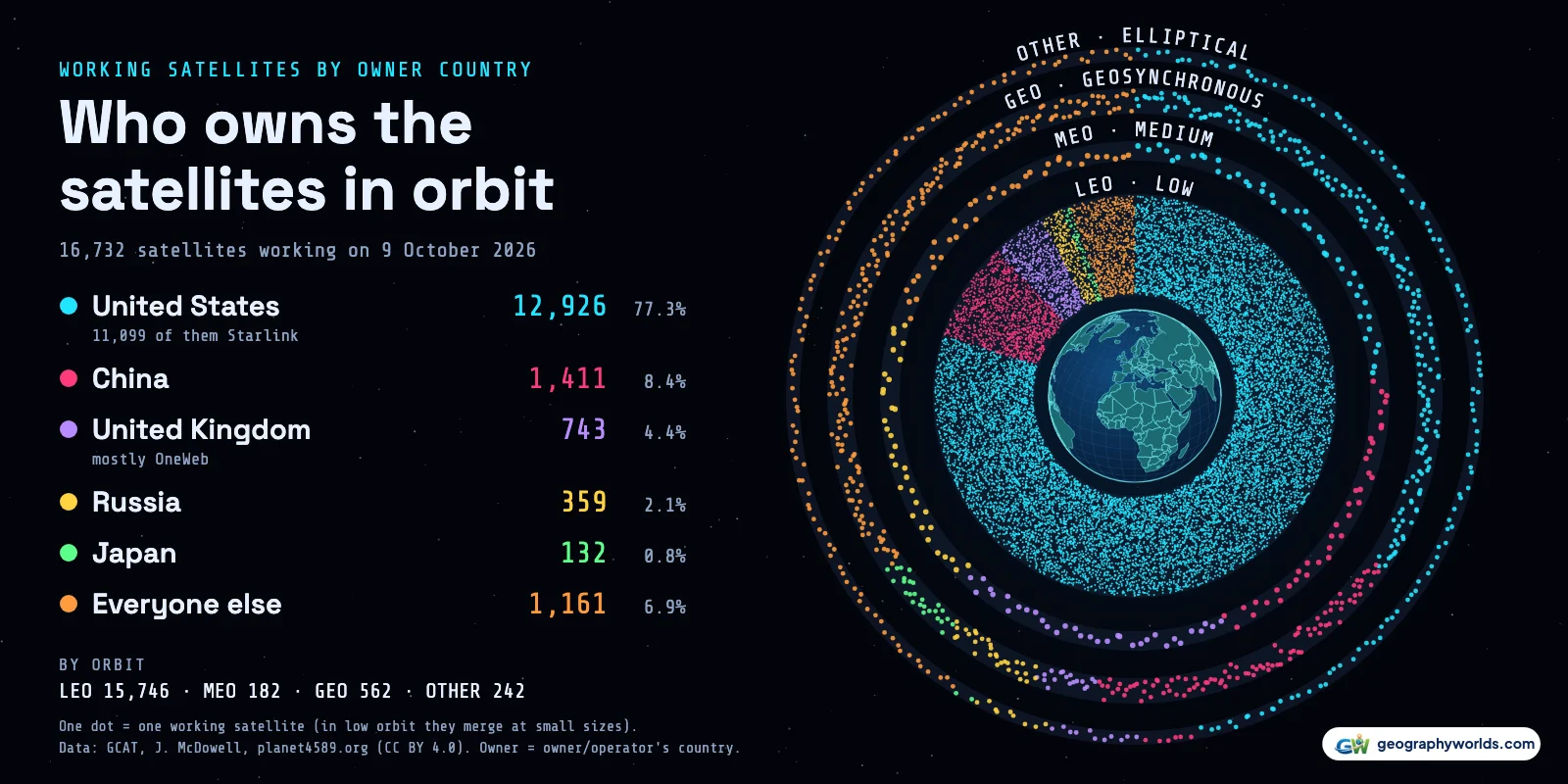
The United States has the most satellites by a huge margin: 12,926 of the 16,732 working satellites in Earth orbit on 9 October 2026 belonged to American owners, 77% of the world total, and 11,099 of those were SpaceX's Starlink. China is second with 1,411, the United Kingdom third with 743 (87% of them OneWeb), Russia fourth with 359 and Japan fifth with 132. France, Italy, South Korea, Germany and India complete the top ten, and 83 countries own at least one working satellite.
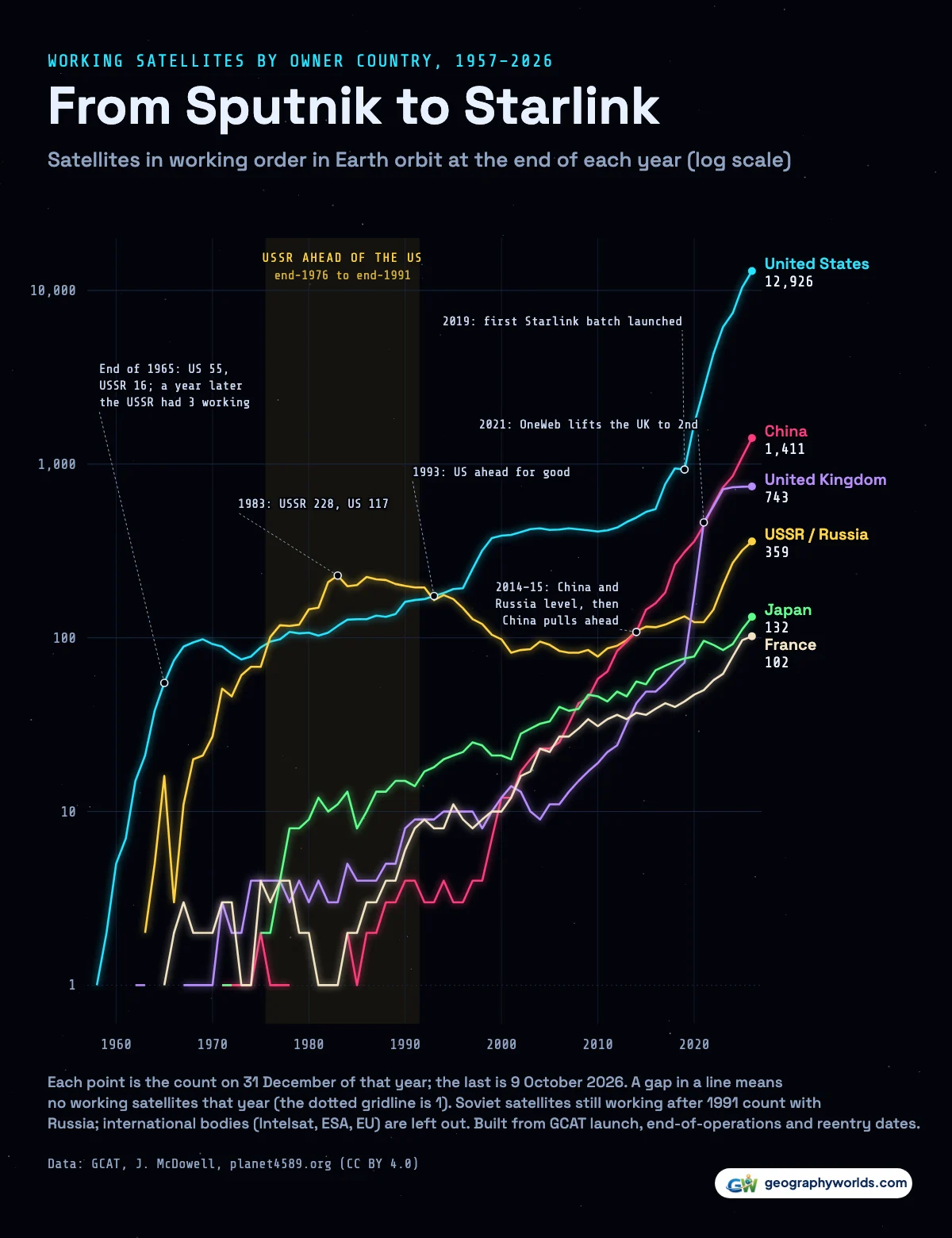
Those figures count satellites by the country of their owner or operator, not by who launched or built them, using Jonathan McDowell's General Catalog of Artificial Space Objects (GCAT), the most complete public record of everything ever put into orbit. Because GCAT records when each satellite went up and when it stopped working, the same count can be run backwards to the end of every year since 1957. That history is the more surprising part: for 16 straight year-ends the Soviet Union had more working satellites than the United States, and the British were briefly second to the Americans as recently as 2021.
1957–1975: a two-country club with short-lived satellites
The space age opened with Sputnik 1 on 4 October 1957, and the United States followed with Explorer I on 1 February 1958. The next owners joined slowly. The United Kingdom's Ariel 1 and Canada's Alouette 1 (1962) came next; Italy followed with San Marco 1 (1964), France with Asterix (1965), Australia with WRESAT (1967), West Germany with Azur (1969), and Japan and China with Ohsumi (1970) and DFH-1 (1970). India's first, Aryabhata (1975), came a few years later.

In these years the count of working satellites tells a different story from the count of launches. Most early satellites on both sides worked only briefly: the median satellite launched before 1971 lasted 8 days if it was Soviet and 10 days if it was American. The difference was in the long tail: 21% of American satellites launched before 1971 worked for more than a year, against 6% of Soviet ones, so the American fleet kept accumulating. At the end of 1965 the United States had 55 working satellites to the Soviet Union's 16, and a year later the Soviet figure had fallen to 3.
1976–1991: the Soviet lead most rankings forget
That changed in the mid-1970s, as the Soviet Union kept far more satellites working at once. At the end of 1976 the Soviet Union had more working satellites than the United States for the first time, and it stayed ahead at every year-end through 1991. By the end of 1980 the score was 146 to 107. The gap peaked in 1983, at 228 Soviet satellites against 117 American ones: the USSR then operated almost twice as many satellites as the US.
The lead was a product of volume. Soviet satellites were still much shorter-lived: leaving out crewed spacecraft and items the Space Shuttle carried up and brought back, the median one launched between 1976 and 1991 worked for 7 months, against 5.4 years for an American one, so the Soviet Union had to launch far more of them to keep its networks running. When the USSR dissolved in December 1991 it still had 188 working satellites to America's 165.
1992–2014: Russia's long slide and China's slow climb
The satellites did not disappear with the Soviet Union; Russia inherited them. Counting the Soviet-era fleet together with new Russian launches, Moscow was still ahead at the end of 1992, 195 to 167. The United States has been ahead at every year-end since 1993, though only by 5 satellites at the end of 1994 (181 to 176), helped at the end of the decade by the first commercial constellations in low orbit: Iridium alone put 88 satellites into orbit before 2000. By the end of 1999 the count was 375 American to 104 Russian, and the whole world had 722 working satellites at the end of 2000.
The 2000s were the quietest decade of the space age for satellite numbers. The world total at the end of 2010 was 893, only 24% higher than a decade before, the slowest growth of any decade. China, with 58 working satellites at the end of 2010, was adding satellites faster than anyone except the United States. Around 2014 and 2015 the two were effectively level: by our count China had 108 working satellites at the end of 2014 and Russia 109, a gap that small changes in what counts can reverse. By the end of 2015 China was clearly ahead, 145 to 116, and it has stayed ahead since.
2019 onward: Starlink, OneWeb and the mega-constellations
At the end of 2019 the world had 2,087 working satellites, 931 of them American and 312 Chinese. SpaceX had launched its first batch of Starlink satellites on 24 May 2019, and within six years the shape of the ranking was unrecognisable. By the end of 2025 there were 13,678 working satellites, more than 6 times as many as in 2019, and 10,436 of them were American.

Mega-constellations also produced the strangest moment in the ranking. OneWeb, a broadband network operated from London, put 388 satellites into orbit in 2020 and 2021. At the end of 2021 the United Kingdom had 462 working satellites to China's 443, putting Britain second in the world. China moved back ahead the following year and has widened the gap since, as two companies began filling broadband constellations of their own: China Satellite Network Group now operates 242 satellites and Shanghai Spacecom (Yuanxin) 235.
Today's ranking, orbit by orbit
Starlink alone, with 11,099 working satellites, accounts for 66% of every working satellite in orbit and 86% of America's total. Take it away and the United States would still lead, with 1,827 satellites: Amazon's Kuiper Systems has 392 up already, the National Reconnaissance Office 290, the Space Force's Space Systems Command 166 and the Earth-imaging company Planet 113.
| # | Country | Working | Share | LEO | MEO | GEO | Other | In orbit, working or not |
|---|---|---|---|---|---|---|---|---|
| 1 | United States | 12,926 | 77.3% | 12,574 | 43 | 195 | 114 | 13,977 |
| 2 | China | 1,411 | 8.4% | 1,270 | 37 | 98 | 6 | 1,615 |
| 3 | United Kingdom | 743 | 4.4% | 681 | 33 | 18 | 11 | 795 |
| 4 | Russia | 359 | 2.1% | 287 | 33 | 30 | 9 | 1,704 |
| 5 | Japan | 132 | 0.8% | 104 | 0 | 26 | 2 | 232 |
| 6 | France | 102 | 0.6% | 73 | 2 | 17 | 10 | 183 |
| 7 | Italy | 86 | 0.5% | 72 | 1 | 2 | 11 | 105 |
| 8 | South Korea | 77 | 0.5% | 53 | 0 | 8 | 16 | 92 |
| 9 | Germany | 75 | 0.4% | 66 | 0 | 3 | 6 | 102 |
| 10 | India | 70 | 0.4% | 37 | 0 | 32 | 1 | 116 |
| 11 | Canada | 58 | 0.3% | 44 | 0 | 11 | 3 | 92 |
| 12 | Spain | 52 | 0.3% | 38 | 0 | 5 | 9 | 63 |
| 13 | Turkey | 41 | 0.2% | 35 | 1 | 4 | 1 | 49 |
| 14 | Luxembourg | 37 | 0.2% | 19 | 0 | 15 | 3 | 55 |
| 15 | Finland | 36 | 0.2% | 32 | 0 | 0 | 4 | 37 |
Almost all of the growth is in low Earth orbit, below 2,000 km, which now holds 15,746 working satellites, 94% of the total. Higher orbits look much more like the old, multipolar ranking. Medium Earth orbit, home of the navigation systems, holds only 182, split between the United States' GPS and other satellites (43), China's BeiDou (37), Russia's GLONASS (33), the O3b broadband satellites that GCAT files under the United Kingdom (33) and the European Union's Galileo (27). Geosynchronous orbit, about 35,786 km up, holds 562; the United States has 195 there and China 98.
Below the top five, the list rewards specialised companies more than space agencies.
How ownership is decided
Satellites can be counted at least three ways: by the country that launched them, by the country that registered them with the United Nations, or by the country of the company or agency that owns and operates them. We used the third, GCAT's owner/operator state, because it answers what most people mean by "which country has the most satellites". Starlink and Kuiper count for the United States. OneWeb counts for the United Kingdom: it is run from London and the UK registers its satellites with the UN, even though the French operator Eutelsat has owned it since 2023, so counting by parent company would move roughly 646 satellites to France. Satellites still working that the Soviet Union launched count for Russia. Hong Kong (14) is listed separately from mainland China, as GCAT does, and the 78 satellites owned by international bodies such as the EU (38), ESA (23) and EUMETSAT (9) are left out of the country ranking.
"Working" means GCAT has no end-of-operations date for the satellite; dead satellites still in orbit are excluded, and so are space-station modules, docked or grappled visiting spacecraft, probes beyond Earth orbit, and satellites GCAT lists as lost with no working period on record. The distinction matters most for Russia: 1,704 Russian and Soviet satellites are still in Earth orbit, 3.7 dead ones for every one that works. Across all owners GCAT lists 19,996 satellites in orbit, working or not.
Checking the numbers
The world total matches an independent count closely. The ESA Space Debris Office put the number of functioning satellites at about 15,900 on 31 July 2026, against 16,087 by our method for the same day. ESA counts about 18,850 satellites in space, working or not; GCAT's 19,996 is higher, and one likely reason is that GCAT also lists objects missing from the public US catalogue. The CelesTrak catalogue, which classifies owners and status separately, gives the same top four, with 12,965 active American payloads, 1,539 Chinese (including Hong Kong), 698 British and 378 Russian. Other trackers' Starlink counts agree within a few dozen: KeepTrack listed 11,123 operational on the same day.
The history is a reconstruction and carries more uncertainty. GCAT's end-of-operations dates are often estimates, and McDowell notes that whether a satellite is still active is often a guess when it does not manoeuvre. As a test, our method gives 7,252 working satellites on 1 May 2023, while the Union of Concerned Scientists database, which has since paused its updates, counted 7,560 on that date. The year-by-year figures are best read as trends; close calls could shift by a few satellites, among them the US lead over Russia at the end of 1994, China and Russia's near-tie in 2014–15, and the UK's year in second place. You can download the data as a CSV for every owner country, with orbit types, satellites still in orbit, first satellites and year-end counts; to sketch your own version of the rings or the timeline from those columns, Parity builds charts straight from a spreadsheet.
- McDowell, J. C., General Catalog of Artificial Space Objects (GCAT), planet4589.org/space/gcat: Release 1.8.8, data update 2026 Oct 9. Licence CC BY 4.0 ("Data from J. McDowell, planet4589.org"). Object catalogues satcat, satcat100k, auxcat and tmpcat with their payload catalogues, the current catalogue and the organisations table.
- CelesTrak SATCAT (T. S. Kelso), satcat.csv: Used only to cross-check the count by owner; not republished.
- ESA Space Debris Office, space environment statistics: Cross-check of the world total of functioning satellites.
- Natural Earth country outlines (via world-atlas): Public domain. The globe at the centre of the hero graphic.
If you want to know what the imaging fleets actually produce, our guide to satellite imagery explained picks up where this ranking leaves off, while the navigation satellites in medium orbit are the subject of how GPS works.