
Russia produces the most diamonds: 36.9 million carats in 2024, about 35% of the world's 106.6 million carats of natural diamond, according to the U.S. Geological Survey (USGS). Botswana is second with 17.7 million carats, then Angola (13.6 million), Canada (13.3 million) and the Democratic Republic of the Congo (9.0 million), with Zimbabwe, South Africa and Namibia completing the top eight. Ranked by what the stones are worth instead of how much they weigh, the order changes: Kimberley Process figures value Namibia's diamonds at $417 a carat and Congo's at $10.84.
A carat is a unit of weight (0.2 grams), and a carat of industrial grit counts the same as a carat of flawless gemstone, so a ranking of "the most diamonds" has to say which it is counting. The five largest producers dug 85% of the world's carats in 2024, but they do not hold the same five places when the tally is in dollars.
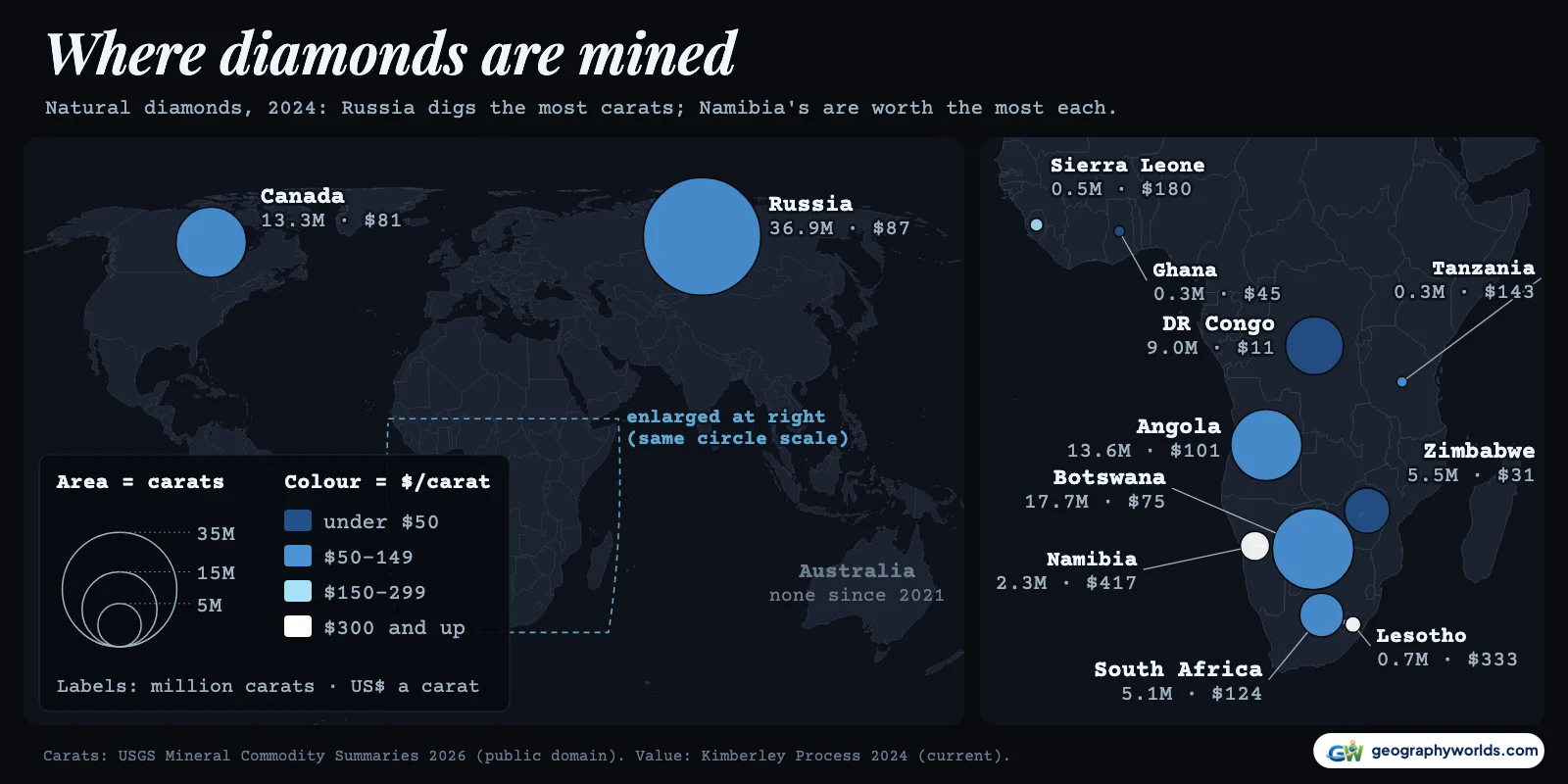
Carats or dollars: two leaderboards that disagree
The Kimberley Process, the certification scheme that tracks rough diamonds across borders, publishes each member's declared production in both carats and US dollars. Its 2024 annual summary puts world output at 129.1 million carats worth $11.28bn, an average of $87 a carat; that total includes a Russian figure KP has since revised up (see Russia below). Three things stand out.
First, Russia stays on top either way: its diamonds averaged $87 a carat, the same as the world average, and it mines so many that no one else comes close in total value. Second, Botswana, Angola and Canada are bunched together in KP's current figures, each worth between about $1.08bn and $1.41bn, though Botswana's first-release value was higher. Third, the middle of the table flips. Namibia, eighth by carats, is fifth by value with $967m. Congo, fifth by carats, falls to ninth with $106m, because a Namibian carat was worth roughly 38 Congolese ones.
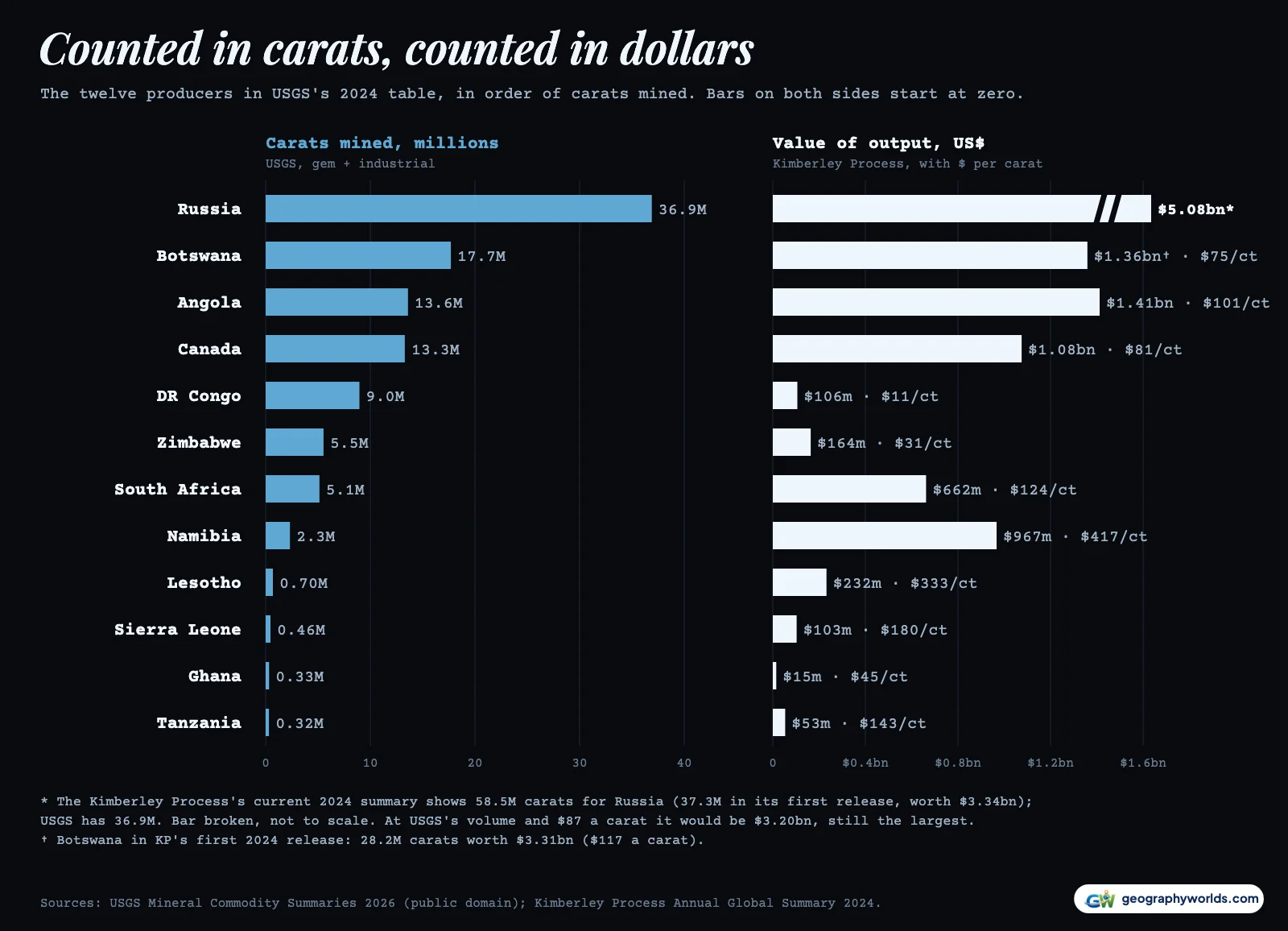
The chart below ranks every producer in USGS's table by its average value per carat. Liberia, whose 48 thousand carats averaged $348, is second in the Kimberley Process's full table; we list only the twelve countries in USGS's table.
Gem stones and industrial grit
USGS splits every country's output into gem-quality and industrial diamond, and the split explains most of the value gap. World production in 2024 was 68.6 million carats of gem-quality stones and 38.0 million carats of industrial diamond. The split is partly an estimate: USGS's Minerals Yearbook table applies a fixed share to each country, such as about 56% gem for Russia, 70% for Botswana, 90% for Angola, 20% for Congo and 10% for Zimbabwe. Canada, Namibia and Lesotho report their output unsplit, so USGS counts all of it as gem, which puts Canada second on gem carats alone.
Industrial diamond from mines matters less than its tonnage suggests. The USGS industrial diamond chapter says most of it is a byproduct of mining gems, and that synthetic diamond accounts for more than 99% of the world's industrial diamond, with factory output of more than 15 billion carats. Next to that, the mines' 38.0 million carats of industrial stones are a rounding error.
| Rank | Country | Gem (M ct) | Industrial (M ct) | Total (M ct) | Share | KP value per carat |
|---|---|---|---|---|---|---|
| 1 | Russia | 20.90 | 16 | 36.90 | 34.6% | $87 |
| 2 | Botswana | 12.70 | 5 | 17.70 | 16.6% | $75 |
| 3 | Angola | 12.60 | 1 | 13.60 | 12.8% | $101 |
| 4 | Canada | 13.30 | – | 13.30 | 12.5% | $81 |
| 5 | DR Congo | 1.96 | 7 | 8.96 | 8.4% | $11 |
| 6 | Zimbabwe | 0.53 | 5 | 5.53 | 5.2% | $31 |
| 7 | South Africa | 2.14 | 3 | 5.14 | 4.8% | $124 |
| 8 | Namibia | 2.32 | – | 2.32 | 2.2% | $417 |
| 9 | Lesotho | 0.70 | – | 0.70 | 0.7% | $333 |
| 10 | Sierra Leone | 0.46 | – | 0.46 | 0.4% | $180 |
| 11 | Ghana | 0.33 | – | 0.33 | 0.3% | $45 |
| 12 | Tanzania | 0.32 | – | 0.32 | 0.3% | $143 |
Russia: a third of the world's carats
Russia mined 20.9 million carats of gem-quality diamond and 16 million of industrial diamond in 2024, by USGS's count, 2.1 times Botswana's total. It has been the largest producer in every year of USGS's tables since 2003, when it mined 33.0 million carats. Most of it is mined by the state-owned company ALROSA. The Mir pit pictured below is at Mirny in Yakutia, eastern Siberia; our guide to the Central Siberian Plateau explains the ancient rock beneath it.

Russia's numbers are also the least certain in the table. USGS's 2024 figures for Russia are identical to the 2023 figures it published a year earlier. ALROSA itself produced 33 million carats in 2024, down from 34.6 million in 2023, IDEX Online reports. The Kimberley Process's first release of 2024 figures, in June 2025, put Russia at 37.3 million carats worth $3.34bn ($89 a carat), Rapaport and IDEX reported. KP's current summary shows 58.5 million carats, 42.4 million of them in July to December alone, against 37.3 million for 2023 and 31.5 million for 2025. USGS's unchanged figure is likely carried forward, as its summary gives no new Russian data. Whichever volume is right, Russia's output was worth the most of any country: $3.20bn even at USGS's volume and $87 a carat. These stones are also shut out of large markets: USGS's gemstones chapter notes that U.S., EU and G7 sanctions remained in effect in 2025, barring Russian rough and polished gem diamonds, including stones cut in third countries.
Botswana: second, and cutting back
Botswana mined 17.7 million carats in 2024, down 31% from 25.6 million in 2023. The cut was deliberate. Debswana, the joint venture between the government and De Beers that runs the country's big mines, reduced output by 27% to 17.93 million carats because of weak demand and planned to go lower, to 15 million carats in 2025, Reuters reported. USGS describes the same slump: a downturn in the natural diamond market since early 2023, worst for stones of one carat or less, which it puts down to weaker demand for luxury goods, excess inventory and the popularity of cheaper synthetic diamonds.

Its value is less certain. KP's current summary has Botswana's 2024 output at 18.1 million carats worth $1.36bn ($75 a carat), against $3.28bn at $131 in 2023. KP's first release put 2024 at 28.2 million carats worth $3.31bn ($117 a carat). Only the current volume matches Debswana's own figure. Botswana's 2025 declaration averaged $128 a carat. Our guide to where Botswana is covers the country itself.
Angola and Canada: a photo finish for third
Angola's 13.6 million carats and Canada's 13.3 million are within the rounding of USGS's table, which gives industrial diamond only to the nearest million carats. Other sources separate them. Angola declared 14.0 million carats to the Kimberley Process, and the state diamond company Endiama called its 14 million carats in 2024 a record that made Angola the third-largest producer behind Russia and Botswana, Reuters reported. USGS's 13.6 million was a 39% jump on its 2023 figure of 9.8 million. Its stones averaged $101 a carat, worth $1.41bn in all, the second-highest total value in the table.
Canada mined 13.3 million carats in 2024. Natural Resources Canada's diamond facts page agrees on 13.3 million carats and ranks Canada fourth in the world by both volume and value, with output down 17% in volume and 30% in value from 2023. NRCan values it at $1.47 billion, a different measure from the $1.08bn (US dollars, $81 a carat) declared to the Kimberley Process.
DR Congo and Zimbabwe: plenty of carats, little value
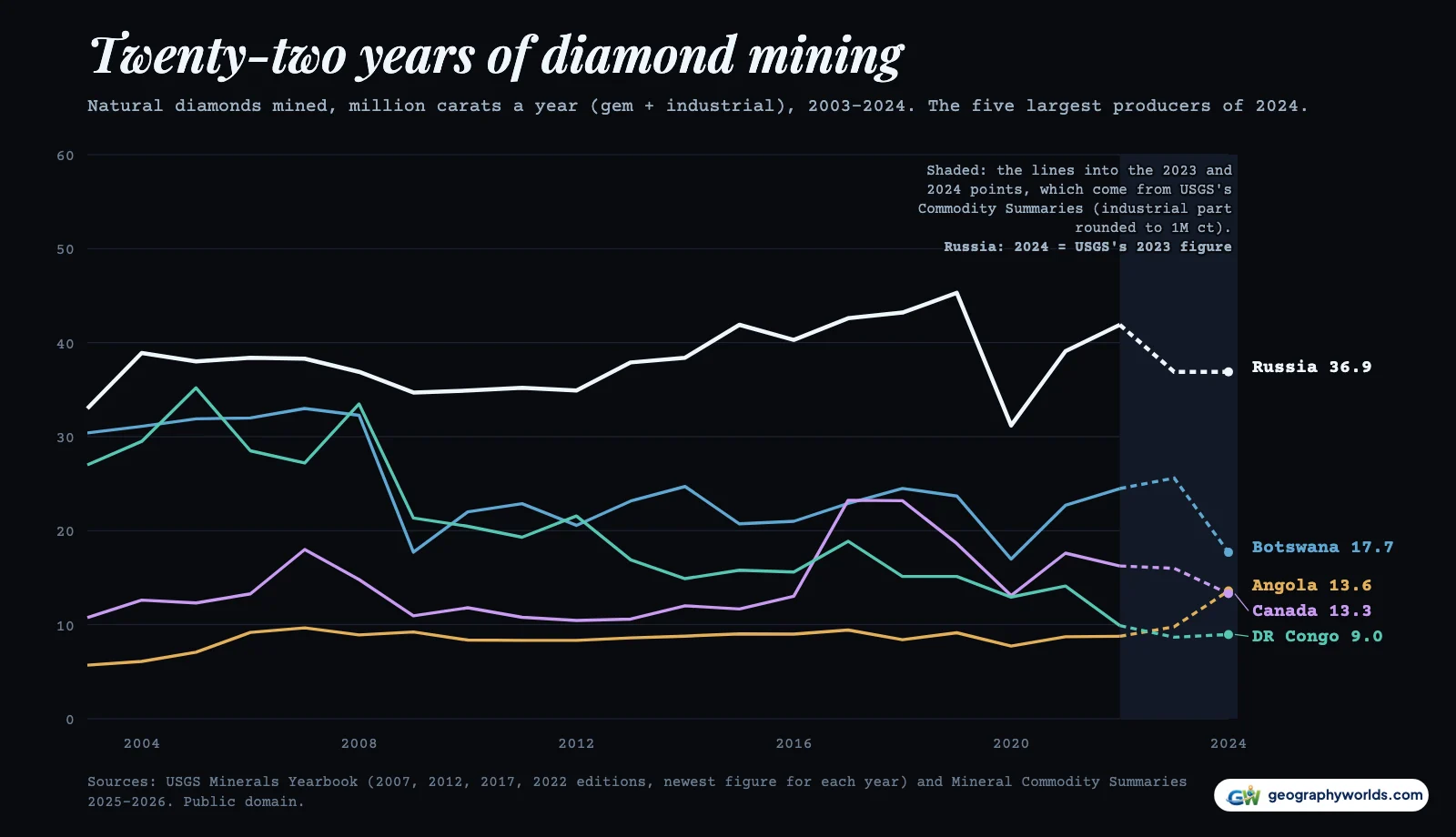
Congo mined 9.0 million carats in 2024, of which USGS counts 7 million as industrial and 2.0 million as gem. That industrial share is 18% of the world's mined industrial diamond, the same figure the research group IPIS gives in its 2025 study, which says Congo produces 3% of gem-quality diamonds and that artisanal diggers supply 60% to 80% of its export volumes. Congo was close to Russia's output in the mid-2000s, peaking at 35.2 million carats in 2005; IPIS describes a fall from around 30 million carats at the start of the century.
Zimbabwe mined 5.5 million carats, 5 million of them industrial, at an average of $31 a carat, for $164m in total.
Namibia, Lesotho and South Africa: few carats, rich stones
Namibia mined only 2.3 million carats, yet the Kimberley Process values them at $417 a carat, the highest of any country producing more than 100,000 carats, and $967m in total. That ordering is not new: in 2014 Namibia's diamonds commissioner put Namibian prices at $450 to $700 a carat against $150 for Botswana and $50 for Zimbabwe, Bloomberg reported. Lesotho's 696 thousand carats averaged $333.
South Africa mined 5.1 million carats in 2024, 2.1 million gem and 3 million industrial, at $124 a carat ($662m).
Australia is missing from the 2024 table altogether. It mined 34.3 million carats in 2005 and still 10.9 million in 2020. The Argyle mine in Western Australia had its final day of mining in November 2020 after 37 years and more than 865 million carats, International Mining reported, and USGS has recorded no Australian production since. Across all producers, world output fell from 183.0 million carats in 2005, the peak in USGS's series, to 106.6 million in 2024, 42% lower.
Where the reserves are
Reserves, the diamonds that can be mined at a profit, are a separate question, and USGS answers it only roughly. Its figures put Russia far ahead with 750 million carats, then Botswana (250 million), Angola and Congo (150 million each), Canada (110 million) and South Africa (87 million). USGS prints the same reserve figure for each country in both its gem and its industrial table, so the two cannot be added; its world totals are given only as 1,700 million carats in one table and more than 2,000 million in the other.
How the ranking was built
Carats for 2024 add USGS's gem-quality and industrial production from the Mineral Commodity Summaries 2026 data release. The series back to 2003 comes from four editions of the Minerals Yearbook, taking the newest edition's figure for each year, plus the 2025 Commodity Summaries for 2023. USGS builds part of its table from Kimberley Process returns, so we checked the main figures against company and government reports instead. Values come from the Kimberley Process summaries and are not in our file. You can download the data as a CSV with every country's 2024 gem, industrial and total carats, its share, its USGS reserves and its yearly totals since 2003; a column of numbers like that becomes a quick chart in Parity if you want to compare two producers yourself.
- U.S. Geological Survey, Mineral Commodity Summaries 2026: Gemstones and Diamond (Industrial) chapters, and the MCS 2026 data release: 2024 mine production of gem-quality and industrial natural diamond by country, and reserves; US government work, public domain
- U.S. Geological Survey, Mineral Commodity Summaries 2025: Gemstones and Diamond (Industrial): 2023 production; public domain
- U.S. Geological Survey, Minerals Yearbook, Diamond, Industrial (2007, 2012, 2017 and 2022 editions), table "Diamonds (natural): world production, by country and type": 2003–2022 production in thousand carats; public domain
- Kimberley Process Certification Scheme, Annual Global Summary 2024 (and 2023, 2025): production value in US dollars and value per carat; quoted in the article and graphics as a cited source, not included in the CSV
- Natural Earth country outlines (via world-atlas): public domain
For how kimberlite pipes form and why diamond fields cluster where they do, read our geography of diamond mining, which picks up where these production figures stop.