

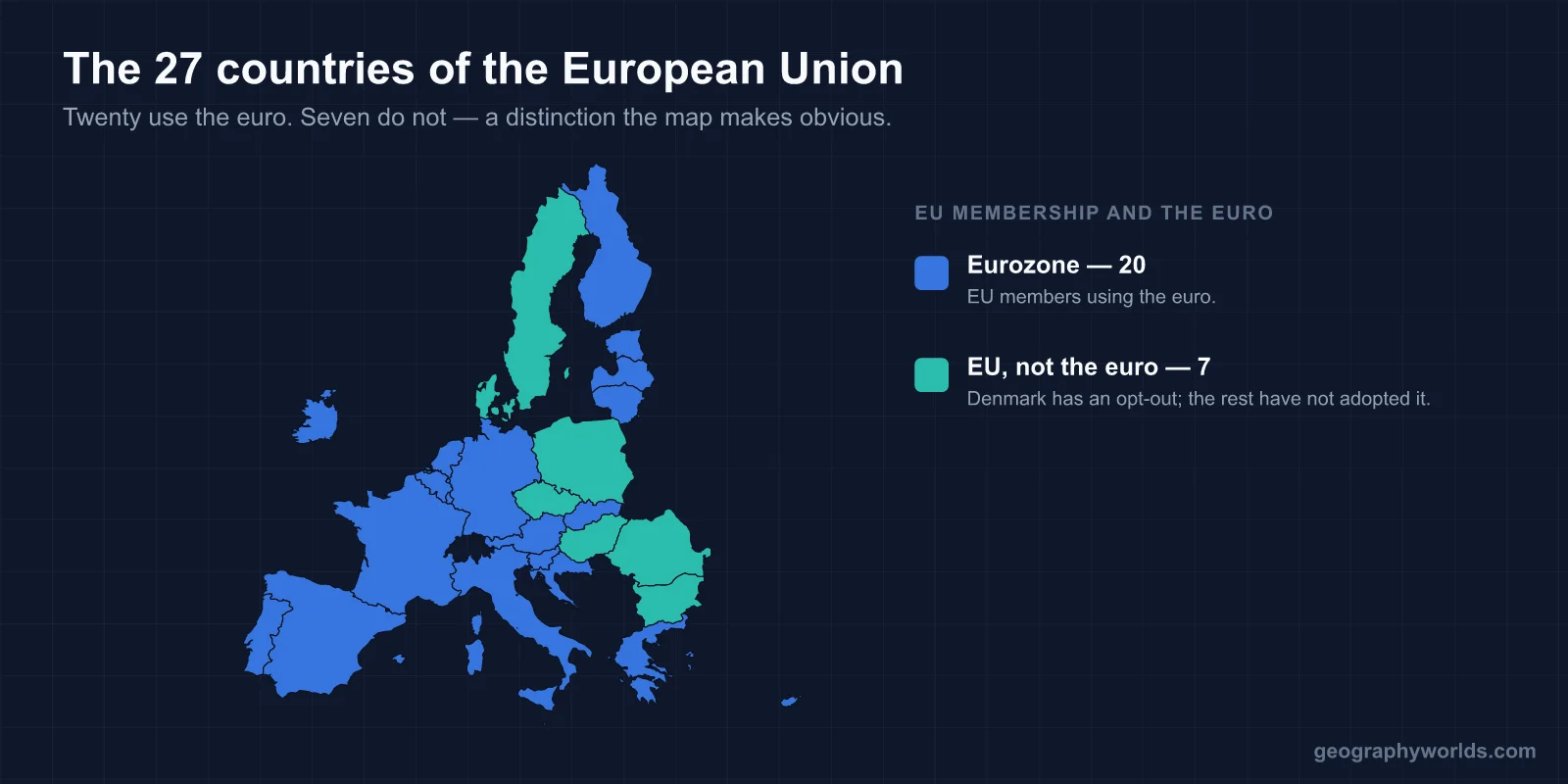
The European Union has 27 member states. It reached 28 in 2013 with Croatia and fell back to 27 when the United Kingdom left on 31 January 2020 — the only country ever to withdraw. Membership has grown from six founding states in a coal and steel arrangement to a union covering about 450 million people and roughly 4.2 million km².
The 27, and the Order They Arrived In
- 1958 — the founding six. Belgium, France, Italy, Luxembourg, the Netherlands and West Germany, under the Treaty of Rome signed the previous year.
- 1973. Denmark, Ireland and the United Kingdom. Norway negotiated entry alongside them and its voters rejected it — twice, in 1972 and again in 1994.
- 1981. Greece. 1986. Portugal and Spain, all three within a decade of the end of dictatorships.
- 1995. Austria, Finland and Sweden, once Cold War neutrality no longer barred the door.
- 2004. Cyprus, the Czech Republic, Estonia, Hungary, Latvia, Lithuania, Malta, Poland, Slovakia and Slovenia — ten at once, the largest enlargement in the union's history.
- 2007. Bulgaria and Romania. 2013. Croatia, so far the last to join.
Two features of that sequence are easy to miss. The 2004 round increased the membership by 66% in a single day and shifted the union's centre of gravity decisively eastward. And nothing has been added in more than a decade — the longest pause since the 1980s.
Why the United Kingdom Is the Only Country to Have Left
The June 2016 referendum returned 51.9% for leaving on a 72% turnout. Article 50 was triggered in March 2017, and after two extensions the UK left on 31 January 2020, with a transition period running to the end of that year. It remains the only withdrawal in the union's history.
There is one earlier precedent of a kind. Greenland, an autonomous territory of Denmark, joined with Denmark in 1973, held its own referendum in 1982 and left in 1985 over fishing rights — a departure by a territory rather than a member state, and the reason Article 50 had to be written from scratch when it appeared in the Lisbon Treaty in 2009.
Algeria is a third curiosity: as an integral part of France until 1962, it was inside the European Economic Community, and it left by becoming independent rather than by any European process.
Eurozone, Schengen, EU — Three Different Maps
Almost every misconception about EU membership comes from assuming these overlap exactly. They do not.
- The eurozone has 20 of the 27. Denmark has a permanent opt-out; Sweden, Poland, Hungary, Czechia, Romania and Bulgaria have not adopted the euro. Meanwhile Monaco, San Marino, Vatican City and Andorra use it by agreement, and Montenegro and Kosovo use it unilaterally — six euro users outside the EU entirely.
- The Schengen Area has 29 members, of which 25 are EU states. Ireland stays out by choice; Cyprus has not yet joined. Norway, Iceland, Switzerland and Liechtenstein are in Schengen without being in the EU.
- The single market extends beyond both through the European Economic Area, which adds Norway, Iceland and Liechtenstein.
So a Norwegian crosses borders freely and trades inside the single market while sitting outside the EU; an Irish citizen is inside the EU and the eurozone but outside Schengen. Asking "is this country in Europe's club" has at least four different correct answers depending on which club is meant.
From Coal and Steel to a Single Market
The union began as an arrangement to make war between France and Germany impractical. The European Coal and Steel Community, proposed by Robert Schuman in May 1950 and operating from 1952, pooled control of the two industries any country needed to rearm. Six states joined; the logic was that shared control of the inputs to war made war between them, in Schuman's phrase, not merely unthinkable but materially impossible.
The Treaty of Rome in 1957 widened this into a common market. Successive treaties then deepened it: the Single European Act in 1986 set the target of a genuine single market by 1992; Maastricht in 1993 created the European Union as such, along with EU citizenship and the path to the euro; Lisbon in 2009 gave it a permanent Council president, a foreign policy chief and — for the first time — an exit clause.
What holds it together legally is the four freedoms: movement of goods, services, capital and people. Those four are indivisible in EU doctrine, which is the single most important fact in understanding both Brexit and Switzerland's relationship with the union. A country cannot take the parts it wants and decline the rest, and every negotiation since 2016 has turned on that principle.
Who Is Waiting, and Why It Takes So Long
Nine countries currently hold candidate status: Albania, Bosnia and Herzegovina, Georgia, Moldova, Montenegro, North Macedonia, Serbia, Turkey and Ukraine. Kosovo is a potential candidate.
Turkey is the extreme case. It applied for association in 1959, signed an agreement in 1963, applied for full membership in 1987, was accepted as a candidate in 1999 and opened negotiations in 2005. Those talks have been effectively frozen for years. North Macedonia has been a candidate since 2005. Montenegro opened negotiations in 2012.
The reason is structural: accession requires adopting the entire body of EU law, some 35 negotiating chapters covering everything from competition policy to food safety, and every chapter must be opened and closed by unanimous agreement of all existing members. Any one of the 27 can stall any candidate at any point, and several have — Bulgaria blocked North Macedonia over language and history, Greece blocked it earlier over its name.
The Budget, and Who Pays for Whom
The EU budget is small relative to its members' — roughly 1% of the union's gross national income, against national budgets of 40% or more. It is agreed in seven-year blocks, which is why negotiations over it are so bitter: a government is committing its successors.
Germany is the largest net contributor in absolute terms, followed by France; Poland has been the largest net recipient for most of its membership. Around a third of the budget still goes to agriculture, down from roughly 70% in the 1980s, and a similar share to cohesion funding aimed at poorer regions.
The 2020 recovery instrument marked a genuine change. For the first time the Commission borrowed on a large scale against the collective budget and distributed the proceeds as grants as well as loans — a step several member states had refused for decades, and one that only became politically possible during the pandemic.
How Twenty-Seven Countries Decide Anything
The union runs on an unusual split. The European Commission proposes legislation and is the only body that can; the Council of the EU, made up of national ministers, and the European Parliament, directly elected by citizens, both have to agree before anything passes.
Most decisions in the Council use qualified majority voting, which requires 55% of member states representing 65% of the EU population — a double threshold designed so that neither a handful of large countries nor a bloc of small ones can dominate. But foreign policy, taxation, and enlargement itself still require unanimity, which is why a single government can hold up sanctions or an accession while being outvoted on agriculture.
The Parliament has 720 seats allocated by "degressive proportionality": Germany has 96 for 84 million people, Malta has 6 for 550,000. A Maltese vote therefore carries roughly twelve times the weight of a German one, a deliberate compromise that keeps small states from being irrelevant.
Twenty-Four Official Languages
The EU has 24 official languages, and every piece of binding legislation must exist in all of them, each version equally authentic in law. There is no single master text. Translation and interpretation absorb a substantial part of the administrative budget and employ several thousand people.
Irish is the clearest illustration of principle over volume. It became a full official language in 2007 despite the fact that almost every Irish citizen also speaks English, and a derogation limiting the translation obligation was phased out entirely by 2022. Maltese is the only Semitic language with EU official status. Luxembourgish, by contrast, is a national language of a founding member and has never been made official at EU level, because Luxembourg never asked.
The working reality is narrower than the rule: most day-to-day business happens in English, French and German, and English remained dominant after the UK's departure even though it is now an official language of only Ireland and Malta among the 27.
The Union Reaches Further Than the Continent
EU territory is not confined to Europe. Nine outermost regions sit thousands of kilometres away and are full parts of the union: French Guiana in South America, Guadeloupe, Martinique, Saint Martin and Mayotte, Réunion in the Indian Ocean, and Spain's Canary Islands and Portugal's Azores and Madeira in the Atlantic.
French Guiana borders Brazil and Suriname, which means the EU has a land frontier with Brazil longer than any of its borders inside Europe. Mayotte lies between Mozambique and Madagascar. All use the euro and all elect MEPs.
Cyprus is the other geographic oddity: it lies off the coast of Syria and is Asian by most physical definitions, yet has been an EU member since 2004 — and only its southern part is under the government's effective control, so EU law is suspended in the north.
Twenty-seven members, three overlapping maps and nine candidate countries is more moving parts than most people expect; the count of countries in Europe is a useful reference point, and the capitals list covers every member state.