

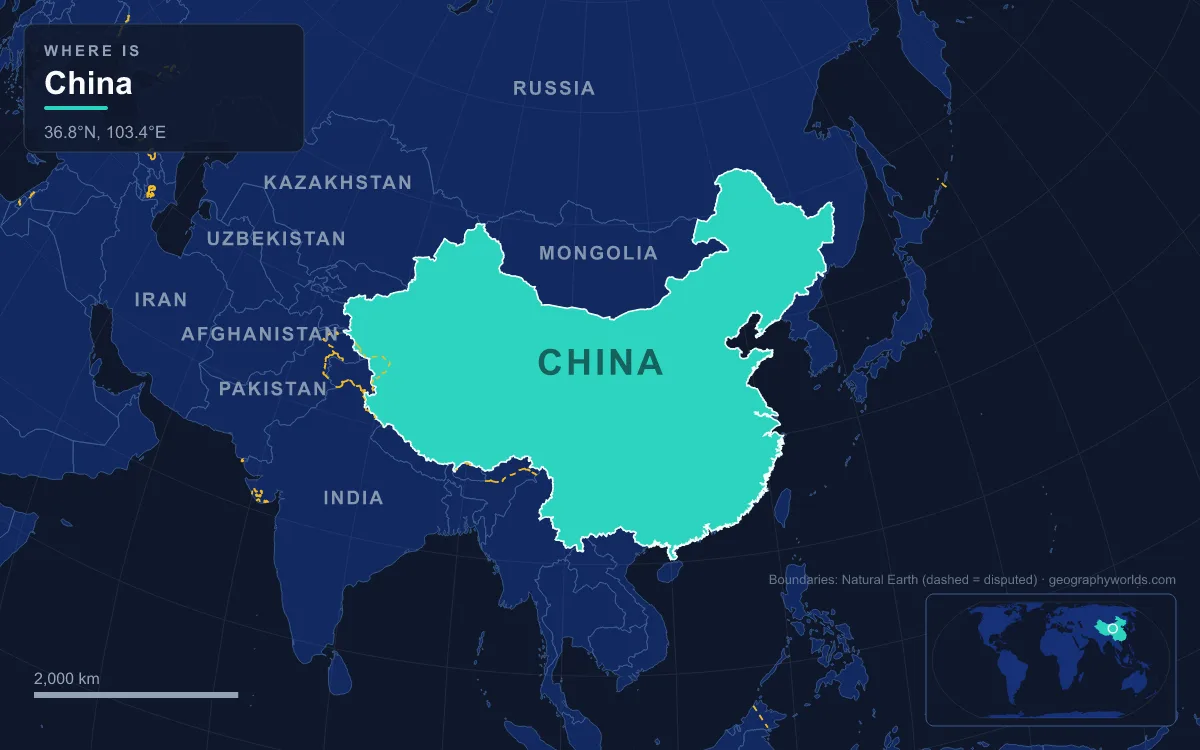
Confucius, the philosopher whose teachings shaped East Asian ethics; Qin Shi Huang, the first emperor, who unified China in 221 BC; Sun Yat-sen, founder of the Republic of China; Mao Zedong, founder of the People’s Republic; Tu Youyou, the Nobel-winning discoverer of the malaria drug artemisinin; and the basketball player Yao Ming are among the most famous people China has produced. Because China is so large, and because many of these people are closely tied to their home towns, this guide maps them by place: each section starts from a city or province and explains who came from there and what they achieved.
Qufu and Gaomi, Shandong: Confucius, Li Qingzhao and Mo Yan
The eastern coastal province of Shandong claims China’s most influential thinker. Confucius (c. 551 – c. 479 BC), born Kong Qiu, is thought to have been born at Zou, in modern Qufu, in the state of Lu. His teachings on personal and government morality, respect for elders and rule by virtue became the basis of Confucianism, and much of the shared culture of China, Korea, Japan and Vietnam descends from them. He was buried beside the Si River north of Qufu, and the town’s temple, family mansion and cemetery remain its main sights.

Shandong also produced one of China’s best-regarded poets. Li Qingzhao (1084 – c. 1155) was born in what is now Zhangqiu, near Jinan, during the Song dynasty, and is ranked among the finest writers of ci, lyric poems set to fixed tune patterns. Nine centuries later Mo Yan (born 1955), the pen name of Guan Moye, grew up in a peasant family in Gaomi Township and set much of his fiction there, including Red Sorghum (1986). He won the Nobel Prize in Literature in 2012 for work the committee said merges folk tales, history and the contemporary.
Handan and Xi’an: Qin Shi Huang and Zhang Yimou
Qin Shi Huang (259–210 BC) was born Ying Zheng in Handan, then capital of the state of Zhao, and became king of Qin as a boy. By 221 BC he had conquered the other warring states and declared himself huangdi, emperor, a title Chinese rulers used for the next two thousand years. His tomb outside Xi’an in Shaanxi is guarded by the Terracotta Army, found by farmers in Lintong County in 1974.
Xi’an is also the home city of Zhang Yimou (born in 1950 or 1951; sources differ), one of the Fifth Generation of Chinese film directors. After years as a farm labourer and textile-mill worker during the Cultural Revolution, he entered the Beijing Film Academy in 1978. His debut Red Sorghum, adapted from Mo Yan, won the Golden Bear in Berlin in 1988; The Story of Qiu Ju won the Golden Lion at Venice in 1992; and he directed the opening ceremony of the 2008 Beijing Olympics, as described in our guide to Beijing, China’s capital.
Luoyang, Chengdu and Guang’an: Du Fu and Deng Xiaoping
Du Fu (712–770) was born near Luoyang in Henan, although the exact place is unknown. With his friend Li Bai he is one of the two poets most associated with the Tang dynasty, and nearly 1,500 of his poems survive. The An Lushan rebellion that began in 755 drove his family from their home, and much of his later poetry records war, displacement and hunger. He lived for a time in Chengdu in Sichuan, where a reconstruction of his thatched cottage is now a popular attraction. Later critics called him the “Poet-Historian” and the “Poet-Sage”.
Sichuan is also the home province of Deng Xiaoping (1904–1997), born in Guang’an, where a bronze statue was unveiled for his centenary in 2004. He became a Marxist while studying and working in France in the 1920s, and after Mao’s death he emerged as China’s paramount leader from 1978 to 1989. His policy of “reform and opening up” created special economic zones such as Shenzhen from 1980 and moved the country towards a market economy. He also ordered the crackdown on the 1989 Tiananmen Square protests, which remains the subject of international condemnation.
Kunyang, Yunnan: Admiral Zheng He
In the far south-west, the town of Kunyang near Kunming is the birthplace of Zheng He (1371–1433 or 1435), who was born Ma He into a Muslim Hui family. Taken into the service of the future Yongle Emperor, he commanded seven treasure voyages across the Indian Ocean between 1405 and 1433. His fleets called in Southeast Asia, India and Arabia and reached the Swahili coast of East Africa, returning with ostriches, zebras, camels and ivory in exchange for gold, silver, porcelain and silk.
Cuiheng and Zhongshan, Guangdong: Sun Yat-sen
Sun Yat-sen (1866–1925) was born in the village of Cuiheng in Xiangshan County, Guangdong; the county was renamed Zhongshan in his honour shortly after his death. He was educated in Hawaii and graduated from the Hong Kong College of Medicine for Chinese in 1892, then spent years in exile organising revolts against the Qing dynasty. After the 1911 Revolution, delegates meeting in Nanjing elected him provisional president, and the Republic of China began on 1 January 1912. He is buried in a mausoleum on Purple Mountain in Nanjing.
Sun is unusual among twentieth-century Chinese leaders in being honoured both in mainland China, governed by the People’s Republic, and in Taiwan, governed by the Republic of China, where he is known as the Father of the Nation. His wife Soong Ching-ling (1893–1981), born in Shanghai and educated in the United States, later served in the government of the People’s Republic and was named its Honorary Chairman shortly before her death.
Shaoshan and Xiangtan, Hunan: Mao Zedong and Qi Baishi
Mao Zedong (1893–1976) was born to a peasant family in Shaoshan, Hunan, and studied in the provincial capital, Changsha. A founding member of the Chinese Communist Party in 1921, he became its leader in 1935, during the Long March of 1934–1935 and proclaimed the People’s Republic from Tiananmen in Beijing on 1 October 1949. He led the country until his death in 1976, a period that included the Great Leap Forward of 1958–1962, followed by the Great Chinese Famine, and the Cultural Revolution launched in 1966.
From nearby Xiangtan came Qi Baishi (1864–1957), a peasant’s son who worked as a carpenter and taught himself to paint from the Manual of the Mustard Seed Garden. Settling in Beijing after 1917, he became known for playful ink paintings of shrimp, mice and birds, and in 1953 was elected president of the China Artists Association. Hunan was also where the agronomist Yuan Longping (1930–2021), born in Beijing, began teaching at the Anjiang Agricultural School and developed the first hybrid rice varieties in the 1970s, work that won him the World Food Prize in 2004.
Shaoxing, Ningbo and Hangzhou, Zhejiang: Lu Xun, Tu Youyou and Jack Ma
Lu Xun (1881–1936), the pen name of Zhou Shuren, was born in Shaoxing into a declining family of scholar-officials. He went to Japan in 1904 to study medicine at Sendai but turned to literature. His short story Diary of a Madman, published in April 1918, was a landmark of the New Culture Movement and of fiction in vernacular Chinese. It was followed by The True Story of Ah Q, and after 1927 he spent his last years writing essays in the Shanghai International Settlement.
The coastal city of Ningbo is the birthplace of Tu Youyou (born 1930). In 1969 she was put in charge of a research group in Project 523, a secret state programme to find a malaria treatment. Reading a text by the fourth-century scholar Ge Hong, she tried a low-temperature extraction of sweet wormwood and isolated artemisinin. In 2015 she shared the Nobel Prize in Physiology or Medicine, the first female citizen of the People’s Republic to win a Nobel Prize in any category.

A little further north, in Hangzhou, Jack Ma (born 1964), whose Chinese name is Ma Yun, taught English after graduating from Hangzhou Normal University in 1988. On 28 June 1999 he and 17 friends and students founded Alibaba, starting in his Hangzhou apartment, and the company grew into one of the world’s largest e-commerce businesses.
Shanghai, Wuhan and Shenyang: Yao Ming, Li Na and Lang Lang
China’s big cities have produced its best-known modern athletes and musicians. Yao Ming (born 1980 in Shanghai), 2.29 m tall, played for the Shanghai Sharks before the Houston Rockets chose him first overall in the 2002 NBA draft. He was an eight-time All-Star and in 2016 became the first Chinese national elected to the Naismith Memorial Basketball Hall of Fame. Li Na (born 1982 in Wuhan, Hubei) won the French Open in 2011 and the Australian Open in 2014, the first player born in Asia to win a major singles title. A decade earlier she had become the first Chinese player to win a WTA Tour title, at the 2004 Guangzhou International Women’s Open, and she reached a career-high ranking of world No. 2 in February 2014. The pianist Lang Lang (born 1982 in Shenyang, Liaoning) was the first Chinese pianist engaged by the Berlin Philharmonic and the Vienna Philharmonic. For the size and history of these cities, see our list of the largest cities in China.