
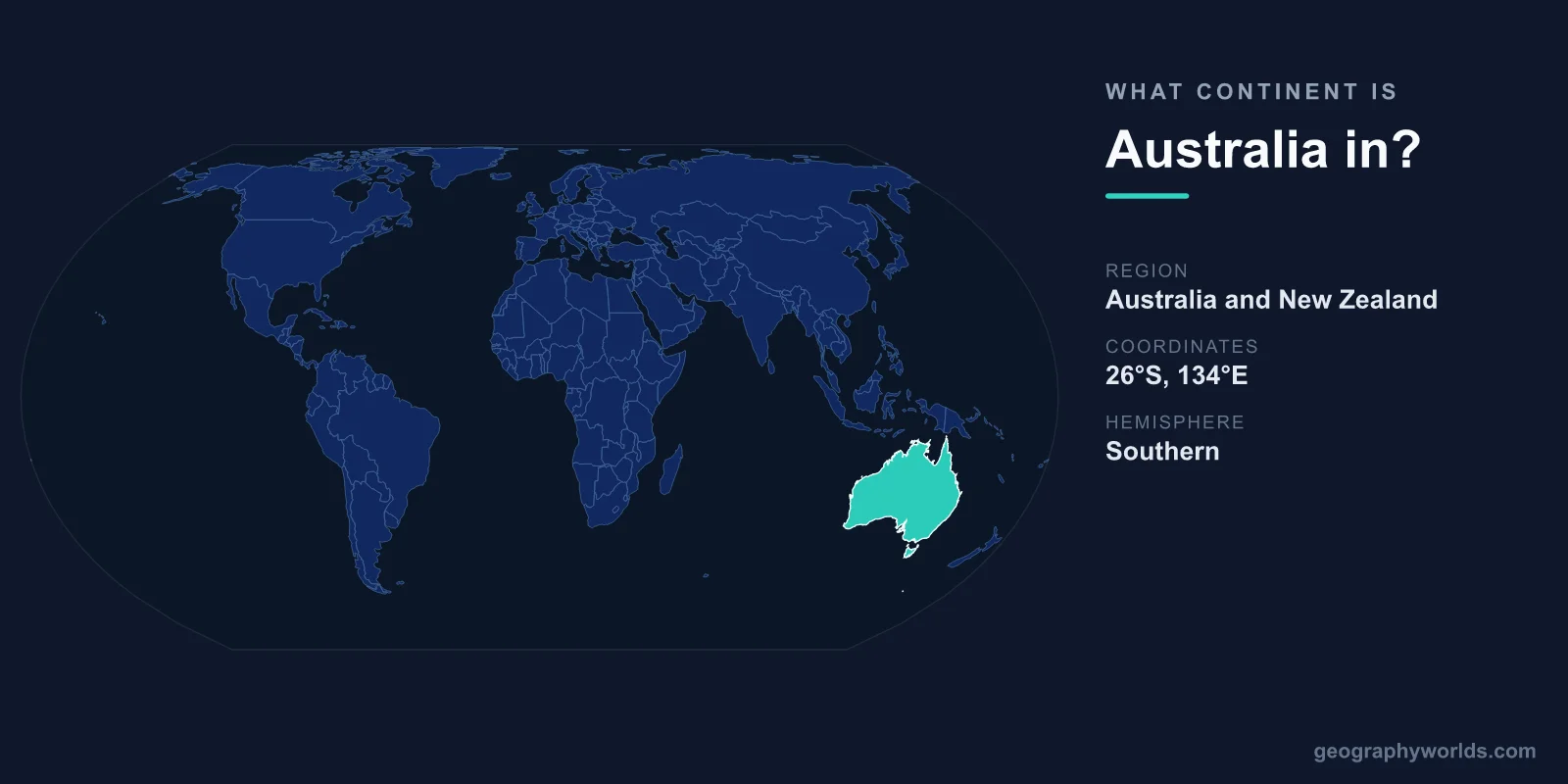
Australia is located on its own continent, also called Australia, which is the smallest of the world's seven continents and the only continent occupied entirely by a single country. In the wider geographic scheme, this landmass is also grouped within the region known as Oceania, which combines mainland Australia with the Pacific island nations to its north and east. So depending on the model being used, the short answer is either "Australia" (the continent) or "Oceania" (the broader region) — both are correct.
Australia: A Country and a Continent
Australia is unusual because the same name applies to a nation and a continent. The Commonwealth of Australia is the country, with its capital at Canberra, while the Australian continent is the underlying landmass it sits on. No other country in the world fills an entire continent the way Australia does.
The continent covers roughly 7,692,024 km², which makes Australia both the smallest continent and the sixth-largest country on Earth by land area. Because it is ringed by water on every side, it is frequently nicknamed the "island continent." It is bordered by the Indian Ocean to the west, the Pacific Ocean to the east, and the Southern Ocean to the south, with the Timor and Arafura Seas separating it from Asia in the north.
The Seven-Continent vs Oceania Model
Confusion about which continent Australia belongs to usually comes from competing classification systems. In the most common English-language model, the seven continents are Africa, Antarctica, Asia, Europe, North America, South America, and Australia. Under this model, Australia is its own continent.
However, many geographers and atlases prefer the term Oceania when grouping the surrounding region. Oceania is not strictly a continent in the geological sense but a regional grouping that includes the Australian mainland plus thousands of Pacific islands across Melanesia, Micronesia, and Polynesia — countries such as New Zealand, Fiji, Papua New Guinea, and the Solomon Islands. So when a quiz or textbook says "Australia/Oceania," it is folding both ideas together.
A Geologically Separate Landmass
Australia genuinely qualifies as a distinct continent because it sits on its own tectonic plate, the Australian Plate, and is geologically isolated from every other landmass. Tens of millions of years of separation have made it the flattest and driest inhabited continent on the planet.
- Highest point: Mount Kosciuszko, at 2,228 metres
- Interior: roughly 70% of the country is arid or semi-arid "outback"
- Eastern spine: the Great Dividing Range runs along the east coast, separating the fertile coastal strip from the dry interior
- Great Barrier Reef: the world's largest coral reef system, stretching about 2,300 km off the northeast coast and visible from space
This long isolation also explains Australia's extraordinary wildlife. Marsupials such as kangaroos and koalas, and egg-laying mammals like the platypus, evolved here and exist almost nowhere else on Earth.
Where Australia Sits Relative to Its Neighbours
Although remote, Australia is not as cut off as it can seem on a map. Its closest neighbour is Papua New Guinea, just 150 km north across the Torres Strait. Indonesia and East Timor lie to the northwest, while New Zealand is around 2,000 km to the southeast across the Tasman Sea. Numerous smaller Pacific nations complete the surrounding Oceania region.
The continent spans a wide range of climates because of its size, running from tropical rainforests and savanna in the north to temperate, cooler zones in the southeast — even snowfields in the Australian Alps, which in some winters receive more snow than the Swiss Alps. If you enjoy testing your geography knowledge of regions like this, our interactive geography games are a fun way to learn. For a deeper dive into the nation itself, see our australia country guide.
Frequently Asked Questions
Is Australia a continent or a country?
It is both. Australia is the name of a sovereign country and of the continent that country occupies. It is the only nation on Earth that covers an entire continent on its own.
Is Australia part of Asia?
No. Australia is its own continent and is not part of Asia, though it lies relatively close to Southeast Asian countries like Indonesia. Politically and geographically it is classified as Australia or, more broadly, Oceania.
What is the difference between Australia and Oceania?
Australia is the single continental landmass. Oceania is a larger regional grouping that includes Australia plus the Pacific island nations such as New Zealand, Fiji, and Papua New Guinea. Oceania is used as a "continent" label mainly to account for those islands.
Is Australia the smallest continent?
Yes. At about 7.7 million km², Australia is the smallest of the seven continents, far smaller than Asia or Africa, yet it is still the sixth-largest country in the world by land area.