
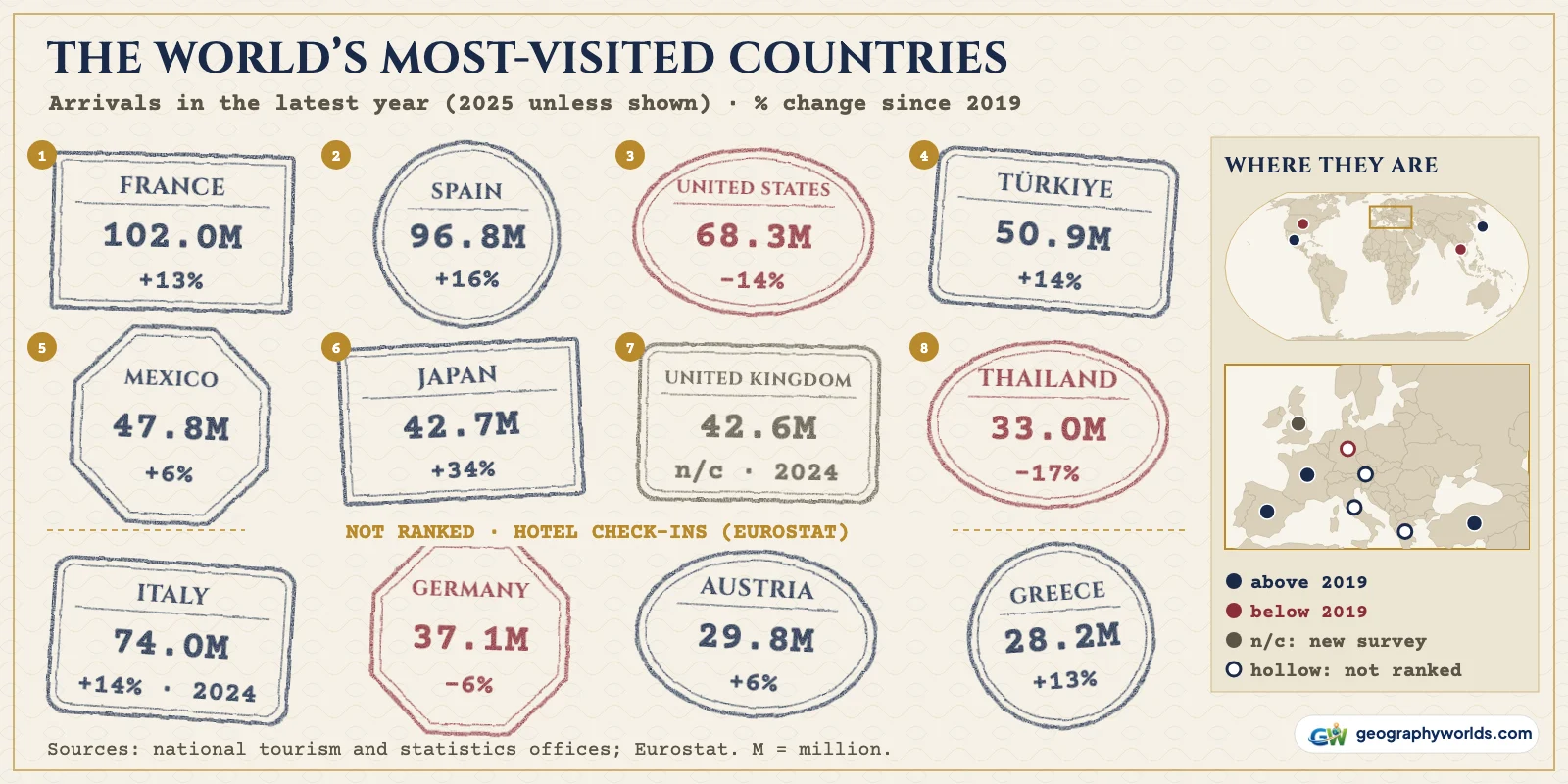
France is the country with the most tourists: about 102 million international tourists in 2025, according to an estimate by Atout France, the national tourism agency. Spain is second with 96.8 million (INE, Spain's statistics office), followed by the United States (68.3 million), Türkiye (50.9 million overnight visitors), Mexico (47.8 million) and Japan (42.7 million). These are counted at the border or by border survey, and they count arrivals, not people: someone who visits twice is counted twice. Italy's figure measures something else: its 74.0 million for 2024 are foreign check-ins at hotels and other accommodation, which record a traveller at every hotel, so it is shown separately with Germany, Austria and Greece. China reports more, 154.5 million inbound visits, but that total includes day trips and no overnight split has been published, so it is left out of the ranking.
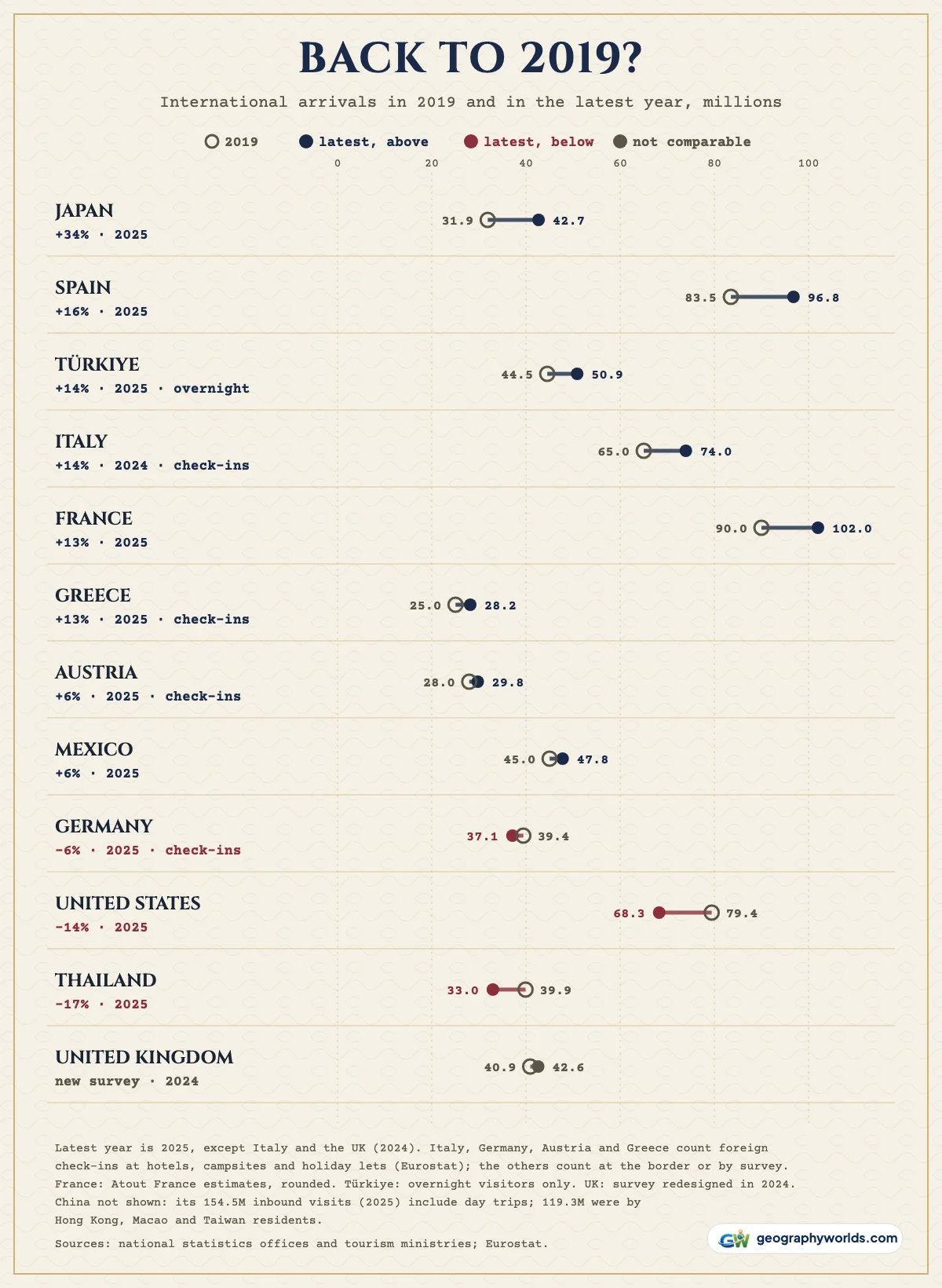
What changed since 2019, the last year before the pandemic? The recovery is uneven: 8 of the 11 countries with a comparable series are above their 2019 level, and three are still well below it.
| Rank | Country | Latest (millions) | Year | 2019 (millions) | Change | Per resident | What is counted |
|---|---|---|---|---|---|---|---|
| 1 | France | 102.0 | 2025 | 90.0 | +13.3% | 1.48 | Estimate from surveys and payments data |
| 2 | Spain | 96.8 | 2025 | 83.5 | +15.9% | 1.96 | Counted at the border |
| 3 | United States | 68.3 | 2025 | 79.4 | −14.0% | 0.20 | Counted at the border |
| 4 | Türkiye | 50.9 | 2025 | 44.5 | +14.3% | 0.59 | Counted at the border (overnight only) |
| 5 | Mexico | 47.8 | 2025 | 45.0 | +6.1% | 0.36 | Border survey |
| 6 | Japan | 42.7 | 2025 | 31.9 | +33.9% | 0.35 | Counted at the border |
| 7 | United Kingdom | 42.6 | 2024 | 40.9 | not comparable | 0.61 | Border survey |
| 8 | Thailand | 33.0 | 2025 | 39.9 | −17.4% | 0.46 | Counted at the border |
The four countries below are measured here by Eurostat's count of foreign check-ins at accommodation, which records a traveller at every hotel, so they are not ranked against the table above.
| Country | Latest (millions) | Year | 2019 (millions) | Change | Per resident | What is counted |
|---|---|---|---|---|---|---|
| Italy | 74.0 | 2024 | 65.0 | +13.8% | 1.26 | Check-ins at accommodation |
| Germany | 37.1 | 2025 | 39.4 | −5.8% | 0.44 | Check-ins at accommodation |
| Austria | 29.8 | 2025 | 28.0 | +6.4% | 3.23 | Check-ins at accommodation |
| Greece | 28.2 | 2025 | 25.0 | +12.5% | 2.71 | Check-ins at accommodation |
Before: the 2019 league table
In 2019 France already led, with 90 million arrivals including its overseas departments, a figure Atout France rounded to the nearest million in its 2019 annual report. Spain counted 83.5 million tourists, and the United States was a clear third with 79.4 million visitors who stayed at least one night. Mexico (45.0 million) and Türkiye (44.5 million overnight visitors) came next. On its check-in measure, Italy recorded 65.0 million.
China belonged near the top of that list. Its Ministry of Culture and Tourism reported 65.7 million overnight inbound visitors in 2019, which would have placed it between the United States and Mexico. Thailand ranked 7th of the 8 border-count countries with 39.9 million, and Japan, with 31.9 million, was last of them.
After: the 2025 league table
The top two are unchanged, and both are bigger. France's 102 million is +13% on 2019, up from 100 million in 2024, the year of the Paris Olympics and the reopening of Notre-Dame, both of which Atout France singles out in its 2025 results. Spain grew faster, +16%, to 96,803,894 tourists, a record in INE's series.
The United States kept third place despite its fall. Türkiye (50.9 million, +14%) passed Mexico (47.8 million, +6%) for fourth. Japan climbed from 8th to 6th, and Thailand slid from 7th to 8th. Among the check-in countries, Italy's 74.0 million in 2024 were +14% on 2019.

Japan's extra ten million, and who is behind it
The largest change among the 12 countries in the tables belongs to Japan. The Japan National Tourism Organization counted 31.9 million visitor arrivals in 2019 and a preliminary 42.7 million in 2025, +34%, after 36.9 million in 2024. Visitors from South Korea rose from 5.6 million to 9.5 million, while arrivals from China, the largest market in 2019, were 9.1 million in 2025, still slightly below the 9.6 million of 2019.
JNTO's count is a border count: it includes transit passengers who pass immigration and excludes foreigners who live in Japan, so it is close to, but not quite the same as, a count of tourists who stayed the night. If you are planning a trip, our guide to the best time to visit Japan covers when the crowds peak.
Still short of 2019: Thailand, the United States and Germany
Thailand has the deepest gap. Its Ministry of Tourism and Sports recorded 39.9 million international tourist arrivals in 2019 and 33.0 million in 2025, −17%.
The United States received 68.3 million international visitors in 2025, 86% of its 2019 total, according to the National Travel and Tourism Office's I-94 arrivals file. Canada explains much of the shortfall. Canadian visits fell from 20.7 million in 2019 to 16.0 million in 2025, −23%, and that drop alone accounts for 42% of the national decline. Overseas visitors, everyone except Canadians and Mexicans, went from 40.4 million to 34.3 million, −15%; visitors from China went from 2.83 million to 1.56 million. Mexican visits were close to flat at 18.0 million against 18.3 million.
Germany is the quieter case. It publishes no border count of visitors, which would be hard to take at the open internal frontiers of the Schengen area; its figure is the number of foreign guests checking in to hotels, campsites and holiday accommodation: 37.1 million in 2025 against 39.4 million in 2019, −6%.
Where tourists outnumber residents
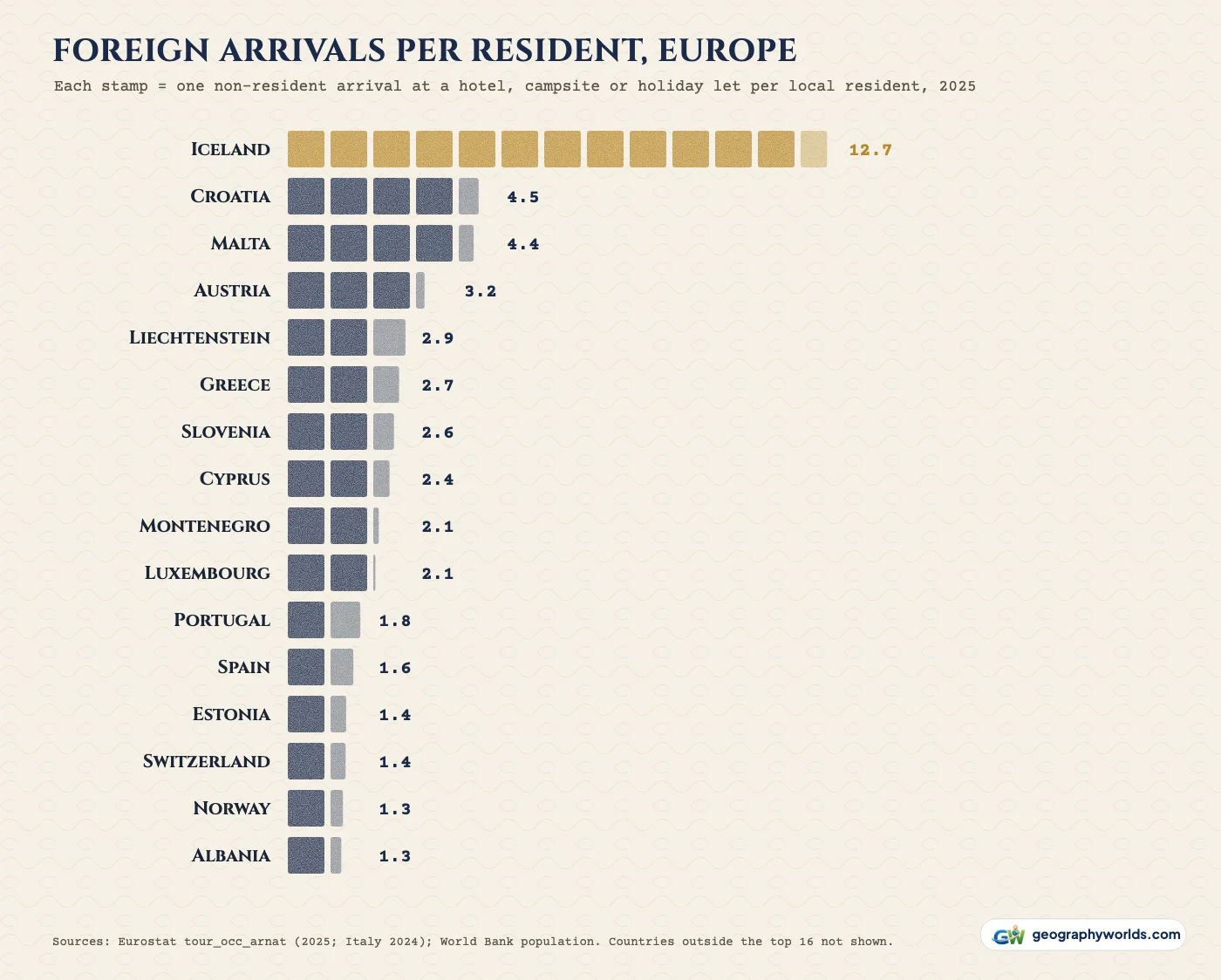
Absolute totals favour big countries. Divide arrivals by population and the order changes. On Eurostat's check-in measure, which treats every European country alike, Austria received 3.2 foreign arrivals per resident in 2025 and Greece 2.7, against 1.6 in Spain, 1.3 in Italy (2024), 0.9 in France and 0.4 in Germany. On the border counts, Spain had 2.0 per resident, the United States 0.20 and Japan, for all its growth, 0.35.
Across Europe, using Eurostat's accommodation data so that every country is measured the same way, Iceland stands far apart. It recorded 5.0 million foreign check-ins in 2025, 12.7 for each person living there. The method inflates that figure: an arrival is a check-in, so a visitor who tours the island and sleeps in five places counts five times. Croatia (4.5) and Malta (4.4) follow.
Why France's 102 million and Spain's 96.8 million are different kinds of number
Spain's INE counts tourists at the frontier through its FRONTUR survey and keeps same-day visitors apart; it recorded another 47.2 million of them in 2025. France's 102 million is an estimate by Atout France, rounded to the nearest million rather than counted at the border; the agency's release credits INSEE, Banque de France and Oxford Economics data for its visitor-night figures.
Measure both countries the same way and the order flips. Eurostat's count of foreign arrivals at paid accommodation gives Spain 80.0 million in 2025 and France 58.7 million. Atout France's estimate covers stays in paid and unpaid accommodation, including second homes and visits to friends and family, which a hotel count misses; a check-in count, for its part, records a traveller again at every new hotel.
Other countries draw the line elsewhere again. Türkiye's ministry counted 52.8 million foreign visitors in 2025, but 1.9 million did not stay the night, against 0.54 million in 2019; the table uses overnight visitors only, which is why Türkiye's rise is +14% rather than +17%. Its count also leaves out 11.2 million Turkish citizens living abroad who came home. Mexico's 47.8 million counts only visitors who slept at least one night; INEGI recorded another 39.0 million border same-day visitors and 11.4 million cruise passengers on day calls. Greece's 28.2 million is Eurostat's check-in count; the Bank of Greece, which surveys travellers at the border, put 2025 at 37.98 million, To Vima reported.
Two entries need a warning. Italy's latest complete figure is for 2024: Eurostat lists 87.9 million for 2025, but ISTAT's own release says foreign arrivals rose only 1.4% that year, and the two cannot both be right. The United Kingdom's 42.6 million visits in 2024 come from a redesigned survey that also added Northern Ireland for the first time; the Office for National Statistics publishes them as official statistics in development, so we do not compare them with the 40.9 million of 2019.
China is the extreme case. Its 154.5 million inbound visits in 2025 include 119.3 million entries by residents of Hong Kong, Macao and Taiwan. In 2019 only 65.7 million of its 145.3 million inbound visits involved a night's stay, and the ministry has not published that split for 2025. Foreign visitors alone numbered 35.2 million, +10% on the 31.9 million of 2019.
Where these figures come from
UN Tourism compiles every country's arrivals, but its database is open only to members. The World Bank reissues those figures as indicator ST.INT.ARVL under a CC BY-4.0 licence, yet its series stops in 2020, and where a country reports no overnight count it substitutes all visitors, day-trippers included. Every number here was therefore read from the publisher's own file: INE's FRONTUR table, the NTTO arrivals workbook, JNTO's monthly releases, Thailand's receipts tables, INEGI's bulletins, the ONS Travel trends articles, Türkiye's border bulletin and Eurostat's accommodation table. Arrivals per resident use World Bank population for 2025. You can download the data as a CSV: 48 rows, including every European country in Eurostat's table; if you would rather see your own shortlist as a chart than as a table, Parity can build one straight from that file. Sources:
- INE (Spain), FRONTUR: tourists by type of visitor, table 23981: international tourists (overnight) at the frontier, annual 2019–2025; INE allows reuse with attribution
- Atout France, press release 'Bilan touristique de l'année 2025' (19 Feb 2026) and fact sheet: France 2025 and 2024, estimates built from INSEE, Banque de France and Oxford Economics data, rounded to the million
- Atout France, Rapport d'activité 2019: France 2019: 90 million arrivals including overseas departments, source DGE
- US National Travel and Tourism Office (NTTO), I-94 annual arrivals 2000–present: non-US residents staying 1+ nights, 2019–2025; US government work, public domain
- INEGI (Mexico), Encuestas de Viajeros Internacionales: December 2025 bulletin and December 2020 note: international tourists who stayed at least one night; INEGI terms allow reuse with attribution
- JNTO (Japan National Tourism Organization), visitor arrivals releases for December 2025 and December 2023: 2025 preliminary, 2019 definitive; credit line 'JAPAN NATIONAL TOURISM ORGANIZATION' as JNTO requires
- Ministry of Tourism and Sports (Thailand), tourism receipts from international tourist arrivals, 2025 and 2019: number of international tourist arrivals
- Ministry of Culture and Tourism (Türkiye), Sınır İstatistikleri Yıllık Bülteni 2025: foreign visitors at the border, 2016–2025
- Office for National Statistics (UK), Travel trends 2024 and 2019: visits by overseas residents; 2024 is official statistics in development; Open Government Licence
- Eurostat, Arrivals at tourist accommodation establishments (tour_occ_arnat): non-resident arrivals at hotels, holiday and other short-stay accommodation and campsites; used for Italy, Germany, Austria, Greece and the per-resident chart; CC BY 4.0
- Ministry of Culture and Tourism (China), 2019 tourism market summary and 2019 statistical bulletin
- China News Service on the Ministry of Culture and Tourism's 2025 statistical bulletin (2 June 2026)
- World Bank, Population, total (SP.POP.TOTL): latest year, used for arrivals per resident; CC BY 4.0
- World Bank WDI, International tourism, number of arrivals (ST.INT.ARVL): source UN Tourism; licence field CC BY-4.0; not used for the ranking because its last year is 2020
- Natural Earth country outlines (via world-atlas): public domain; locator map
Arrivals are only half the picture, since most visitors head for the same handful of places; our ranking of the most visited cities in the world shows where they actually go once they land.