

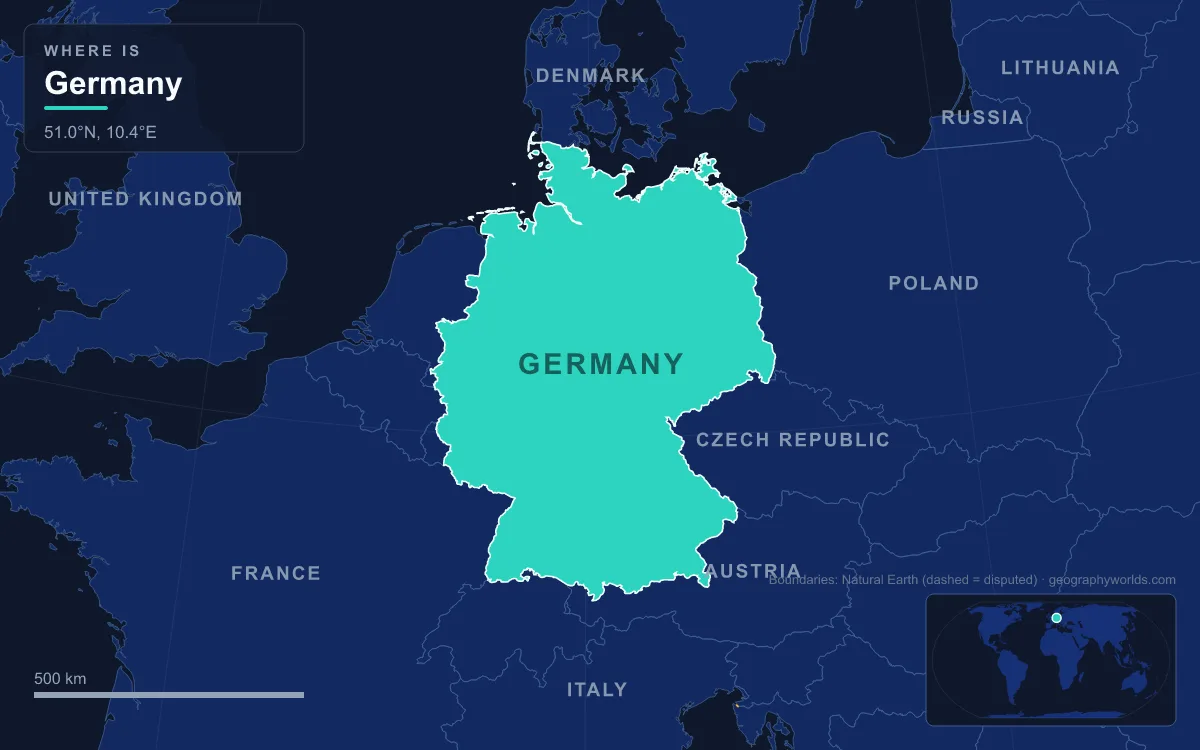
The most famous people from Germany include Albert Einstein, the physicist behind the theory of relativity; Ludwig van Beethoven, the Bonn-born composer of the Ninth Symphony; Martin Luther, whose Ninety-five Theses of 1517 set off the Protestant Reformation; Johann Wolfgang von Goethe, author of Faust; Johannes Gutenberg, who built Europe's movable-type printing press in Mainz; Otto von Bismarck, the first chancellor of a united Germany; and Angela Merkel, who led the country from 2005 to 2021. Add the bacteriologist Robert Koch, the tennis player Steffi Graf and the racing driver Michael Schumacher and the list runs from the fifteenth century to the present. Because Germany only became one state in 1871, the clearest way to read that list is era by era, and each era below is tied to the towns where these people worked.
Mainz and Wittenberg, 1450–1546: Gutenberg, Luther and Dürer
Johannes Gutenberg (c. 1400–1468) was the son of a patrician merchant in Mainz on the Rhine, and trained in metalwork. In the 1450s he combined a hand mould for casting metal type, an oil-based ink and a wooden press similar to the agricultural screw presses of the period. The Gutenberg Bible, printed in Mainz around 1455, was the first major book produced this way in Europe, and the technique spread down the Rhine and across the continent within decades.
That machinery gave Martin Luther (1483–1546) his audience. Born in Eisleben in Saxony and ordained a priest in 1507, Luther taught theology at the small university of Wittenberg. In 1517 he wrote the Ninety-five Theses attacking the sale of indulgences, and printed copies spread across the German lands in weeks. Pope Leo X excommunicated him in January 1521, and later that year Emperor Charles V declared him an outlaw at the Diet of Worms. Hidden at the Wartburg castle near Eisenach, he translated the New Testament into German; the 1522 edition did as much to standardise written German as any grammar book.
The painter and printmaker Albrecht Dürer (1471–1528) was Luther's contemporary in Nuremberg. He visited Italy, absorbed the Renaissance, and brought it home in woodcuts and engravings such as Melencolia I (1514). From 1512 he worked under the patronage of Emperor Maximilian I, and his self-portraits made him one of the first artists in northern Europe to present himself as a public figure.
Leipzig, Königsberg and Weimar, 1720–1832: Bach, Kant, Goethe and Beethoven
Johann Sebastian Bach (1685–1750) was born in Eisenach into a family of town musicians. After posts at the courts of Weimar and Köthen he became Thomaskantor in Leipzig in 1723, responsible for the music of four Lutheran churches, and stayed until his death. The Brandenburg Concertos, the St Matthew Passion and the Mass in B minor come from these decades, though his reputation only fully revived after Felix Mendelssohn conducted the St Matthew Passion in Berlin in 1829.
Immanuel Kant (1724–1804) spent almost his whole life in Königsberg, the Prussian port on the Baltic that became Kaliningrad in Russia after 1945. His Critique of Pure Reason (1781) argued that space and time are forms of human perception rather than features of things in themselves, and it remains a set text in philosophy.
Weimar, a ducal capital in Thuringia, became the literary centre of the German-speaking world. Johann Wolfgang von Goethe (1749–1832), born in Frankfurt, moved there in 1775 after his novel The Sorrows of Young Werther (1774) made him famous across Europe. He sat on the Duke's privy council, ran the court theatre and wrote poetry, science and the two parts of Faust. Friedrich Schiller (1759–1805), born in Marbach on the Neckar, wrote The Robbers while still a military-academy student in Stuttgart and later joined Goethe in Weimar; his "Ode to Joy" is the text Beethoven set in his last symphony.
Ludwig van Beethoven (1770–1827) was born in Bonn, where the family house on Bonngasse is now a museum. At twenty-one he moved to Vienna to study with Joseph Haydn and never came back, but he remains a German composer by birth and training. Despite growing deafness he produced nine symphonies, 32 piano sonatas and the Missa solemnis; the Ninth Symphony, premiered in Vienna in 1824, was the first major example of a choral symphony.

1848 to 1918: Marx, Bismarck, Clara Schumann and the laboratories of the Kaiserreich
Karl Marx (1818–1883) was born in Trier, in the Prussian Rhineland, and earned a doctorate from the University of Jena in 1841. With Friedrich Engels he wrote The Communist Manifesto (1848), and the first volume of Das Kapital followed in 1867. He spent most of his adult life in exile in London, but his ideas shaped twentieth-century politics from Moscow to Beijing.
Otto von Bismarck (1815–1898) did more than anyone to create the country Marx left. As minister president of Prussia from 1862 he fought three short wars, against Denmark (1864), Austria (1866) and France (1870–71), and in January 1871 the German Empire was proclaimed with the Prussian king as emperor. Bismarck served as its first chancellor until 1890 and introduced state health insurance and old-age pensions in the 1880s.
Clara Schumann (1819–1896), born Clara Wieck in Leipzig, gave concerts for 61 years and changed what a piano recital looked like, dropping showpieces in favour of serious repertoire. She premiered many works by her husband Robert Schumann and by Johannes Brahms, and composed a piano concerto of her own.
The Empire's universities produced a run of scientific firsts. Robert Koch (1843–1910) identified the anthrax bacterium in 1876 and the bacterium that causes tuberculosis in 1882, and received the 1905 Nobel Prize in Physiology or Medicine. Wilhelm Röntgen (1845–1923) detected X-rays in Würzburg in 1895 and in 1901 became the first person to receive the Nobel Prize in Physics. In Mannheim, Carl Benz (1844–1929) patented his three-wheeled Motorwagen in 1886; his firm later merged with Daimler to form Daimler-Benz, maker of Mercedes-Benz cars.
Weimar Republic, Nazi rule and exile, 1919–1945
Albert Einstein (1879–1955) was born in Ulm, in the Kingdom of Württemberg. He gave up his German citizenship as a teenager, became Swiss, and published his special theory of relativity in 1905 while working at the patent office in Bern. In 1914 he moved to Berlin to join the Prussian Academy of Sciences, and in 1922 he was awarded the 1921 Nobel Prize in Physics, chiefly for the photoelectric effect. When Adolf Hitler came to power in 1933, Einstein, who was Jewish, left Europe for Princeton in the United States and later became an American citizen.

Max Planck (1858–1947) had launched quantum theory in 1900 and won the 1918 Nobel Prize in Physics; the Max Planck Society, which today runs more than 80 research institutes, is named after him. The mathematician Emmy Noether (1882–1935), born in Erlangen, proved the theorem linking symmetries to conservation laws that physicists still use, then was dismissed from Göttingen in 1933 and died in the United States two years later.
Thomas Mann (1875–1955), from the Hanseatic port of Lübeck, won the 1929 Nobel Prize in Literature; his first novel, Buddenbrooks (1901), portrays a Lübeck merchant family much like his own. He fled to Switzerland in 1933 and then to the United States. Marlene Dietrich (1901–1992), born in Berlin, became an international star as Lola Lola in The Blue Angel (1930) and took American citizenship in 1939. Inside Germany, Sophie Scholl (1921–1943), from Forchtenberg in Württemberg, distributed leaflets for the White Rose resistance group at the University of Munich; she and her brother Hans were arrested and executed in February 1943.
Bonn and East Berlin, 1949–1990: Adenauer, Brandt, Böll and Grass
After 1949 there were two German states. In the west, Konrad Adenauer (1876–1967), a former mayor of Cologne, became the first chancellor of the Federal Republic, governing from Bonn until 1963 and tying the country to France, NATO and the European Economic Community. Willy Brandt (1913–1992), born in Lübeck, had fled to Norway and Sweden under the Nazis. As chancellor from 1969 to 1974 he pursued Ostpolitik, reconciliation with Poland and the Eastern bloc; he knelt at the Warsaw Ghetto memorial in 1970 and won the Nobel Peace Prize in 1971. Helmut Kohl (1930–2017) was chancellor from 1982 to 1998 and oversaw reunification on 3 October 1990.
Post-war literature wrestled with the Nazi years. Heinrich Böll (1917–1985), from Cologne, had refused to join the Hitler Youth and was later a conscript soldier; he received the Nobel Prize in Literature in 1972. Günter Grass (1927–2015) was born in the Free City of Danzig, today Gdańsk in Poland. His first novel, The Tin Drum (1959), is set there, and he received the Nobel Prize in Literature in 1999. On the football pitch, Franz Beckenbauer (1945–2024) of Munich captained West Germany to the 1974 World Cup and coached the team to the 1990 title, one of only three men to win the trophy as both player and manager. In the arts, Pina Bausch (1940–2009) from Solingen took over the Wuppertal ballet in 1973 and turned it into Tanztheater Wuppertal, a company whose mix of dance and theatre shaped modern choreography.
Reunified Germany since 1990: Merkel, Graf, Schumacher, Nowitzki and Zimmer
Angela Merkel (born 1954) was born in Hamburg but grew up in East Germany after her family moved there when she was a baby. She earned a doctorate in quantum chemistry in 1986 and entered politics in 1989. She served as chancellor from 2005 to 2021, the only woman and the only former East German to hold the office.
German sport produced two record-setters from the same year. Steffi Graf (born 1969), from Mannheim, won 22 major singles titles and in 1988 became the first player to take all four majors and the Olympic gold medal in one calendar year, the "Golden Slam". Michael Schumacher (born 1969), from Hürth near Cologne, won seven Formula One world championships, a record later equalled by Lewis Hamilton. Dirk Nowitzki (born 1978), from Würzburg, played all 21 of his NBA seasons with the Dallas Mavericks, was the league's Most Valuable Player in 2007 and led the team to its only title in 2011.
Hans Zimmer (born 1957), from Frankfurt, began his career in Britain before moving to Los Angeles. He has scored more than 150 films and won Academy Awards for The Lion King (1994) and Dune (2021).
Together, the list traces the country itself: printing and Reformation in the Holy Roman Empire, music and philosophy in the small states that preceded unification, science under the Empire, exile and resistance under Nazi rule, and a divided then reunited republic. For the regions these people came from, the Germany country guide maps the sixteen states, the history of the Berlin Wall covers the division Brandt and Merkel lived through, and you can follow Dietrich, Einstein and Brandt to the city that shaped them in our guide to Berlin, Germany's capital.