
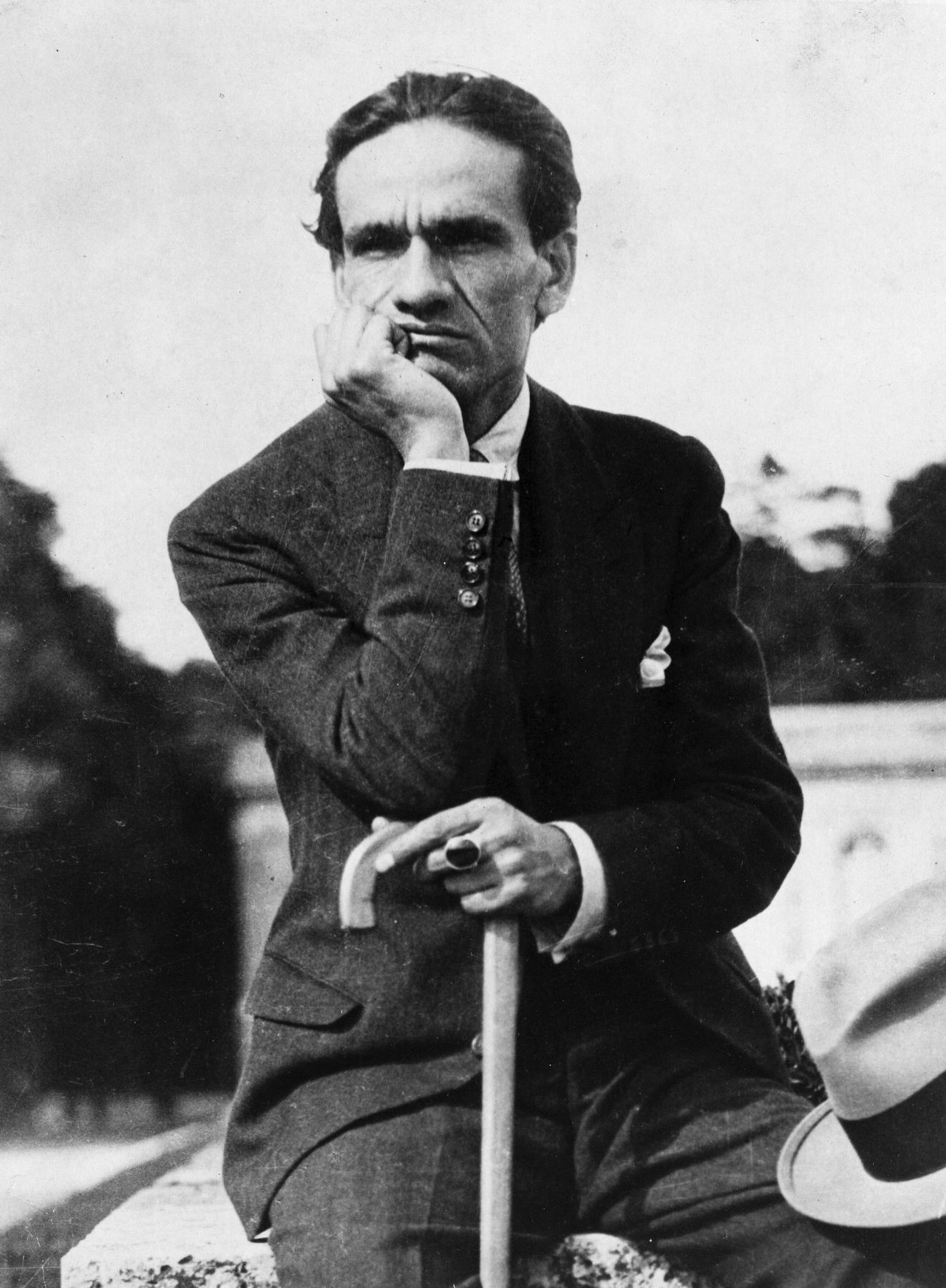
Mario Vargas Llosa, who won the 2010 Nobel Prize in Literature, heads a list of famous Peruvians that also includes the Inca ruler Pachacútec, who turned Cusco into an empire; the poet César Vallejo, author of Trilce (1922); the singer Yma Sumac, whose 1950 album Voice of the Xtabay reached number one in the United States; the footballer Teófilo Cubillas, scorer of ten World Cup goals; the diplomat Javier Pérez de Cuéllar, UN Secretary-General from 1982 to 1991; and the chef Gastón Acurio, who carried Peruvian cooking to the world. Add Rose of Lima, the first saint born in the Americas, the Afro-Peruvian singer Susana Baca and the world surfing champion Sofía Mulánovich, and the list covers five centuries and almost every field. Below, each field is taken in turn, with the people who define it.
Pachacútec, Túpac Amaru II, Rose of Lima and Javier Pérez de Cuéllar in Public Life
Pachacútec, or Pachacuti, was the ninth ruler of Cusco and the one who transformed a small highland chiefdom into the Inca Empire, Tawantinsuyu. The standard chronology, worked out by the archaeologist John Rowe in 1945, dates his reign to 1438–1471, although radiocarbon evidence points to an earlier start and some scholars treat his story as partly mythological. Most archaeologists now believe Machu Picchu was built as his royal estate, and the chronicler Garcilaso de la Vega credited him with creating the Inti Raymi sun festival. The way his empire stretched along the Andes is mapped in our guide to Inca Empire geography.

Túpac Amaru II (c. 1742–1781), born José Gabriel Condorcanqui, was a cacique educated in Cusco and a descendant of the last Inca of Vilcabamba. On 4 November 1780 he seized and executed the colonial official Antonio de Arriaga and launched a rebellion against the forced-labour mita and other colonial abuses; on 16 November he decreed the abolition of Black slavery, the first such decree in Spanish America. He was executed in Cusco's Plaza de Armas on 18 May 1781, and has since become a symbol of Indigenous resistance.
Rose of Lima (1586–1617), born Isabel Flores de Oliva, was a lay Dominican known for severe penance and for caring for the city's poor. Pope Clement X canonised her on 12 April 1671, making her the first person born in the Americas to be declared a saint. She remains the patron saint of Peru.
In the 20th century, Javier Pérez de Cuéllar (1920–2020), born in Lima, served two terms as the fifth Secretary-General of the United Nations, from 1982 to 1991, dealing with the Iran–Iraq War, Namibian independence and the Soviet withdrawal from Afghanistan. He later served as Peru's prime minister in 2000–2001.
Inca Garcilaso de la Vega, César Vallejo, José María Arguedas and Mario Vargas Llosa in Literature
Peruvian literature begins with a man of two worlds. Inca Garcilaso de la Vega (1539–1616) was born in Cusco to a Spanish conquistador and an Inca noblewoman, grew up speaking Quechua and sailed to Spain at 21. His Comentarios Reales de los Incas, published in Lisbon in 1609 and drawn from stories his Inca relatives told him as a child, was the first work by an author born in the Americas to enter the Western canon.
César Vallejo (1892–1938) came from Santiago de Chuco, a remote Andean village, the youngest of eleven children. After Los heraldos negros (1919) he published Trilce in 1922, still regarded as one of the most radically avant-garde poetry collections in Spanish. It appeared soon after he had spent 112 days in a Trujillo jail, unjustly accused of taking part in a looting in his home town. He left for Europe in 1923 and died in Paris, poor, in 1938.
José María Arguedas (1911–1969), born in Andahuaylas, learned Quechua living with Indigenous families as a boy and wrote in both languages. His novel Los ríos profundos (Deep Rivers, 1958) gave Andean characters a voice rarely heard in earlier fiction.
Mario Vargas Llosa (1936–2025), born in Arequipa, rose to fame with The Time of the Hero (1963), a novel about a Lima military academy, followed by The Green House (1965) and Conversation in the Cathedral (1969). He ran for president in 1990 and lost to Alberto Fujimori, took Spanish citizenship in 1993 while keeping his Peruvian nationality, and received the Nobel Prize in Literature in 2010.
Julio C. Tello, Daniel Alcides Carrión and Pedro Paulet in Science
Julio C. Tello (1880–1947) was born into a Quechua-speaking family in Huarochirí Province and trained in medicine before turning to archaeology. Often called the father of Peruvian archaeology and the first Indigenous archaeologist in South America, he uncovered the Paracas culture, including nearly 400 textiles from its mummy bundles, made Chavín de Huántar the focus of his Andean work and founded a national museum of archaeology.
Daniel Alcides Carrión (1857–1885) was a medical student who, in 1885, had friends inoculate him with blood from a patient's wart to prove that the deadly Oroya fever and the skin disease verruga peruana were the same illness. He proved it and died of it. The condition is now called Carrion's disease, Peru declared him a national hero in 1991, and 5 October, the day he died, is the Day of Peruvian Medicine.
Pedro Paulet (1874–1945), from Tiabaya near Arequipa, was a chemist and diplomat who later said he had built and tested a liquid-fuelled rocket engine in the 1890s. Some early rocket experts called him a pioneer on that basis, but his experiments were never independently verified, so he is best described as a claimed rather than proven forerunner of rocketry.
Yma Sumac, Chabuca Granda, Susana Baca and Juan Diego Flórez in Music
Yma Sumac (1922–2008) was born Zoila Chávarri in Callao and grew up in Cajamarca. Her stage name comes from the Quechua for "how beautiful". Her debut album, Voice of the Xtabay (1950), went to number one on Billboard's album chart and sold a million copies in the United States, and in 1956 she won a Guinness World Record for the range of her voice.

Chabuca Granda (1920–1983), born in Cotabambas Province in Apurímac and raised in Lima, wrote criollo waltzes with Afro-Peruvian rhythms; "La flor de la canela", from the early period in which she evoked old Lima and its Barranco district, is the best known. Her work was declared national cultural heritage in 2017, and she was posthumously awarded the Order of the Sun in 2019.
Susana Baca (born 1944) grew up in Chorrillos, a fishing district of greater Lima, and became central to the revival of Afro-Peruvian music. She won the Latin Grammy for Best Folk Album in 2002 for Lamento Negro and in July 2011 became Minister of Culture, the second Afro-Peruvian cabinet minister in the country's history.
In opera, the Lima-born tenor Juan Diego Flórez (born 1973) is known for bel canto roles. On 20 February 2007, at the opening night of Donizetti's La fille du régiment at La Scala in Milan, he broke the house's 74-year tradition of no encores by repeating the aria "Ah! mes amis", with its nine high Cs.
Martín Chambi and Claudia Llosa Behind the Camera
Martín Chambi (1891–1973) was born into a Quechua-speaking farming family in Puno and became one of the first major Indigenous photographers in Latin America. After opening a studio in Sicuani in 1917 he moved to Cusco, where he photographed townspeople, ruins and Andean landscapes, pioneering the picture postcard in Peru. New York's Museum of Modern Art gave him a retrospective in 1979. The city he documented is described in our article on Cusco as a UNESCO World Heritage Site.
Claudia Llosa (born 1976), a Lima-born director and niece of Vargas Llosa, made The Milk of Sorrow (La teta asustada, 2009), about the legacy of the Shining Path years. It won the Golden Bear at the Berlin International Film Festival in 2009 and in 2010 was nominated for the Academy Award for Best Foreign Language Film.
Teófilo Cubillas, Cecilia Tait, Sofía Mulánovich and Paolo Guerrero in Sport
Teófilo Cubillas (born 1949), nicknamed "El Nene" at Alianza Lima, scored 10 goals in 13 World Cup matches, helped Peru reach the quarter-finals in 1970 and 1978, and won the 1975 Copa América. He was South American Footballer of the Year in 1972.
Cecilia Tait (born 1962), "La Zurda de Oro" (the Golden Lefty), captained Peru's women's volleyball team to the silver medal at the 1988 Seoul Olympics, after a world championship silver on home soil in 1982. She later went into politics.
Sofía Mulánovich (born 1983) won three of the six Championship Tour events in 2004 and took the world surfing title, the first Latin American woman to do so. She was inducted into the Surfing Hall of Fame in 2007.
The striker Paolo Guerrero (born 1984) spent eight Bundesliga seasons in Germany, first at Bayern Munich and then at Hamburg, and scored the winning goal of the 2012 FIFA Club World Cup final for Corinthians.
Gastón Acurio and Virgilio Martínez in Lima's Kitchens
No field has lifted Peru's reputation as quickly in the 21st century as cooking. Gastón Acurio (born 1967) runs Astrid & Gastón in Lima and the La Mar cebicherías, writes books and hosts television. A 2022 Inter-American Development Bank study on innovation in Peruvian cuisine concluded that he, more than anyone, renewed it and opened the way for a new generation of chefs.
One of that generation, Virgilio Martínez (born 1977), applies modern technique to native Andean and Amazonian ingredients at his Lima restaurant, Central. It entered The World's 50 Best Restaurants list at number 50 in 2013 and reached number one in 2023.
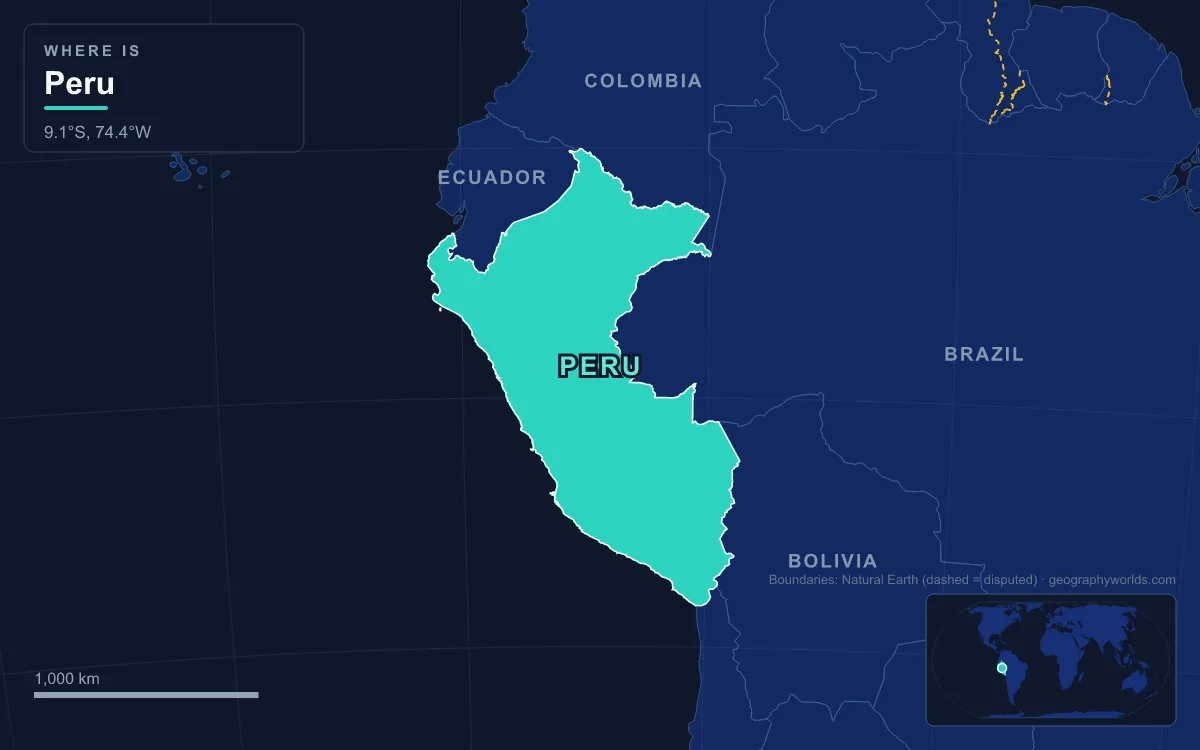
From Túpac Amaru II's highland rebellion to Mulánovich's Pacific waves, these Peruvians came from a country of coast, mountains and rainforest, and our look at how big Peru is shows how much ground lies between Callao, Puno and Andahuaylas.