

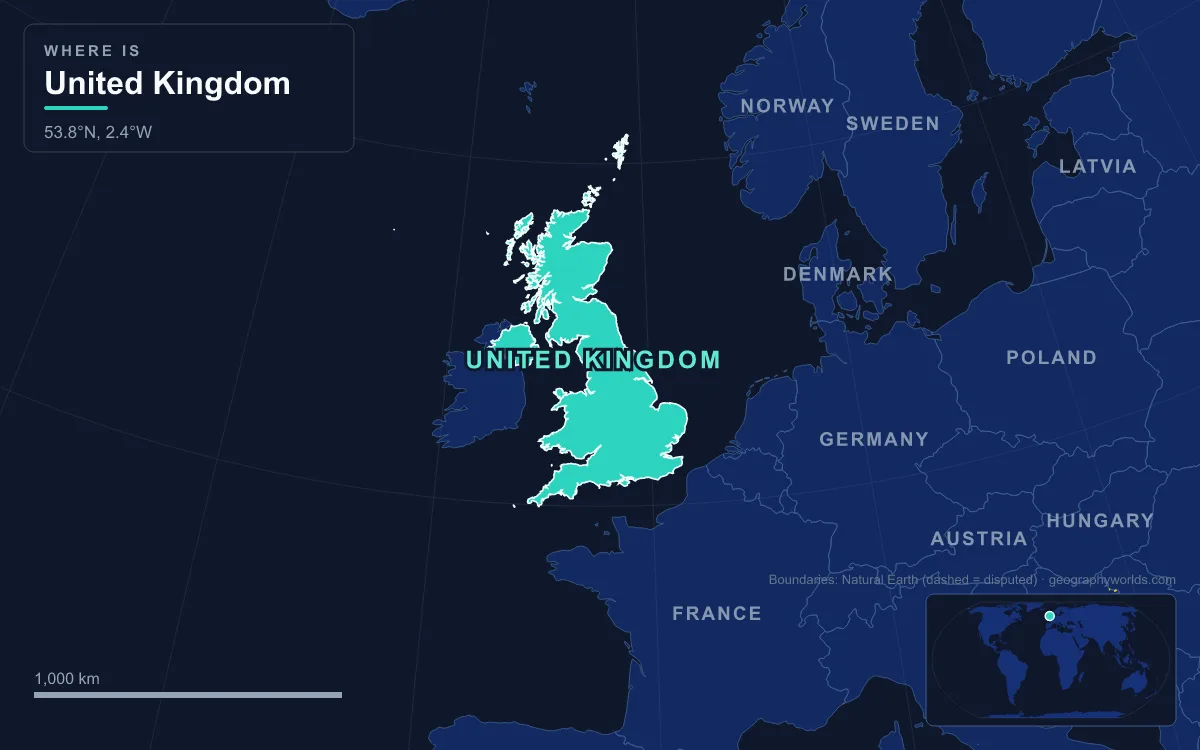
William Shakespeare, Isaac Newton, Charles Darwin, Winston Churchill, Queen Elizabeth II, the Beatles and Adele are among the best-known people from the United Kingdom: Shakespeare for 39 plays including Hamlet, Newton for the laws of motion and gravity, Darwin for evolution by natural selection, Churchill for leading Britain through the Second World War, Elizabeth II for the longest reign in British history, the Beatles for reshaping pop music from Liverpool, and Adele for 21, the best-selling album of the twenty-first century. Around them stand Alan Turing, Jane Austen, Charlie Chaplin, Florence Nightingale and Lewis Hamilton. The UK as a state dates from 1707 (Great Britain) and 1801 (the United Kingdom), so earlier figures such as Shakespeare were English subjects rather than British ones; this guide groups everyone by the field they changed.
Newton, Darwin, Faraday, Franklin and Hawking: the scientists
Isaac Newton (1643–1727) was born at Woolsthorpe Manor, a farmhouse in Lincolnshire, three months after his father's death. His Philosophiæ Naturalis Principia Mathematica, published in 1687, set out the three laws of motion and universal gravitation, and he shares credit with Gottfried Leibniz for calculus. He later sat in Parliament and ran the Royal Mint.

Charles Darwin (1809–1882), born in Shrewsbury, sailed round the world on HMS Beagle and spent two decades assembling evidence before publishing On the Origin of Species in 1859. Michael Faraday (1791–1867), a blacksmith's son from south London with little schooling, discovered electromagnetic induction, the principle behind every electric generator. Rosalind Franklin (1920–1958), a Londoner, produced X-ray diffraction images of DNA at King's College London; Photo 51, taken by her student Raymond Gosling, was shown to James Watson without her permission and helped him and Francis Crick model the double helix. Stephen Hawking (1942–2018), born in Oxford, held Newton's old chair as Lucasian Professor of Mathematics at Cambridge from 1979 to 2009, and A Brief History of Time spent a record 237 weeks on the Sunday Times bestseller list.
Watt, Stephenson, Brunel, Lovelace, Turing and Berners-Lee: engines to the web
The Industrial Revolution ran on British engineering. James Watt (1736–1819), from Greenock on the Clyde, built a steam engine in 1776 that used far less coal than Thomas Newcomen's earlier design. George Stephenson (1781–1848), a Northumberland colliery worker's son, built early railways, and his track gauge of 1,435 mm (4 ft 8½ in) is still the world's standard. Isambard Kingdom Brunel (1806–1859), born in Portsmouth, engineered the Great Western Railway from London to Bristol and built the SS Great Western, the largest steamship afloat when it was launched.
Ada Lovelace (1815–1852), daughter of the poet Lord Byron, wrote notes on Charles Babbage's proposed Analytical Engine that included a method for calculating numbers with it, and saw that such a machine could handle more than arithmetic; she is often called the first computer programmer. Alan Turing (1912–1954), born in Maida Vale, London, defined the Turing machine in 1936 and led Hut 8 at Bletchley Park, breaking German naval Enigma messages. Tim Berners-Lee (born 1955), another Londoner, proposed the World Wide Web at CERN on 12 March 1989 and wrote the first web server and browser.
Shakespeare, Austen, Dickens, the Brontës, Burns and Rowling: the writers
William Shakespeare (1564–1616) was born in Stratford-upon-Avon in Warwickshire and made his career in London. His surviving work runs to some 39 plays, 154 sonnets and three long poems, and his plays are performed more often than any other playwright's. Jane Austen (1775–1817), a rector's daughter from Steventon in Hampshire, published four novels anonymously in her lifetime, among them Pride and Prejudice (1813). Charles Dickens (1812–1870), born in Portsmouth, left school at twelve to work in a boot-blacking factory while his father sat in a debtors' prison, and wrote that world into Oliver Twist and David Copperfield. From Haworth parsonage in Yorkshire came the Brontë sisters; Charlotte (1816–1855) published Jane Eyre in 1847 under the pen name Currer Bell.
The other nations of the UK have their own canon. Robert Burns (1759–1796), born in Alloway in Ayrshire, is the national poet of Scotland and wrote in Scots as well as English. Dylan Thomas (1914–1953), from Swansea, wrote the radio play Under Milk Wood and the poem "Do not go gentle into that good night". C. S. Lewis (1898–1963) was born in Belfast, before the partition of Ireland, and wrote the seven Chronicles of Narnia. George Orwell (1903–1950) was born in India to a British family, raised in England, and published Animal Farm (1945) and Nineteen Eighty-Four (1949). J. K. Rowling (born 1965), from Yate in Gloucestershire, published Harry Potter and the Philosopher's Stone in 1997; the seven-book series has sold more than 600 million copies.
Elgar, the Beatles, David Bowie and Adele: the musicians
Edward Elgar (1857–1934) was born in the village of Lower Broadheath near Worcester, the son of a piano tuner and music-shop owner, and taught himself much of his craft. The Enigma Variations made his name, the first Pomp and Circumstance march supplied the tune for "Land of Hope and Glory", and in 1924 he became Master of the King's Music.
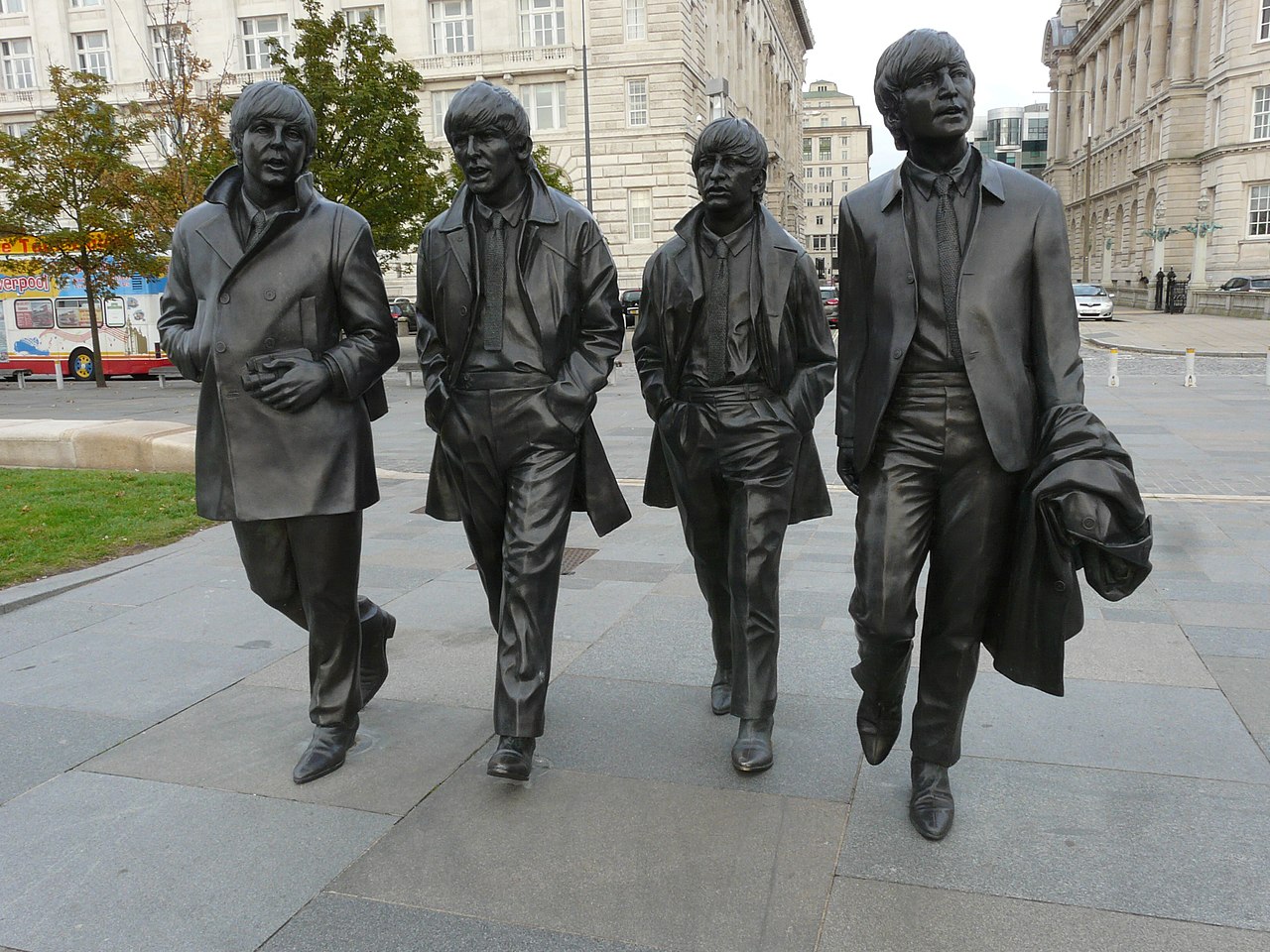
The Beatles formed in Liverpool in 1960: John Lennon (1940–1980), Paul McCartney (born 1942), George Harrison (1943–2001) and Ringo Starr (born 1940). They moved popular music from two-minute singles to studio albums such as Revolver and Sgt. Pepper's Lonely Hearts Club Band, and remain the best-selling music act of all time, with estimated sales of more than 600 million units.
David Bowie (1947–2016), born David Jones in Brixton, south London, broke through with "Space Oddity" in 1969 and then invented a new persona almost every album, starting with The Rise and Fall of Ziggy Stardust and the Spiders from Mars (1972). Adele Adkins (born 1988), from Tottenham in north London, is a graduate of the BRIT School in Croydon. Her second album, 21 (2011), spent 24 weeks at number one on the US Billboard 200, and she has won 16 Grammy Awards.
Chaplin, Hitchcock and Judi Dench: the screen
Charlie Chaplin (1889–1977) grew up in poverty in south London, probably in Walworth, and toured music halls before Hollywood made his Tramp character known worldwide. In 1919 he co-founded United Artists, which gave him control of his own films, and his first feature-length film, The Kid, followed in 1921. Alfred Hitchcock (1899–1980) was the son of a greengrocer in Leytonstone, east London. He directed more than 50 feature films, moving to Hollywood in 1939, and Psycho (1960) is still used to teach suspense. Judi Dench (born 1934), from York, made her professional stage debut with the Old Vic company in 1957 and won the Academy Award for Best Supporting Actress for playing Elizabeth I in Shakespeare in Love (1998).
Victoria, Nightingale, Pankhurst, Churchill, Thatcher and Elizabeth II: public life
Queen Victoria (1819–1901) reigned from 1837 to 1901, and the era named after her covers the railway age, the growth of industrial cities and a great expansion of the British Empire; in 1876 Parliament added the title Empress of India. Florence Nightingale (1820–1910) was born to English parents in Florence, Italy, and named after the city. During the Crimean War she ran nursing at the army hospital outside Constantinople, then used statistics to argue for sanitary reform and founded a nursing school at St Thomas' Hospital in London.
Emmeline Pankhurst (1858–1928), born in Moss Side, Manchester, founded the Women's Social and Political Union in 1903. Its militant campaign helped win votes for some women in 1918. Winston Churchill (1874–1965) was Prime Minister from 1940 to 1945 and again from 1951 to 1955, and received the 1953 Nobel Prize in Literature for his histories and speeches. Margaret Thatcher (1925–2013), a grocer's daughter from Grantham in Lincolnshire, became the first woman Prime Minister in 1979 and held the office until 1990, making her the longest-serving Prime Minister of the twentieth century.
Elizabeth II (1926–2022), born in Mayfair, London, became queen on 6 February 1952 at the age of 25. Her reign of 70 years and 214 days is the longest of any British monarch, and she was queen of 32 different sovereign states at various points in her life.
Bobby Moore, Andy Murray, Jessica Ennis-Hill, Mo Farah and Lewis Hamilton: sport
Bobby Moore (1941–1993), from Barking in east London, captained West Ham United for more than a decade and captained England to victory in the 1966 World Cup final at Wembley, beating West Germany 4–2 after extra time. Andy Murray (born 1987) was born in Glasgow and grew up in Dunblane; he won the 2012 US Open and Wimbledon in 2013 and 2016, ending a 77-year wait for a British men's singles champion there, and took two Olympic gold medals. Jessica Ennis-Hill (born 1986), from Sheffield, won heptathlon gold at the London 2012 Olympics and three world titles.
Mo Farah (born 1983) was born in Somalia, and in 2022 he revealed that he had been trafficked to London at the age of nine under another child's name. He later became a British citizen and won the 5,000 m and 10,000 m at both the 2012 and 2016 Olympics. Lewis Hamilton (born 1985), from Stevenage in Hertfordshire, has won seven Formula One world championships, level with Michael Schumacher, and holds the records for most race wins and pole positions.
The spread across England, Scotland, Wales and Northern Ireland matters to how these names are claimed at home: Burns and Murray are Scottish first, Dylan Thomas is Welsh, and C. S. Lewis was born in Belfast. If the difference between those labels is unclear, our explainer on the UK, Great Britain and England sorts it out, the United Kingdom country guide covers the four nations in more depth, and many of the people above did their defining work in London, the UK's capital.