
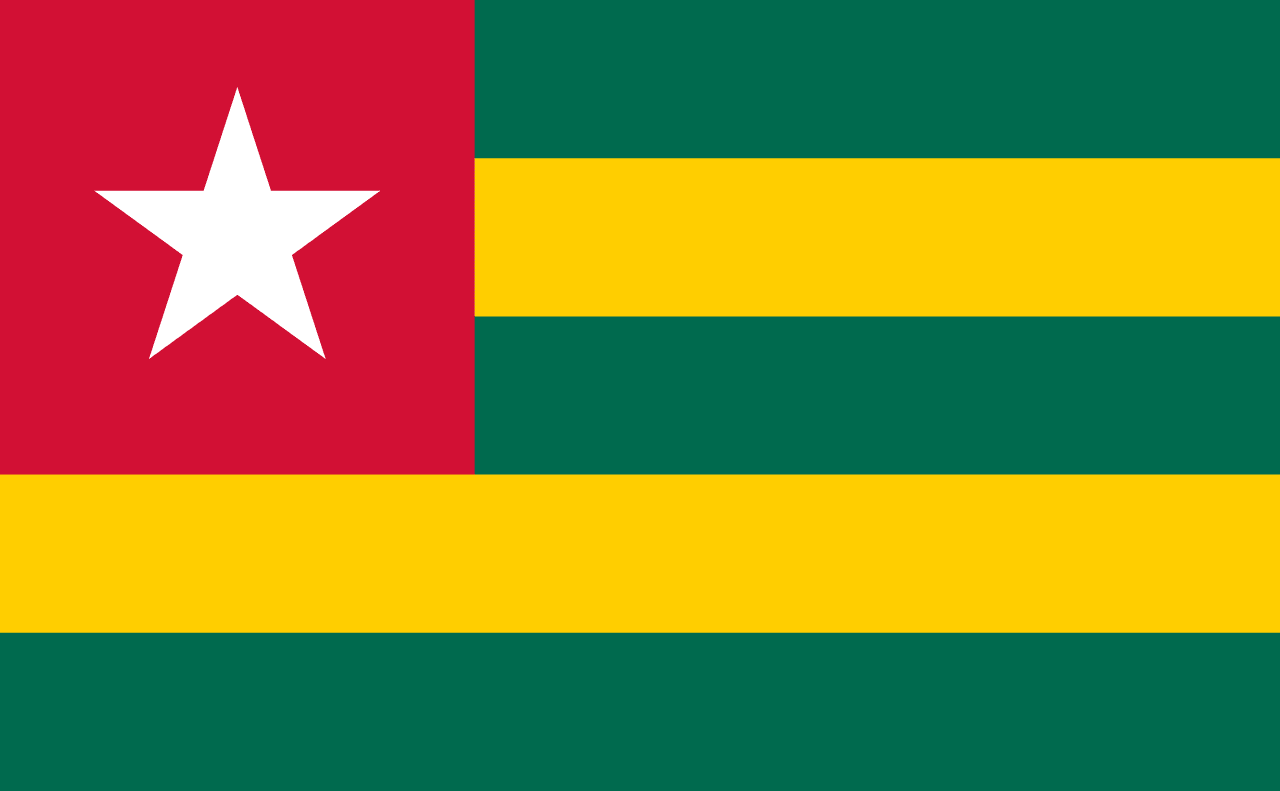
Among the family of West African banners that share the colors of Pan-Africanism, the flag of Togo stands out for one quiet but deliberate choice: it does not rely on stripes alone. Instead, it borrows a layout more familiar from the other side of the Atlantic, pairing five horizontal bands with a single white star set against a red square in the corner. The result is a flag that feels both proudly African and unexpectedly cosmopolitan, a small nation's statement of identity hoisted at the very moment it stepped into independence.
Adopted in 1960, the same year Togo gained its freedom, this flag has flown unchanged ever since. Its endurance is part of its appeal. While many newly independent countries revised their emblems repeatedly during turbulent decades, Togo settled on a design that has needed no editing, no committee revisions, and no compromise. To understand why, it helps to look closely at the colors, the geometry, and the artist behind it.
The Colors and What They Stand For
Togo's flag draws on four colors, three of them the classic Pan-African green, yellow, and red, joined by white. Each carries a meaning rooted in the land and the people who built the country.
Green speaks to agriculture and the hope that grows from the soil. Farming has long anchored Togolese life, from the coastal plains to the inland hills, and the green bands honor that dependence on the earth. Yellow represents the country's mineral wealth, a nod to the phosphate deposits and other resources that have shaped its economy. Red, the color of the canton, stands for courage, fidelity, and the sacrifices made on the road to nationhood. And white, the color of the lone star, symbolizes purity and life, an aspiration toward wisdom and peace.
What makes this palette satisfying is how the symbolism maps onto the physical design. The colors are not scattered for decoration; they are arranged so that the eye reads them as a sequence of values: the green of the fields, the gold of the underground riches, and the red of the people's resolve, crowned by a star of light.
A Closer Look at the Design
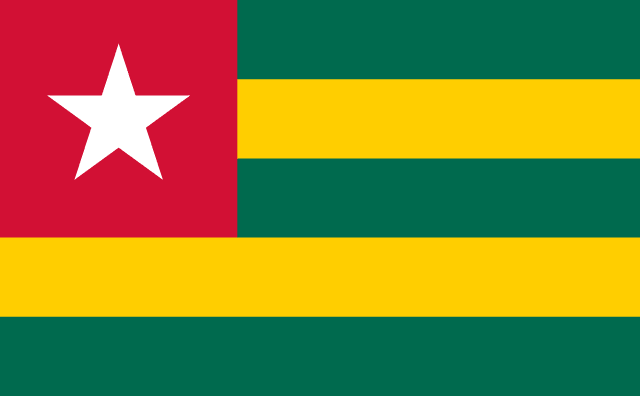
The flag is built from five horizontal stripes of equal width, alternating green and yellow, beginning and ending with green. That gives three green bands and two yellow ones. Laid over the upper hoist corner is a red canton, a square block, and centered within it sits a five-pointed white star.
This canton-and-stripes arrangement is the detail that sets Togo apart from neighbors whose flags use vertical thirds or plain horizontal tricolors. The proportions were chosen with care: the red square is sized so the star reads clearly without crowding the corner, and the alternating stripes create a rhythm that balances the weight of the canton. It is a composition that rewards a second glance, deceptively simple yet precisely engineered.
The Artist Behind the Banner
Togo's flag was designed by Paul Ahyi, one of the country's most celebrated artists and a figure of pan-African cultural importance. That a working artist, rather than an anonymous government office, shaped the national emblem gives the flag an unusual pedigree. Ahyi approached the task with a designer's instinct for proportion and contrast, and the clean confidence of the layout reflects that.
Having an identifiable creator also lends the flag a human story. It is not merely a bureaucratic product but a piece of authored design, conceived at a pivotal historical moment and carried forward by a country that has never felt the need to replace it. For readers who want the broader context of the nation itself, the togo country guide offers a fuller picture of its geography, culture, and history.
Historical Background
The flag's debut coincided with one of the great waves of African independence. Across the continent in 1960, colonial rule was giving way to sovereign states, and new flags were being raised almost monthly. Togo joined that movement, and its choice of green, yellow, and red placed it firmly within the Pan-African tradition associated with the colors first popularized by Ghana and Ethiopia.
Yet Togo did not simply copy its neighbors. By adding a star in a colored canton, the designers signaled both solidarity with the wider African project and a distinct national personality. Since that first hoisting, the flag has remained constant, a fixed point through decades of political change. Its stability is itself a kind of statement: that the symbols agreed upon at independence still hold.
Cultural Significance and National Identity
For Togolese citizens, the flag is woven into the texture of public life. It appears at schools, government buildings, and border posts, and it takes center stage during independence celebrations each year. The five stripes have become shorthand for the country itself, a visual signature recognized instantly at home and increasingly abroad.
The flag also functions as a bridge between the local and the continental. Its Pan-African colors connect Togo to a shared story of liberation and self-determination, while the white star asserts the particular hopes of one nation. In moments of pride, whether civic or sporting, citizens reach for these colors as the natural expression of belonging.
The Flag in Modern Life
Today the flag travels far beyond official ceremonies. Supporters wave it at football matches, where the national team's colors echo the banner directly. It decorates Independence Day festivities, adorns clothing and crafts, and surfaces in the diaspora wherever Togolese communities gather. Its strong, legible design makes it well suited to flags, badges, and digital icons alike, a practical advantage in an age of screens.
Because the colors are shared so widely across the region, the star and canton do a lot of work in making the flag recognizable at a glance. That single white star, glowing against red, is the feature most people remember, and it remains the visual anchor of Togolese national imagery.
Interesting Facts
- The flag was adopted in 1960, the year Togo became independent, and has remained unchanged ever since.
- It was designed by the renowned Togolese artist Paul Ahyi.
- The canton-and-stripes layout is often described as one of several African flags inspired by the design of the United States flag.
- There are five horizontal stripes, three green and two yellow, with green at both the top and bottom.
- The four colors carry distinct meanings: green for agriculture, yellow for mineral wealth, red for courage, and the white star for purity and life.
- Togo sits in West Africa, on the continent of Africa, with a short coastline on the Gulf of Guinea.
Frequently Asked Questions
When was the flag of Togo adopted?
The flag was adopted in 1960, the year Togo achieved independence. It has flown without modification since then, making it one of the more stable national flags in the region.
What do the colors of the Togolese flag mean?
Green represents agriculture, yellow stands for the country's mineral wealth, and red symbolizes courage. The white star set in the red canton represents purity and life.
Who designed the flag of Togo?
The flag was designed by Paul Ahyi, a celebrated Togolese artist. His background in the visual arts is often credited with the flag's clean proportions and strong, balanced composition.
What continent is Togo on, and what flags is it similar to?
Togo is located in West Africa, on the African continent. Its green, yellow, and red colors place it within the Pan-African tradition shared by many neighbors, while its red canton and white star give it a layout often compared to the United States flag, setting it apart from the simpler stripe-only designs nearby.