
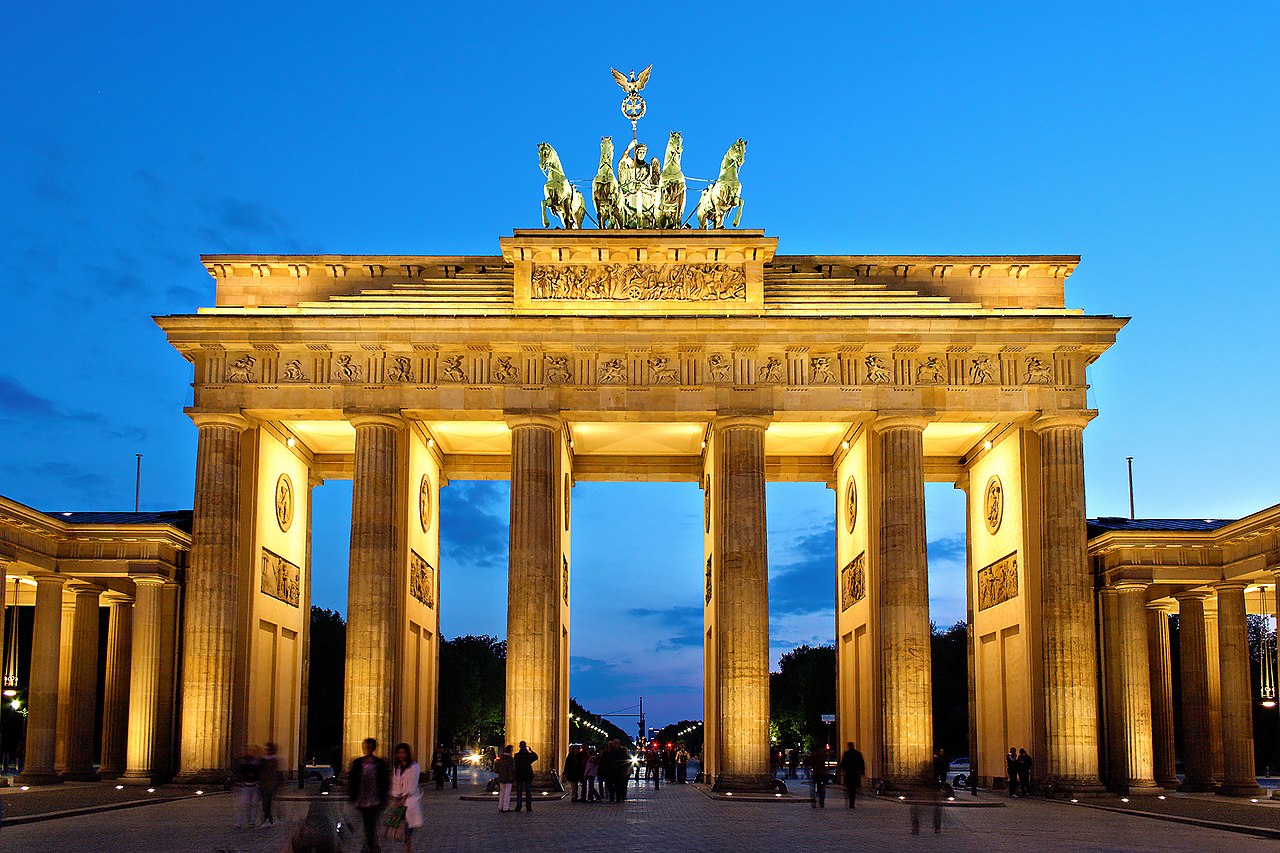
Germany is the most populous country in the European Union, with around 84 million people, and it sits right in the middle of Europe with nine neighbours — more than any other European country except Russia. It has been a single country for less time than the United States has existed: modern Germany was only unified in 1871, split in two in 1949, and put back together in 1990. That short national history sits on top of a very long regional one, and it explains almost everything about how the country works.

Nine Neighbours
Germany borders Denmark, Poland, Czechia, Austria, Switzerland, France, Luxembourg, Belgium and the Netherlands. Being in the middle of a continent with no natural barriers on most sides has shaped its entire history.
The country covers about 357,000 square kilometres and runs from the North Sea and Baltic coasts in the north down to the Alps in the south. Its highest mountain, the Zugspitze, is 2,962 metres.
The north is flat and was scraped smooth by ice-age glaciers. The middle is hilly and forested. The south is mountainous. You can see this in the food, the buildings and even the dialects as you travel down the country.
Sixteen States
Germany is a federal country of sixteen Länder, and they have real power — over schools, police and culture in particular. That is why the school system is different in Bavaria from in Hamburg, and why holidays vary from state to state.
Three of the states are single cities: Berlin, Hamburg and Bremen. Bavaria is the largest by area and has the strongest separate identity, with its own dialect, its own political party and a habit of doing things differently.
The federal structure exists partly by design. After 1945 the Allies deliberately built a system in which no single central authority could easily dominate the country again.
A Very New Country
Before 1871 there was no Germany. There were hundreds of separate kingdoms, duchies, principalities, bishoprics and free cities — at one point over 300 of them — loosely grouped in the Holy Roman Empire.
Prussia unified most of them into the German Empire in January 1871. That is more recent than the founding of the United States, Brazil or Mexico.
After the Second World War the country was divided into West Germany, a democracy allied with the West, and East Germany, a communist state allied with the Soviet Union. They were separate countries for 41 years, with different governments, currencies, schools and even different traffic-light figures.
The Berlin Wall
Berlin sat entirely inside East Germany, and the city itself was divided. So many people were leaving through West Berlin — around 3.5 million between 1949 and 1961 — that East Germany built a wall around it, starting overnight on 13 August 1961.
The wall ran 155 kilometres around West Berlin and was not a single wall but two, with a patrolled strip between them nicknamed the death strip. Families were separated for decades, in some cases with relatives living a few hundred metres apart.
It came down on 9 November 1989, after a spokesman for the East German government misread a note at a press conference and said new travel rules applied immediately. Crowds went to the checkpoints, the guards had no orders, and they opened the gates. Germany was formally reunified less than a year later, on 3 October 1990, which is now the national day.
Autobahn
Germany's motorway network runs about 13,000 kilometres, and around half of it has no general speed limit — the only country in the world where that is true on a large scale.
There is an advisory speed of 130 km/h, and limits do apply near cities, roadworks and junctions, which is most of the network in practice. Where there is no limit, the fast lane is genuinely fast.
The rules that go with it are strict. Overtaking on the right is prohibited. Running out of fuel on the autobahn is an offence, because stopping is dangerous. Winter tyres are legally required in winter conditions. German driving licences take considerably more training and cost far more than in most countries.
Try Building a German Word
German makes new words by gluing existing ones together, with no spaces and no hyphens. Once you know the pieces you can read words you have never seen.
Handschuh is hand-shoe, meaning glove. Krankenhaus is sick-house, meaning hospital. Fernseher is far-seer, meaning television. Staubsauger is dust-sucker, meaning vacuum cleaner. Schildkröte is shield-toad, meaning tortoise.
They can get long. Rindfleischetikettierungsüberwachungsaufgabenübertragungsgesetz was a real Mecklenburg-Vorpommern law about beef labelling supervision, at 63 letters. Try inventing your own: a nose-cloth is a handkerchief, Taschentuch, which is actually pocket-cloth. German is very literal.
Inventions
Johannes Gutenberg introduced movable-type printing to Europe around 1440, and it changed the world faster than almost any other invention. Within fifty years there were printing presses in over 250 European cities and millions of books in circulation.
Germans also invented or co-invented the car — Karl Benz patented his in 1886 — along with the diesel engine, the jet engine, the modern bicycle, aspirin, the contact lens, the coffee filter, the Christmas tree as we know it, the gummy bear and the MP3 file format.
Germany has produced more Nobel Prize winners in the sciences than any country except the United States. Albert Einstein was born in Ulm, published his theory of relativity while working in a Swiss patent office, and left Germany in 1933.
Forests and Castles
About a third of Germany is forest, and Germans take them seriously enough that the concept of sustainable forestry was invented there. The word Nachhaltigkeit was coined in a 1713 book about not cutting down trees faster than they grow — the origin of the modern idea of sustainability.
The Black Forest in the south-west is dense enough that it looks dark from a distance, hence the name. It is the home of the cuckoo clock and of Black Forest gateau, and its folklore fed straight into the Brothers Grimm's fairy tales, collected in the early 1800s.
Germany has around 20,000 castles, more than any other country. Neuschwanstein in Bavaria, built by King Ludwig II from 1869, is the one Disney's castle logo was modelled on. Ludwig nearly bankrupted himself building it and lived in it for only a few months.
School and the Two-Track System
German schooling splits children earlier than most countries. After primary school, usually at about ten, pupils go to one of several different kinds of secondary school depending on their results and their teachers' recommendation.
The Gymnasium leads to the Abitur, the exam needed for university. Other tracks lead to vocational qualifications. Moving between tracks is possible but historically has been difficult, and the system is regularly criticised for deciding too much too young.
The vocational side is the part other countries copy. Germany's dual system combines classroom study with paid apprenticeship at a real company, usually over two to three and a half years, and it covers hundreds of recognised trades from carpentry to industrial mechanics to banking. Around half of young Germans go through it, and it is a large part of why German manufacturing is what it is.
Bread, Sausage and Christmas Markets
Germany has over 3,000 registered types of bread and around 1,500 kinds of sausage, and both figures come from trade associations that take the counting seriously. German bread culture was added to the national list of intangible heritage in 2014.
Beer is regulated by a purity law, the Reinheitsgebot, originally issued in Bavaria in 1516, which specified that beer could contain only barley, hops and water. Yeast was added to the list later, once anyone knew it existed.
Christmas markets, Weihnachtsmärkte, run through Advent in almost every German town. The one in Dresden, the Striezelmarkt, has been held since 1434. The Christmas tree, Advent calendar and Advent wreath are all German inventions that have travelled worldwide.
Rivers That Made the Country
The Rhine runs about 1,230 kilometres from the Swiss Alps to the North Sea and is the busiest waterway in Europe for cargo. Barges carry coal, chemicals and containers between Rotterdam and Switzerland, and the stretch through the gorge between Bingen and Koblenz is a World Heritage Site lined with castles on both banks.
The Danube is the only major European river that flows east rather than west, starting in the Black Forest and ending in the Black Sea 2,850 kilometres later. The Elbe, Weser and Oder complete the set.
Hamburg, 100 kilometres inland on the Elbe, is Germany's largest port and the third busiest in Europe. It has more bridges than Venice, Amsterdam and London put together — over 2,300 of them.
Punctuality and Recycling
Germany recycles more of its household waste than almost any country, and the system is elaborate. Bins are separated by paper, packaging, glass by colour, organic waste and everything else, and glass bottles and cans carry a deposit called Pfand that you get back when you return them.
The return rate for deposit bottles is above 95%. Sunday is legally a quiet day in most states, with shops closed and rules against noisy activities like mowing the lawn or drilling.
The reputation for punctuality is real in most areas and has one famous exception. Deutsche Bahn, the national railway, has been the subject of years of national complaint about delays — a fact Germans find far funnier and more irritating than any foreigner does. To keep exploring, read about religion in Germany and see the full list of countries in Europe.
