

Germany is split almost evenly three ways: about 24% Catholic, about 22% Protestant, and roughly 44% with no religion at all, plus a Muslim population of around 6%. That balance is new. As recently as 1990, more than 70% of Germans belonged to one of the two big churches. The country is also unusual in the developed world for collecting a religion tax through the ordinary income-tax system.
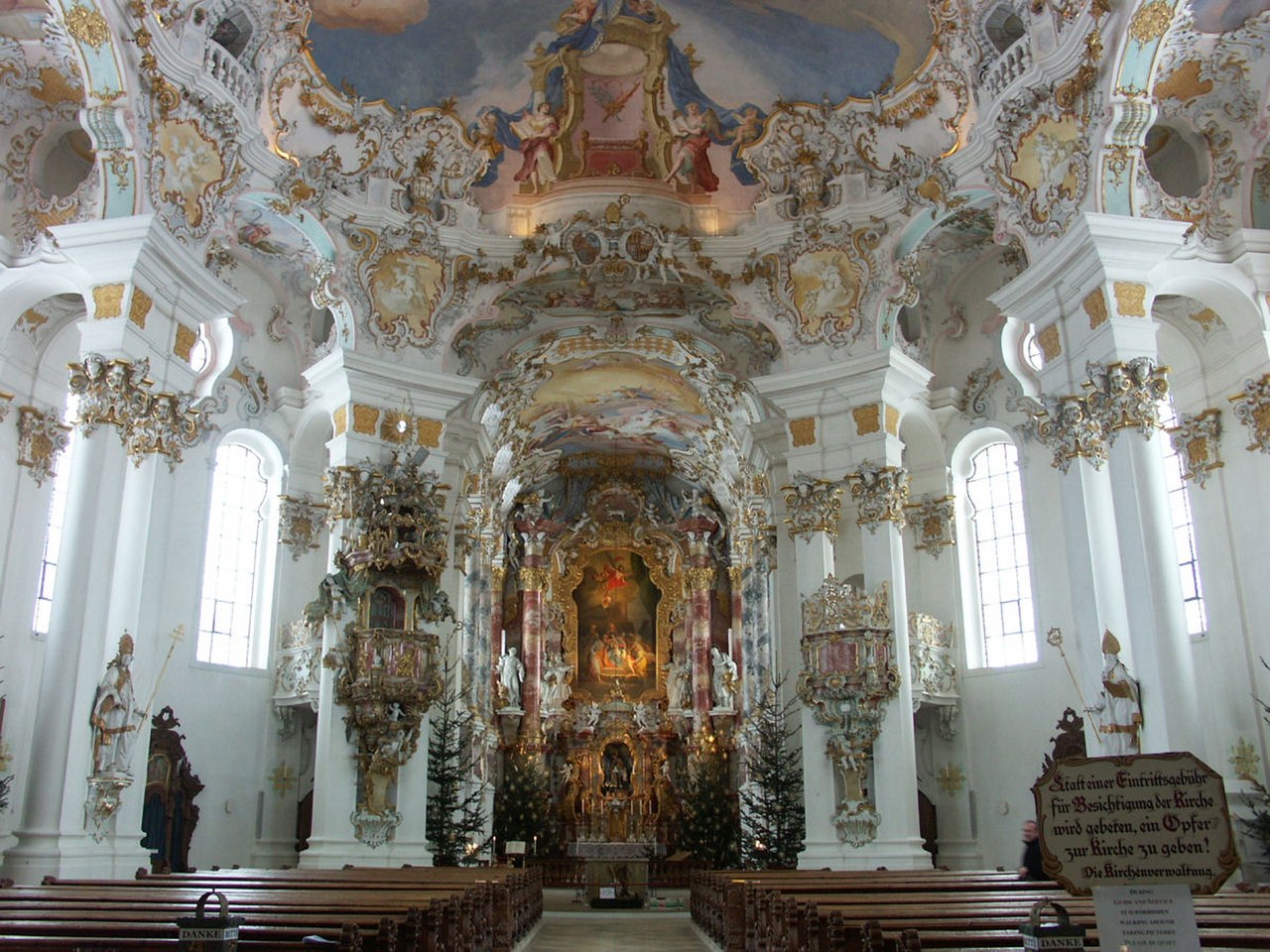
The Church Tax Nobody Else Has
If you register as Catholic, Protestant or Jewish in Germany, the state collects a Kirchensteuer on your behalf: 8% of your income tax in Bavaria and Baden-Württemberg, 9% everywhere else. It is deducted from wages automatically, and the state keeps a small administration fee for the service.
The sums are enormous. The Catholic and Protestant churches together take in something on the order of €13 billion a year from this source, which makes the German churches among the wealthiest religious institutions in the world and funds a vast network of hospitals, kindergartens, care homes and schools.
It is also the most-cited reason people leave. To stop paying, you must formally deregister — the Kirchenaustritt — at a local registry office or court, filling in a form and paying a fee of roughly €30. Hundreds of thousands do it every year, and the numbers spike after abuse scandals and after tax changes make the deduction more visible.
How the Map Got Its Shape
The Catholic-Protestant geography of Germany was set by war and treaty rather than by preaching. The Peace of Augsburg in 1555 established the principle later summarised as cuius regio, eius religio — the ruler's religion is the territory's religion — which meant a prince's decision determined the faith of everyone under him.
The Peace of Westphalia in 1648, ending the Thirty Years' War, fixed the arrangement more durably using 1624 as the reference year for which confession held which territory. The result is a patchwork that still shows up in survey maps: heavily Catholic Bavaria, the Rhineland and the Saarland; Protestant heartlands across the north and centre.
Martin Luther is inseparable from that map. He posted his ninety-five theses at Wittenberg in 1517, was excommunicated in 1521, and translated the New Testament into German while sheltering at the Wartburg — a translation that did as much to standardise the German language as it did to divide German religion.
Eastern Germany Is the Least Religious Place on Earth
The former German Democratic Republic contains the most thoroughly secular population ever measured. In Saxony-Anhalt, Thuringia and Mecklenburg-Vorpommern, the share of people with no religious affiliation runs around 75 to 80%. Surveys of belief in God in the east return figures in the teens and twenties.
This is not simply what happens to a society over time. It was produced deliberately over forty years of state atheism: church membership harmed careers, religious instruction was pushed out of schools, and the state promoted the Jugendweihe, a secular coming-of-age ceremony, as a replacement for confirmation. Participation reached the high nineties by the 1980s.
The striking part is what happened after 1990. Removing the pressure did not bring people back. Two generations had grown up with no religious vocabulary at all, and the east has stayed secular while the west has secularised only gradually — the clearest natural experiment anywhere in the effect of sustained state policy on belief.
The Guest Workers and the Mosques
Germany's Muslim population, usually estimated at 5 to 5.5 million, is the second largest in Western Europe and the product of a specific labour agreement. The recruitment treaty with Turkey signed in October 1961 brought workers to fill postwar labour shortages, on the assumption that they would rotate home.
They did not. Recruitment stopped in 1973, family reunification followed, and a temporary workforce became a permanent population. People of Turkish background remain the largest group, joined more recently by Syrians and Afghans after the arrivals of 2015 and 2016.
The DITIB organisation, linked to Turkey's state religious authority, runs a large share of German mosques and staffs many of them with imams sent from Turkey — an arrangement increasingly criticised in Germany and slowly being replaced by domestic imam training, including a seminary opened in Osnabrück in 2021.
A Jewish Community Rebuilt Twice
Germany's Jewish community numbered around 500,000 in 1933. The Holocaust and the emigration that preceded it left roughly 15,000 in the country in 1950, and for decades afterwards it was widely assumed that Jewish life in Germany would not continue.
It grew instead, and the reason was the collapse of the Soviet Union. From 1991, Germany admitted Jewish immigrants from the former USSR as Kontingentflüchtlinge, quota refugees, and more than 200,000 came. Community membership rose to around 100,000, with far more people of Jewish descent than that.
The New Synagogue on Oranienburger Straße in Berlin, its dome rebuilt in 1995, is the visible symbol of that return. Police protection outside synagogues and Jewish schools is standard, and the 2019 attack on the synagogue in Halle on Yom Kippur — stopped only by a locked door — showed why.
Religion Class Is on the Timetable
Article 7 of the Basic Law makes religious instruction a regular subject in state schools, taught in accordance with the principles of the religious community concerned. Pupils are separated into Catholic and Protestant classes, with ethics or philosophy as the alternative, and from age 14 a pupil may choose for themselves.
The provision has been extended unevenly to Islam. Several states, notably North Rhine-Westphalia, now offer Islamic religious instruction in German, though the question of which body speaks for Muslims — the constitutional model assumes a church-like structure — has slowed it everywhere.
Berlin and Bremen are exceptions under a clause of the Basic Law preserving arrangements that predated 1949, which is why the capital teaches a non-denominational ethics course instead.
The Scandals and the Exodus
Both large churches have lost members steadily since the 1970s, but the departures accelerated sharply after abuse revelations. A study commissioned by the German bishops and published in 2018 documented 3,677 cases of abuse of minors by clergy between 1946 and 2014; a separate report on the Munich archdiocese in 2022 implicated senior figures in mishandling cases.
In 2022 the Catholic Church in Germany lost over half a million members in a single year, and the Protestant church a comparable number. In 2023 the two churches together fell below 50% of the population for the first time in German history.
The Catholic response, the Synodal Path launched in 2019 to discuss power, celibacy, the role of women and sexual morality, produced resolutions that Rome has repeatedly warned against — leaving the German church in an unresolved argument with the Vatican while its membership continues to fall.
Sunday Is Protected by Law
Article 139 of the Weimar constitution, carried into the Basic Law, protects Sundays and public holidays as days of rest and spiritual elevation. In practice this is why German shops close on Sundays while the rest of Europe's do not, an arrangement defended in court repeatedly and still largely intact.
Certain days go further. Good Friday and, in several states, the Catholic feast of All Saints are stille Tage — silent days — on which dancing in public venues is prohibited by state law. Clubs in Bavaria and elsewhere shut, and the annual attempts by secular groups to hold protest dance events have produced a small genre of court cases.
Public holidays differ by state along the old confessional lines. Corpus Christi is a holiday in Bavaria and the Rhineland and a working day in Hamburg; Reformation Day, 31 October, is a holiday across the north and east and not in the Catholic south. The map of 1648 is still legible in the calendar.
Who Speaks for German Muslims
German law grants far-reaching privileges — the church tax, religious instruction, chaplaincies — to bodies recognised as corporations under public law. Catholic and Protestant churches and the Jewish community hold that status. No Muslim organisation does, nationally, and the reason is structural rather than hostile.
The model assumes a religion with formal membership rolls and a single representative hierarchy, which Sunni Islam does not have. Four large associations, including DITIB and the Islamic Council, negotiate with government through the German Islam Conference, convened since 2006, but none can claim to speak for the whole.
Individual states have worked around it with bilateral treaties, notably Hamburg in 2012 and Bremen in 2013, which granted Muslim holidays and religious instruction without full corporation status — a workable compromise that leaves the underlying question open.
What "Christian" Means in Germany Now
Formal membership overstates practice considerably. Sunday attendance among German Catholics has fallen to under 10% of registered members, and Protestant attendance is lower still. Many of those who pay the church tax do so for reasons closer to civic habit than to conviction: access to church kindergartens and care homes, a church wedding, a funeral.
The institutions remain powerful regardless. The churches are the largest non-state employers in Germany through Caritas and the Diakonie, with well over a million employees between them, and until recent court rulings they could apply religious conditions to hiring across that workforce.
That is the German pattern in a sentence: a country where belief has thinned faster than institutions have, where the tax code still asks your religion, and where — unlike most of Europe's 44 countries — the churches remain major economic actors long after most Germans stopped going to them. It is close to the inverse of French laïcité, which reaches a similar level of practice by refusing the state any dealings with religion at all.