
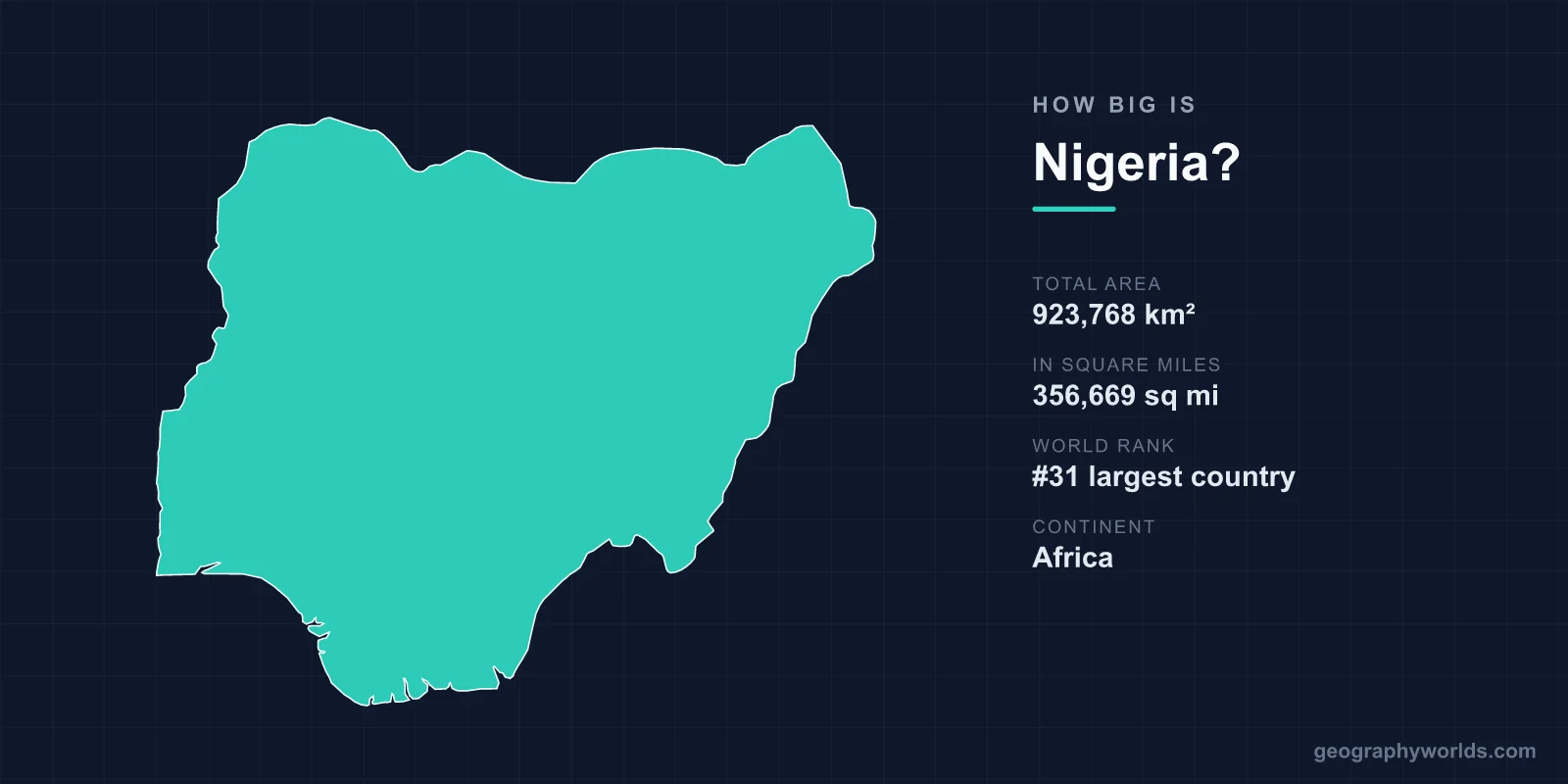
Nigeria covers a total area of 923,768 km² (356,669 sq mi), making it the 31st largest country in the world and the 14th largest in Africa. That makes it roughly twice the size of the U.S. state of California, and it occupies about 0.62% of the Earth's total land area of around 149 million km².
Nigeria's Size in Numbers
Nigeria's landmass is best understood through a few key figures. While it ranks 31st globally by area, it punches well above its size in human terms: it is the most populous country in Africa and the sixth or seventh most populous in the world. That combination of moderate area and enormous population gives Nigeria one of the higher population densities among large African nations.
- Total area: 923,768 km² (356,669 sq mi)
- Land area: roughly 910,768 km², with about 13,000 km² of inland water
- World rank by area: 31st
- Continent: Africa (West Africa, on the Gulf of Guinea)
- Capital: Abuja
- Coastline: 853 km along the Atlantic
To translate that into everyday terms: if you drove across Nigeria at highway speeds without stopping, it would take the better part of a day to cross it in any direction. The country is large enough to contain several distinct climate zones at once.
How Far Does Nigeria Stretch?
Nigeria measures approximately 1,050 km from north to south and about 1,150 km from east to west, giving it a compact, roughly rectangular shape rather than the elongated form of countries like Chile or Italy. This relatively balanced footprint means no part of the country is extremely remote from the geographic center.
Despite spanning over a thousand kilometres in each direction, Nigeria's terrain shifts dramatically across that distance. The south opens onto 853 km of Atlantic coastline along the Gulf of Guinea, where mangrove swamps and the sprawling Niger Delta dominate. Moving inland and northward, the landscape rises through tropical forest into open savanna grassland, and finally into the semi-arid plains of the Sahel near the borders with Niger and Chad. The highest point, Chappal Waddi, reaches 2,419 m (7,936 ft) in the eastern highlands near the Cameroon border.
How Nigeria Compares to Other Countries
Size comparisons make Nigeria's scale easier to picture:
- vs. California: about twice as large (California is roughly 423,000 km²).
- vs. France: Nigeria (923,768 km²) is about 1.4 times the size of mainland France (640,679 km²).
- vs. Japan: nearly two and a half times larger than Japan (377,975 km²).
- vs. Texas: roughly one-third larger than the U.S. state of Texas.
- vs. the United Kingdom: almost four times the area of the UK.
Within Africa, Nigeria is smaller than giants like Algeria, the Democratic Republic of the Congo, Sudan, and Libya, but it dwarfs neighbours such as Ghana and Benin. Its modest size relative to those continental heavyweights is one reason its population density feels so striking. For more detail on the country itself, see our nigeria country guide.
The Geography Packed Into That Area
What makes Nigeria's 923,768 km² so remarkable is the ecological variety squeezed into it. Within a single country you can travel from rainforest receiving over 3,000 mm of rain a year in the Niger Delta to dry Sahel plains in the far north, all within roughly a thousand kilometres. The country experiences two main seasons: a wet season from April to October and a dry season from November to March.
Key physical features include the Niger River, West Africa's longest at about 4,180 km, and its vast delta, one of the largest river deltas in the world. The cool Jos Plateau rises to around 1,200 m in the center, offering a temperate refuge in the middle of the tropics. Other landmarks include Zuma Rock, a 725 m monolith near Abuja known as the "Gateway to Abuja," and the protected rainforests of Cross River National Park in the southeast.
Why Nigeria's Size Matters
Nigeria's territory may rank only 31st globally, but the land supports an extraordinary human and cultural footprint. More than 250 distinct ethnic groups live within its borders, and the country's population, well over 200 million, makes it Africa's demographic heavyweight. The combination of a strategic coastline, abundant oil reserves in the delta, and rich agricultural land across the savanna belt has made Nigeria one of the continent's largest economies, all built on a landmass about the size of two Californias.
Frequently Asked Questions
Is Nigeria bigger than France?
Yes. Nigeria's 923,768 km² is roughly 1.4 times the size of mainland France, which covers about 640,679 km².
What U.S. state is Nigeria most similar to in size?
Nigeria is about twice the size of California and roughly one-third larger than Texas, so it falls comfortably between the two in terms of land area.
Where does Nigeria rank in Africa by size?
Nigeria is the 14th largest country in Africa by area. It is far smaller than Algeria or the Democratic Republic of the Congo, but much larger than coastal neighbours like Ghana and Benin.
How long is Nigeria's coastline?
Nigeria has 853 km of coastline along the Gulf of Guinea in the Atlantic Ocean, fronted largely by the mangroves and waterways of the Niger Delta.
