
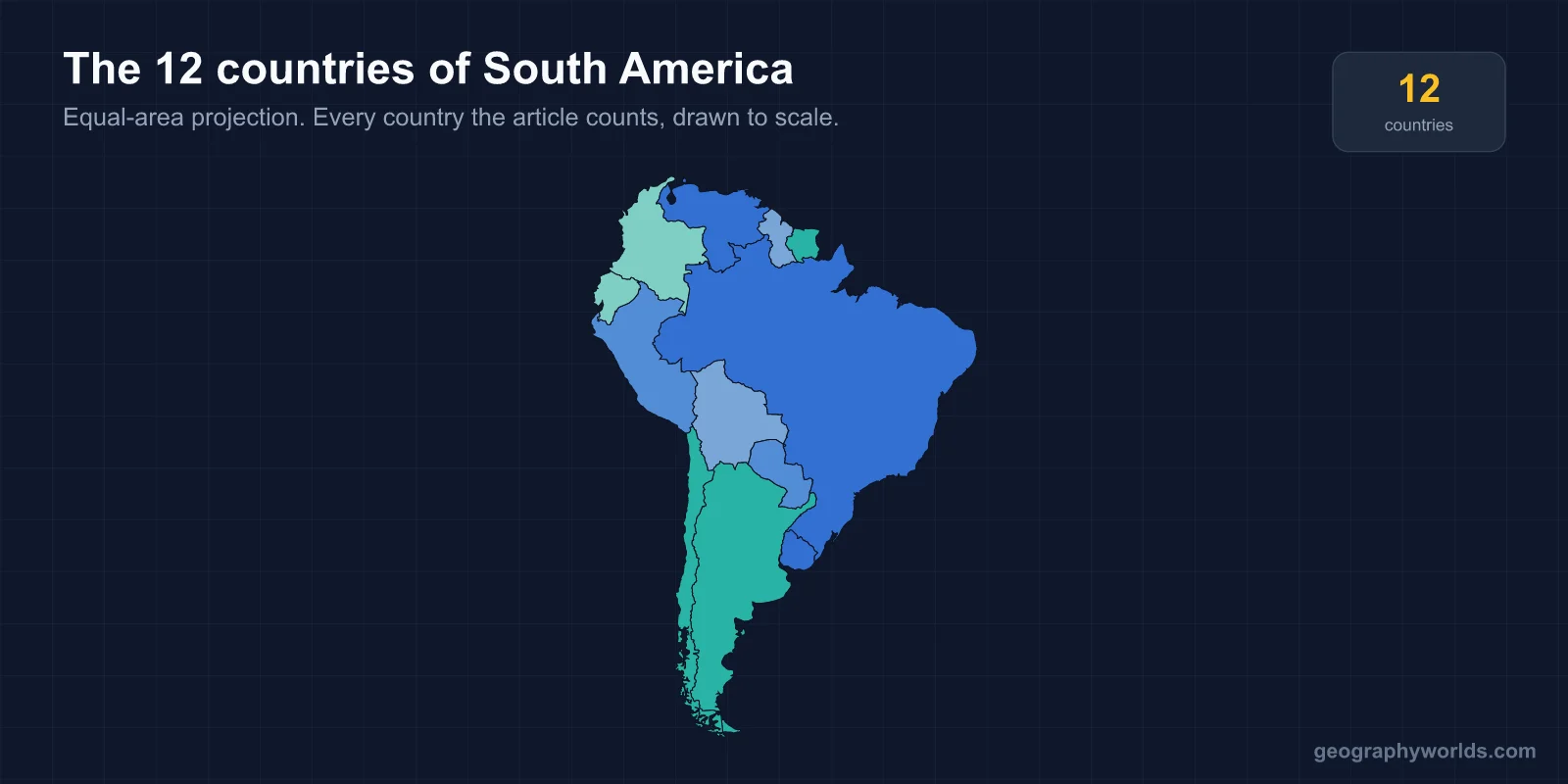
South America contains 12 sovereign countries: Brazil, Argentina, Peru, Colombia, Bolivia, Venezuela, Chile, Paraguay, Ecuador, Guyana, Uruguay and Suriname. A thirteenth political entity on the mainland, French Guiana, is not a country but an overseas department of France and therefore part of the European Union.
All Twelve Countries, Largest to Smallest
Ordering by land area shows immediately how unevenly the continent is divided:
- Brazil — about 8.5 million km², capital Brasília
- Argentina — about 2.78 million km², capital Buenos Aires
- Peru — about 1.29 million km², capital Lima
- Colombia — about 1.14 million km², capital Bogotá
- Bolivia — about 1.10 million km², seat of government La Paz, constitutional capital Sucre
- Venezuela — about 916,000 km², capital Caracas
- Chile — about 756,000 km², capital Santiago
- Paraguay — about 406,000 km², capital Asunción
- Ecuador — about 284,000 km², capital Quito
- Guyana — about 215,000 km², capital Georgetown
- Uruguay — about 176,000 km², capital Montevideo
- Suriname — about 164,000 km², capital Paramaribo
The largest is more than fifty times the size of the smallest. By population the ordering shifts: Brazil again leads with over 210 million, but Colombia (roughly 52 million) overtakes Argentina (roughly 46 million), and Suriname, with well under a million people, is the least populous country on the continent by a wide margin.
Language reinforces the same split. Nine of the twelve have Spanish as an official language, Brazil has Portuguese, Guyana has English and Suriname has Dutch. Several also give official or co-official status to indigenous languages: Bolivia recognises Quechua, Aymara, Guaraní and dozens of others in its 2009 constitution, Peru recognises Quechua and Aymara in the areas where they predominate, and Paraguay is close to genuinely bilingual, with Guaraní spoken by a majority of the population alongside Spanish.
The Territories That Are Not Countries
The count of twelve is stable across the United Nations, the CIA World Factbook and standard atlases, but several nearby entities cause confusion.
French Guiana is the important one. It sits on the mainland between Suriname and Brazil, has a population of roughly 300,000, and is an integral overseas department and region of France — not a colony, not a dependency, but France itself. Its residents are French and EU citizens, its currency is the euro, and it hosts the Guiana Space Centre at Kourou, the European Space Agency's principal launch site. Its equatorial position, close to 5°N, gives rockets a useful boost from the Earth's rotation, which is precisely why it was chosen.
The Falkland Islands (Islas Malvinas) and South Georgia and the South Sandwich Islands are British Overseas Territories in the South Atlantic; the Falklands are claimed by Argentina, and the sovereignty dispute led to the 1982 war. Trinidad and Tobago lies just off the Venezuelan coast and is geologically part of the South American continental shelf, but it is conventionally counted as part of the Caribbean and North America. Panama is a Central American country despite bordering Colombia. Aruba, Curaçao and Bonaire sit on the South American shelf but are constituent countries or special municipalities of the Kingdom of the Netherlands.
Brazil's Outsized Share
Brazil occupies roughly 47 per cent of South America's land area and holds about half its population. It borders every South American country except Chile and Ecuador — ten neighbours in total, more than any other country in the Western Hemisphere.
That dominance shapes the continent in concrete ways. Brazil is the only Portuguese-speaking country in South America, a consequence of the 1494 Treaty of Tordesillas, which divided newly encountered lands between Spain and Portugal along a meridian roughly 370 leagues west of the Cape Verde islands. The line was drawn before the interior was mapped, and Portuguese expansion through the bandeirante expeditions pushed the effective boundary far west of the treaty meridian, producing the enormous modern Brazil.
Brazil also contains the bulk of the Amazon basin, though the river system extends into Peru, Colombia, Ecuador, Bolivia, Venezuela, Guyana and Suriname. Detailed coverage of the country is in our Brazil country guide.
The Andean Spine and the Atlantic Lowlands
The continent's political map follows its physical one closely. The Andes run roughly 7,000 kilometres down the western edge, the longest continental mountain range on Earth, and the Pacific-facing states — Colombia, Ecuador, Peru, Bolivia and Chile — are all defined by them. Aconcagua in Argentina, at about 6,961 metres, is the highest summit outside Asia.
East of the Andes lies a very different world: the Amazon basin, the Cerrado savanna, the Gran Chaco, and the Pampas grasslands of Argentina and Uruguay. Chile is the extreme case of geographic determinism, stretching over 4,300 kilometres north to south while averaging under 180 kilometres wide, squeezed between the Andes and the Pacific and containing the Atacama, the driest non-polar desert on the planet.
Two countries are landlocked: Bolivia and Paraguay. Bolivia's position is politically charged, since it lost its Pacific coastline to Chile in the War of the Pacific (1879–1884) and has pressed the claim ever since, maintaining a navy on Lake Titicaca and marking an annual Day of the Sea.
Bolivia contributes a separate counting oddity of its own: it is one of the few countries in the world with two capitals. Sucre is the constitutional capital and seat of the judiciary, while La Paz houses the executive and legislature and functions as the working capital. At roughly 3,600 metres, La Paz is the highest seat of national government on Earth.
Guyana, Suriname and the Continent's Odd Corner
The three Guianas — Guyana, Suriname and French Guiana — form a distinct cultural region that has little in common with the rest of the continent. They were colonised by Britain, the Netherlands and France rather than Spain or Portugal, and their official languages are English, Dutch and French respectively. Guyana is the only South American country with English as its official language, and Suriname the only one with Dutch.
Both look culturally toward the Caribbean rather than Latin America. Guyana is a member of CARICOM and its population includes large Indo-Guyanese and Afro-Guyanese communities descended from indentured labourers and enslaved people brought to work the sugar plantations. Suriname is similarly plural, with Hindustani, Javanese, Creole and Maroon populations.
Guyana has recently become the continent's most dramatic economic story. Major offshore oil discoveries in the Stabroek Block from 2015 onward transformed a small agricultural economy into one of the fastest-growing in the world by GDP per capita. That wealth has also intensified Venezuela's long-standing claim to the Essequibo region, which comprises roughly two-thirds of Guyana's territory — a dispute dating to an 1899 arbitral award and now before the International Court of Justice.
The continent is also unusually urbanised for its income level. Around four in five South Americans live in cities, a share comparable to Western Europe, and the population is heavily concentrated on the coastal rim — the Atlantic seaboard of Brazil, Uruguay and Argentina, and the Pacific strip of Peru and Chile — while the vast interior of the Amazon basin remains among the most sparsely peopled inhabited regions on the planet.
Twelve Against Africa's Fifty-Four
South America's twelve countries are worth setting against other continents. Africa has 54 sovereign states in about 30.3 million km²; South America has 12 in about 17.8 million km². Africa therefore packs more than four times as many countries into less than twice the area. Europe fits roughly 44 to 50 states, depending on the counting rules, into a landmass smaller than Brazil alone.
The explanation is largely colonial. Africa's borders were substantially fixed at the 1884–85 Berlin Conference, which partitioned the continent among many competing European powers and left a dense mosaic of territories that became independent states. South America was divided between just two Iberian powers, and the Spanish portion fragmented along the lines of existing colonial administrative units — the viceroyalties and audiencias — which were large. Simón Bolívar's ambition of a single Gran Colombia collapsed by 1831 into Venezuela, Ecuador and New Granada, but even that fragmentation produced sizeable countries.
You can compare the counts directly through our pages on how many countries are in Africa and how many countries are in Europe.
Counting Rules That Trip People Up
Most disagreements about the number come down to four recurring mistakes: counting French Guiana as a country when it is part of France; counting the Falkland Islands as a separate state rather than a British Overseas Territory; including Trinidad and Tobago or the Dutch Caribbean islands on geological rather than conventional grounds; or including Panama, which is Central American.
A final subtlety: Chile, Ecuador and Colombia all hold Pacific island territory well offshore — Easter Island, the Galápagos and the San Andrés archipelago respectively — and Ecuador's Galápagos sit about 900 kilometres from the mainland. These are integral parts of their countries rather than separate entities, so they change the shape of the map without changing the count.
Apply the standard rule — sovereign states recognised by the United Nations, on the South American mainland — and the answer is unambiguously twelve. All twelve are UN member states, and all twelve are members of the Organization of American States. If you would like to test whether you can name and place all of them, try our geography games.
