
India is the most populous country in the world, with over 1.4 billion people — about one in every six humans alive. It is the seventh-largest country by area, has 28 states and 8 union territories, 22 official languages, and every major religion practised somewhere within it. It also has the wettest place on Earth, part of the world's highest mountain range, and a desert, all in the same country.

How Many People Is 1.4 Billion?
If every person in India stood in a line one metre apart, the line would go around the equator about 35 times.
India passed China as the most populous country in 2023. Around half of Indians are under 30, which makes it one of the youngest large countries in the world at a time when most rich countries are getting older.
Uttar Pradesh, one Indian state, has around 240 million people. If it were a country it would be the fifth largest in the world, ahead of Pakistan, Brazil and Nigeria.
Twenty-Two Official Languages
India's constitution recognises 22 scheduled languages, and the 2011 census recorded 121 languages spoken by more than 10,000 people each, plus hundreds more.
Hindi is the most spoken, but it is a first language for under half the country. India has no national language — the courts have said so explicitly. Hindi and English are the two official languages of the central government, and each state picks its own.
Indian banknotes carry the value in 17 languages: Hindi and English on the front, and fifteen more on the back. Languages in the north are mostly Indo-European, related distantly to English and Latin; languages in the south, including Tamil, Telugu, Kannada and Malayalam, belong to a completely different family called Dravidian.
Every Kind of Landscape
The Himalayas run along the northern border and contain the highest mountains on Earth. India shares Kangchenjunga, the world's third-highest peak at 8,586 metres, with Nepal.
Below them lie the vast flat plains of the Ganges and Indus, some of the most fertile and most crowded farmland anywhere. To the west is the Thar Desert; to the south the Deccan Plateau; and along both coasts are the Western and Eastern Ghats.
Mawsynram and Cherrapunji in Meghalaya are among the wettest inhabited places on Earth, with around 11,000 millimetres of rain a year. Villagers there grow living bridges by training the roots of rubber fig trees across streams over 15 to 30 years, because wooden bridges rot in the damp. Some of the bridges are over 500 years old and get stronger as they age.
The Monsoon
Most of India's rain falls in about four months, from June to September, when the summer monsoon arrives. The whole country waits for it.
It works because land heats up faster than sea. Warm air rises over the Indian subcontinent in summer, and moist air rushes in from the Indian Ocean to replace it, dumping rain as it rises over the land and the mountains.
The India Meteorological Department tracks its arrival day by day, usually reaching Kerala around 1 June and covering the country by mid-July. A weak monsoon means poor harvests for hundreds of millions of farmers, so the forecast is front-page news.
Numbers Came From Here
The digits you use every day — 0, 1, 2, 3 and the rest — were developed in India. They travelled to the Arab world and then to Europe, which is why they are called Arabic numerals even though they are Indian.
More importantly, Indian mathematicians worked out the idea of zero as a number in its own right, not just a gap. The oldest known written zero as a placeholder is in the Bakhshali manuscript, and the mathematician Brahmagupta set out rules for arithmetic with zero and negative numbers in 628 CE.
Without zero there is no place-value system, and without that there is no easy arithmetic, no algebra as we know it and no computing. It is probably the single most useful thing any civilisation has ever exported.
Try This: Count Like an Indian
India uses a different way of grouping large numbers. Instead of thousands, millions and billions, it uses thousands, lakhs and crores.
One lakh is 100,000 and is written 1,00,000 — the commas go in different places. One crore is 10 million, written 1,00,00,000. Ten crore is 100 million, and 100 crore is one billion.
Try converting: India's population of about 1.42 billion is 142 crore. A price of 50 lakh rupees is five million rupees. Once you see the pattern, Indian newspapers become much easier to read — and it is a genuinely different mental model of numbers, not just different words.
Festivals
India probably has more festivals than any other country, because every religion and every region has its own.
Diwali, the festival of lights, is the biggest. Houses are lit with oil lamps called diyas, families exchange sweets, and the night sky fills with fireworks. Holi in spring involves throwing coloured powder at everyone within reach. Eid, Christmas, Guru Nanak Jayanti, Onam, Pongal, Durga Puja and Ganesh Chaturthi are all major occasions in different parts of the country.
The Kumbh Mela is the largest gathering of humans anywhere on Earth. Held at rotating sites on a twelve-year cycle, it has drawn crowds estimated in the hundreds of millions over several weeks — visible from space, and requiring a temporary city with its own roads, hospitals and police force.
Food
There is no such thing as Indian food as a single cuisine. The north eats wheat as roti and naan; the south eats rice, dosa and idli; the coasts eat fish; the deserts eat lentils and millet.
Spices are the common thread, and India grows and consumes more of them than any country. Black pepper was so valuable in Roman times that it was used to pay ransoms, and the search for a sea route to the Indian spice trade is what sent European ships around the world in the first place.
India also has the highest proportion of vegetarians of any country, somewhere between 20% and 40% depending on the survey. Chilli peppers, now central to Indian cooking, arrived only in the 1500s from the Americas — before that the heat came from pepper and ginger.
Cricket, Films and Chess
Cricket is not just popular in India — it is closer to a national obsession. The Indian Premier League is one of the richest sports competitions in the world, and matches against Pakistan draw television audiences in the hundreds of millions.
India also makes more films than any other country, somewhere between 1,500 and 2,000 a year in more than 20 languages. Hindi cinema, nicknamed Bollywood, is only part of it: Tamil, Telugu, Malayalam, Kannada, Bengali and Marathi film industries are all substantial in their own right.
Chess was invented in India, as a game called chaturanga, around the sixth century. It travelled to Persia, then to the Arab world, then to Europe, changing the pieces along the way — the Persian word shah mat, meaning the king is helpless, is where checkmate comes from. Snakes and ladders is Indian too, and started as a game about morality.
Wildlife
India is one of seventeen countries classed as megadiverse. It has around 8% of all recorded species on about 2.4% of the world's land.
It is the only country with both lions and tigers in the wild. Asiatic lions survive only in the Gir Forest in Gujarat, where the population has recovered from around 20 in the early 1900s to over 600. India holds roughly 70% of the world's wild tigers.
It also has one-horned rhinos in Assam, snow leopards in the Himalayas, Asian elephants, sloth bears and the Ganges river dolphin, which is functionally blind and navigates entirely by sound in muddy water.
The Country That Was Once an Island
About 140 million years ago, the land that is now India was not attached to Asia at all. It was part of a southern supercontinent called Gondwana, along with Africa, South America, Antarctica and Australia.
It broke away and drifted north across the ocean at up to 15 centimetres a year, which is remarkably fast for a continent. Around 50 million years ago it crashed into Asia.
It has not stopped. India is still pushing north by about 5 centimetres a year, and the crumple zone where the two landmasses meet is the Himalayas, which are still rising. That collision is why India is a distinct triangular shape jutting into the Indian Ocean, why it has the highest mountains in the world along its northern edge, and why earthquakes are common in the north.
Old and New at Once
The Indus Valley Civilisation, in what is now Pakistan and north-west India, had planned cities with grid streets, brick sewers and standardised weights around 2600 BCE — at the same time as the Egyptian pyramids. Its writing has never been deciphered.
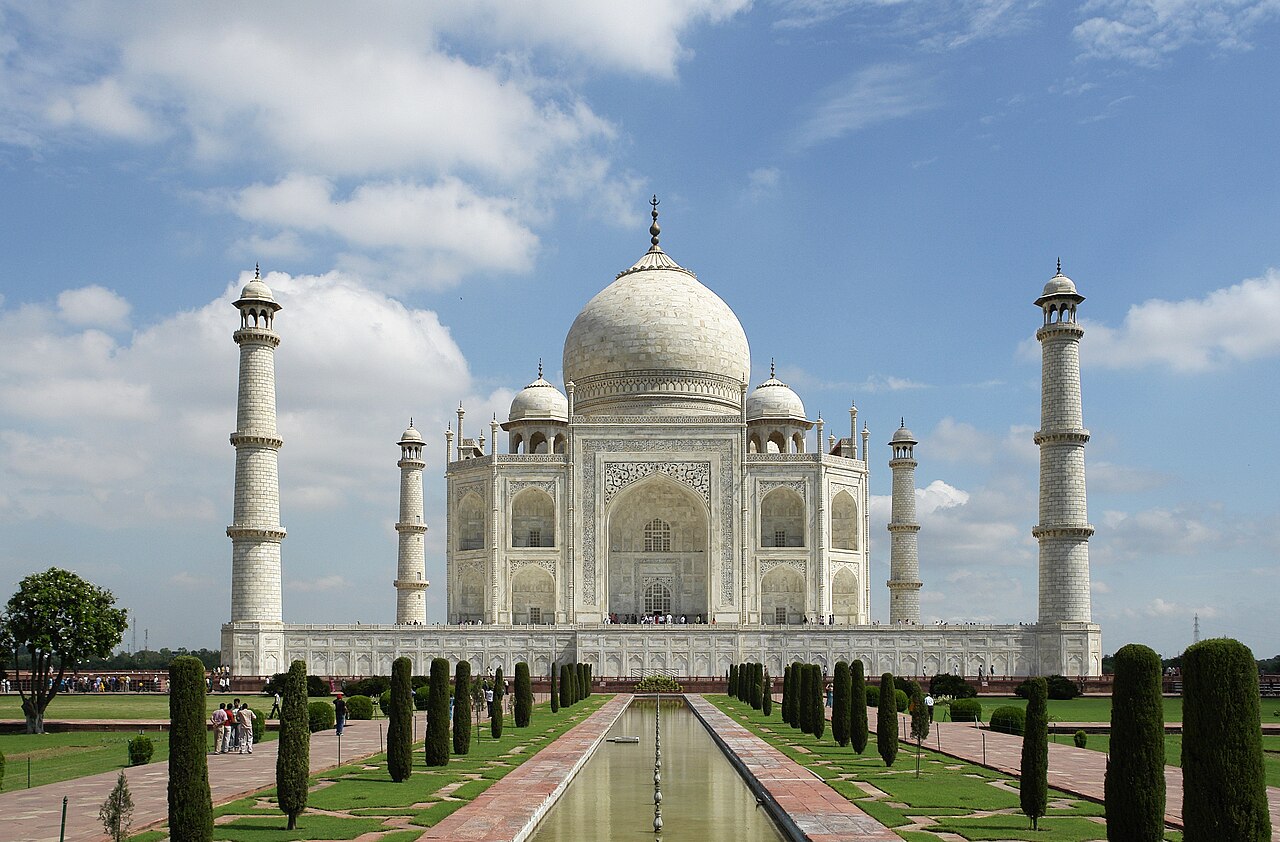
The Taj Mahal at Agra was built between 1632 and 1653 by the emperor Shah Jahan as a tomb for his wife Mumtaz Mahal. It is made of white marble that appears to change colour through the day, and it took around 20,000 workers and 1,000 elephants.
Modern India runs one of the world's largest railway networks, carrying over 20 million passengers a day, and became the fourth country to soft-land a spacecraft on the Moon in 2023 — and the first to land near its south pole. To keep exploring, read about religion in India and where Hindi is spoken.