
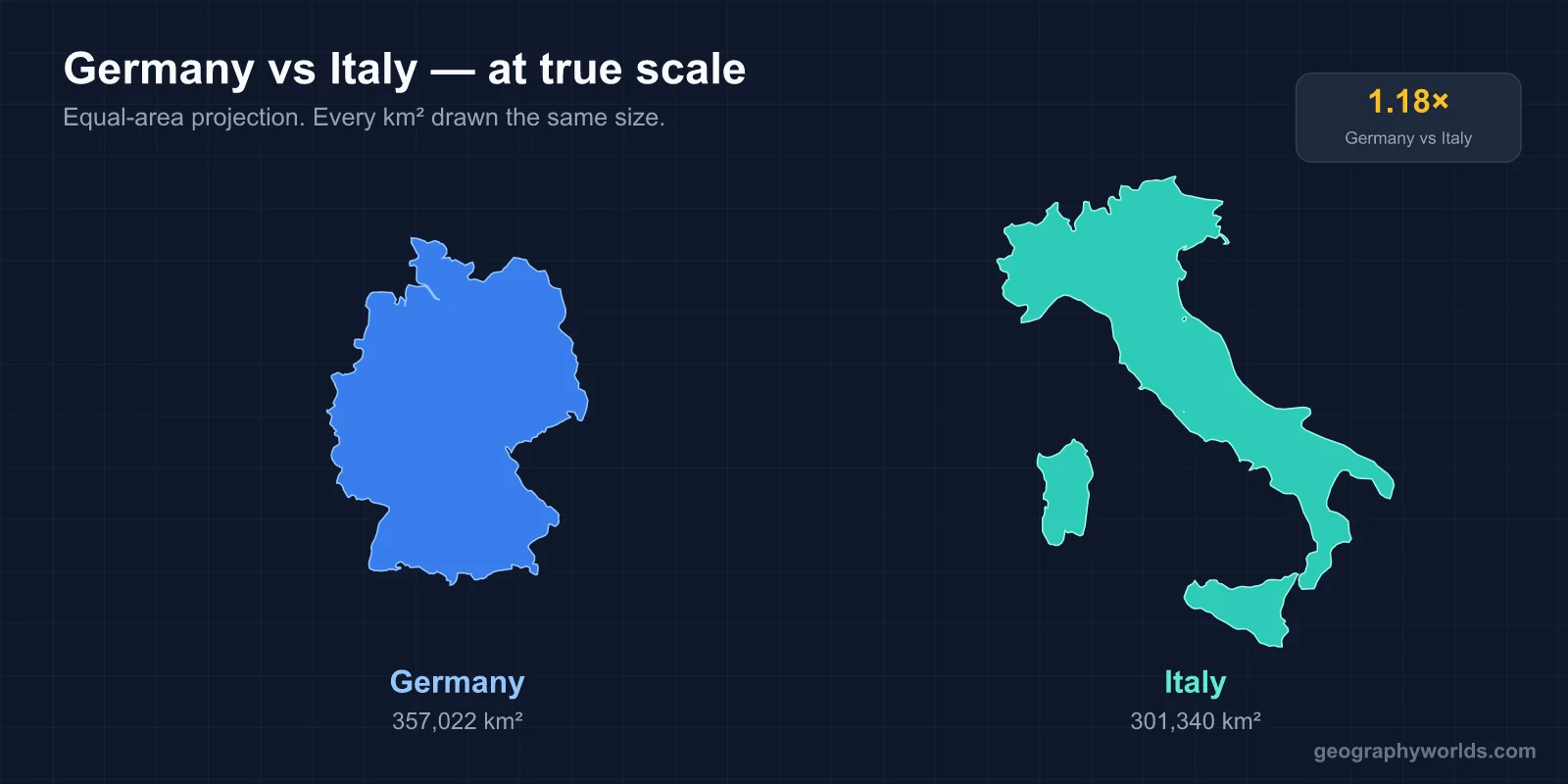
Yes. Germany is larger than Italy. Germany covers 357,022 km², while Italy covers 301,340 km². Germany is about 1.18 times the size of Italy — larger by 55,682 km², which is roughly the size of Slovakia or Croatia. Both countries are central to European Union politics, economy, and culture.
The Short Answer
Germany and Italy are two of the most influential European countries by economy, population, and cultural reach. Germany is bigger by area, population, and GDP. Italy is more compact, has a longer coastline (due to its peninsular shape), and a more diverse historical legacy. Both are founding members of the European Union (along with France, Netherlands, Belgium, and Luxembourg).
The size gap is modest — about 18% — but consistent across most measurements. Germany's flat northern plains contrast with Italy's mountainous, peninsular geography, giving the two countries very different "feels" despite their similar sizes.

The Real Numbers
- Germany total area: 357,022 km² (137,847 sq mi)
- Italy total area: 301,340 km² (116,348 sq mi)
- Difference: 55,682 km² — about the size of Slovakia or Croatia
- Ratio: Germany is about 1.18× the size of Italy
Globally, Germany ranks 63rd by area, between Vietnam and Republic of Congo. Italy ranks 71st, between New Zealand and Burkina Faso. Both are mid-sized European countries — much smaller than France or Spain, but larger than the UK, Romania, or Poland.
Population
Germany has substantially more people than Italy:
- Germany population: ~83,800,000
- Italy population: ~59,200,000
- Germany density: ~235 people per km²
- Italy density: ~196 people per km²
Germany has about 41% more people than Italy. Germany is the most populous country in the EU (since the UK left). Italy is the third most populous in the EU after Germany and France. Both countries are densely populated by EU standards (more than 2× the EU average density).
Geography
Germany is divided into:
- North German Plain: Flat, fertile lowlands in the north (Hamburg, Bremen)
- Central uplands: Forested hills and low mountains (Harz, Thüringer Wald)
- Southern alpine foothills: Approaching the Alps (Bavaria)
- Bavarian Alps: Including the Zugspitze (2,962 m), Germany's highest peak
- Major rivers: Rhine (flowing north to the North Sea), Danube (flowing east toward the Black Sea), Elbe, Main
- Coasts: Short North Sea coast (Hamburg/Bremen) and Baltic Sea coast (Schleswig-Holstein)
Italy is a long peninsula:
- The Alps: Forming Italy's northern border; peaks include Mont Blanc (4,808 m, shared with France) and the Matterhorn (4,478 m, shared with Switzerland)
- Po Valley: The flat agricultural heartland in the north
- Apennine Mountains: Running the length of the peninsula like a spine
- Coasts: About 7,600 km of Mediterranean coast — much more than Germany's 2,389 km combined
- Islands: Sicily, Sardinia, and many smaller islands
Climate
Germany has a temperate seasonal climate — oceanic in the northwest (mild, wet), continental in the east (colder winters, warmer summers). Winters bring snow to most of the country; summers are warm but not hot. Average temperatures range from -1°C in winter to 17°C in summer.
Italy has a Mediterranean climate dominant in most of the country, but with notable regional variations. Northern Italy (Po Valley, Milan, Turin) has continental influences with hotter summers and colder winters than the south. Central and southern Italy (Rome, Naples) are warm year-round with hot dry summers. The Alps in the far north have alpine climate with heavy snow.
Economy
Germany has the largest economy in Europe:
- Germany GDP: ~$4.5 trillion
- Italy GDP: ~$2.3 trillion
- Germany per capita GDP: ~$54,000
- Italy per capita GDP: ~$39,000
Germany's economy is about 2× the size of Italy's in absolute terms. Per capita, Germany is about 38% richer on average. Germany is a manufacturing powerhouse — Volkswagen, BMW, Mercedes, Siemens, SAP, BASF are German companies. Italy is also a major industrial country — Fiat, Ferrari, Lamborghini, Ducati, Pirelli are Italian. Italy is the world's largest producer of wine and a leading producer of olive oil.
History
Both countries unified relatively recently. Italy was unified in 1861 under King Victor Emmanuel II, completing the Risorgimento movement. Germany was unified in 1871 under Chancellor Otto von Bismarck and Emperor Wilhelm I. Before unification, both regions were divided into many small states, principalities, and city-states. Italy had Venice, Florence, the Papal States, the Kingdom of Naples, etc. Germany had Prussia, Bavaria, Saxony, Hanover, and dozens of others.
Both countries became fascist dictatorships in the 1920s-1930s (Mussolini's Italy and Hitler's Germany), allied during World War II, and were defeated in 1945. Both rebuilt rapidly in the post-war era — Germany became the powerhouse of the Wirtschaftswunder (economic miracle); Italy became one of the top economies in Europe by the 1960s. Today both are stable parliamentary democracies and central EU members.
Cultural Influence
Italy's cultural influence is enormous and ancient. Roman Empire, the Renaissance (Florence, Rome, Venice), the Vatican (center of Roman Catholicism), opera (born in Florence in 1597), cuisine (pasta, pizza, gelato), fashion (Milan), automobiles (Ferrari, Lamborghini), art (Michelangelo, Leonardo, Caravaggio). Italy has 58 UNESCO World Heritage Sites — the most of any country in the world.
Germany's cultural influence is also enormous. Classical music (Bach, Beethoven, Brahms, Wagner), philosophy (Kant, Hegel, Marx, Nietzsche), literature (Goethe, Schiller, Mann, Kafka), science (Einstein, Planck, Heisenberg, Hawking — wait, Hawking was British, my mistake), engineering, beer culture (Oktoberfest), automobiles (Volkswagen, BMW, Mercedes, Porsche). Germany has 52 UNESCO World Heritage Sites — second only to Italy.
Food and Cuisine
Italian cuisine is one of the most influential in the world. Pasta, pizza, risotto, gelato, espresso, prosciutto, parmesan — these are global staples. Italy is the largest wine producer in the world (about 51 million hectoliters annually), the largest olive oil producer in Europe, and the source of regional cuisines that vary dramatically from Sicilian (with North African influences) to Northern Italian (with Austrian and French influences). Italian dining culture emphasizes long meals with multiple courses.
German cuisine is also significant but less internationally famous. Beer is the most globally recognized German contribution — Bavarian beer purity laws (Reinheitsgebot) date to 1516, and Oktoberfest is the world's largest beer festival (about 6 million attendees annually). German cuisine includes sausages (wurst), pretzels, schnitzel, sauerbraten, sauerkraut, and the bread tradition is among the world's most diverse with over 3,000 varieties. Wine production is significant in the Rhine and Mosel valleys.
Tourism
Italy is one of the world's top tourist destinations — about 65 million international visitors annually (4th most-visited country after France, Spain, US). Major attractions: Rome (Colosseum, Vatican), Venice (canals, gondolas), Florence (Uffizi, Duomo), Tuscany, Amalfi Coast, Sicily, the Alps and Dolomites.
Germany receives about 39 million international tourists annually. Major attractions: Berlin (Brandenburg Gate, Berlin Wall remains, museum island), Munich (Oktoberfest, Marienplatz), Neuschwanstein Castle, the Black Forest, the Rhine Valley, Heidelberg, Hamburg, Cologne Cathedral.
Key Facts
- Germany is about 1.18× the size of Italy.
- Germany has 41% more people than Italy.
- Germany's economy is 2× larger than Italy's.
- Italy has the longest coastline of the two (7,600 km vs 2,389 km).
- Italy has the most UNESCO World Heritage Sites of any country (58); Germany is 4th (52).
Fun Facts
- Italy contains two independent countries inside its borders — Vatican City and San Marino.
- Germany has 16 states (Bundesländer); Italy has 20 regions.
- The Rhine River is shared between Germany, Switzerland, France, and the Netherlands.
- The Po River, Italy's longest, is entirely within Italy.
- Both countries have famous lake regions — Bavarian lakes in Germany, the Italian Lakes (Como, Garda, Maggiore) in Italy.
- Italy's elongated peninsular shape gives it the highest ratio of coastline-to-area of any major European country.
- Germany's Black Forest covers an area larger than the entire country of Luxembourg.
- Both countries are major football (soccer) powers — Germany has 4 FIFA World Cup titles, Italy has 4 as well, making them tied for the most among European nations.
The Bottom Line
Germany is bigger than Italy by area (18% larger), population (41% more), and economy (2× larger). But Italy has more coastline, more UNESCO sites, and arguably greater historical cultural influence due to its ancient roots. Both are pillars of European civilization and central to the European Union.
The two countries occupy different niches: Germany as Europe's economic engine and largest population, Italy as Europe's cultural heart and Mediterranean hub. The size difference is one of the smaller gaps between major European powers — they're peers in the European hierarchy. Both have shaped global culture, science, and politics in profound ways, and they remain among the most influential countries in the modern world.