
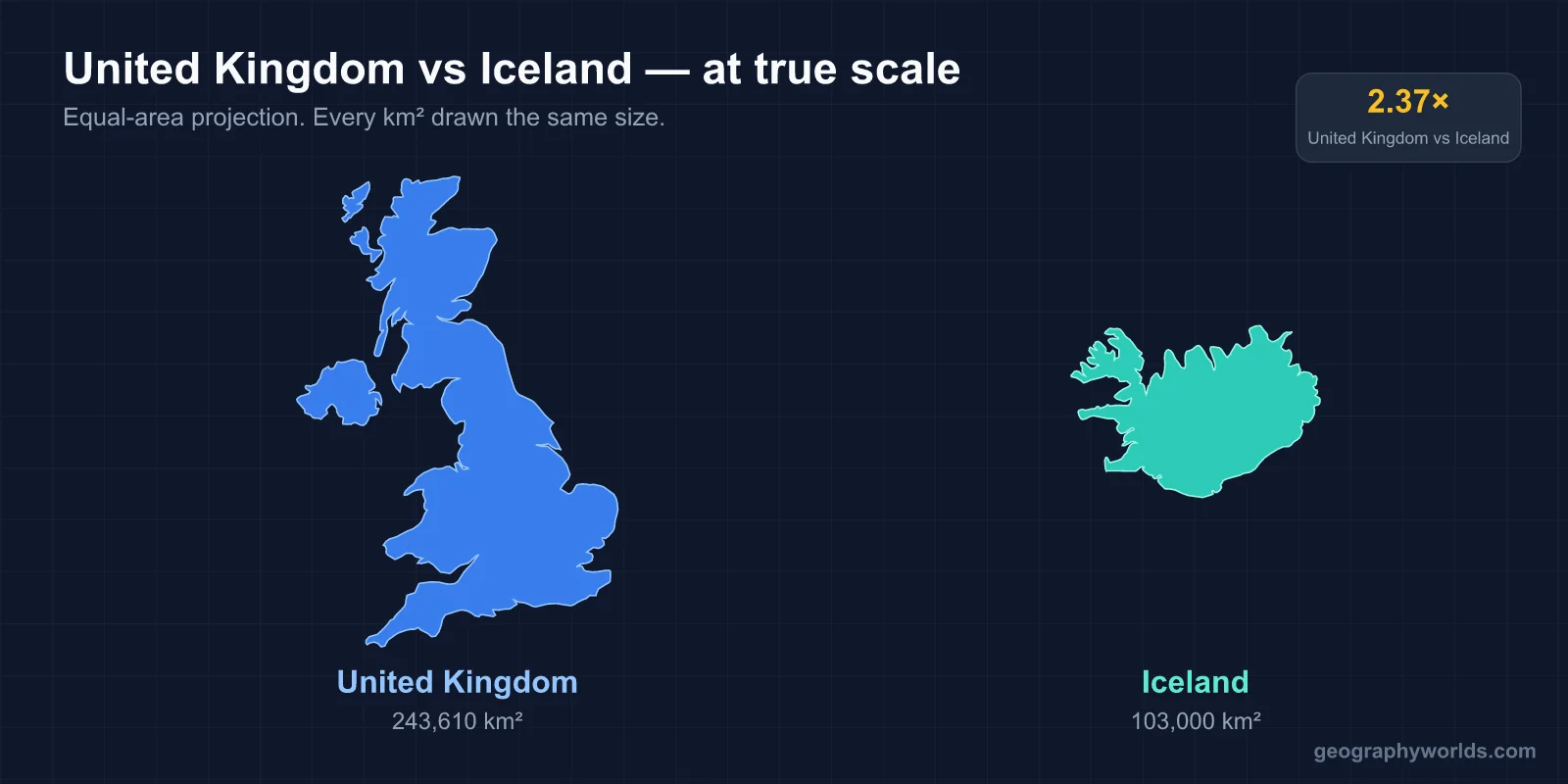
Iceland and the UK are both island nations in the North Atlantic — Iceland a sparsely-populated volcanic island near the Arctic, the UK a densely-populated archipelago off the European mainland. Both are surrounded by ocean, but their geographies and human footprints differ dramatically. So which is bigger?
The Short Answer
No, the UK is much bigger than Iceland. The UK covers 243,610 km². Iceland covers 103,000 km². The UK is approximately 2.36 times larger than Iceland.
Side-by-Side Numbers
- Iceland area: 103,000 km² (39,769 sq mi)
- UK area: 243,610 km² (94,058 sq mi)
- Difference: UK is ~141,000 km² larger
- Ratio: UK is ~2.36× the size of Iceland
- Iceland population: ~395,000
- UK population: ~67 million
Iceland
Iceland is a North Atlantic island nation, located just south of the Arctic Circle between Greenland and Norway. The country sits atop the Mid-Atlantic Ridge — the boundary between the North American and Eurasian tectonic plates — which makes it one of the most geologically active places on Earth. Iceland has approximately 130 volcanoes, including over 30 active volcanic systems, geysers, hot springs, and vast lava fields. About 11% of the island is covered by glaciers, including Vatnajökull — Europe's largest glacier outside of Russia.
Iceland's capital, Reykjavík, is home to about 140,000 people in the city and 230,000 in the metro area — more than half of the country's population. Most of the interior is uninhabited highland. The country was settled by Norse Vikings in the late 9th century, with significant Celtic influence from enslaved peoples brought from Ireland and Scotland. It became fully independent from Denmark in 1944.
The United Kingdom
The United Kingdom of Great Britain and Northern Ireland comprises four constituent countries: England (the largest and most populous), Scotland, Wales, and Northern Ireland. The "Great Britain" island contains England, Scotland, and Wales; Northern Ireland sits on the island of Ireland, sharing it with the Republic of Ireland. The UK also includes numerous smaller islands.
The UK is highly urbanized. London, with about 9 million people in the metro area, is the dominant city; Greater London plus the surrounding South East holds nearly a third of the country's population. Other major cities include Birmingham, Manchester, Glasgow, Leeds, Liverpool, Edinburgh, and Cardiff. The country is generally flat to gently rolling, with the Scottish Highlands (Ben Nevis, 1,345 m), the Pennines, the Cambrian Mountains, and the Lake District as notable exceptions.
Population Density
The population gap is staggering. The UK has 67 million people; Iceland has 395,000. The UK has roughly 170 times more people than Iceland in only 2.4 times the area. The UK's population density is about 281 per km²; Iceland's is about 4 per km² — one of the lowest in Europe. Iceland is one of the most sparsely populated countries in Europe; the UK is one of the most densely populated.
Climate
Iceland's climate is surprisingly mild for its latitude, thanks to the Gulf Stream. Summer temperatures in Reykjavík average 10–13°C, and winters average just below freezing. The climate is wet, windy, and changeable. The interior highlands have a polar climate. Iceland gets nearly 24 hours of daylight in mid-summer and only 4 hours in mid-winter, with the famous northern lights visible from late August to April.
The UK has a temperate maritime climate moderated by the Gulf Stream. Summers are mild (typical July highs of 20–22°C), winters are cool but rarely severe. Rainfall is moderate but consistent. Snow is occasional except in the Scottish Highlands and the Pennines. Both countries owe their relatively mild winters to the Gulf Stream, which pushes warm Atlantic water northward.
Geology
Iceland and the UK have radically different geological stories. Iceland is one of the most geologically active places on Earth. The Mid-Atlantic Ridge runs directly through the island, splitting it between the North American and Eurasian plates. The country averages about one volcanic eruption every five years. Major recent eruptions include Eyjafjallajökull (2010, which famously shut down European air travel for a week), Holuhraun (2014), and Fagradalsfjall (2021–2023). The UK is geologically stable. The British Isles have not had significant volcanic activity for tens of millions of years, and earthquakes are rare and small. The UK's rocks range from 3 billion-year-old gneisses in northwest Scotland to modern sediments.
Economy
The UK has the world's 6th largest economy at roughly $3.3 trillion. Major industries include financial services (London is one of the world's leading financial centers), professional services, aerospace, pharmaceuticals, the creative industries, and education. Iceland has a much smaller economy at about $30 billion, but its GDP per capita is one of the highest in Europe at about $77,000. Major industries include fishing (still about 30% of exports), aluminum smelting (using cheap geothermal and hydroelectric power), tourism, and increasingly tech and biotech.
Energy
Iceland is a global leader in renewable energy. About 100% of its electricity comes from renewables — primarily hydroelectric (70%) and geothermal (30%). Geothermal also provides about 90% of the country's heating. The combination of cheap green energy has made Iceland an unlikely hub for energy-intensive industries like aluminum smelting, server farms, and data centers. The UK has been making rapid progress on decarbonization — coal-fired power has been almost entirely phased out, with offshore wind making up an increasing share of electricity generation. The UK aims for net-zero emissions by 2050.
Tourism
Both countries are major tourism destinations relative to their populations. Iceland's tourism boom in the 2010s saw visitor numbers explode from about 500,000 in 2010 to 2.3 million in 2018 (about 6× the country's population). Top attractions include the Blue Lagoon, the Golden Circle (Geysir, Gullfoss, Þingvellir), glaciers, waterfalls, the South Coast, and Reykjavík. The UK welcomes about 38 million international visitors annually. Top attractions include London (the British Museum, the Tower, Buckingham Palace, Westminster), Edinburgh, Stonehenge, Bath, Oxford, and the Lake District.
History
Iceland was settled by Norse Vikings starting around 870 CE. The Icelandic Alþingi — the world's oldest continuously-functioning parliament — was founded around 930 CE at Þingvellir. Iceland was under Norwegian rule from 1262 and then Danish rule from 1380 until full independence in 1944. The country's population has remained small throughout its history, but Iceland punches well above its weight culturally — the medieval Icelandic sagas are among the great works of world literature.
The UK has shaped global history more than nearly any nation its size. After Roman occupation and Anglo-Saxon and Norman conquests, England gradually consolidated into a major European power. The Acts of Union (1707 with Scotland, 1801 with Ireland) created the United Kingdom. The British Empire became the largest in history at its 1922 peak, covering nearly a quarter of the world's land and population. Most of the empire was dismantled in the 20th century. In 2020, the UK formally left the European Union ("Brexit").
Cultural Influence
The UK has had enormous global cultural influence — through the English language, literature (Shakespeare, Austen, Dickens, Tolkien, Rowling), music (the Beatles, Queen, the Rolling Stones), film and television, and the legacy of the British Empire. Iceland's cultural influence is smaller in scale but distinctive — Icelandic literature (the medieval sagas), music (Björk, Sigur Rós, Of Monsters and Men), film, and increasingly cuisine and design have gained international audiences far out of proportion to the country's small population.
Languages
English is the UK's primary language and now the world's lingua franca, spoken by about 1.5 billion people globally as a first or second language. The UK also officially recognizes Welsh (about 540,000 speakers), Scottish Gaelic (about 60,000), Scots, Irish, and Cornish, though English dominates daily life. Icelandic is spoken by virtually all 395,000 Icelanders and is one of the most linguistically conservative languages in Europe — modern Icelandic is close enough to Old Norse that Icelanders can read 13th-century sagas with relative ease. This is comparable to an English speaker reading a 1,000-year-old text in Old English — but the linguistic distance is dramatically smaller in Icelandic.
Key Facts
- The UK is about 2.36× larger than Iceland by area.
- The UK has 170× more people than Iceland.
- Iceland is one of the most volcanically active places on Earth.
- Iceland gets 100% of its electricity from renewables.
- Both are NATO members; Iceland is the only NATO member without a standing military.
Fun Facts
- Iceland has more sheep than people (about 470,000 sheep vs 395,000 people).
- The UK has 1,000+ castles, more than any country its size.
- Iceland was the world's first country to elect a female president (1980).
- The UK's longest river (the Severn) is shorter than Iceland's longest (the Þjórsá).
- Iceland's parliament is the world's oldest continuously-functioning legislature.
The Bottom Line
The UK is significantly larger than Iceland — about 2.36 times larger by area. But the population gap is far more dramatic: the UK has 170 times more people than Iceland. The two are both North Atlantic island nations with strong historical and cultural ties, but they exist at very different scales. Both will continue to be major cultural exporters and important North Atlantic nations for the foreseeable future.
Quiz Island Nations!
Test your knowledge of Iceland, the UK, and great island countries.
Play Geography Games →