
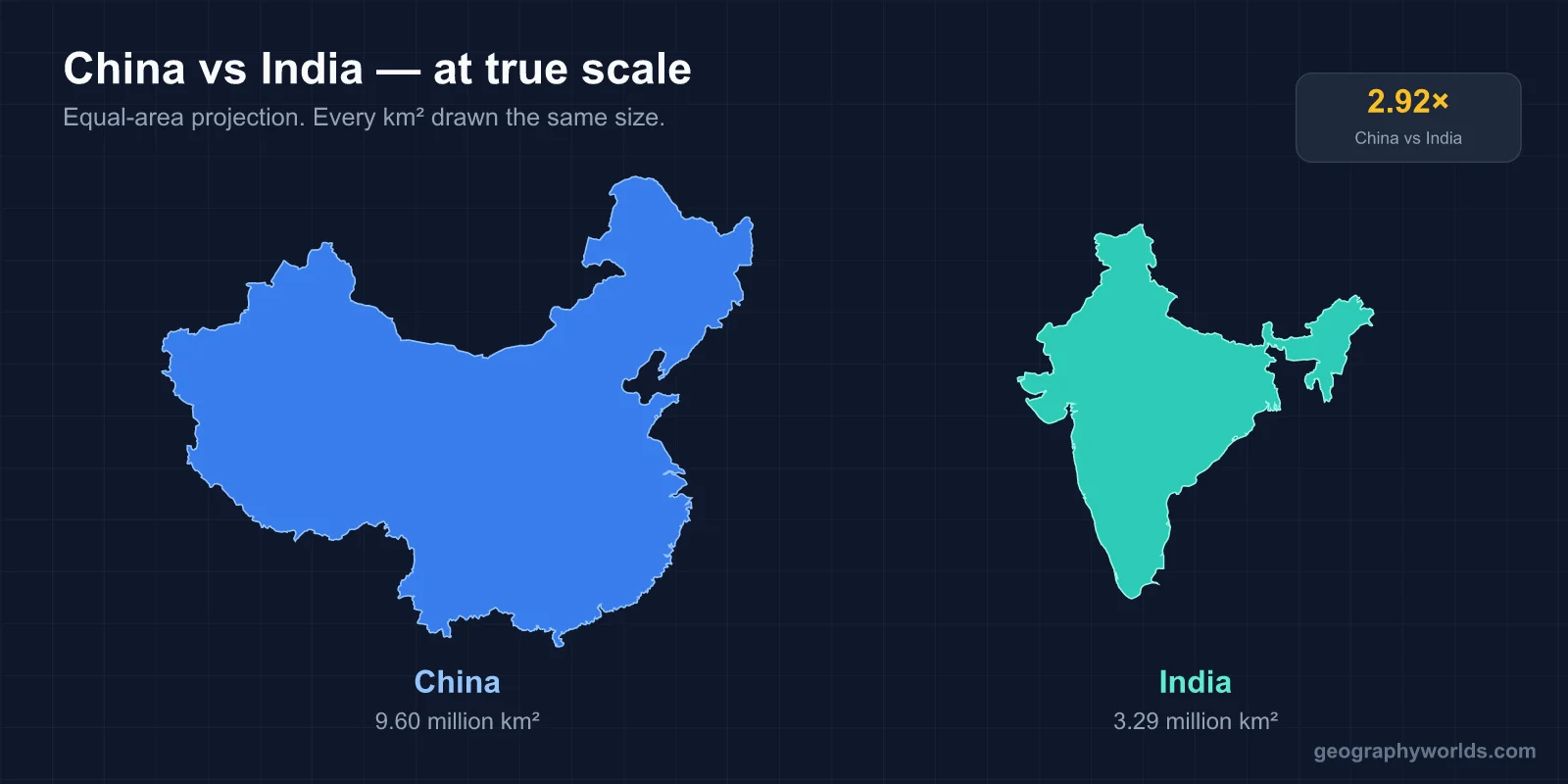
No. China is much larger than India. China covers 9,596,961 km², while India covers 3,287,263 km². China is about 2.92 times the size of India — large enough to fit nearly three Indias inside its borders. But the population picture has flipped: India recently overtook China to become the world's most populous country.
The Short Answer
India and China are the two most populous countries on Earth — together they hold about 36% of the world's population. But geographically, they're in very different size categories. China is the 3rd or 4th largest country in the world; India is the 7th. China is nearly 3× larger by area.
The countries share a 3,488-km border in the Himalayas, with ongoing territorial disputes over Aksai Chin (Chinese-controlled, Indian-claimed) and Arunachal Pradesh (Indian-controlled, Chinese-claimed). Beyond the border, the two have a complex relationship — major trading partners but also strategic competitors.

The Real Numbers
- China total area: 9,596,961 km² (3,705,407 sq mi)
- India total area: 3,287,263 km² (1,269,219 sq mi)
- Difference: 6,309,698 km² — about the size of Australia minus Tasmania
- Ratio: China is about 2.92× the size of India
To put the gap in perspective: China is bigger than India by the area of Australia. The 6.3 million km² gap is itself larger than any country in the world except Russia, Canada, the US, China, and Brazil.
Population: India Has Overtaken China
The population picture has fundamentally shifted in the 2020s:
- India population (2024): ~1,430,000,000
- China population (2024): ~1,409,000,000
- India density: ~435 people per km²
- China density: ~147 people per km²
India officially overtook China as the world's most populous country in April 2023 — a moment that ended over 70 years of China holding the top spot. India's population is still growing while China's has been declining since around 2022 due to low birth rates (driven by the one-child policy of 1979-2015 and continuing low fertility).
India is now nearly 3× more densely populated than China. India's population is packed into 1/3 the land area, making it one of the most densely populated large countries in the world. The Indo-Gangetic Plain in particular has densities exceeding 1,000 people per km² in many regions.
Geographic Diversity
China contains the Himalayas (the world's highest mountains), the Tibetan Plateau (the highest plateau on Earth), the Gobi Desert, the Taklamakan Desert, the North China Plain, the Yangtze and Yellow river basins, tropical Hainan Island, and the high-altitude steppes of Inner Mongolia. China spans about 5,200 km east-to-west and 5,500 km north-to-south. It has Pacific coastline of 14,500 km.
India contains the Himalayas (the world's highest mountains, shared with China and Nepal), the Indo-Gangetic Plain, the Thar Desert in Rajasthan, the Western and Eastern Ghats coastal mountain ranges, the Deccan Plateau, tropical rainforests in the northeast and west, and a long coastline along the Arabian Sea, Bay of Bengal, and Indian Ocean. India is more compact than China — about 3,200 km east-to-west and 3,000 km north-to-south.
Climate
China spans roughly 31 degrees of latitude (18°N to 53°N) and has tropical, subtropical, continental, subarctic, and high-altitude alpine climates. The east is monsoon-influenced; the west is arid. Northern China has very cold winters; southern China is subtropical. Hainan Island has a true tropical climate.
India is more uniformly tropical/subtropical because most of it sits between 8°N and 35°N. The Indian subcontinent is dominated by the monsoon system — strong wet seasons (June-September) followed by dry seasons. India has tropical forests, tropical savannas, deserts (Thar in the northwest), alpine zones in the Himalayan north, and a long, hot coastline. The climate diversity is significant but more compressed than China's.
Economy
China's economy is much larger than India's:
- China GDP (nominal): ~$17.7 trillion
- India GDP (nominal): ~$3.7 trillion
- China per capita GDP: ~$12,800
- India per capita GDP: ~$2,600
China's economy is about 4.8× larger than India's. Per capita, China is about 5× richer on average. India is growing faster (5-7% GDP growth per year vs China's 3-5%) but starting from a much lower base. By PPP, both countries' economies are larger relative to nominal figures — China's PPP GDP is about $30 trillion, India's is about $13 trillion.
Religion and Culture
India is the birthplace of Hinduism, Buddhism, Jainism, and Sikhism. About 79% of Indians are Hindu, 14% are Muslim, 2% are Christian, 2% are Sikh, with smaller populations of Buddhists, Jains, and others. India has over 22 official languages (Hindi, English, Bengali, Telugu, Marathi, Tamil, Urdu, Gujarati, Kannada, Malayalam, Punjabi, etc.) and hundreds of unofficial ones.
China is officially atheist (the Communist Party doesn't recognize religion), but in practice has substantial populations of Buddhists, Daoists, Christians (Catholic and Protestant), and Muslims (especially Uyghurs and Hui in the west). Han Chinese make up about 92% of the population. The official language is Mandarin, but Cantonese, Wu, Min, Hakka, and many others are spoken regionally. About 50 ethnic minorities (Uyghur, Tibetan, Zhuang, Manchu, Hui, Miao, and others) make up the remaining 8% of the population.
The Border Dispute
India and China share a 3,488-km border in the Himalayas. The border has never been formally agreed upon — China and India fought a brief war in 1962 along this border, and there have been frequent clashes since. The two main disputed areas are:
- Aksai Chin: Administered by China, claimed by India. About 38,000 km² of high-altitude desert in northern Kashmir.
- Arunachal Pradesh: Administered by India, claimed by China as "South Tibet." About 84,000 km² of mountainous terrain in northeastern India.
Periodic incidents (most recently the Galwan Valley clash in 2020) remind both countries of the unresolved border. Despite these tensions, India and China are also major trading partners, with bilateral trade worth over $130 billion annually.
States and Provinces
India is a federal republic with 28 states and 8 union territories. The largest state by area is Rajasthan (342,239 km²) — about the size of Germany. The most populous state is Uttar Pradesh (231 million people) — if it were a country, it would be the 5th most populous in the world. Indian states have significant autonomy in administration, languages, education, and culture.
China is divided into 23 provinces, 5 autonomous regions, 4 direct-controlled municipalities (Beijing, Shanghai, Tianjin, Chongqing), and 2 special administrative regions (Hong Kong, Macau). The largest province by area is Xinjiang (1.66 million km²) — about half the size of India. The most populous is Guangdong (126 million people). Chinese provinces have less autonomy than Indian states; the central government in Beijing exerts much tighter control.
Key Facts
- China is about 2.92× the size of India.
- India has slightly more people than China (1.43B vs 1.41B as of 2024).
- India's population density is nearly 3× China's.
- China's economy is about 4.8× larger than India's.
- The China-India border (3,488 km) is unsettled and disputed in two major areas.
Fun Facts
- Mount Everest sits on the China-Nepal border, not the India-China border, though India is just 100 km south.
- The Chinese province of Xinjiang alone (1.66 million km²) is more than half the size of India.
- India is home to 22 UNESCO World Heritage Sites; China has 56.
- Both countries are nuclear powers — India tested its first nuclear weapon in 1974, China in 1964.
- Together, India and China have produced about 4.2 billion people — that's more than the entire population of Africa, Europe, and the Americas combined.
- India's economy is projected to overtake Japan to become the world's 4th-largest by 2027, and Germany by 2030.
- China and India together host the world's two largest railway networks by passenger volume — Indian Railways alone carries about 8 billion passengers per year.
- The Sino-Indian War of 1962 lasted only one month but reshaped the strategic geography of the entire Himalayan region.
The Bottom Line
China is much larger than India by area — nearly 3× — but India has recently surpassed China in population. The two countries are profoundly important for the 21st century: they hold a third of humanity, both have nuclear weapons, both are major economic powers, and both have unresolved border disputes with each other.
By area, China dominates. By population, India just barely leads. By economy, China dwarfs India by 5×. The size comparison is just one piece of a complex bilateral relationship that will shape global affairs for decades to come. The next century may see India's economic and demographic rise close the gap that has long defined Asia's two giants.
Quiz Asian Geography!
Test your knowledge of India, China, and other Asian countries.
Play Geography Games →