
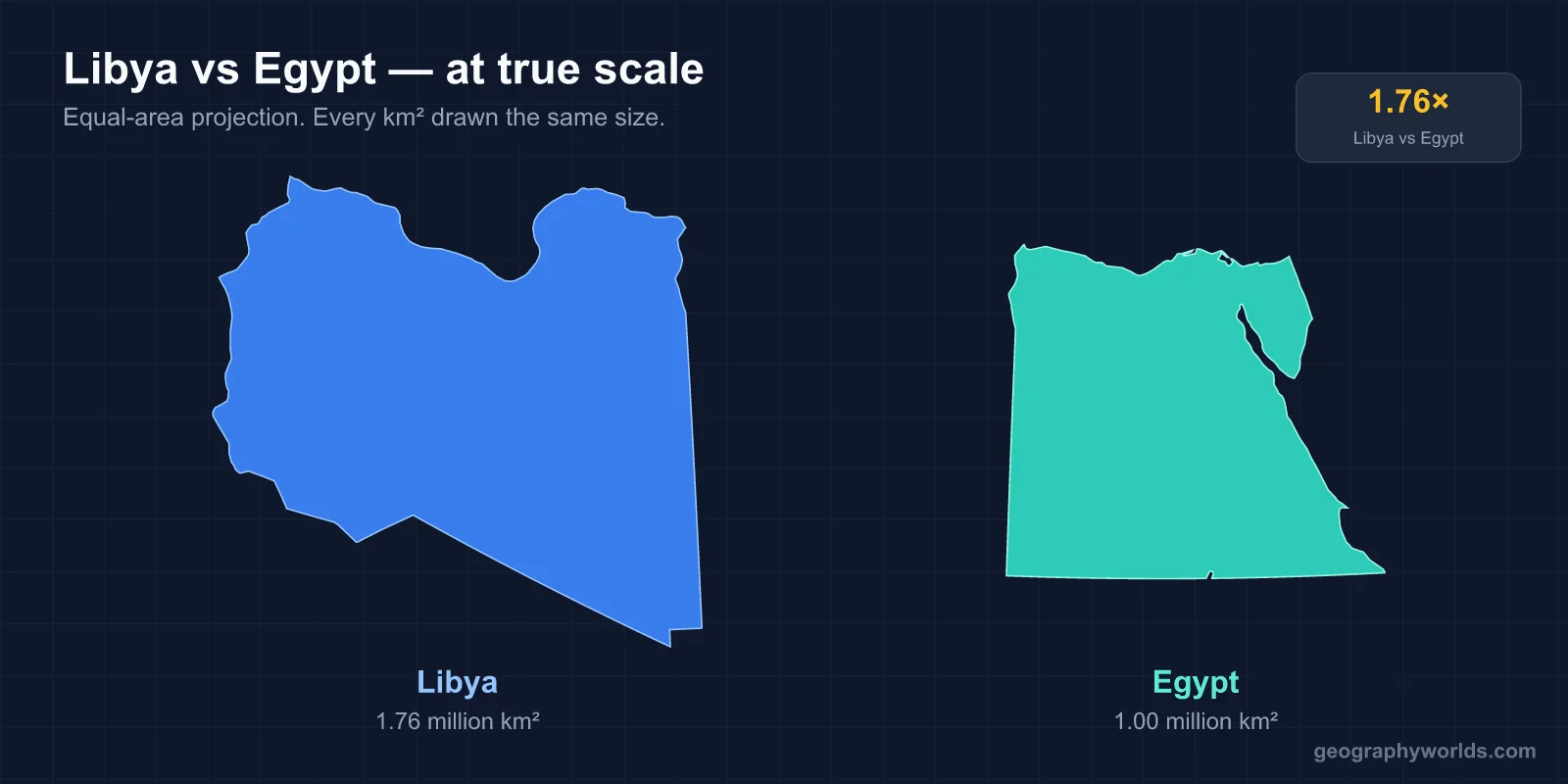
Yes. Libya is larger than Egypt by area. Libya covers 1,759,540 km², while Egypt covers 1,001,450 km². Libya is about 1.76 times the size of Egypt — larger by 758,090 km², roughly the size of Chile or Zambia. But Egypt has nearly 17 times more people than Libya (110 million vs 6.8 million).
The Short Answer
Libya is the 17th-largest country in the world and the 4th-largest in Africa (after Algeria, the Democratic Republic of the Congo, and Sudan). Egypt is the 30th-largest globally and the 13th-largest in Africa. Both border the Mediterranean Sea and are dominated by desert — about 90% of Libya is Sahara, and 95% of Egypt is uninhabited desert.
Despite Libya's larger size, Egypt is far more populated, economically active, and historically influential. Egypt's civilization spans over 5,000 years; Libya as a unified state is much younger. The two countries share a long border (1,150 km) but have had different historical trajectories.

The Real Numbers
- Libya total area: 1,759,540 km² (679,362 sq mi)
- Egypt total area: 1,001,450 km² (386,662 sq mi)
- Difference: 758,090 km² — about the size of Chile or Zambia
- Ratio: Libya is about 1.76× the size of Egypt
Both countries are major North African states. Libya is the 4th-largest in Africa; Egypt is significantly smaller but still ranks in the top 15 African nations by area.
Population
Egypt has dramatically more people:
- Egypt population: ~110,000,000
- Libya population: ~6,800,000
- Egypt density: ~110 people per km²
- Libya density: ~3.9 people per km²
Egypt has 16.2× more people than Libya, despite Libya being larger. Egypt's population is concentrated along the Nile River and its delta — about 95-97% of Egyptians live in just 5% of the country's land. Libya is one of the world's most sparsely populated countries — most of the country is empty desert. Libya's population is concentrated in the coastal cities (Tripoli, Benghazi, Misrata, Sirte) along the Mediterranean.
Geography
Libya is dominated by the Sahara Desert. Major regions:
- Coastal plain: A narrow strip along the Mediterranean where most Libyans live
- Tripolitania: Northwest region around Tripoli
- Cyrenaica: Northeast region around Benghazi
- Fezzan: Vast southwestern desert region
- Sahara Desert: Covers 90%+ of the country
- Tibesti Mountains: Highland region in the south, shared with Chad
Egypt is similarly desert-dominated:
- Nile Valley: Green agricultural strip running south to north
- Nile Delta: Fertile fan-shaped delta on the Mediterranean
- Western Desert: Part of the Sahara, covering 2/3 of Egypt
- Eastern Desert: Between the Nile and the Red Sea
- Sinai Peninsula: Triangular landmass between Africa and Asia
- Lake Nasser: Reservoir behind the Aswan High Dam
Economy
Both countries depend heavily on oil and gas:
- Egypt GDP: ~$398 billion
- Libya GDP: ~$45 billion
- Egypt per capita GDP: ~$3,600
- Libya per capita GDP: ~$6,600
Egypt's economy is about 9× larger than Libya's in absolute terms, but Libya is about 80% richer per capita. Libya's oil reserves are among the largest in Africa. Egypt has a more diversified economy — tourism, manufacturing, agriculture, services, and Suez Canal revenues complement its oil and gas sector.
Libya has been politically unstable since the 2011 civil war that overthrew Muammar Gaddafi. Ongoing conflict has damaged the economy and reduced oil production. Egypt has been more stable but also faces economic challenges including high inflation and currency depreciation.
History
Egypt has one of the world's oldest continuous civilizations, dating back over 5,000 years. Ancient Egypt produced the pyramids, hieroglyphic writing, and one of the longest-running governmental traditions in human history. After Roman, Byzantine, Arab, Ottoman, French, and British rule, Egypt gained independence in 1922 and became a republic in 1953.
Libya's history is also ancient but as a unified modern state, Libya is much younger. The country was Phoenician, Greek, Roman, and Ottoman territory at various times. Italy colonized Libya from 1911 to 1947. Independence came in 1951. Muammar Gaddafi ruled from 1969 to 2011 — 42 years of one-man rule. Since 2011, Libya has been divided between rival governments and militias.
Religion and Culture
Both are Muslim-majority countries with strong Arab cultural identities. Egypt is about 90% Sunni Muslim, with a significant Coptic Christian minority (about 10%). Libya is about 97% Sunni Muslim, with a very small Christian minority. Arabic is the primary language in both countries, with Egyptian Arabic being one of the most widely understood Arabic dialects due to Egyptian films and television.
Key Facts
- Libya is about 1.76× the size of Egypt.
- Egypt has 16.2× more people than Libya.
- Egypt's economy is 9× larger than Libya's.
- Both are major Sahara Desert states.
- Egypt has one of the world's oldest civilizations; Libya is a younger modern state.
Fun Facts
- The Libyan Sahara has been mostly uninhabited for thousands of years.
- Egypt's Suez Canal handles about 12% of world trade by tonnage.
- Both countries have ancient archaeological sites — Egypt the Pyramids, Libya the Greek-Roman ruins of Leptis Magna and Cyrene.
- Libya's oil reserves are estimated at about 48 billion barrels — about 80% of those in Saudi Arabia.
- Egypt has 7 UNESCO World Heritage Sites; Libya has 5.
Tourism Comparison
Egypt has one of the world's most developed tourism industries. The Pyramids of Giza, Sphinx, Luxor's Valley of the Kings, Karnak Temple, Aswan, Abu Simbel, and Red Sea resorts (Hurghada, Sharm El Sheikh) attract millions of visitors annually. Egypt typically receives 13-15 million international tourists per year, generating about 12% of GDP.
Libya's tourism industry has been devastated by post-2011 instability. Before the civil war, Libya was attempting to develop tourism around its remarkable Greek and Roman ruins (Leptis Magna, Cyrene, Sabratha — all UNESCO World Heritage Sites), Saharan oases, and Mediterranean coast. Today, ongoing security concerns mean Libya receives very few international tourists — fewer than 100,000 per year.
Border and Migration
Libya and Egypt share a 1,150 km border in the Sahara Desert. The border is mostly empty desert and has historically been crossed by Bedouin nomads. Modern times have seen significant migration in both directions — Egyptian workers have long sought employment in oil-rich Libya, while Libyan refugees have moved to Egypt during periods of conflict. The post-2011 Libyan civil war displaced millions, many fleeing to Egypt or further north to Europe via Mediterranean routes.
Religion and Languages
Both countries are Muslim-majority and Arabic-speaking, with similar cultural foundations. Egypt has a significant Coptic Christian minority (about 10%) that has lived there since the 1st century AD — one of the world's oldest Christian communities. Libya is almost entirely Sunni Muslim, with very small Christian minorities. Arabic is the official language in both countries, with regional variations. Egyptian Arabic is one of the most widely understood dialects of Arabic globally due to Egyptian media exports.
Oil and Gas
Libya has about 48 billion barrels of proven oil reserves — the largest in Africa and among the world's top 10. Oil production has been disrupted by the post-2011 civil conflict, but the reserves remain a major economic asset. Libya is also a member of OPEC. Egypt has more modest oil reserves but significant natural gas, including the Zohr field discovered in 2015 — one of the largest gas finds in the Mediterranean.
The Bottom Line
Libya is bigger than Egypt by area (76% larger), but Egypt has 16× more people, a much larger economy, and one of the world's oldest civilizations. Both are major North African desert states, but with very different demographics, economic structures, and political situations. The size comparison illustrates how vast empty desert can occupy huge territory without supporting large populations — Egypt makes more of less land, while Libya has more land than it currently uses productively. The future of both countries depends on managing water scarcity, climate change, demographic pressures, and political stability in challenging desert environments. Both have potential to become more economically vibrant if they can solve their political and resource challenges. Both also continue to play important roles in regional geopolitics, with Egypt as a key Arab power and US ally, and Libya as a strategically important North African state. The Libya-Egypt relationship will continue to shape North Africa for years to come — particularly as both countries navigate their respective political and economic challenges in an increasingly complex regional environment. Cooperation between Egypt and Libya could unlock significant economic potential, while continued instability could create regional security concerns affecting the entire Mediterranean region. Both Mediterranean coastlines offer potential for shipping, fisheries, and offshore energy development.