
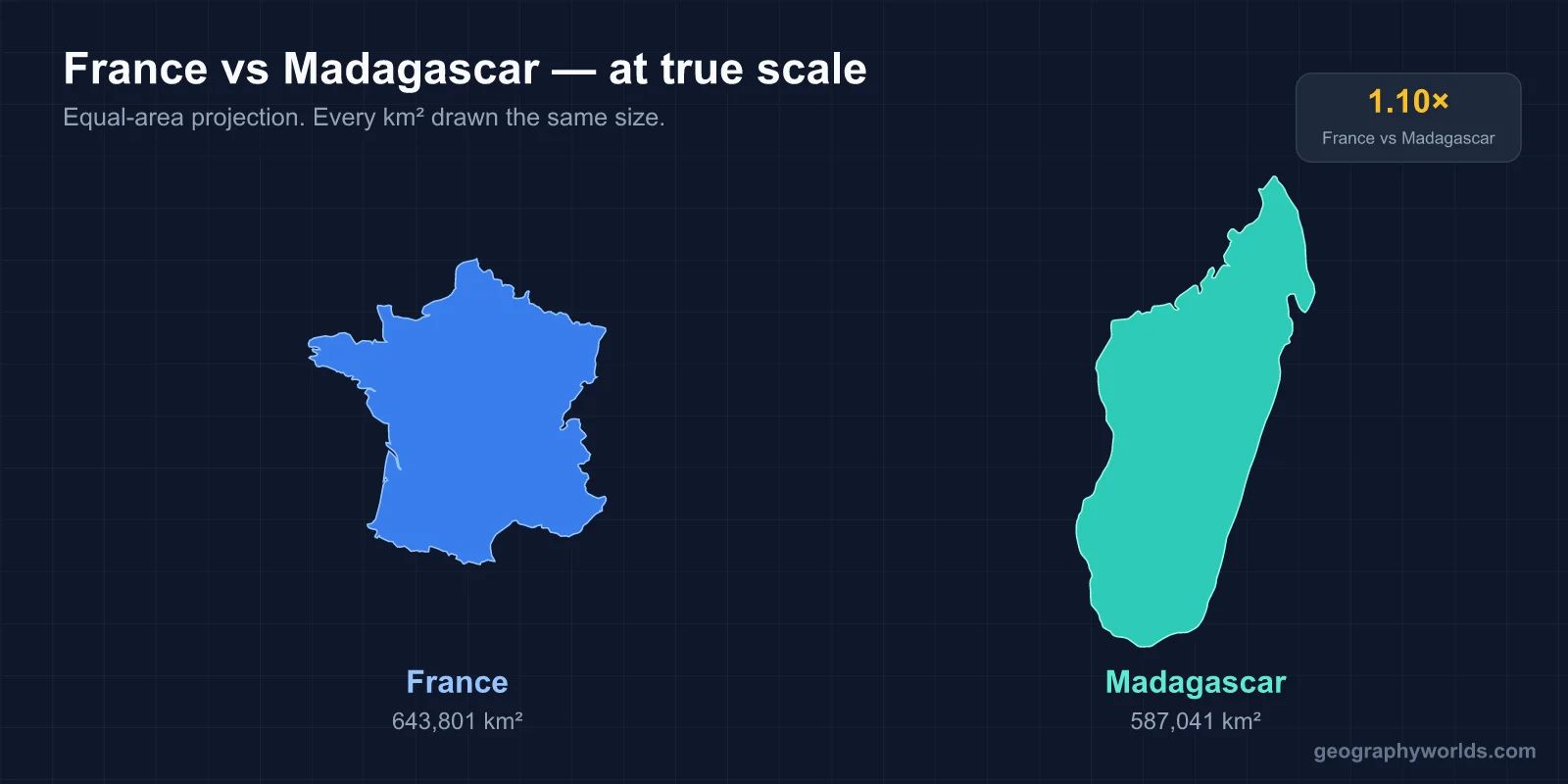
No. France is larger than Madagascar, but only by about 10%. France covers 643,801 km², while Madagascar covers 587,041 km². France is about 1.10 times the size of Madagascar — a difference of about 56,760 km², roughly the size of Croatia or Slovakia. Both are large by any measure, but France's slightly bigger landmass gives it the edge.
The Short Answer
Madagascar is the world's 4th-largest island (after Greenland, New Guinea, and Borneo). France is the 3rd-largest country in Europe (after Russia and Ukraine, with metropolitan France only — if you include overseas territories, France is much bigger). The two are surprisingly close in size, with France winning by a modest 10% margin. Both have rich biodiversity, distinct cultures, and historical importance.
Madagascar separated from the African continent about 165 million years ago and from India about 88 million years ago. This long isolation produced unique flora and fauna — about 90% of Madagascar's species are found nowhere else on Earth. France, by contrast, has been culturally and biologically connected to mainland Europe throughout its history.

The Real Numbers
- France (metropolitan) total area: 643,801 km² (248,573 sq mi)
- Madagascar total area: 587,041 km² (226,658 sq mi)
- Difference: 56,760 km² — about the size of Croatia or Slovakia
- Ratio: France is about 1.10× the size of Madagascar
Note: this uses "metropolitan France" — the part in Europe. If you include all French overseas territories (French Guiana, Reunion, Martinique, Guadeloupe, Mayotte, French Polynesia, New Caledonia, etc.), France's total area is about 763,000 km² — making it about 30% larger than Madagascar.
Population
France has nearly 2.5× more people than Madagascar:
- France population: ~68,000,000
- Madagascar population: ~30,000,000
- France density: ~106 people per km²
- Madagascar density: ~51 people per km²
France's population is much larger and more densely distributed. Madagascar's population has been growing rapidly (about 2.4% per year) and is projected to reach 50 million by 2050, while France's population growth is slow (around 0.3% per year). The trajectory suggests Madagascar's population may eventually approach France's, even though France will remain larger by area.
Geographic Diversity
Madagascar has remarkable geographic variety for a single island:
- Central Highlands: The interior plateau, where the capital Antananarivo sits (1,280 m elevation)
- Eastern Rainforest: Tropical wet forests with extreme biodiversity, including most of Madagascar's lemur species
- Western Dry Forest: Including the famous Avenue of the Baobabs
- Southern Spiny Forest: A unique semi-desert ecosystem with bizarre endemic plants
- Northern Tropical: Including Nosy Be, a major tourist destination
- Coral reefs: Along much of the coast, including the 4th-largest reef system in the world
France has similar variety despite being a continental country:
- The Alps: Including Mont Blanc (4,808 m), the highest peak in Western Europe
- Pyrenees: The mountain range along the Spanish border
- Massif Central: Plateau region in central France
- Mediterranean coast: Côte d'Azur, Provence
- Atlantic coast: Brittany, Aquitaine, Normandy
- English Channel coast: Normandy, including the famous D-Day beaches
- Wine regions: Bordeaux, Burgundy, Champagne, Loire Valley
Biodiversity
This is where Madagascar dramatically outshines France. Madagascar is one of the most biologically unique places on Earth:
- Lemurs: All 100+ species of lemurs are endemic to Madagascar — found nowhere else.
- Chameleons: About half the world's chameleon species live in Madagascar.
- Baobabs: 6 of the 8 baobab species are endemic to Madagascar.
- Plants: About 12,000 plant species, with 80%+ endemic.
- Reptiles and amphibians: Hundreds of unique species.
France's biodiversity is significant for Europe but follows continental patterns. The Pyrenees and Alps host alpine ecosystems; the Mediterranean coast has unique flora; Brittany has Atlantic ecosystems. But France doesn't have Madagascar's level of endemism — most French species also occur in neighboring European countries.
Climate
Madagascar has tropical climate dominant in most of the island, but with significant regional variation. The eastern coast is hot and wet year-round (rainforest); the western coast is hotter and drier (savanna and dry forest); the south is semi-arid (spiny forest); the central highlands are cooler due to elevation. Cyclone season runs from November to April, with major storms occasionally hitting the eastern coast.
France has temperate climate dominant, with variations: oceanic (mild, wet) in the west, continental (cold winters, warm summers) in the east, Mediterranean (hot dry summers) in the south, and alpine in the mountains. France has all four seasons distinctly, unlike Madagascar's wet/dry tropical pattern.
Economy
France's economy is much larger:
- France GDP: ~$3.1 trillion
- Madagascar GDP: ~$15 billion
- France per capita GDP: ~$46,000
- Madagascar per capita GDP: ~$500
France's economy is roughly 200× larger than Madagascar's. Per capita, France is about 90× richer on average. Madagascar is one of the world's poorest countries despite its natural resources and biodiversity. The country struggles with poverty, political instability, deforestation, and limited infrastructure.
France has one of the world's most diversified economies — finance, manufacturing (Airbus, Renault, automotive supplies), luxury goods (LVMH, L'Oréal, Kering), agriculture (wine, cheese, grain), tourism, and energy. France is consistently in the world's top 7-8 economies by nominal GDP.
Languages and Culture
Madagascar's official languages are Malagasy and French. Malagasy is an Austronesian language — related to Indonesian and other Pacific languages, reflecting Madagascar's settlement history by Indonesian sailors around 350-550 AD. This makes Malagasy unique in Africa — it's not part of any African language family. French became official during the colonial period (Madagascar was a French colony from 1897 to 1960).
France's official language is French, with regional languages (Breton, Basque, Catalan, Corsican, Occitan, Alsatian) having varying degrees of recognition. France has one of the world's most prestigious cultural and intellectual traditions — from medieval cathedrals to modern philosophy, literature, cuisine, and fashion.
Key Facts
- France is about 1.10× the size of Madagascar (metropolitan France).
- France has 2.5× more people than Madagascar.
- Madagascar is the world's 4th-largest island.
- About 90% of Madagascar's species are endemic (found nowhere else).
- Madagascar was a French colony from 1897 to 1960.
Fun Facts
- Madagascar's capital, Antananarivo, sits at 1,280 m elevation — higher than the highest peak in the UK.
- France has more time zones than any country in the world (12 total) when including all overseas territories.
- Madagascar has more chameleon species than the rest of the world combined.
- France's overseas department of French Guiana is in South America — making France technically a South American country, too.
- The Strait of Mozambique between Madagascar and mainland Africa is about 400 km wide at its narrowest.
- Madagascar's currency, the ariary, was reintroduced in 2005, replacing the franc — Madagascar and Mauritania were the last countries to use the franc as currency.
- France's Mont Blanc tunnel through the Alps is one of the world's most important transport links between France and Italy.
- Madagascar's economy is heavily dependent on vanilla — the country produces about 80% of the world's natural vanilla supply.
Tourism and Travel
Both countries attract substantial tourism but at very different scales. France is the world's most-visited country, receiving about 90 million international tourists annually. Major attractions include Paris (Eiffel Tower, Louvre, Notre-Dame), the French Riviera, Provence, the Loire Valley castles, the Alps and ski resorts, Bordeaux wine country, and Normandy beaches. Tourism contributes roughly 8-10% of French GDP.
Madagascar receives about 300,000-400,000 international tourists annually — orders of magnitude fewer than France. Major attractions include Avenue of the Baobabs, Andasibe-Mantadia National Park (for lemur viewing), Tsingy de Bemaraha (the famous limestone "stone forest"), Nosy Be island, and Isalo National Park. Despite its biodiversity and unique attractions, Madagascar's tourism industry is underdeveloped due to limited infrastructure, political instability, and high travel costs.
Environmental Challenges
Madagascar faces severe environmental challenges. Deforestation has reduced the country's original forest cover to less than 10% of its historical extent. Slash-and-burn agriculture, charcoal production, and population growth drive ongoing forest loss. Many lemur species are critically endangered due to habitat destruction. Climate change is also worsening conditions, with the south of the country facing famine-level droughts in recent years.
France faces different environmental issues — air quality in cities, water management, agricultural runoff, and climate change impacts on its alpine regions and Mediterranean coastline. France has been at the forefront of climate diplomacy (the 2015 Paris Agreement was negotiated and signed in Paris) and has invested heavily in renewable energy and nuclear power (which provides about 70% of French electricity).
The Bottom Line
France is slightly bigger than Madagascar — about 10% larger — but they're much closer in size than most people would guess. France has 2.5× more people and a vastly larger economy. Madagascar has more unique biodiversity and a much lower population density. Both countries have rich cultures, distinct geographies, and important roles in their respective regions.
Quiz World Islands & Countries!
Test your knowledge of Madagascar, France, and beyond.
Play Geography Games →