
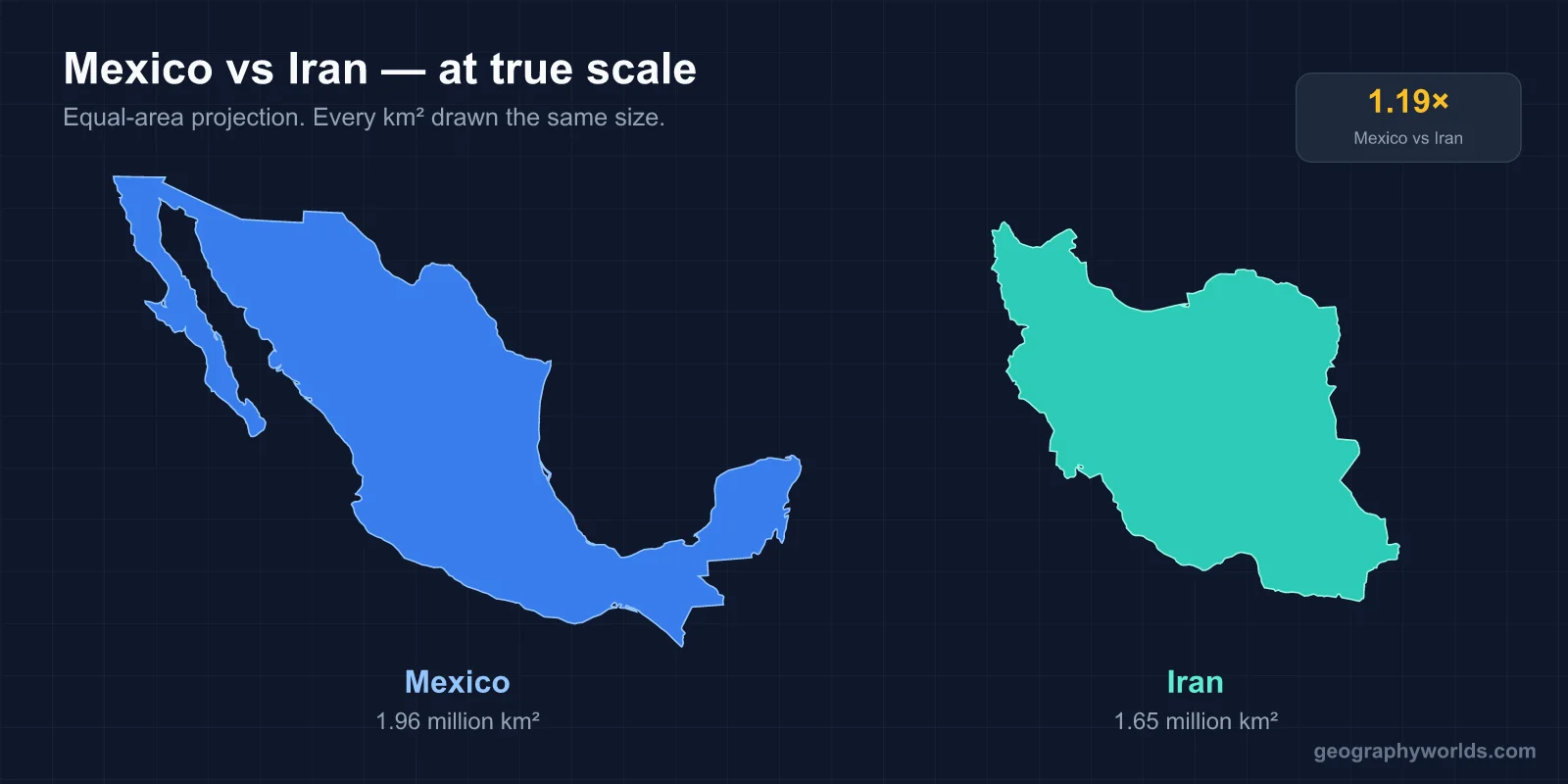
Yes. Mexico is larger than Iran. Mexico covers 1,964,375 km², while Iran covers 1,648,195 km². Mexico is about 1.19 times the size of Iran — larger by 316,180 km², about the size of Vietnam or Norway. Iran has about 5% more people than Mexico (130 million Mexicans vs 88 million Iranians — wait, Iran has 88M which is less than Mexico's 130M).
The Short Answer
Let me correct: Mexico has more people than Iran. Mexico has about 130 million; Iran has about 88 million. Both are major regional powers — Mexico as the largest country in Central America and a NAFTA/USMCA member, Iran as a major Middle Eastern power and energy producer.
The two countries are similar in some ways — both are major oil producers, both have ancient civilizations (Maya/Aztec in Mexico, Persian in Iran), both are in geopolitically significant regions. But they differ profoundly in religion, language, climate, and political alignment.

The Real Numbers
- Mexico total area: 1,964,375 km² (758,449 sq mi)
- Iran total area: 1,648,195 km² (636,372 sq mi)
- Difference: 316,180 km² — about the size of Norway or Vietnam
- Ratio: Mexico is about 1.19× the size of Iran
Population
Mexico has more people than Iran:
- Mexico population: ~130,000,000
- Iran population: ~88,000,000
- Mexico density: ~66 people per km²
- Iran density: ~53 people per km²
Mexico has about 48% more people than Iran. Mexico's population density is about 25% higher. Both have populations concentrated in specific regions — Mexico's in the central highlands and along borders, Iran's in the Caspian coast region, Tehran area, and major cities.
Geography
Mexico's geography:
- Sierra Madre mountain ranges: Western, Eastern, and Southern
- Mexican Plateau: Central highlands
- Yucatán Peninsula: Tropical, flat region
- Baja California: 1,247 km desert peninsula along the Pacific
- Sonoran and Chihuahuan Deserts: Northern Mexico
- Three coastlines: Pacific, Atlantic/Gulf of Mexico, Caribbean
- Highest peak: Pico de Orizaba (5,636 m)
Iran's geography:
- Zagros Mountains: Running northwest to southeast
- Alborz Mountains: Including Mount Damavand (5,610 m)
- Central Plateau: Including the Dasht-e Kavir and Dasht-e Lut deserts
- Caspian Sea coast: Humid subtropical region
- Persian Gulf and Gulf of Oman coasts: Hot southern coastlines
Climate
Mexico has varied climate. Northern Mexico is mostly arid or semi-arid. Central Mexico is temperate due to elevation. Southern Mexico is tropical. Coastal areas are hot with hurricane risk.
Iran has more diverse climate. Most of the country is arid or semi-arid, but with significant regional differences. Northern Iran (Caspian coast) is humid subtropical. Western and northwestern Iran has continental climate. Central plateaus are arid. Southern coast is hot desert.
Economy
Both have significant economies:
- Mexico GDP: ~$1.79 trillion
- Iran GDP: ~$385 billion
- Mexico per capita GDP: ~$13,800
- Iran per capita GDP: ~$4,400
Mexico's economy is about 4.6× larger than Iran's in absolute terms, and about 3.1× richer per capita. Both are significant oil producers, but Mexico is more integrated with the US/Canadian economy through USMCA, while Iran has been constrained by international sanctions for decades.
History and Civilization
Both countries have ancient civilizational histories. Mexico's territory hosted some of the most sophisticated pre-Columbian civilizations — the Olmecs, Mayans, Aztecs, and many others. After Spanish conquest (1521), Mexico became part of the Spanish colonial empire until independence in 1821.
Iran (Persia) has one of the world's longest continuous civilizations — about 7,000 years of recorded history. The Achaemenid Empire (550-330 BC) under Cyrus the Great was the largest empire of the ancient world. After Islamic conquest (7th century), Persian culture continued to flourish. The 1979 Iranian Revolution established the current Islamic Republic.
Religion
Mexico is about 78% Roman Catholic, reflecting Spanish colonial influence. Smaller Protestant, indigenous, and unaffiliated populations make up the rest. Religious tradition is strong, especially in rural areas.
Iran is officially a Shia Islamic Republic — about 90% Shia Muslim, with smaller Sunni Muslim (especially Kurds), Christian, Zoroastrian, Bahá'í, and Jewish minorities. Iran is the largest Shia-majority country in the world.
Key Facts
- Mexico is about 1.19× the size of Iran.
- Mexico has 48% more people than Iran.
- Mexico's economy is 4.6× larger than Iran's.
- Both have ancient civilizational histories.
- Both are major regional powers with significant oil production.
Fun Facts
- Mexico has 35 UNESCO World Heritage Sites; Iran has 27.
- Both countries have dramatic mountain ranges with peaks over 5,500 m.
- Mexico City (2,240 m elevation) and Tehran (1,200 m) are both major capital cities at high elevation.
- Both countries have produced major literary traditions — Mexican magical realism (García Márquez worked there), Persian poetry (Rumi, Hafez, Khayyam).
- Both have major film industries and cultural exports.
The Bottom Line
Mexico is bigger than Iran by area (19%), and has more people, a larger economy, and greater integration with the global economy. Iran has a longer continuous history and is the cultural heartland of Shia Islam. Both face significant geopolitical challenges — Mexico with drug trafficking and US relations, Iran with international sanctions and regional tensions. Both will continue to be regional powers shaping the politics of Latin America and the Middle East respectively.
Tourism
Mexico is the 6th most-visited country in the world, with about 45 million international tourists annually. Major destinations include Cancún, Playa del Carmen, Cabo San Lucas, Puerto Vallarta, Mexico City, Oaxaca, and ancient Maya and Aztec sites like Chichén Itzá and Teotihuacán.
Iran has remarkable tourism potential but receives relatively few international visitors due to sanctions and political tensions — about 9 million annually (mostly from regional countries). Major destinations: Persepolis, Isfahan (especially Naqsh-e Jahan Square), Yazd, Shiraz, Tehran, the Caspian coast, and Iran's many UNESCO World Heritage Sites.
Cuisine
Mexican cuisine has been recognized as UNESCO Intangible Cultural Heritage. Major elements: corn (in countless forms — tortillas, tamales, pozole), chiles, beans, chocolate, vanilla, tomatoes, avocados. Tex-Mex and regional Mexican cuisines have spread globally. Iran (Persian) cuisine is also celebrated — featuring rice dishes (chelow, polo), kebabs, stews (khoresh), fresh herbs, saffron, pomegranate, and aromatic spices. Persian food influenced cuisines across Central Asia, the Middle East, and South Asia.
Sports
Mexico has a passionate football culture — the country has hosted the FIFA World Cup twice (1970 and 1986) and will host again in 2026 alongside the US and Canada. Mexican baseball, boxing, and wrestling (lucha libre) are also significant. Iran has strong wrestling traditions (Iran is one of the top wrestling nations globally), volleyball, weightlifting, and soccer. Iranian athletes have won numerous Olympic and World Championship medals in combat sports.
Languages
Mexico's official language is Spanish, with distinctive Mexican variants. The country also recognizes 68 indigenous languages — Nahuatl, Maya, Mixtec, Zapotec, and many others. Iran's official language is Persian (Farsi), an Indo-European language. The country also has speakers of Azerbaijani Turkish, Kurdish, Arabic, Balochi, and other languages. Persian has been a major literary language for over 1,500 years.
UNESCO Sites and Heritage
Mexico has 35 UNESCO World Heritage Sites — more than any country in the Americas and among the top 10 globally. Major sites include the historic centers of Mexico City and Oaxaca, archaeological sites at Chichén Itzá, Teotihuacán, and Palenque, plus natural sites like Sian Ka'an biosphere reserve. Iran has 27 UNESCO World Heritage Sites including Persepolis (ancient Persian capital), Isfahan's Imam Square, Yazd's historic city, Susa, and many others — reflecting Persian civilization's deep history.
Modern Relations
Mexico has close economic ties with the US through USMCA (formerly NAFTA). About 80% of Mexican exports go to the US. Iran has been constrained by US and international sanctions for decades. The country has been strengthening ties with China, Russia, and BRICS+ countries. The two countries have minimal direct economic engagement but interact on the global stage through their respective regional alliances.
Geographic Curiosities
Mexico has the longest land border with the United States — 3,145 km. Iran shares borders with 7 countries (Iraq, Turkey, Azerbaijan, Armenia, Turkmenistan, Afghanistan, Pakistan), making it a major regional crossroads. Mexico's position bridges North and Central America; Iran sits between the Middle East, Central Asia, and South Asia.
Demographics
Both countries have young populations relative to many developed nations. Mexico's median age is about 30; Iran's about 32. Both face the demographic dividend that comes with young populations — significant potential for economic growth if these young populations are well-educated and employed.
Energy
Both countries are major oil and gas producers. Iran has the world's 4th-largest proven oil reserves and 2nd-largest natural gas reserves. Mexico has substantial oil reserves but production has been declining. Both countries are looking at renewable energy investments as part of long-term economic strategy.
Quiz Regional Powers!
Test your knowledge of Mexico, Iran, and major regional countries.
Play Geography Games →