
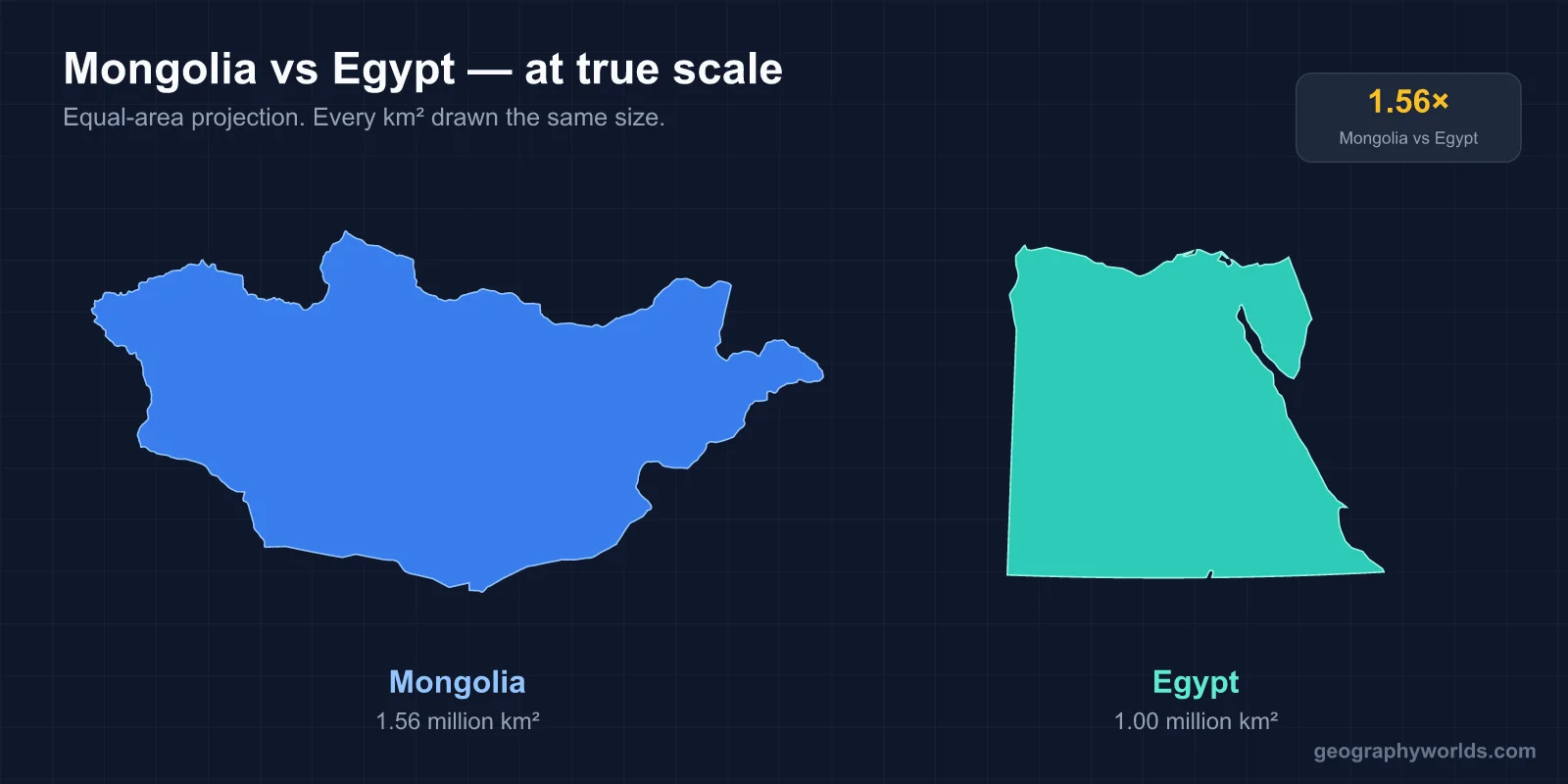
Mongolia and Egypt are two of the most historically consequential nations of their respective regions — Mongolia the seat of the largest contiguous land empire in history, Egypt the cradle of one of the world's oldest civilizations. So which is bigger by area?
The Short Answer
Yes, Mongolia is bigger than Egypt. Mongolia covers 1,564,116 km². Egypt covers 1,001,450 km². Mongolia is approximately 56% larger than Egypt.
Side-by-Side Numbers
- Mongolia area: 1,564,116 km² (603,909 sq mi)
- Egypt area: 1,001,450 km² (386,662 sq mi)
- Difference: Mongolia is ~563,000 km² larger
- Ratio: Mongolia is ~1.56× the size of Egypt
- Mongolia population: ~3.4 million
- Egypt population: ~111 million
Mongolia
Mongolia is a landlocked country in East/Central Asia, sandwiched between Russia to the north and China to the south. It is the 18th largest country in the world by area and the most sparsely populated sovereign state — about 2 people per km². The capital, Ulaanbaatar, holds nearly half of the country's population (1.6 million people).
Geography is dominated by the Gobi Desert in the south, vast steppe grasslands in the center and east, and the Altai and Khangai mountain ranges in the west. Average elevation is high (1,580 m), making Mongolia one of the highest countries by mean elevation. The country was historically the heart of the Mongol Empire (1206–1368), which under Genghis Khan and his successors became the largest contiguous land empire in human history.
Egypt
Egypt is in northeast Africa, with its Sinai Peninsula extending into Asia. It borders Libya to the west, Sudan to the south, and Israel and the Gaza Strip to the east. Egypt has coastlines on the Mediterranean Sea to the north and the Red Sea to the east. The country is the 30th largest in the world by area but contains the most populous country in the Arab world with about 111 million people.
Egypt is overwhelmingly defined by the Nile River. About 95% of Egyptians live within a few kilometers of the Nile or its delta, occupying only about 4% of the country's land area. The rest of Egypt is desert — the Western Desert (part of the Sahara), the Eastern Desert (between the Nile and the Red Sea), and the Sinai Desert. Cairo, the capital, has about 22 million people in its metro area.
Population Contrast
Egypt has 33 times more people than Mongolia — 111 million vs 3.4 million. In a country only 64% the size of Mongolia, Egypt packs 33 times the population. Mongolia's population density of about 2 per km² is the lowest of any sovereign country; Egypt's is about 111 per km² overall, but the effective density (since 95% of Egyptians live near the Nile) is over 1,500 per km² in the inhabited zones.
Climate
Both have desert climates but with very different characteristics. Mongolia has an extreme continental climate. Winters are bitterly cold — average January temperatures in Ulaanbaatar are −20°C, and the capital is sometimes called the coldest national capital on Earth. Summers can be hot (up to 30°C). The country has very low precipitation (200–350 mm annually) and over 250 sunny days per year. Egypt has a hot desert climate. Coastal Mediterranean Egypt has the most temperate climate with mild winters and warm summers. Cairo and the Nile Delta have hot summers (30–35°C) and mild winters (10–20°C). Upper Egypt is hotter and drier. The Western and Eastern Deserts are among the most arid places on Earth.
Civilizational History
Both have civilizational histories of global significance. Mongolia's historical impact dwarfs its current size. The Mongol Empire under Genghis Khan and his successors became the largest contiguous land empire in history, stretching from Korea to Hungary at its peak. The empire shaped trade routes (the Silk Road flourished under Mongol "Pax Mongolica"), religious diffusion, and political development across Eurasia for centuries. Modern Mongolia became independent from Chinese rule in 1911. Egypt has one of the deepest documented histories in the world. Ancient Egypt — with its pyramids, pharaohs, hieroglyphic writing, and elaborate religious system — flourished for over 3,000 years (about 3100 BCE to 30 BCE). After centuries of Greek, Roman, Byzantine, Arab, Ottoman, and British rule, Egypt became fully independent in 1953.
Economy
Egypt has a much larger economy than Mongolia. Egypt's GDP is about $400 billion (PPP about $1.7 trillion). Major industries include services (tourism), agriculture (cotton, rice, wheat), manufacturing, the Suez Canal (which collects significant transit fees), and oil and gas. Mongolia has a much smaller economy at about $19 billion. Mining dominates (copper, gold, coal, uranium), and traditional nomadic herding still employs 25–30% of the population.
Tourism
Egypt is one of the world's great tourism destinations. The Pyramids of Giza, the Sphinx, the temples of Luxor and Karnak, Abu Simbel, the Valley of the Kings, Aswan, and the Red Sea resorts (Sharm El Sheikh, Hurghada) draw millions of visitors. Egypt receives about 15 million international tourists per year (varying with political stability). Mongolia's tourism is much smaller — about 600,000 international visitors per year. Visitors come for the Gobi Desert, the Naadam Festival (held each July with wrestling, horse racing, and archery competitions), eagle hunting in the Altai Mountains, and the experience of staying in a traditional ger camp with nomadic families.
Religion
Egypt is about 90% Sunni Muslim, with the largest Christian minority in the Middle East: roughly 10% of Egyptians are Coptic Christians, an ancient indigenous Christian community dating back to the 1st century CE. Mongolia's primary religion is Tibetan Buddhism (about 53%) — Mongolia was a major center of Tibetan Buddhism for centuries. Shamanism, Islam (mostly among ethnic Kazakhs in the west), and Christianity have smaller followings. Communist-era policies destroyed many religious institutions, but Buddhism has been recovering since the 1990s.
Languages
Mongolia's official language is Mongolian, which uses the Cyrillic alphabet (officially since 1946; the country is gradually returning to the traditional Mongolian script for official use by 2025). Kazakh is the official second language in some western regions. Egyptian Arabic — the most widely understood Arabic dialect in the world due to Egypt's film and TV industry — is the national language. Egyptian Arabic differs significantly from Modern Standard Arabic and from other regional dialects.
Strategic Importance
Both occupy strategically important positions. Mongolia sits between two great powers — Russia and China — and has navigated its relationship with both carefully. The country has tried to maintain a "third neighbor" policy of engaging with the US, EU, Japan, and Korea to balance its dependence on its giant neighbors. Mongolia has significant mineral wealth that the world increasingly needs. Egypt controls the Suez Canal — one of the world's most important shipping chokepoints, carrying about 12% of global trade. Egypt is also a major US ally, the largest Arab military force, and a key mediator in Middle Eastern conflicts including the ongoing Israeli-Palestinian conflict.
Climate Change Impacts
Both regions face significant climate change challenges. Mongolia has warmed at more than twice the global average over the past 70 years. The country is experiencing severe desertification, drying of major lakes, shrinking glaciers, and increasingly severe "dzud" winters that wipe out millions of livestock. About 76% of Mongolia is now affected by some degree of land degradation. Egypt faces severe water security threats from upstream developments on the Nile (especially Ethiopia's Grand Renaissance Dam), sea-level rise in the densely-populated Nile Delta, and increasing heat waves. The Nile Delta — home to about 40 million people — is one of the world's most climate-vulnerable regions.
Key Facts
- Mongolia is about 56% larger than Egypt by area.
- Egypt has 33× more people than Mongolia.
- Egypt's population is concentrated along the Nile (just 4% of land).
- Mongolia is the most sparsely populated sovereign country.
- Both have civilizations going back over 3,000 years.
Fun Facts
- Mongolia has more horses than humans.
- Egypt's Suez Canal generates about $9 billion per year.
- The Mongol Empire at its peak ruled about 25% of the world's population.
- Egypt has 7 UNESCO World Heritage Sites; Mongolia has 6.
- Both countries have major desert tourism economies.
- Egypt's population is growing about 1.6% per year; Mongolia's is roughly stable.
- Both nations have iconic deserts (the Sahara/Eastern Desert; the Gobi).
- Egypt is one of the cradles of human civilization.
- The Mongol Empire was the largest contiguous land empire in history.
The Bottom Line
Mongolia is larger than Egypt — by about 56%. But Egypt has 33 times more people, a much larger economy, and a much more diverse and developed society. Mongolia has vast emptiness and dramatic landscapes; Egypt has a dense population concentrated along the Nile, with ancient cultural heritage that has shaped human civilization.
Quiz Ancient Nations!
Test your knowledge of Mongolia, Egypt, and great ancient civilizations.
Play Geography Games →