
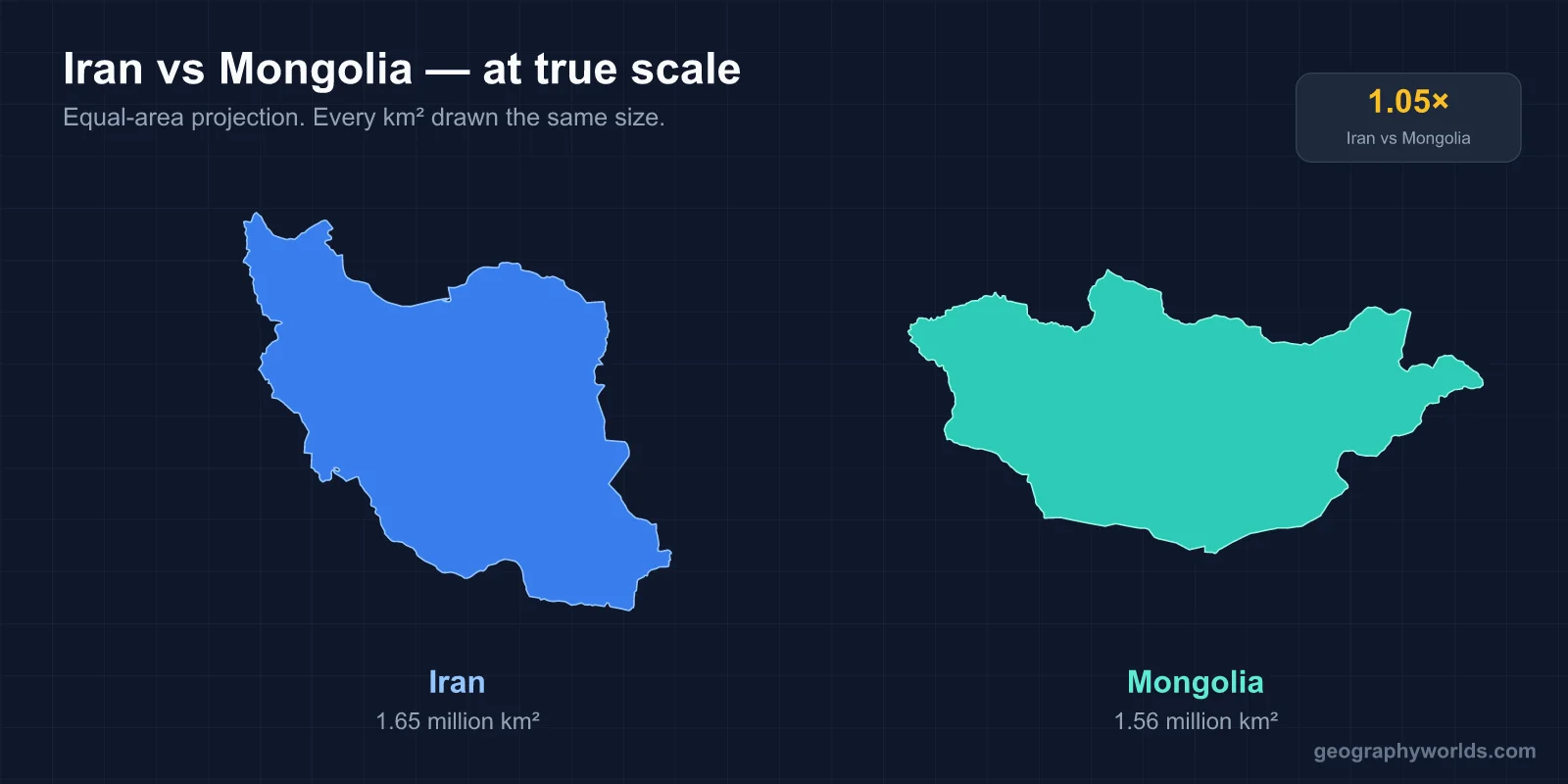
No, but they're close. Iran is slightly larger than Mongolia. Iran covers 1,648,195 km², while Mongolia covers 1,564,116 km². Iran is about 1.05 times the size of Mongolia — larger by 84,079 km², which is roughly the size of Ireland. But Iran has about 25× more people than Mongolia.
The Short Answer
Iran and Mongolia are both massive Asian countries that few people realize are so similar in size. Iran is the 17th-largest country in the world; Mongolia is the 18th. They're effectively tied in area but very different in everything else. Iran is in West Asia with a Muslim-majority Persian population. Mongolia is in East Asia with a Buddhist-influenced Turkic-Mongolic population. Iran has 88 million people; Mongolia has 3.4 million.
Both countries also share characteristics — vast empty landscapes, deep nomadic traditions, and historic empires (the Achaemenid and Sasanian Persian Empires; the Mongol Empire under Genghis Khan).

The Real Numbers
- Iran total area: 1,648,195 km² (636,372 sq mi)
- Mongolia total area: 1,564,116 km² (603,909 sq mi)
- Difference: 84,079 km² — about the size of Ireland
- Ratio: Iran is about 1.05× the size of Mongolia
Population
Iran has dramatically more people:
- Iran population: ~88,000,000
- Mongolia population: ~3,400,000
- Iran density: ~53 people per km²
- Mongolia density: ~2.2 people per km²
Iran has 25.9× more people than Mongolia. Iran's density is about 24× higher. Mongolia is the most sparsely populated independent country in the world (excluding some Pacific island nations) — its density is comparable to Greenland or some Arctic regions.
Geography
Iran has remarkable geographic diversity:
- Zagros Mountains: Northwest to southeast
- Alborz Mountains: Along the Caspian, including Mount Damavand (5,610 m)
- Central Plateau: Including the Dasht-e Kavir and Dasht-e Lut deserts
- Caspian Sea coast: Humid subtropical region
- Persian Gulf and Gulf of Oman coast: Hot southern coastline
Mongolia is mostly steppe and desert:
- Steppe (grasslands): Vast plains covering much of the country
- Gobi Desert: Southern Mongolia and into northern China
- Altai Mountains: Western mountains
- Khangai Mountains: Central mountains
- Lake Khövsgöl: Large freshwater lake in the north
- Highest peak: Khüiten Peak (4,374 m)
Climate
Iran has diverse climate — most of the country is arid or semi-arid. Continental climate dominates inland. Coastal areas have milder conditions. The Dasht-e Lut is one of the hottest places on Earth (surface temperatures over 70°C have been recorded).
Mongolia has extreme continental climate — cold winters (averaging -20 to -30°C, sometimes much colder) and warm summers (averaging 20-25°C). The country has the lowest annual average temperature of any inhabited country. Ulaanbaatar is the coldest capital city in the world. Mongolia is also extremely arid — most of the country gets less than 250 mm of precipitation annually.
Economy
Iran has a much larger economy:
- Iran GDP: ~$385 billion
- Mongolia GDP: ~$18 billion
- Iran per capita GDP: ~$4,400
- Mongolia per capita GDP: ~$5,300
Iran's economy is about 21× larger than Mongolia's in absolute terms, but Mongolia is slightly richer per capita. Iran's economy is heavily dependent on oil and gas, with international sanctions limiting growth. Mongolia's economy depends on mining (copper, gold, coal, uranium) and is closely tied to Chinese demand for raw materials.
History and Empires
Both countries have produced some of history's most impressive empires. Iran (Persia) was the heart of the Achaemenid Empire (550-330 BC), which under Cyrus the Great and Darius I controlled territory from the Indus Valley to Egypt — the largest empire of the ancient world. The Sasanian Empire (224-651 AD) was Rome's most formidable rival. After Islamic conquest, Iranian dynasties continued (Safavids, Qajars, Pahlavis) until the 1979 revolution.
Mongolia's empire under Genghis Khan and his successors (1206-1368) became the largest contiguous land empire in history, controlling about 24 million km² and 100 million people from Korea to Eastern Europe. The Mongols changed world history fundamentally — accelerating trade, spreading technology, and reshaping Asia. After the empire fragmented, Mongolia was dominated by China for centuries before becoming a Soviet satellite, then independent in 1991.
Key Facts
- Iran is about 1.05× the size of Mongolia.
- Iran has 25.9× more people than Mongolia.
- Mongolia is the most sparsely populated independent country in the world (after Pacific island nations).
- Both countries produced major historical empires (Persian and Mongol).
- Mongolia is landlocked; Iran has substantial coastlines on the Caspian Sea, Persian Gulf, and Gulf of Oman.
Fun Facts
- About 40% of Mongolians are still nomadic or semi-nomadic, traveling with traditional ger (yurt) tents.
- Iran has 27 UNESCO World Heritage Sites; Mongolia has 5.
- Mongolia's national alphabet is Cyrillic (introduced during Soviet era); Iran uses the Perso-Arabic script.
- Both countries have major mountain ranges — Iran's Alborz and Zagros, Mongolia's Altai and Khangai.
- Ulaanbaatar (Mongolia) and Tehran (Iran) are both major capital cities of vast countries — but Tehran is 3× the population of Ulaanbaatar.
Modern Politics
Iran has been an Islamic Republic since 1979, with both elected institutions (President, Parliament) and an unelected Supreme Leader who holds ultimate authority. The country has been at odds with the US and many Western countries for decades. Iran is a major regional power in the Middle East, with significant influence in Iraq, Syria, Lebanon, and Yemen through allied groups.
Mongolia is a parliamentary democracy that emerged from Soviet rule in 1991. The country has navigated a careful position between its two giant neighbors — Russia and China. Mongolia maintains close economic ties with China (its largest trading partner) while preserving political independence and democratic governance. Mongolia is one of the few Asian countries that has successfully transitioned to multi-party democracy.
Religion
Iran is officially Shia Islamic — about 90% of Iranians are Shia Muslim, with smaller Sunni Muslim (especially Kurds), Christian, Bahá'í, Zoroastrian, and Jewish minorities. Iran is the largest Shia-majority country in the world and considers itself the center of Shia Islam.
Mongolia is predominantly Buddhist (Tibetan Buddhism), with about 50% identifying as Buddhist. Traditional shamanism is still practiced by some, especially in rural areas. About 40% identify as non-religious. Mongolia's religious heritage was suppressed during Soviet rule but has been reviving since 1991.
Tourism Development
Iran has tremendous tourism potential but international tourism is limited by sanctions and political tensions. The country has 27 UNESCO World Heritage Sites — among the highest in the Middle East. Major attractions include Persepolis, Isfahan, Yazd, Shiraz, and the cities of Mashhad and Qom. Domestic tourism is significant; international tourism remains constrained.
Mongolia's tourism industry has grown significantly but remains small in absolute terms. The country receives about 600,000 international tourists annually. Major attractions include the Gobi Desert, Mongolian Steppe, Ulaanbaatar, Buddhist monasteries, and the chance to experience nomadic culture (staying in traditional ger camps).
Economy Structure
Iran has a diversified but constrained economy. Oil and gas are dominant, but Iran also has significant agriculture (saffron, pistachios), petrochemicals, automotive, and traditional crafts. International sanctions have limited Iran's integration with the global economy.
Mongolia's economy is dominated by mining (copper, gold, coal, uranium) and to a lesser extent by livestock and agriculture. The country is highly dependent on commodity prices and Chinese demand. Mongolia has tried to diversify, but mining remains the foundation.
Nuclear and Strategic Position
Iran has had an ongoing nuclear program that has been a major source of international tension. The Joint Comprehensive Plan of Action (JCPOA) in 2015 limited Iran's nuclear activities in exchange for sanctions relief, but the deal collapsed after US withdrawal in 2018. Iran maintains significant ballistic missile capabilities and has a network of proxy forces across the Middle East.
Mongolia is a nuclear-free zone — the country has formally declared itself non-nuclear since 1992. Mongolia maintains a careful balance between Russia and China, the two major powers that flank it. The country has worked to develop economic and diplomatic ties with the US, EU, Japan, and other "third neighbors" to balance its geopolitically vulnerable position between Russia and China. Mongolia's approach to its strategic situation has been praised as a model for small countries navigating between major powers. The country represents an interesting case study in how a small population can maintain independence and democratic governance despite being squeezed between two much larger neighbors.
The Bottom Line
Iran is barely larger than Mongolia — about 5% in area. But Iran has 26× more people, a much larger economy, and more global influence. Mongolia is one of the world's most sparsely populated countries with a unique nomadic culture. Both have produced empires that shaped world history, and both occupy strategic positions in modern Asia. The size similarity highlights how different countries can occupy comparable territory but support wildly different populations and economies.