
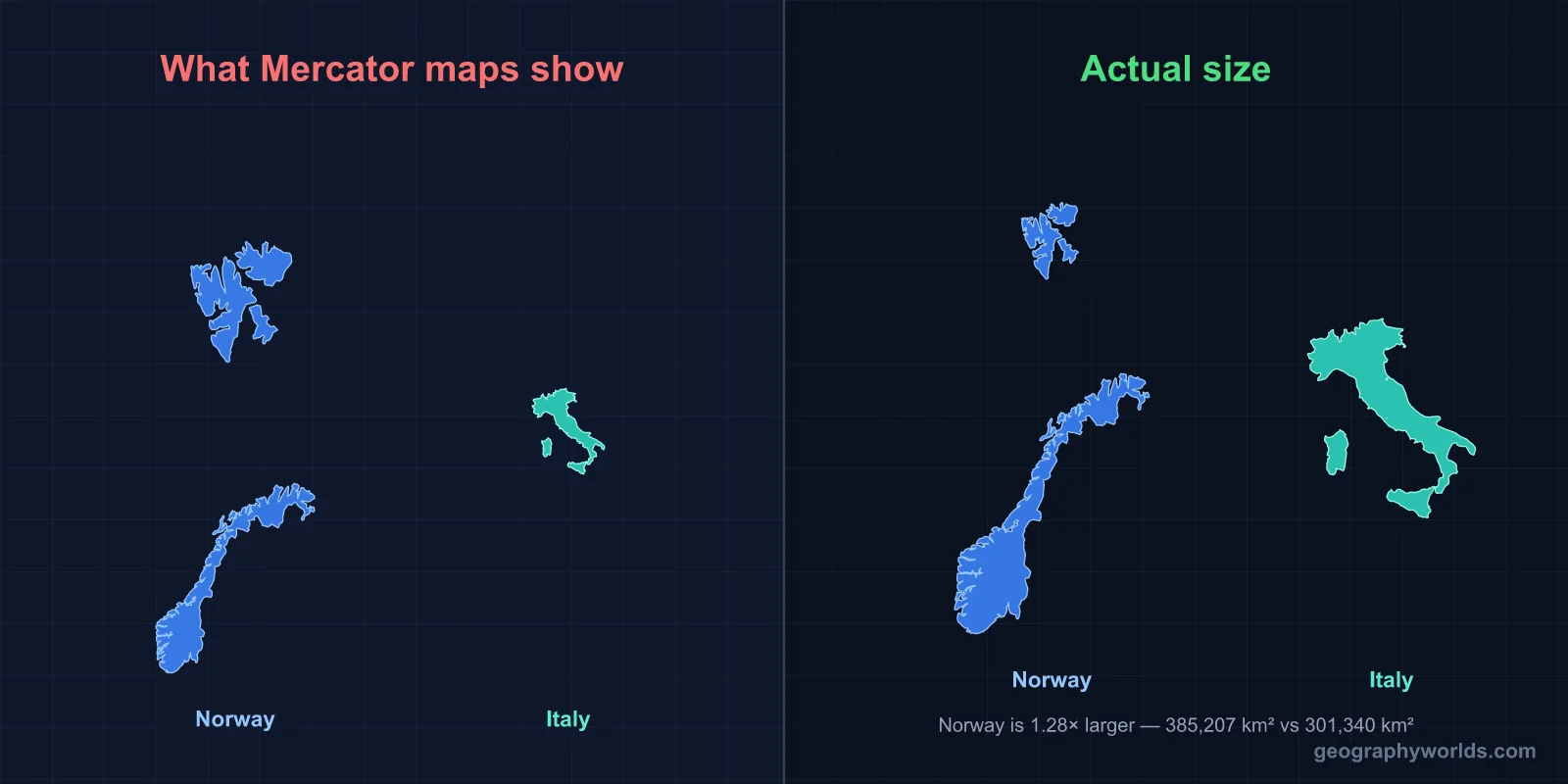
Norway and Italy are two of Europe's most geographically distinctive countries — Norway a long, narrow Scandinavian nation defined by fjords and the Arctic, Italy a Mediterranean peninsula shaped like a boot. They're close in size but their geographies could hardly be more different.
The Short Answer
Yes, Norway is bigger than Italy. Norway covers 385,207 km² (including Svalbard and Jan Mayen). Italy covers 301,340 km². Norway is approximately 28% larger. Even Norway's mainland alone (about 324,000 km²) is larger than Italy.
Side-by-Side Numbers
- Norway area: 385,207 km² (148,729 sq mi) including Svalbard
- Norway mainland only: ~324,000 km²
- Italy area: 301,340 km² (116,348 sq mi)
- Difference: Norway is ~84,000 km² larger (with Svalbard)
- Ratio: Norway is ~1.28× the size of Italy
- Norway population: ~5.5 million
- Italy population: ~59 million
Norway
Norway occupies the western part of the Scandinavian Peninsula in northern Europe, with extensive territory above the Arctic Circle. The country borders Sweden, Finland, and Russia, with the North Atlantic and Norwegian Sea to the west. Norway's mainland is famously long and narrow — about 1,750 km from Lindesnes in the south to Nordkapp in the north, but at its narrowest in Tysfjord only 6.3 km wide.
The Norwegian coast is one of the most dramatic on Earth, with thousands of islands and 1,190 deep fjords gouged into the bedrock by Ice Age glaciers. The Sognefjord, at 205 km long and 1,308 m deep, is one of the longest and deepest fjords in the world. About 28,953 km of mainland coastline becomes over 100,000 km when including all the bays and islands. Norway's territory also includes Svalbard, a Norwegian-administered Arctic archipelago about 1,000 km north of the mainland, and the volcanic island of Jan Mayen.
Italy
Italy is a peninsular country in southern Europe, easily recognizable by its boot shape extending into the Mediterranean Sea. It borders France, Switzerland, Austria, and Slovenia to the north, and includes the major islands of Sicily and Sardinia. Italy has about 7,600 km of coastline owing to its peninsular shape and the long perimeters of its islands. The country is divided into 20 administrative regions, each with distinct cultural identity, dialect, and cuisine.
Italy's geography is dominated by mountains and coastline. The Alps form the northern border, with Mont Blanc and the Matterhorn nearby. The Apennines run down the length of the peninsula like a spine. The Po Valley in the north is Italy's major flat agricultural region. Rome (3 million in city, 4.2 million metro), Milan, Naples, Turin, Florence, and Venice are major cities.
Population Contrast
Italy has about 11 times more people than Norway — 59 million versus 5.5 million. In essentially the same physical space, Italy packs an enormous urban civilization while Norway has one of the most sparsely populated landscapes in Europe. Italy's population density is about 196 per km²; Norway's is about 14 per km². Norway is one of the most sparsely populated countries in Europe; Italy is moderately dense for a developed nation.
Climate
Norway's climate varies dramatically across its long stretch. The western coast, warmed by the Gulf Stream, has a maritime climate with mild winters (Bergen averages 4°C in January) and cool summers. Inland and at higher elevations, conditions are continental and colder. The far north, including Svalbard, has Arctic conditions with months of polar night and midnight sun. Northern Norway is the only place on the European mainland where you can see the aurora borealis reliably.
Italy's climate is mostly Mediterranean. Southern Italy, Sicily, and Sardinia have hot, dry summers and mild, wet winters. The Po Valley in the north has a humid subtropical climate. The Italian Alps have alpine conditions with significant snowfall. Northern Italy can be foggy in winter; the south can be very hot in summer (the 2023 Italian heatwave saw temperatures over 47°C in Sicily, near European records).
Economy
Italy has the 8th largest economy in the world by GDP at about $2.4 trillion. Major industries include manufacturing (cars from Fiat, Ferrari, Lamborghini; luxury fashion from Gucci, Prada, Armani, Versace, Dolce & Gabbana; appliances), tourism, agriculture (wine, olive oil, pasta, cheese), and financial services. Norway has a much smaller economy at about $480 billion but extraordinarily high GDP per capita (around $87,000) thanks largely to North Sea oil and gas wealth and a small population. Norway runs the world's largest sovereign wealth fund, the Government Pension Fund Global, worth approximately $1.5 trillion.
Tourism
Italy is one of the world's top tourism destinations, receiving about 65 million international visitors per year (5th globally). Rome's Colosseum and Vatican; Venice's canals; Florence's Uffizi; Pompeii; the Amalfi Coast; the Cinque Terre; Tuscany; Sicily; Sardinia; the Italian Alps — the list of major destinations is almost endless. Italy has more UNESCO World Heritage Sites (59) than any other country in the world. Norway receives about 6 million international tourists per year — far less than Italy but significant relative to Norway's population. Major draws include the Western Fjords (Geirangerfjord and Nærøyfjord are UNESCO sites), Bergen with its Hanseatic warehouses, the Lofoten Islands, Tromsø, and Svalbard.
History and Culture
Italy is at the heart of Western civilization. The Roman Empire ruled most of the Mediterranean and Europe for centuries. The Renaissance was born in Florence and spread across Italy. The country has shaped Western art, music, food, science, philosophy, and politics perhaps more than any other single nation. Italy fragmented into competing city-states for much of the Middle Ages and Renaissance before being unified as a single nation in 1861.
Norway has been continuously settled for around 10,000 years. Vikings from Norway raided, traded, and settled across Europe from the late 8th to 11th centuries, reaching as far as North America (Vinland) and Constantinople. Norway was united with Denmark from 1380 to 1814, then with Sweden until 1905, when it became fully independent. Modern Norway is a global leader in renewable energy, electric vehicle adoption, and human development.
Food
Italy is a global culinary powerhouse. Italian cuisine — pasta, pizza, risotto, regional dishes from Sicilian arancini to Venetian seafood — is one of the most beloved in the world. Italy is the world's top producer of wine (some years tied with France) and the second-largest producer of olive oil. Italian food culture emphasizes simple, fresh ingredients and regional pride. Norwegian cuisine is built around fish — salmon, herring, cod (dried as klippfisk), mackerel, and shellfish — alongside lamb, reindeer, root vegetables, and dairy. Brown cheese (brunost), cloudberry preserves, lefse (potato flatbread), and lutefisk are distinctive. Norway introduced salmon sushi to Japan in the 1980s, an unexpected culinary cross-pollination.
Energy
Both nations have made decarbonization a priority but with different approaches. Norway is one of the world's leading oil and gas producers but also one of the most aggressive decarbonizers. Hydroelectricity provides nearly all the country's electricity, and over 80% of new car sales are EVs — the highest in the world. The country is on track to ban new sales of internal-combustion vehicles by 2025. Italy has been scaling up renewables (especially solar and wind) and is integrated into European energy markets. Italy faces challenges from energy import dependence (especially natural gas, much of which historically came from Russia) but has reduced reliance significantly since 2022. Both countries are among the leaders of European energy transition efforts.
Sport
Italy is a football-mad nation — Italian Serie A has produced some of the world's greatest clubs (Juventus, AC Milan, Inter Milan) and the national team has won four World Cups (1934, 1938, 1982, 2006). Italy is also a global force in cycling, motor sports (Ferrari's F1 legacy), and tennis. Norway excels at winter sports — cross-country skiing, biathlon, ski jumping, and increasingly alpine skiing. Norway has won more Winter Olympic medals than any other country in history, despite its small population. Norwegian footballers like Erling Haaland are now among the world's most valuable players.
Key Facts
- Norway is about 28% larger than Italy by area.
- Italy has 11× more people than Norway.
- Italy has more UNESCO World Heritage Sites than any other country (59).
- Norway has the world's largest sovereign wealth fund.
- Both are NATO members.
Fun Facts
- Norway's coastline including all islands is over 100,000 km long.
- Italy has more than 1,500 lakes.
- Norway's Svalbard is home to the Global Seed Vault.
- Italy is the country with the most UNESCO sites.
- Norway has territory north of 80°N latitude.
The Bottom Line
Norway is larger than Italy — by about 28%. But Italy has 11 times more people, a much larger economy, and a vastly bigger cultural and historical footprint. Norway has dramatic landscapes, oil wealth, and a quiet but powerful presence on the global stage as a model of sustainability and stability. Both will continue to be among the most prosperous and stable countries in Europe.
Quiz European Nations!
Test your knowledge of Norway, Italy, and great European countries.
Play Geography Games →