
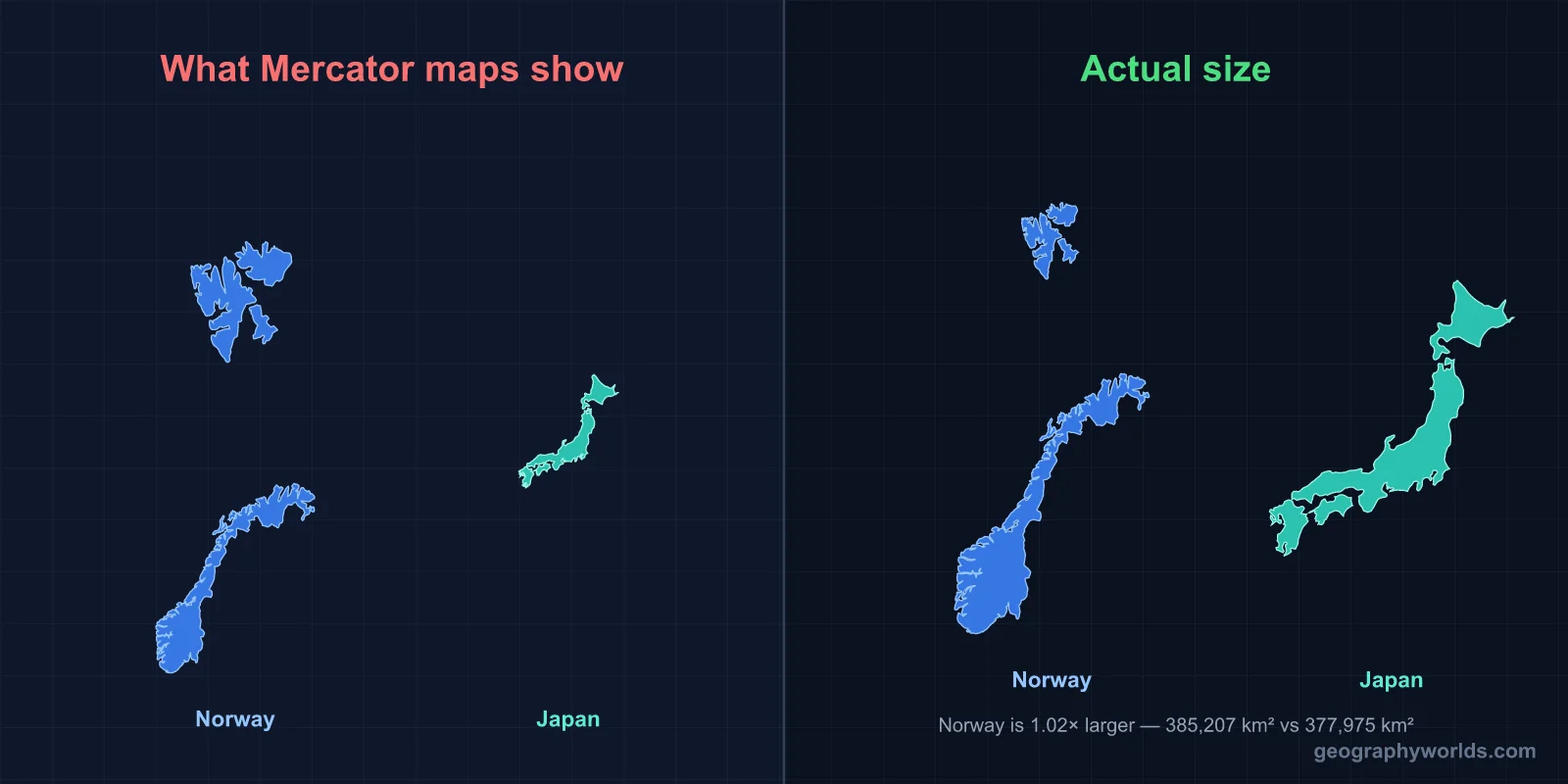
Norway and Japan are halfway around the world from each other, but they share some surprising similarities: both are long, narrow countries with rugged coastlines, both have economies dominated by exports, and both punch above their weight diplomatically. So which one is actually bigger in area? Norway, but by a slim margin.
The Short Answer
Yes, Norway is bigger than Japan — but barely. Norway covers 385,207 km² (including Svalbard and Jan Mayen). Japan covers 377,975 km². Norway is about 1.9% larger. The countries are nearly the same size, within 8,000 km² of each other.
Side-by-Side Numbers
- Norway area: 385,207 km² (148,729 sq mi) including Svalbard
- Norway mainland only: ~324,000 km² (without Svalbard and Jan Mayen)
- Japan area: 377,975 km² (145,937 sq mi)
- Difference: Norway is ~7,200 km² larger (including Svalbard)
- Ratio: Norway is ~1.02× the size of Japan
- Norway population: ~5.5 million
- Japan population: ~123 million
Norway
Norway occupies the western part of the Scandinavian Peninsula in northern Europe, with extensive territory above the Arctic Circle. The country borders Sweden, Finland, and Russia, with the North Atlantic and Norwegian Sea to the west. Norway is famously long and narrow — its mainland stretches about 1,750 km from Lindesnes in the south to Nordkapp in the north, but at its narrowest in Tysfjord, the country is only 6.3 km wide.
The Norwegian coast is one of the most dramatic on Earth, with thousands of islands and 1,190 deep fjords gouged into the bedrock by Ice Age glaciers. The Sognefjord, at 205 km long and 1,308 m deep, is one of the longest and deepest fjords in the world. About 28,953 km of mainland coastline becomes over 100,000 km when including all the bays and islands. Norway's territory also includes Svalbard, a Norwegian-administered Arctic archipelago about 1,000 km north of the mainland, and the volcanic island of Jan Mayen.
Japan
Japan is an East Asian island nation in the Pacific Ocean, off the coasts of China, Korea, and Russia. It consists of about 14,125 islands, with the four main ones — Honshu, Hokkaido, Kyushu, and Shikoku — accounting for the vast majority of the land area. Japan stretches about 3,000 km from Hokkaido in the north to Okinawa in the south. The country has 29,750 km of coastline.
Japan sits on the convergence of four tectonic plates, making it one of the most seismically and volcanically active places on Earth. About 73% of the country is mountainous, with most of the population concentrated in narrow coastal plains. Mount Fuji (3,776 m) is the highest peak. Major rivers include the Shinano, Tone, Tedori, and Yodo. Tokyo's metro area, with 37+ million people, is the largest urban area in the world.
Population Density
Norway and Japan are extreme opposites demographically. Japan has 123 million people in 377,975 km² (about 325 per km²). Norway has just 5.5 million people in 385,207 km² (about 14 per km²). Japan is roughly 23 times denser than Norway despite being virtually the same size. Norway is one of the most sparsely populated countries in Europe; Japan is one of the most densely populated large countries in the world.
Climate
Norway's climate varies dramatically across its long stretch. The western coast, warmed by the Gulf Stream, has a maritime climate with mild winters (Bergen averages 4°C in January) and cool summers. Inland and at higher elevations, conditions are continental and colder. The far north, including Svalbard, has Arctic conditions with months of polar night and midnight sun. Northern Norway is the only place on the European mainland where you can see the aurora borealis reliably.
Japan's climate ranges from subarctic in Hokkaido to subtropical in Okinawa. Most of Honshu has a humid subtropical climate with hot, humid summers, mild winters, and significant rainfall. The Sea of Japan coast gets heavy winter snow due to cold Siberian air picking up moisture over the relatively warm sea — Sapporo gets about 5 m of snow per year, the most of any major city in the world. Typhoons strike Japan from late summer through early fall.
Economy
Both countries have advanced economies, but they're very different in scale. Japan has the 4th largest economy in the world by GDP at about $4.2 trillion, dominated by manufacturing (cars, electronics), robotics, and increasingly services. Norway has a much smaller economy at about $480 billion but extraordinarily high GDP per capita (around $87,000) thanks largely to North Sea oil and gas wealth and a small population. Norway has used its oil revenues to build the world's largest sovereign wealth fund, the Government Pension Fund Global, worth approximately $1.5 trillion.
Government
Both countries are constitutional monarchies. Norway's King Harald V (born 1937) has reigned since 1991; Japan's Emperor Naruhito (born 1960) has reigned since 2019. Both monarchies are largely ceremonial, with real power held by parliaments and prime ministers. Norway's political system is a parliamentary republic with a strong tradition of social democracy, generous welfare state, and consensus politics. Japan's political system is also parliamentary but has been dominated for most of the post-war era by the conservative Liberal Democratic Party.
History
Norway has been continuously settled for around 10,000 years, since the retreat of the last Ice Age glaciers. Vikings from Norway (and other parts of Scandinavia) raided, traded, and settled across Europe from the late 8th to 11th centuries, reaching as far as North America (Vinland) and Constantinople. Norway was united with Denmark from 1380 to 1814, then with Sweden until 1905, when it became fully independent. Japan has been inhabited for at least 30,000 years. The Yamato dynasty consolidated power around the 6th century CE. Japan's Tokugawa shogunate enforced 250+ years of isolation (1603–1867) before the Meiji Restoration began rapid modernization in 1868.
Energy and Environment
Norway is one of the world's largest oil and gas producers but also one of the most ambitious decarbonizers. Hydroelectricity provides nearly all the country's electricity. Norway has the world's highest per-capita rate of electric vehicle adoption — over 80% of new car sales are EVs. The country is on track to ban new sales of internal-combustion vehicles by 2025. Japan, after the 2011 Fukushima nuclear disaster, has shifted toward fossil fuels, renewables, and a measured restart of nuclear plants. The country has set a goal of net-zero emissions by 2050 but faces significant challenges due to limited domestic resources.
Tourism and Culture
Norway is famous for its fjords, the northern lights, the midnight sun, and outdoor activities like skiing, fishing, and hiking. Major destinations include the Western Fjords (Geirangerfjord and Nærøyfjord are UNESCO sites), Bergen with its Hanseatic warehouses, the Lofoten Islands, Tromsø, and Svalbard. About 6 million international tourists visit Norway annually. Japan welcomes about 32 million international visitors per year, with top draws being Tokyo, Kyoto's temples and gardens, Osaka, Hiroshima, Mount Fuji, the Japanese Alps, Hokkaido's ski resorts and food culture, and Okinawa's beaches.
Cuisine
Both food cultures revolve heavily around seafood. Norwegian cuisine is built around fish — salmon, herring, cod (dried as klippfisk), mackerel, and shellfish — alongside lamb, reindeer, root vegetables, and dairy. Brown cheese (brunost), cloudberry preserves, lefse (potato flatbread), and lutefisk are distinctive. Japanese cuisine, "washoku," is on the UNESCO Intangible Cultural Heritage list. Sushi, sashimi, tempura, ramen, udon, soba, kaiseki, and a vast world of regional specialties define the tradition. Both countries' food cultures emphasize freshness, seasonality, and simple preparation. Interestingly, Norway introduced raw salmon sushi to Japan in the 1980s — fatty Atlantic salmon was previously avoided in Japan because Pacific salmon often carried parasites; Norwegian aquaculture solved that and the new salmon sushi style spread back to the rest of the world from there.
Key Facts
- Norway is about 2% larger than Japan when Svalbard is included.
- Japan has 23× more people than Norway.
- Both are constitutional monarchies with ceremonial royals.
- Norway has the world's largest sovereign wealth fund.
- Japan has the world's largest metropolitan area (Tokyo).
Fun Facts
- Norway's coastline including all islands is over 100,000 km long.
- Japan has more than 100 active volcanoes.
- Norway has a 60-day winter "polar night" in its far north.
- Tokyo has more Michelin-starred restaurants than any other city.
- Norway invented salmon sushi (sold to Japan in the 1980s).
The Bottom Line
Norway is slightly larger than Japan — by about 2%. The two countries are virtually the same size geographically but radically different in population, climate, density, and economic structure. Norway is sparsely populated, resource-rich, and dramatically northern. Japan is densely populated, manufacturing-driven, and strung across volcanic islands. Both will continue to be among the world's most stable, prosperous democracies through the 21st century, even as both navigate aging populations and energy transitions.
Quiz World Nations!
Test your knowledge of Norway, Japan, and the great nations of the world.
Play Geography Games →