
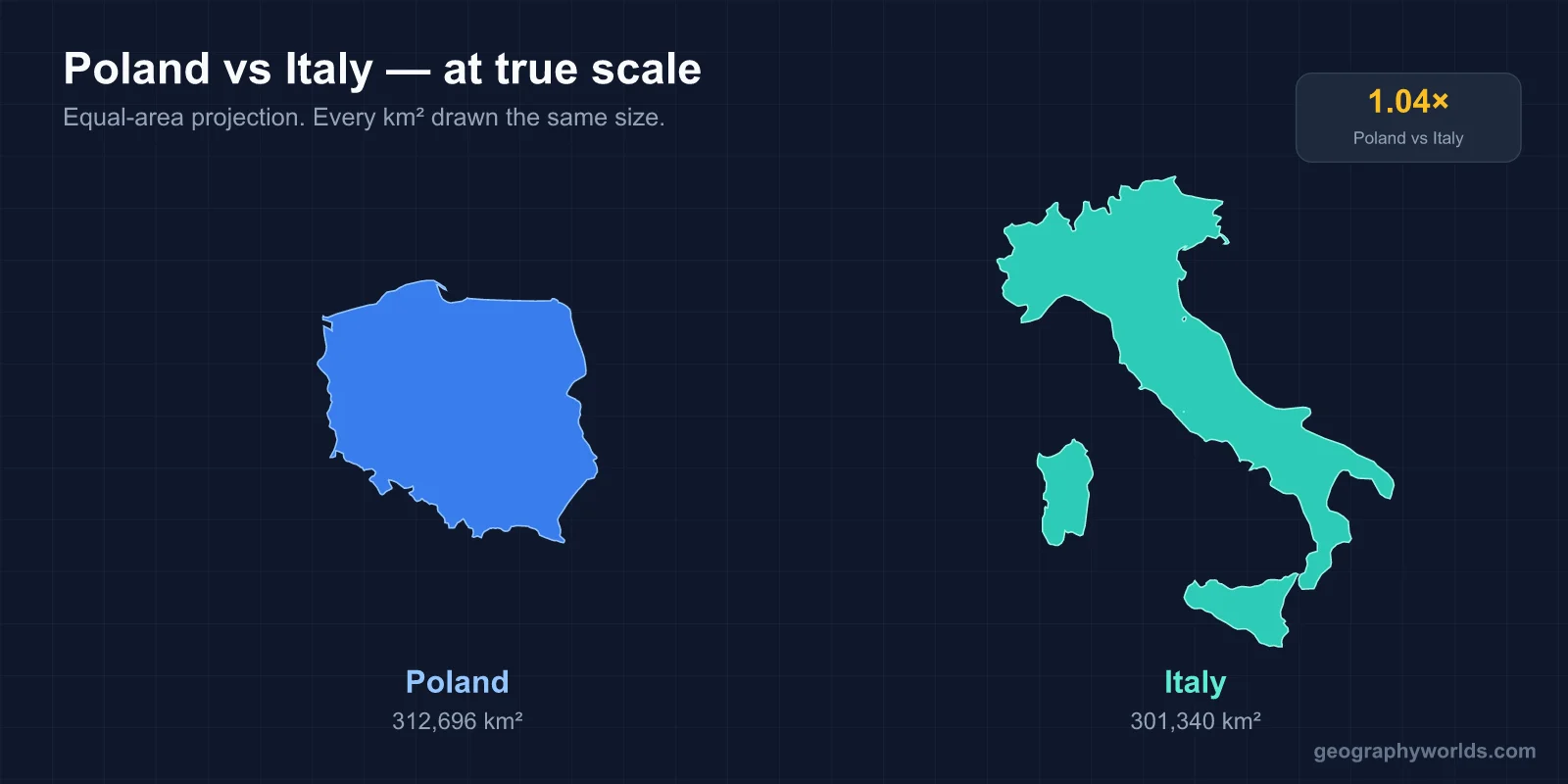
Poland and Italy are two of Europe's major nations — Italy a peninsular country at the heart of Mediterranean civilization, Poland a Central European country that has emerged as one of the EU's most consequential members. So which one is bigger?
The Short Answer
Yes, Poland is slightly bigger than Italy. Poland covers 312,696 km². Italy covers 301,340 km². Poland is approximately 3.8% larger than Italy. They're remarkably close in size.
Side-by-Side Numbers
- Poland area: 312,696 km² (120,733 sq mi)
- Italy area: 301,340 km² (116,348 sq mi)
- Difference: Poland is ~11,000 km² larger
- Ratio: Poland is ~1.04× the size of Italy
- Poland population: ~37 million
- Italy population: ~59 million
Poland
Poland sits in Central Europe, bordered by Germany to the west, Czechia and Slovakia to the south, Ukraine and Belarus to the east, Lithuania and the Russian exclave of Kaliningrad to the northeast, and the Baltic Sea to the north. The country has roughly 528 km of coastline. It is the 6th most populous country in the European Union and one of the largest by area within the EU.
Most of Poland is low and flat, especially the Northern European Plain that dominates the central part of the country. The Sudetes and Carpathian Mountains run along the southern border with Czechia and Slovakia, with Rysy (2,499 m) as the highest peak. The Vistula River, Poland's longest, flows from the Carpathians north through Kraków and Warsaw to the Baltic at Gdańsk. Major cities include Warsaw (the capital, 1.8 million), Kraków, Łódź, Wrocław, Poznań, and Gdańsk.
Italy
Italy is a peninsular country in southern Europe, easily recognizable by its boot shape extending into the Mediterranean Sea. It borders France, Switzerland, Austria, and Slovenia to the north, and includes the major islands of Sicily and Sardinia. Italy is divided into 20 administrative regions, each with distinct cultural identity, dialect, and cuisine. Rome (3 million in city, 4.2 million metro), Milan, Naples, Turin, Florence, and Venice are major cities.
Italy's geography is dominated by mountains and coastline. The Alps form the northern border, with Mont Blanc and the Matterhorn nearby. The Apennines run down the length of the peninsula like a spine. The Po Valley in the north is Italy's major flat agricultural region. Italy has about 7,600 km of coastline.
Population
Italy has about 59 million people; Poland has about 37 million. Italy has 60% more people in 4% less area. Population density: Italy about 195 per km², Poland about 118 per km². Both countries have aging populations, but Italy is older — median age around 47, vs Poland's 41. Both have experienced significant emigration in recent decades, though Poland has seen significant return migration and immigration in the past few years (especially Ukrainian refugees since 2022).
Climate
The two countries have very different climates. Poland has a temperate climate transitioning from oceanic in the west to continental in the east. Winters can be cold (often below freezing), summers are mild (typical July highs of 20–25°C). The Baltic Sea coast moderates conditions in the north; the southern mountains can have alpine conditions. Italy has a predominantly Mediterranean climate, especially in the central and southern peninsulas, with hot dry summers and mild wet winters. The Po Valley in the north has a humid subtropical climate. The Italian Alps have alpine conditions with significant snowfall.
Economy
Italy has a much larger economy than Poland. Italy's GDP is about $2.4 trillion (8th largest in the world). Major industries include manufacturing (cars from Fiat, Ferrari, Lamborghini; luxury fashion from Gucci, Prada, Armani; appliances), tourism, agriculture (wine, olive oil, pasta, cheese), and financial services. Poland's GDP is about $850 billion (21st largest globally). Poland has been one of the EU's fastest-growing economies for over a decade. Major industries include manufacturing, IT services, mining (Poland is a major coal producer), retail, and agriculture.
History
Both have rich and tumultuous histories. Italy is at the heart of Western civilization. The Roman Empire ruled most of the Mediterranean and Europe for centuries. The Renaissance was born in Florence and spread across Italy. The country has shaped Western art, music, food, science, philosophy, and politics. Italy fragmented into competing city-states for much of the Middle Ages and Renaissance before being unified as a single nation in 1861.
Poland's history is one of the most dramatic in Europe. The country was a major power during the Polish-Lithuanian Commonwealth (1569–1795), one of the largest and most populous countries in Europe at its peak. But the late 18th century brought the partitions of Poland by Russia, Prussia, and Austria — by 1795, Poland disappeared from the map for 123 years. It was reestablished in 1918, only to be invaded by Nazi Germany in 1939 (the start of World War II) and the Soviet Union shortly after. Six million Polish citizens (about 17% of the population, including 3 million Jews) died in WWII.
Religion
Both are historically Catholic countries with significant differences. Italy is the heart of Roman Catholicism — the Vatican City (the seat of the Pope) is an independent state within Rome. About 80% of Italians identify as Catholic, though active religious practice has declined significantly. Pope John Paul II (1978–2005) was Polish, the first non-Italian Pope in over 400 years. Poland is one of the most religiously observant countries in Europe — about 71% of Poles identify as practicing Catholics. The Catholic Church played a major role in Polish resistance to Soviet domination during the Cold War.
Cuisine
Both have famous food cultures. Italian cuisine is one of the most globally beloved — pasta, pizza, risotto, regional dishes from Sicilian arancini to Venetian seafood. Italy is the world's top producer of wine (some years tied with France) and the second-largest producer of olive oil. Italian food culture emphasizes simple, fresh ingredients and regional pride. Polish cuisine is hearty and reflects Central European traditions: pierogi (dumplings), bigos (hunter's stew), kielbasa, żurek (sour rye soup), gołąbki (cabbage rolls), and oscypek (smoked sheep cheese). Vodka is Poland's national drink — Polish vodka has been distilled for over 500 years.
EU Role and Modern Politics
Italy was a founding member of the European Coal and Steel Community in 1951, which became the EU. The country has been a key player in European integration and is part of the Eurozone. Poland joined the EU in 2004 and is one of its largest members but has not adopted the Euro. Both countries have experienced political turbulence in the 2010s and 2020s, with right-wing populist movements gaining significant influence. Poland has been one of the largest recipients of EU funds and a key supporter of Ukraine since Russia's 2022 invasion.
Sport and Culture
Both nations have strong sporting traditions. Italy has 4 FIFA World Cup titles (1934, 1938, 1982, 2006) and is one of football's great nations. Italian fashion, design, and luxury brands dominate global markets. Poland has produced major athletes in football (Robert Lewandowski is one of the top strikers of his generation), volleyball, and motorsports. Polish classical music (Chopin) and literature (Wisława Szymborska, Czesław Miłosz — both Nobel laureates) have global influence.
Tourism
Italy is one of the most-visited countries in the world, welcoming about 65 million international visitors per year. Top destinations include Rome's Colosseum and Vatican; Venice's canals; Florence's Uffizi; Pompeii; the Amalfi Coast; the Cinque Terre; Tuscany; Sicily; Sardinia; and the Italian Alps. Italy has more UNESCO World Heritage Sites (59) than any other country in the world. Poland welcomes about 22 million international visitors per year. Top destinations include Kraków's historic old town, the Auschwitz-Birkenau Memorial, the Wieliczka Salt Mine, Warsaw's rebuilt old town, the Tatra Mountains, the Baltic coast (especially Gdańsk and Sopot), and Poznań.
Key Facts
- Poland is about 4% larger than Italy by area.
- Italy has 60% more people than Poland.
- Italy has a much larger economy.
- Both are largely Catholic but with different religiosity levels.
- Both are NATO members and major EU economies.
Fun Facts
- Italy has more UNESCO World Heritage Sites than any other country (59).
- Poland has 17 UNESCO World Heritage Sites.
- Italy is home to the Vatican City — the smallest sovereign state in the world.
- Poland has the largest castle in the world by surface area — Malbork.
- Both countries border the EU's northern frontiers.
The Bottom Line
Poland is slightly bigger than Italy — by about 4%. But Italy has 60% more people, a much larger economy, and a vastly bigger cultural and historical footprint. Poland has been one of Europe's fastest-growing economies since joining the EU and increasingly plays a major role in continental politics, particularly around supporting Ukraine and EU defense.
Quiz European Nations!
Test your knowledge of Poland, Italy, and great European countries.
Play Geography Games →