
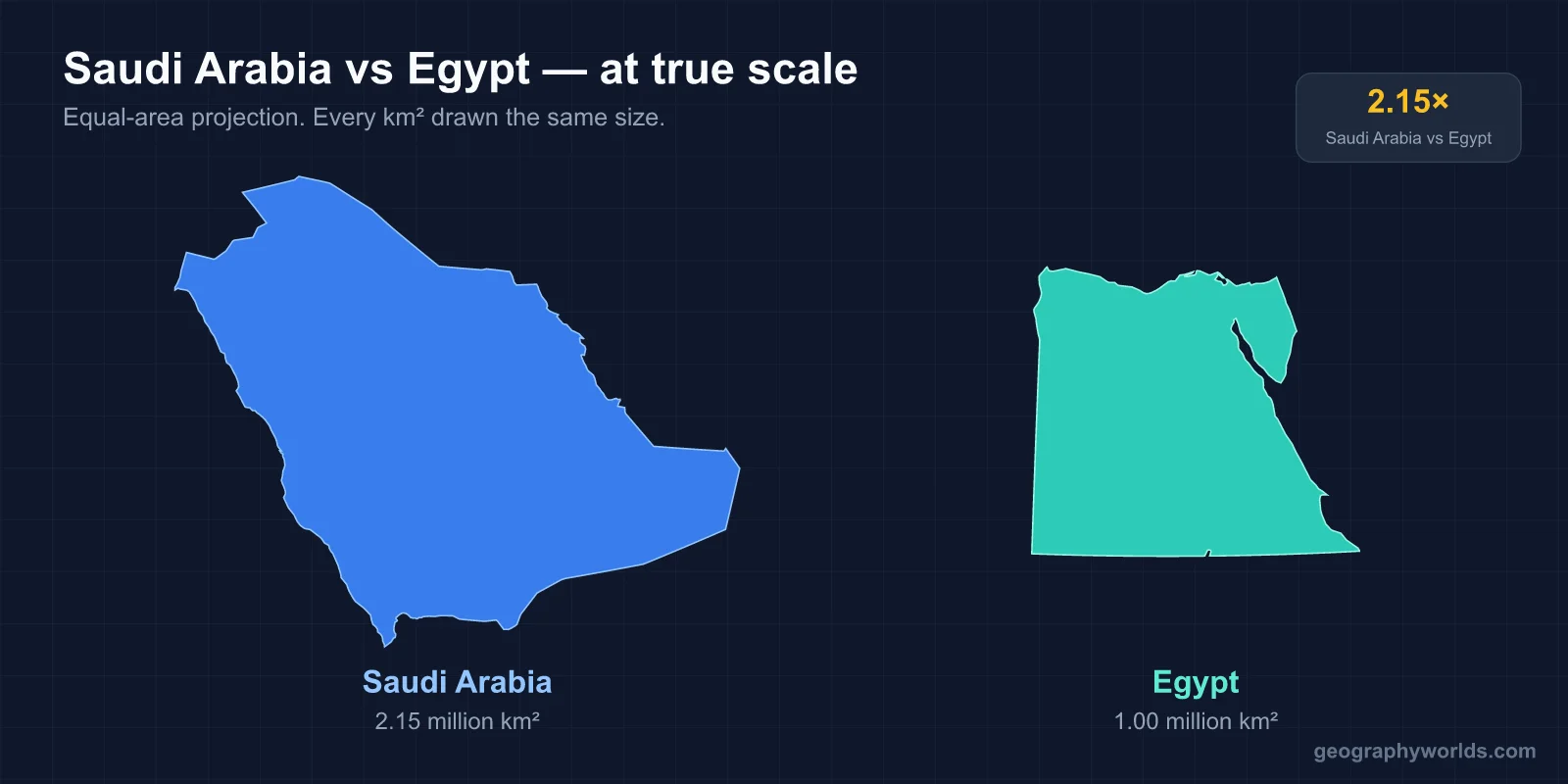
Yes. Saudi Arabia is much larger than Egypt. Saudi Arabia covers 2,149,690 km², while Egypt covers 1,001,450 km². Saudi Arabia is about 2.15 times the size of Egypt — large enough to fit two Egypts inside its borders, with room left over for Lebanon. But Egypt has nearly 3 times more people than Saudi Arabia.
The Short Answer
Saudi Arabia is the largest country in the Middle East and the largest country in Western Asia. It dominates the Arabian Peninsula, covering about 80% of the peninsula's area. Egypt is the most populous country in the Arab world but a significantly smaller country geographically. The two are major regional powers with very different geographic profiles.
Despite the size gap, Egypt has more people, a larger economy (debatably), and a much longer civilizational history. Both countries are dominated by desert — most of Egypt is the Sahara, while most of Saudi Arabia is the Arabian Desert — but their populations cluster in completely different ways.

The Real Numbers
- Saudi Arabia total area: 2,149,690 km² (830,000 sq mi)
- Egypt total area: 1,001,450 km² (386,662 sq mi)
- Difference: 1,148,240 km² — about the size of South Africa or Bolivia
- Ratio: Saudi Arabia is about 2.15× the size of Egypt
Globally, Saudi Arabia ranks 12th by area — between Mexico (13th) and Indonesia (14th). Egypt ranks 30th — between Pakistan (33rd) and Tanzania (31st). Both are significant by world standards but in different size tiers.
Population: Egypt Wins Big
While Saudi Arabia is larger by area, Egypt has substantially more people:
- Egypt population: ~110,000,000
- Saudi Arabia population: ~37,000,000
- Egypt density: ~110 people per km²
- Saudi Arabia density: ~17 people per km²
Egypt has about 3 times more people than Saudi Arabia, despite being smaller. Egypt's population density is about 6.5 times higher than Saudi Arabia's. But this density is misleading — almost all of Egypt's population is concentrated along the Nile River (about 5% of the country's land area), where actual density approaches 1,500 people per km². The rest of Egypt is almost empty desert.
The Nile vs the Arabian Peninsula
Egypt is essentially a desert with one giant river running through it. About 95-97% of Egyptians live within 20 km of the Nile or its delta. The fertile Nile valley and delta cover only about 40,000 km² — that's where modern Egypt actually exists. The vast Western Desert (Sahara) and Eastern Desert make up the rest of the country but contain only a few oases (Siwa, Bahariya, Dakhla, Kharga) and Bedouin nomadic populations.
Saudi Arabia covers most of the Arabian Peninsula. The country has no major rivers — it's essentially a vast arid plateau with mountains along the western (Hejaz/Asir) and southwestern (Yemen border) edges. Saudi Arabia's population is concentrated in cities (Riyadh, Jeddah, Mecca, Medina, Dammam) and oases. Vast portions of the country (the Empty Quarter / Rub' al Khali, the Nafud Desert) are essentially unpopulated.
Climate
Both countries are dominated by hot desert climate. Egypt's climate is arid to hyper-arid in most areas, with very hot summers (40-45°C) and mild winters (10-20°C). The Mediterranean coast in the north (Alexandria area) has a slightly milder climate with more rainfall. Most of Egypt receives less than 50 mm of rain annually.
Saudi Arabia is also arid to hyper-arid. Summer temperatures regularly exceed 45°C, and the Empty Quarter has recorded temperatures over 55°C. Winter nights can drop below freezing in higher elevations. The southwestern Asir Mountains receive more rainfall (up to 600 mm annually) due to monsoon influence — they're one of the few green spots in Saudi Arabia. The Hejaz region (along the Red Sea coast) has Mediterranean influence.
Economy
Both countries have significant economies, but with different structures:
- Saudi Arabia GDP: ~$1.07 trillion
- Egypt GDP: ~$398 billion
- Saudi Arabia per capita GDP: ~$29,000
- Egypt per capita GDP: ~$3,600
Saudi Arabia's economy is about 2.7× larger than Egypt's in total terms. Per capita, Saudi Arabia is about 8× richer on average. The main reason: oil. Saudi Arabia has about 17% of the world's proven petroleum reserves and is the largest exporter. Saudi Aramco is one of the most valuable companies in the world.
Egypt's economy is more diversified — tourism (the pyramids, Red Sea resorts), agriculture (Nile delta produces cotton, rice, fruits), Suez Canal revenues, manufacturing, and remittances from Egyptians working abroad. Egypt has been working to diversify and modernize its economy, but per-capita income remains much lower than Saudi Arabia's.
Religion and Culture
Both countries are Muslim-majority and culturally Arab, but with significant differences. Saudi Arabia is the heartland of Islam — home to Mecca (the holiest city in Islam) and Medina (the second-holiest). The country is officially a Wahhabi Sunni Islamic state with strict religious laws. The Saudi royal family bases its legitimacy on Islamic credentials (the King is "Custodian of the Two Holy Mosques").
Egypt is also a Muslim-majority country (about 90% Sunni Muslim), but with a significant Coptic Christian minority (about 10% of the population) and a more secular legal tradition. Cairo's Al-Azhar University is one of the oldest and most prestigious Islamic universities in the world. Egypt is known for its rich cultural heritage spanning pharaonic, Greco-Roman, Coptic, and Islamic civilizations.
Geopolitical Influence
Saudi Arabia is the regional heavyweight of the Arab world by economic and energy influence. It leads OPEC, hosts the GCC headquarters, and uses oil revenue to project soft power across the Muslim world (funding mosques, schools, and Islamic institutions globally). The Saudi-Iran rivalry shapes much of Middle Eastern geopolitics, with Saudi Arabia backing Sunni-aligned governments and groups.
Egypt is the cultural and demographic anchor of the Arab world. Cairo is the largest Arab city, Al-Azhar University is the most influential Islamic theological institution, and Egyptian dialect Arabic is widely understood across the Arab world due to Egypt's film and music industry. Egypt also controls the Suez Canal — a strategically vital chokepoint for global trade. Both countries are major US allies and play central roles in Arab regional politics.
Tourism
Egypt has long been a top tourism destination because of its pharaonic monuments — the Pyramids of Giza, the Sphinx, Luxor's temples and Valley of the Kings, Abu Simbel. Plus the Red Sea coast (Hurghada, Sharm El Sheikh) for diving and beach tourism. Egypt receives about 13 million international tourists annually.
Saudi Arabia historically restricted tourism to religious pilgrims (Hajj and Umrah). The Hajj alone brings about 2 million Muslims to Mecca each year — one of the largest annual religious gatherings in the world. Saudi Arabia has only recently (since 2019) opened to general international tourism as part of Vision 2030 economic diversification. New tourist destinations include AlUla (rock-cut tombs), Riyadh, and the Red Sea coast. Saudi Arabia is building NEOM, a futuristic mega-city.
Key Facts
- Saudi Arabia is about 2.15× the size of Egypt.
- Egypt has 3× more people than Saudi Arabia.
- Egypt's population density is 6.5× higher than Saudi Arabia's.
- Saudi Arabia is the largest country in the Middle East.
- Saudi Arabia's economy is about 2.7× larger than Egypt's in absolute terms.
Fun Facts
- Saudi Arabia's Empty Quarter (Rub' al Khali) covers 650,000 km² — bigger than France.
- The Nile flows north — making Egypt's "Upper Egypt" actually in the south.
- Saudi Arabia has more proven oil reserves than any other country except Venezuela.
- Mecca during Hajj is so crowded that it briefly becomes one of the densest places on Earth.
- Egypt's Suez Canal handles about 12% of global trade by tonnage.
- Saudi Arabia's NEOM mega-project will eventually cover an area larger than Belgium.
- About 90% of Egyptians are concentrated on just 4% of Egypt's land area along the Nile.
- Saudi Arabia's King Fahd International Airport is the world's largest airport by area — covering 776 km², bigger than the entire country of Bahrain.
- The combined Saudi Arabia + Egypt area is roughly the size of Argentina.
The Bottom Line
Saudi Arabia is bigger than Egypt by area — more than 2× larger — but Egypt has nearly 3× more people. Saudi Arabia is the largest country in the Middle East and one of the world's top oil producers. Egypt is the most populous country in the Arab world and a civilizational pillar with 5,000+ years of continuous history.
The two countries represent different scales of Middle Eastern power: Saudi Arabia as the geographically dominant, oil-rich modern power; Egypt as the densely populated cultural and historical heartland. Both are major regional players, but in very different ways.