
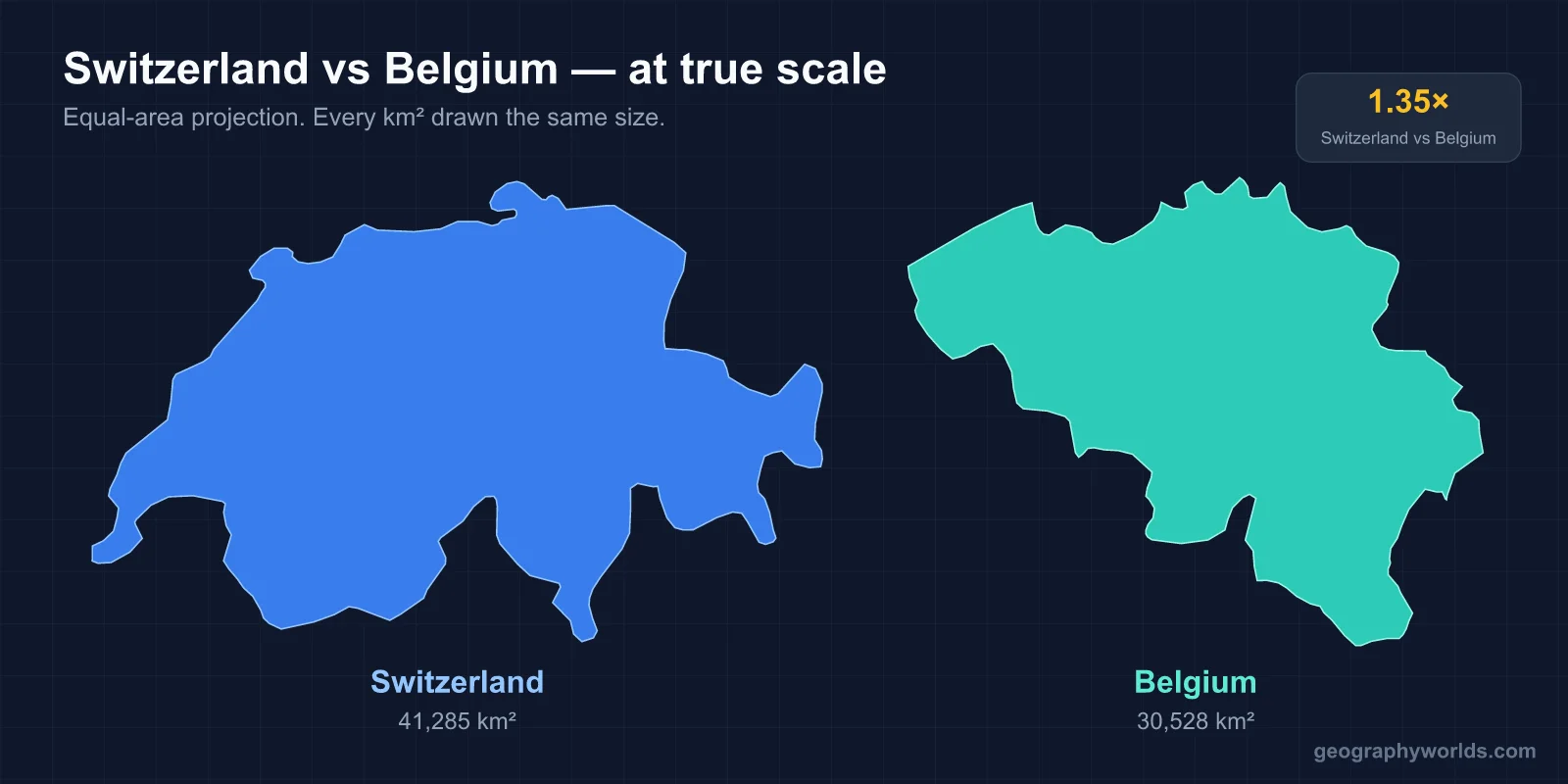
Yes. Switzerland is larger than Belgium. Switzerland covers 41,285 km², while Belgium covers 30,528 km². Switzerland is about 1.35 times the size of Belgium — larger by 10,757 km², about the size of Cyprus or Lebanon. But Belgium has nearly 30% more people than Switzerland.
The Short Answer
Switzerland and Belgium are two small but globally influential European countries. Switzerland is a wealthy, neutral Alpine nation known for banking, watches, and chocolate. Belgium is a Western European country famous for being the heart of European Union governance (Brussels hosts the EU Commission, EU Council, and NATO headquarters). Both are multilingual, prosperous countries with strong international identities.
Despite Switzerland being larger, Belgium has more people, higher population density, and the EU's capital. Switzerland has higher per-capita wealth and famous neutrality. Both have shaped European history in different ways.
The Real Numbers
- Switzerland total area: 41,285 km² (15,940 sq mi)
- Belgium total area: 30,528 km² (11,787 sq mi)
- Difference: 10,757 km² — about the size of Lebanon or Cyprus
- Ratio: Switzerland is about 1.35× the size of Belgium
Population
Belgium has more people:
- Belgium population: ~11,700,000
- Switzerland population: ~8,800,000
- Belgium density: ~383 people per km²
- Switzerland density: ~213 people per km²
Belgium has about 33% more people than Switzerland. Belgian density is about 80% higher. Belgium is one of the most densely populated countries in Europe, with most of its population concentrated in the Flemish Region (northern Belgium) and around Brussels.
Geography
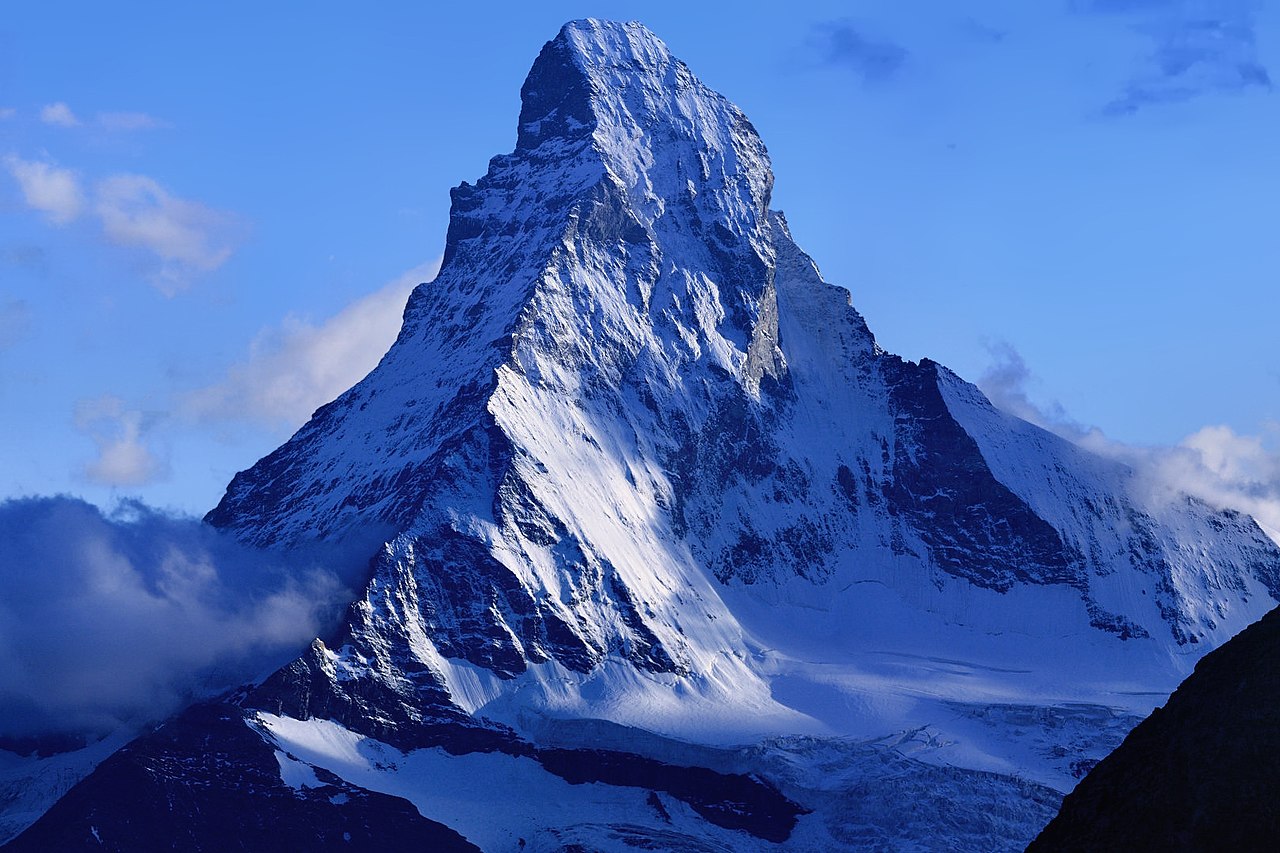
Switzerland is dominated by the Alps:
- The Alps: Cover about 60% of Switzerland
- Mittelland (Central Plateau): Most populated region
- Major lakes: Lake Geneva, Lake Constance, Lake Lucerne
- Major rivers: Rhine, Rhône, Inn, Ticino
- Highest peak: Dufourspitze (4,634 m)
- Landlocked: No coastline
Belgium is mostly flat lowlands:
- Coastal lowlands: Along the North Sea (Belgium has 65 km of coastline)
- Central plains: Most of central Belgium
- Ardennes: Forested hills in the southeast
- Highest point: Signal de Botrange (694 m) — modest by European standards
- Major rivers: Scheldt, Meuse
Climate
Switzerland has alpine and continental climate. The Mittelland has temperate climate similar to neighboring Germany. Mountain areas have alpine conditions with significant snow. Summers are warm (18-25°C in lower elevations), winters cold (-5 to +5°C in lower elevations, much colder at altitude).
Belgium has temperate maritime climate. Summers are mild (17-22°C), winters cool (0-5°C). Rainfall is consistent year-round, with the country being famously cloudy and damp. The Belgian coast moderates temperatures compared to inland areas.
Languages
Both countries are famously multilingual:
- Switzerland: 4 official languages — German (63%), French (23%), Italian (8%), Romansh (0.5%)
- Belgium: 3 official languages — Dutch/Flemish (60%), French (40%), German (1%)
Switzerland's linguistic regions are organized into 26 cantons that are mostly monolingual within themselves. Belgium's linguistic divisions are more politically charged — Flemish-speaking Flanders and French-speaking Wallonia have long had tensions, and Belgium has faced periodic political crises around this divide.
Economy
Both are wealthy:
- Switzerland GDP: ~$885 billion
- Belgium GDP: ~$590 billion
- Switzerland per capita GDP: ~$101,000
- Belgium per capita GDP: ~$50,000
Switzerland's economy is about 50% larger than Belgium's in absolute terms, and about 2× richer per capita. Both have advanced economies. Switzerland: banking, pharmaceuticals, watches, machinery. Belgium: chemicals, automotive (Ford, Audi manufacturing), pharmaceuticals, port logistics (Antwerp is one of Europe's busiest ports), diamonds (Antwerp dominates global diamond trade).
Political Structure
Switzerland is a federation of 26 cantons with direct democracy. The country has been militarily neutral since 1815. Switzerland is not in the EU but has bilateral agreements that integrate it closely with European markets.
Belgium is a federal parliamentary constitutional monarchy. The country is divided into 3 regions (Flanders, Wallonia, Brussels-Capital) and 3 linguistic communities. Belgium is a founding member of the EU and NATO. Brussels hosts the headquarters of both organizations, making it the de facto capital of European integration.
Key Facts
- Switzerland is about 1.35× the size of Belgium.
- Belgium has 33% more people than Switzerland.
- Switzerland's economy is about 50% larger and 2× richer per capita.
- Belgium hosts the EU Commission, Council, and NATO headquarters.
- Both are famously multilingual European countries.
Fun Facts
- Belgium produces about 220,000 tons of chocolate annually — comparable to Switzerland's output despite Belgium being smaller.
- Switzerland and Belgium both have famous beer cultures — Belgian beers (especially Trappist ales) are world-renowned.
- Both countries have distinctive cuisines — Belgian fries (invented in Belgium, not France), Swiss fondue and raclette.
- Antwerp processes about 84% of the world's rough diamonds.
- Belgium has produced major comic book traditions — including Tintin and the Smurfs.
The Bottom Line
Switzerland is about 35% larger than Belgium, but Belgium has 33% more people. Both are small, wealthy European countries with disproportionate global influence — Switzerland through banking and neutrality, Belgium through European integration. The Swiss-Belgian comparison shows that small countries can play very different but equally important roles in shaping European and global affairs. Both have strong identities despite or because of their multilingual, federal structures.
History
Switzerland has been a confederation since 1291 — over 730 years of continuous existence. The country was officially neutral since the Treaty of Westphalia in 1648 and has avoided major European wars since 1815. Modern Switzerland is a federal republic with 26 cantons that each retain significant autonomy.
Belgium became an independent country in 1830 after separating from the Netherlands. The country was a major colonial power in Africa (controlling what is now the Democratic Republic of Congo). Belgium suffered severely in both World Wars due to its position between Germany and France. After WWII, Belgium became a founding member of the European Coal and Steel Community (precursor to the EU) and NATO.
Tourism
Switzerland attracts about 12 million tourists annually for skiing, Alps, lake cities, Swiss villages, and history. Belgium receives about 9 million international tourists, with major destinations including Brussels, Bruges (famously well-preserved medieval city), Ghent, Antwerp, and the Belgian coast. Both have excellent culinary tourism — Swiss chocolate and cheese, Belgian beer and chocolate.
Sports
Both have strong sports traditions. Switzerland is famous for skiing, mountaineering, ice hockey, and tennis (Roger Federer). Belgium is known for cycling (multiple Tour de France winners), football, and martial arts. The Spa-Francorchamps F1 circuit in Belgium is one of the most famous in racing.
Languages and Cultural Identity
Switzerland's multilingualism is organized geographically — cantons are mostly monolingual, with German-speaking, French-speaking, Italian-speaking, and Romansh-speaking regions. The country has managed multilingualism remarkably well, with strong national identity transcending language. Belgium's multilingualism is more politically fraught — the Flemish (Dutch-speaking) and Walloon (French-speaking) communities have had ongoing tensions, with periodic crises around devolution and federal governance.
Banking and Finance
Switzerland's banking sector is famous globally — UBS and Credit Suisse (before its 2023 absorption into UBS) were among the world's largest banks. Swiss banking secrecy historically attracted wealth from around the world, though international pressure has reduced this in recent decades. Belgian banks are smaller and more focused on European markets — KBC and BNP Paribas Fortis are major Belgian banks.
The Bottom Line
Switzerland is about 35% larger than Belgium, but Belgium has 33% more people. Both are small, wealthy European countries with disproportionate global influence — Switzerland through banking and neutrality, Belgium through European integration. They demonstrate that small countries can play very different but equally important roles in shaping global affairs.
Religion
Switzerland has a mix of Roman Catholic and Protestant Reformed traditions, reflecting its complex history of religious reformation. About 35% Catholic, 23% Protestant, 30% non-religious, with smaller Muslim and other communities. The country has strong traditions of religious freedom dating back centuries.
Belgium is predominantly Catholic — about 60% identify as Catholic, with the Catholic Church having significant historical influence. The country also has Protestant, Jewish, Muslim, and increasingly non-religious populations. Belgium has been officially secular since 1830 but with strong religious cultural heritage.
Education
Both countries have excellent education systems. Switzerland has ETH Zurich, EPFL, and the University of Zurich among top institutions. Belgium has KU Leuven, UCLouvain, and Ghent University. Both have strong vocational training systems and high educational attainment among their populations. The Swiss approach to vocational training (apprenticeships starting at age 15-16) is studied as a model globally; Belgium has been moving toward similar approaches.
Future Outlook
Both countries face similar challenges including aging populations, immigration management, and adapting to climate change. Switzerland is navigating its non-EU status while maintaining close ties to Europe. Belgium is navigating internal political tensions between Flemish and Walloon communities. Both have strong economic and democratic foundations that should help them navigate coming decades.
Quiz Small European Countries!
Test your knowledge of Switzerland, Belgium, and the EU.
Play Geography Games →