
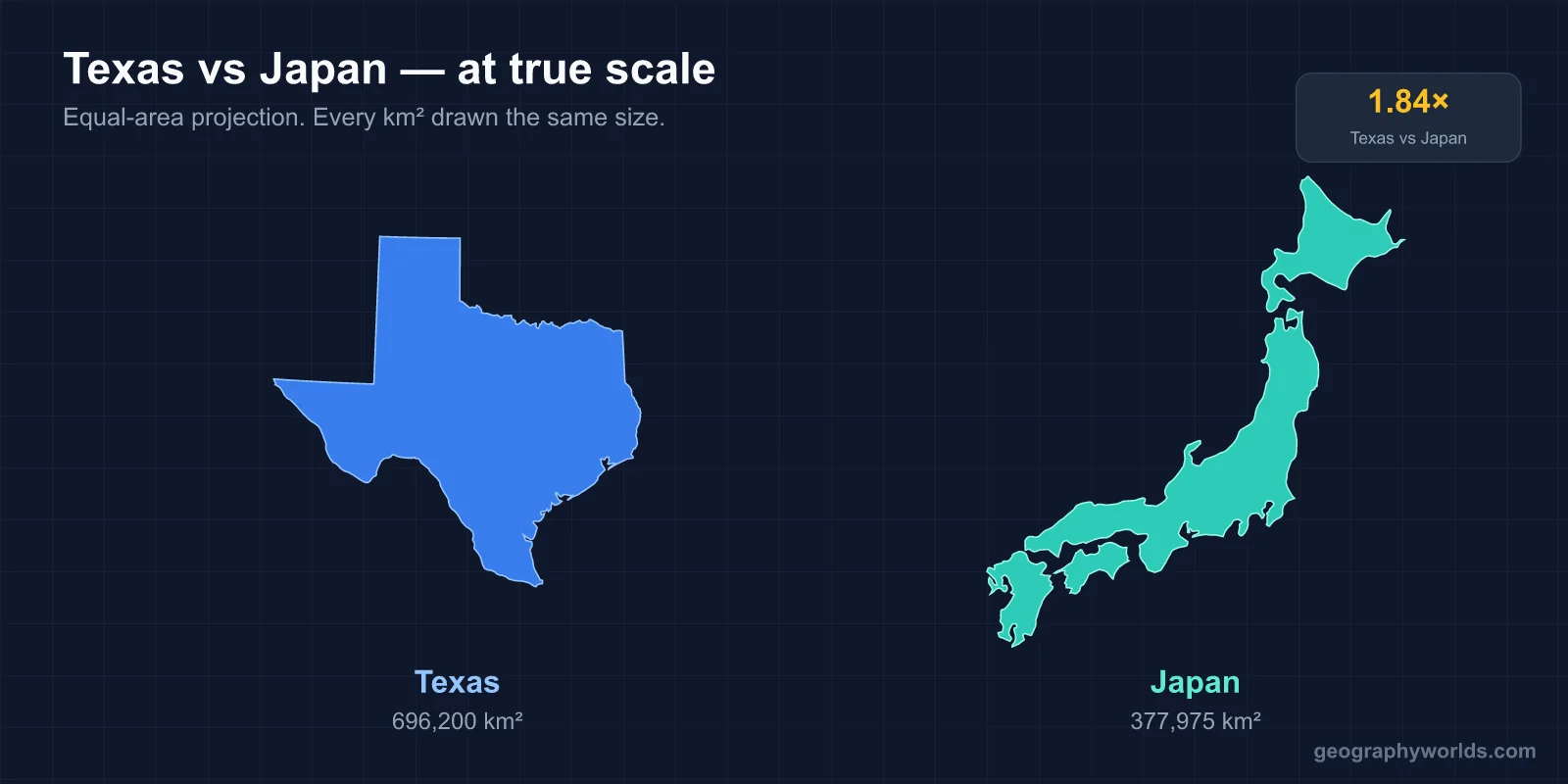
Yes. Texas is significantly larger than Japan. Texas covers 696,200 km² (268,597 sq mi), while Japan covers 377,975 km² (145,937 sq mi). Texas is about 1.84 times the size of Japan — roughly the area of two Japans laid side by side, with a New Hampshire-sized piece left over.
The Short Answer
If you picked up Japan and dropped it onto Texas, Japan would cover roughly the eastern half of the state — from the Louisiana border to about San Antonio. Texas would have most of its western half, including the Big Bend and El Paso, still completely uncovered. That's how much extra room Texas has.
The comparison surprises a lot of people. Japan looks substantial on most world maps — a long, curving archipelago stretching across more than 20 degrees of latitude. Texas, meanwhile, is just one of fifty US states. But state-scale in the US frequently dwarfs country-scale in much of the rest of the world, and Texas is one of the most extreme examples.

The Real Numbers
- Texas total area: 696,200 km² (268,597 sq mi)
- Japan total area: 377,975 km² (145,937 sq mi)
- Difference: 318,225 km² — about the size of Poland
- Ratio: Texas is about 1.84× the size of Japan
Texas would rank 27th in the world if it were a country, sliding in between Botswana and Myanmar. Japan ranks 62nd globally, between Zimbabwe and Germany. So while Japan looks long and impressive on a map, it actually sits in the middle of the global country-size ranking.
Why This Comparison Surprises People
The reason people often guess wrong on Texas vs Japan comes down to mental model. Japan stretches across about 3,000 km from Hokkaido in the north to the southern islands of Okinawa. That latitudinal range — roughly equivalent to the distance from Maine to Florida — gives Japan a sprawling, continent-spanning visual presence on a map.
Texas, by contrast, is compact. From the panhandle to the Rio Grande is roughly 1,290 km, and east-to-west is about 1,244 km. The state is almost square. But that compact square is over 696,000 km² of land — nearly double what Japan packs into its long, narrow archipelago.
The Mercator projection plays a small role here too. Japan, sitting between 24°N and 45°N, gets slightly inflated by Mercator. Texas, at 26°N-36°N, gets less inflation. So Japan looks marginally bigger on flat maps than it really is, while Texas looks roughly its true size.
Population Flips the Comparison
While Texas wins on area, Japan absolutely dominates on population:
- Japan population: ~125,000,000
- Texas population: ~30,500,000
- Japan population density: ~331 people per km²
- Texas population density: ~44 people per km²
Japan has more than four times the population of Texas living in a country roughly half its size. That makes Japan more than seven times denser than Texas. Most of Texas — the western half especially — has densities below 10 people per km². Tokyo metropolitan area alone is home to more people than the entire state of Texas.
City Comparison
The urban geography of these two places couldn't be more different. Japan's population is heavily concentrated in three giant metro areas — Greater Tokyo (37 million), Keihanshin or "Osaka-Kyoto-Kobe" (19 million), and Chukyo or "Nagoya" (10 million) — together holding about half of Japan's entire population.
Texas has four big metro areas — Dallas-Fort Worth (~7.9 million), Houston (~7.3 million), San Antonio (~2.6 million), and Austin (~2.4 million) — but they're spread out across the state. Greater Tokyo alone is bigger than every Texas metro combined, and bigger than the entire state of Texas by population.
Climate and Geography
Japan and Texas both span notable climate ranges, but they look very different. Japan goes from subarctic Hokkaido (snowy winters, cool summers) to subtropical Okinawa (palm trees and coral reefs). It's mountainous — only about 30% of Japan's land is flat enough to be habitable, which is why its cities are so dense.
Texas spans humid subtropical in the east (piney woods, swamps), semi-arid in the central plains, and true desert in the west (Big Bend, El Paso). Its terrain ranges from coastal wetlands to the Edwards Plateau to the Guadalupe Mountains. Texas has 19 major rivers and one significant coastline (the Gulf of Mexico). Japan has thousands of rivers but almost no flat coastal plains the size of those in Texas.
Economy: Different Scales
Despite being smaller than Texas in area, Japan has one of the world's largest economies. Japan's GDP is about $4.2 trillion. Texas' GDP is about $2.4 trillion. Japan's economy is roughly 75% larger than Texas' — a function of having 4× the population and a highly developed industrial base.
If Texas were a country, it would have the 8th- or 9th-largest economy in the world, between Italy and Russia. Japan sits 3rd or 4th in global GDP rankings. So even though Texas is bigger by land, Japan is the bigger economic player.
What Else Is Roughly the Size of Texas?
- Botswana: 581,730 km² — about 84% of Texas
- France: 643,801 km² — about 92% of Texas
- Ukraine: 603,550 km² — about 87% of Texas
- Myanmar: 676,578 km² — about 97% of Texas
- Afghanistan: 652,230 km² — about 94% of Texas
Texas is in a select club of US states larger than most of the world's countries. Only Alaska in the US is larger. After Texas comes California, Montana, and New Mexico — but Texas is the most populous state of that group by far.
What Else Is Roughly the Size of Japan?
- Germany: 357,022 km² — about 94% of Japan
- Vietnam: 331,212 km² — about 88% of Japan
- Norway: 385,207 km² — about 102% of Japan
- Zimbabwe: 390,757 km² — about 103% of Japan
- Montana (US state): 380,800 km² — about 101% of Japan
Japan is roughly the size of Montana, Norway, or Germany — meaning it's a medium-sized country by global standards. That makes its population (125 million) and economy all the more impressive given how little land they sit on.
Travel Time Across Each
The longest drive in Texas — from El Paso to Texarkana — is about 1,260 km and takes 13 hours nonstop. The equivalent journey in Japan would take you from the southern tip of Kyushu to the northern tip of Honshu, covering most of the country lengthwise. Japan has the famous Shinkansen high-speed rail network linking its major cities at speeds up to 320 km/h. Texas has highways. The contrast in how each place organizes movement says a lot about their population density, geography, and infrastructure philosophy.
By comparison, you can cross all of Japan north-to-south by Shinkansen in about a day. Crossing Texas in the same way by car or bus would take roughly the same amount of time, but on highways through mostly empty land rather than dense urban corridors.
Key Facts
- Texas is about 1.84× the size of Japan by area.
- Japan has more than 4× the population of Texas.
- Japan is about 7× more densely populated than Texas.
- Greater Tokyo alone holds more people than the entire state of Texas.
- Japan's GDP is roughly 75% larger than Texas' GDP.
Fun Facts
- Texas was an independent country (the Republic of Texas) from 1836 to 1845 — about the same population then as a single Tokyo neighborhood today.
- Japan has roughly 6,852 islands; Texas has roughly 12 major barrier islands on its coast.
- Only 30% of Japan is flat enough to be settled; about 95% of Texas could theoretically be settled, though large swaths remain empty.
- The driving distance from El Paso to Texarkana (~1,300 km) is roughly the same as Tokyo to Sapporo.
- Mount Fuji (3,776 m) is taller than Texas' highest point, Guadalupe Peak (2,667 m), by more than 1,000 meters.
The Bottom Line
Texas is bigger than Japan — by a wide margin in area, but a much narrower one in everything that matters for daily life. Japan packs four times more people, a larger economy, and one of the world's most developed transit networks into half the land. Texas spreads fewer people across more space, with a different definition of what "big" means in everyday life.
If you ever stand on the Big Bend's desert plain and feel the emptiness of Texas, it's worth remembering that the same land area would contain two Japans, or a country of 250 million people if you packed it Japan-style. Same area, different worlds.
Quiz Yourself on World Sizes!
Test your geography knowledge with our interactive games.
Play Geography Games →