
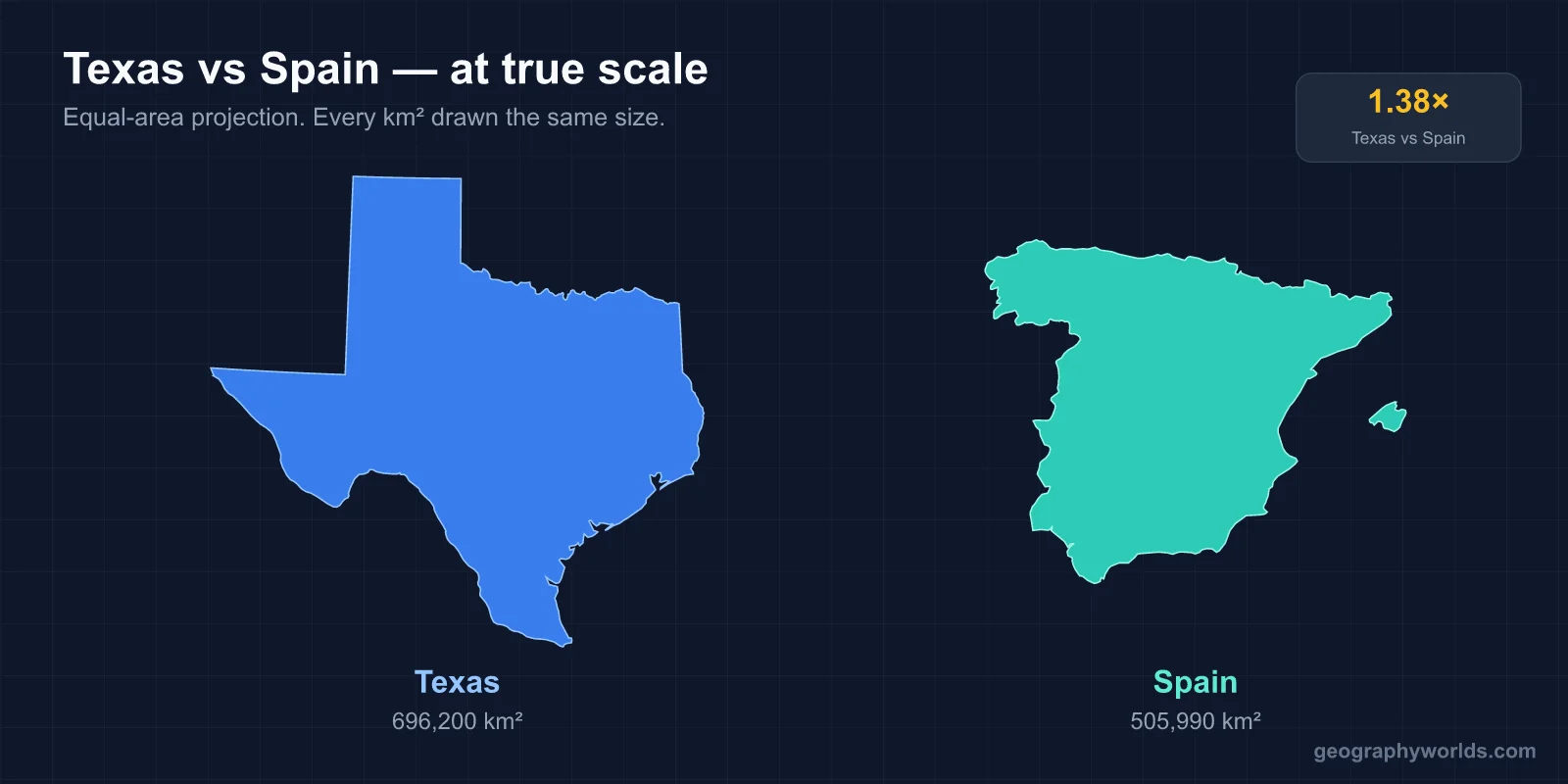
Yes. Texas is larger than Spain. Texas covers 696,200 km², while Spain covers 505,990 km². Texas is about 1.38 times the size of Spain — larger by 190,210 km², about the size of Belarus or Senegal. But Spain has nearly 60% more people than Texas (48 million vs 30.5 million).
The Short Answer
Texas and Spain are both major regional powers — Texas as the 2nd-largest US state and one of the largest sub-national economies in the world, Spain as a major European country with a former global empire. Texas is bigger by area, but Spain has more people, a longer continuous history, and a different economic profile.
The Texas-Spain connection has historical significance: Spanish explorers reached Texas in the 1500s, and Texas was part of Spanish (then Mexican) territory until the Texas Revolution of 1836. Many Texas place names (San Antonio, Houston—wait, Houston is named after Sam Houston not Spanish—but Austin, San Marcos, Corpus Christi, Lubbock are Spanish-origin) and cultural elements have Spanish origins.

The Real Numbers
- Texas total area: 696,200 km² (268,597 sq mi)
- Spain total area: 505,990 km² (195,365 sq mi)
- Difference: 190,210 km² — about the size of Belarus or Senegal
- Ratio: Texas is about 1.38× the size of Spain
Population
Spain has more people:
- Spain population: ~48,800,000
- Texas population: ~30,500,000
- Spain density: ~96 people per km²
- Texas density: ~44 people per km²
Spain has about 60% more people than Texas. Spain's population density is about 2.2× higher. Spain's population is concentrated in Madrid, Barcelona, and along the Mediterranean coast. Texas' population is concentrated in the "Texas Triangle" — Houston, Dallas-Fort Worth, San Antonio, Austin.
Geography
Texas has remarkable geographic diversity:
- Gulf Coast: Beaches, swamps, and major ports (Houston, Galveston)
- East Texas (Piney Woods): Pine forests, similar to Louisiana
- Hill Country: Central Texas, with limestone hills and German heritage
- West Texas: High plains, mesas, and desert (Big Bend, Guadalupe Mountains)
- Panhandle: Flat grasslands extending into Oklahoma
- Rio Grande Valley: Border with Mexico, fertile agricultural region
Spain has its own geographic variety:
- Iberian Peninsula: Shared with Portugal
- Mediterranean coast: Costa Brava, Costa del Sol
- Pyrenees Mountains: Border with France
- Sierra Nevada: Southern mountains including the highest peak in mainland Spain (Mulhacén, 3,478 m)
- Meseta Central: High central plateau where Madrid sits
- Balearic and Canary Islands: Major Mediterranean and Atlantic island groups
Climate
Texas has hot, humid climate in the east, semi-arid in the central plains, and arid desert in the west. Summers are hot throughout (35°C+ is common), winters are mild except in the Panhandle. Texas experiences hurricanes on the Gulf Coast and tornadoes in the Panhandle and northern plains.
Spain has primarily Mediterranean climate (hot dry summers, mild wet winters) in much of the country, with continental climate in the central plateau, oceanic climate in the north (Galicia), and subtropical in the Canary Islands. Spain's climate is generally more pleasant than Texas' summer extremes.
Economy
Texas has a larger economy in absolute terms:
- Texas GDP: ~$2.4 trillion
- Spain GDP: ~$1.62 trillion
- Texas per capita GDP: ~$79,000
- Spain per capita GDP: ~$33,000
Texas' economy is about 48% larger than Spain's in absolute terms and about 2.4× richer per capita. If Texas were a country, it would have the 8th-largest economy in the world. Spain is the 14th-largest economy. Texas' economy is heavily based on oil and gas, technology, agriculture, aerospace, and finance. Spain's economy is more service-oriented, with strong tourism, agriculture (Spain is the world's largest olive oil producer), automotive manufacturing, and financial services.
History
Spain has been a unified nation since 1492 when Ferdinand of Aragon and Isabella of Castile completed the Reconquista (driving out the last Moorish kingdom) and unified Spain. Spain became the dominant European colonial power in the 16th-17th centuries, with possessions across the Americas, Philippines, and beyond. After losing most of its empire in the 19th century and remaining neutral in WWI and WWII, Spain experienced 36 years of fascist dictatorship under Franco (1939-1975), then transitioned to constitutional monarchy and democracy.
Texas was inhabited by various indigenous peoples for thousands of years. Spanish explorers and missionaries arrived in the 1500s; Spanish settlement was limited. Texas became part of independent Mexico in 1821, but Texans declared independence in 1836 after the famous Battle of the Alamo. Texas was an independent republic for 9 years (1836-1845), then joined the United States. Texas seceded during the Civil War and was readmitted after Reconstruction.
Cultural Connections
The Spanish influence on Texas is profound. Many Texas place names are Spanish (Amarillo, San Antonio, Corpus Christi, El Paso, Laredo, San Marcos, Galveston, Brazos). Texas Mexican-American culture (Tejano) blends Spanish, Mexican, and Texan elements. Spanish is spoken by about 28% of Texans. Texas cuisine incorporates Mexican-Spanish elements (Tex-Mex), and the Hispanic population is rapidly growing.
Modern Spain attracts about 85 million international tourists annually (2nd most-visited country in the world after France). Texas is a major US tourist destination, attracting about 80 million domestic and international visitors annually.
Key Facts
- Texas is about 1.38× the size of Spain.
- Spain has 60% more people than Texas.
- Texas' economy is about 48% larger than Spain's.
- Texas is 2.4× richer per capita than Spain.
- Texas has significant Spanish cultural and linguistic heritage from its colonial past.
Fun Facts
- King Ranch in Texas (3,340 km²) is larger than the state of Rhode Island — and would be a meaningful portion of Spain.
- Spain produces about 1.7 million tons of olive oil annually — the world's largest production.
- Both Texas and Spain have major Mediterranean-influenced coastlines.
- The Spanish language has more native speakers globally than English — about 500 million vs about 400 million.
- Texas has more cattle than any US state — about 12 million; Spain has about 6.5 million cattle.
Religion and Society
Spain is historically Catholic — about 60% of Spaniards identify as Catholic, though active religious practice has been declining. Spain has been a major center of Catholic Christianity since Roman times, and its Catholic monarchs played a central role in the Reconquista and colonial expansion. Today Spain is officially secular but with strong Catholic cultural heritage.
Texas has a diverse religious landscape — predominantly Protestant Christian (especially Baptist and other evangelical traditions), with growing Catholic populations (largely due to Mexican and Latino immigration), plus significant Jewish, Muslim, Hindu, and Buddhist minorities. About 65% of Texans identify as Christian, with the rest unaffiliated or other faiths.
Climate and Geography Details
Texas has more dramatic seasonal extremes than Spain — hotter summers (regularly above 38°C in much of the state) and occasionally colder winter snaps. Spain has more pleasant year-round weather in most of the country, with Mediterranean climate dominant. Texas has hurricanes on the Gulf Coast (Hurricane Harvey 2017, Hurricane Ike 2008); Spain has occasional severe storms but no hurricanes.
Both have famous regional cuisines. Texas has barbecue, Tex-Mex, and chili. Spain has paella, tapas, jamón ibérico, gazpacho, and many regional specialties.
The Bottom Line
Texas is bigger than Spain by 38% in area, but Spain has 60% more people. Both are major regional cultural and economic powers. Texas has a younger, more rapidly growing economy and population. Spain has a longer continuous history, more cultural heritage sites, and a position at the heart of Hispanic culture and European integration. The Texas-Spain comparison highlights how historical connections, language, and culture link places far apart geographically. Both will continue to play important regional and global roles in their respective continents. Texas continues to attract migration from across the US and internationally, becoming an even more diverse state. Spain remains a major destination for tourists, immigrants, and retirees from across Europe. Both places will continue to evolve in interesting ways through the 21st century. The Texas-Spain comparison shows how geographic size doesn't tell the whole story — population, economic structure, history, and culture all matter just as much in defining what a place becomes. The historical Spanish heritage that shaped early Texas continues to influence the state today through language, food, music, architecture, and demographics. As Texas continues to grow rapidly and Spain continues its EU integration journey, both will adapt to changing demographic and economic realities in different ways. Their shared linguistic and cultural connection through Spanish remains a strong link across the Atlantic. The cultural exchanges between Texas and Spain continue today through immigration, trade, education, and tourism — links that began over 500 years ago when Spanish conquistadors first reached the territory we now call Texas. The Texas Hispanic community continues to grow, and Spain remains an attractive destination for tourists and retirees from across the US.
Quiz Spanish-Speaking Geography!
Test your knowledge of Texas, Spain, and Spanish-speaking countries.
Play Geography Games →