
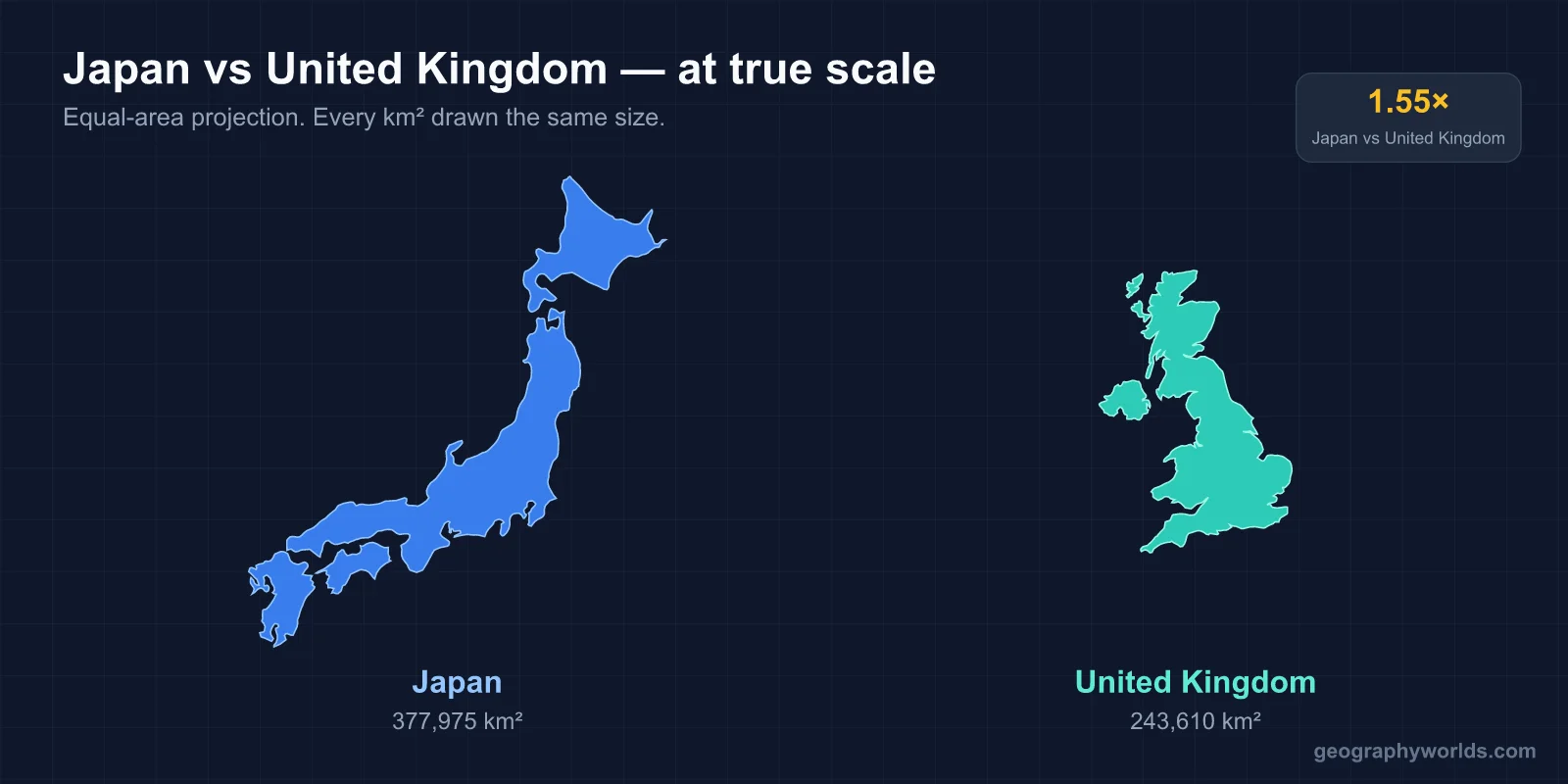
The United Kingdom and Japan share a striking profile: both are island nations off the coast of major continental landmasses, both have global cultural influence far exceeding their physical size, and both have been historical naval and trading powers. But which one is actually bigger? The answer surprises many people.
The Short Answer
No, Japan is bigger than the UK. Japan covers 377,975 km². The UK covers 243,610 km². Japan is approximately 55% larger than the UK. The difference is much greater than people typically assume — Japan is essentially half-again as large as Britain.
Side-by-Side Numbers
- UK area: 243,610 km² (94,058 sq mi)
- Japan area: 377,975 km² (145,937 sq mi)
- Difference: Japan is ~134,000 km² larger
- Ratio: Japan is ~1.55× the size of the UK
- UK population: ~67 million
- Japan population: ~123 million
The United Kingdom
The United Kingdom of Great Britain and Northern Ireland comprises four constituent countries: England (the largest and most populous), Scotland, Wales, and Northern Ireland. The "Great Britain" island contains England, Scotland, and Wales; Northern Ireland sits on the island of Ireland, sharing it with the Republic of Ireland. The UK also includes numerous smaller islands — the Isle of Wight, Anglesey, the Hebrides, Orkney, Shetland, and the Channel Islands (which have separate status).
The UK is highly urbanized. London, with about 9 million people in the metro area, is the dominant city; Greater London plus the surrounding South East holds nearly a third of the country's population. Other major cities include Birmingham, Manchester, Glasgow, Leeds, Liverpool, Edinburgh, and Cardiff. The country is generally flat to gently rolling, with the Scottish Highlands (Ben Nevis, 1,345 m), the Pennines, the Cambrian Mountains, and the Lake District as notable exceptions.
Japan
Japan is an East Asian island nation composed of approximately 14,125 islands, with four main ones — Honshu, Hokkaido, Kyushu, and Shikoku — accounting for the vast majority of the land area. Japan stretches over 3,000 km from north to south, spanning subarctic Hokkaido down to subtropical Okinawa. About 73% of the country is mountainous, with most of the population packed into narrow coastal plains.
The country sits on the convergence of four tectonic plates, making it one of the most seismically active places on Earth. About 1,500 earthquakes are recorded annually, most minor. Japan has 110 active volcanoes — roughly 10% of the world total — and routinely experiences tsunamis. Major cities include Tokyo (37+ million in the metro area, the largest in the world), Yokohama, Osaka, Nagoya, Sapporo, and Fukuoka.
Geography Compared
The UK is roughly compact, with no point more than about 113 km from the sea. Total coastline is around 12,500 km. Japan stretches as a long arc across the Pacific, with a coastline of about 29,750 km — over twice the UK's, despite being only 55% larger in area. Japan's mountainous interior makes much of the country sparsely populated; the UK has more usable land for agriculture, settlement, and infrastructure relative to its size.
Climate
The UK has a temperate maritime climate moderated by the Gulf Stream. Summers are mild (typical July highs of 20–22°C), winters are cool but rarely severe (typical January lows of 1–5°C). Rainfall is moderate but consistent — Britain's reputation for rain comes more from frequency than total amount. Snow is occasional except in the Scottish Highlands and the Pennines.
Japan spans far more climate zones due to its latitude range. Hokkaido has cold continental climate; Sapporo regularly gets 5 m of snow per year. Honshu has humid subtropical climate. Okinawa is subtropical to tropical. Typhoons strike Japan from late summer through early fall, sometimes causing devastating damage. Japan also has a rainy season ("tsuyu") from June to mid-July.
Economy
Both countries are economic giants. The UK has the world's 6th largest economy at roughly $3.3 trillion GDP. Major industries include financial services (London is one of the world's leading financial centers alongside New York), professional services, aerospace, pharmaceuticals, the creative industries (film, TV, music, publishing), and education. Japan has the world's 4th largest economy at roughly $4.2 trillion GDP, dominated by manufacturing, robotics, automobiles, electronics, and increasingly services.
Cultural Influence
Both nations punch far above their weight culturally. The UK has shaped global culture through the English language (now the world's lingua franca), literature (Shakespeare, Austen, Dickens, Tolkien, Rowling), music (the Beatles, Queen, the Rolling Stones), film and television (BBC, Doctor Who, James Bond), and the legacy of the British Empire which spread English law, parliamentary democracy, and Anglo cultural forms worldwide.
Japan has had outsized cultural impact through anime, manga, video games (Nintendo, Sony PlayStation, Sega), J-pop, traditional arts (tea ceremony, ikebana, calligraphy), cuisine (sushi, ramen, sake have spread globally), and martial arts. Japanese aesthetic principles — wabi-sabi, kaizen, minimalism — have influenced design and management worldwide.
History
Britain emerged from Norman Conquest in 1066 as a single English kingdom; Wales, Scotland, and Ireland were progressively incorporated over centuries. The Acts of Union (1707 with Scotland, 1801 with Ireland) created the United Kingdom. The British Empire became the largest in history at its 1922 peak, covering nearly a quarter of the world's land and population. The 20th century saw the empire dismantled. In 2020, the UK formally left the European Union ("Brexit").
Japan was unified under shoguns in the late 16th century and entered the Tokugawa period (1603–1867), 250+ years of self-imposed isolation. Forced open by Commodore Perry in 1853, Japan rapidly modernized after the Meiji Restoration (1868), becoming an industrial and military power. It expanded aggressively in the early 20th century, was devastated in World War II, and rebuilt into one of the world's leading economies during the post-war era.
Population
Japan has nearly twice the population of the UK — 123 million vs 67 million. Both face demographic challenges, but Japan's is far more severe. Japan's population peaked around 2010 and is now shrinking by hundreds of thousands per year; the median age is 49 (the oldest in the world). The UK is aging too but has compensated through immigration; its median age is around 40, and the population is still growing slowly.
Food and Drink Culture
Both have food cultures that are now globally recognized. Japanese cuisine — washoku — is on the UNESCO Intangible Cultural Heritage list. Sushi, ramen, tempura, sake, and matcha have all become international staples. Tokyo holds more Michelin stars than any other city in the world. British food was historically the butt of international jokes, but the modern UK has become a major culinary destination, with London restaurants competing with Tokyo and Paris. Traditional British foods — fish and chips, the full English breakfast, Sunday roast, scones and clotted cream, Scotch whisky, gin — remain culturally important.
Tourism
Japan welcomes about 32 million international visitors per year (peak before the pandemic, now recovering quickly). Top draws include Tokyo, Kyoto's temples, Mount Fuji, Hiroshima, the bullet train experience, cherry blossom season, and the unique pop culture districts of Akihabara and Harajuku. The UK draws about 38 million international visitors annually, ranking among the top 10 most-visited countries. Top attractions: London (the British Museum, the Tower, Buckingham Palace, Westminster), Edinburgh, Stonehenge, Bath, Oxford, and the Lake District.
Geographic Quirks
A few weird geographic facts stand out. The UK includes 14 British Overseas Territories — leftovers of empire — including Bermuda, Gibraltar, the Falkland Islands, and the British Indian Ocean Territory. None of these count toward the 243,610 km² figure for the UK proper. Japan, by contrast, includes some surprising outlying territories: the Ogasawara Islands, more than 1,000 km south of Tokyo; Minami-Tori-shima, Japan's easternmost point in the western Pacific; and the Senkaku Islands, claimed but uninhabited and at the center of a long-running dispute with China. These outlying territories give Japan one of the world's largest Exclusive Economic Zones at sea — about 4.5 million km², more than 10 times Japan's land area.
Key Facts
- Japan is about 55% larger than the UK by area.
- Both are island nations off major continental landmasses.
- Japan has 47% more people than the UK.
- The UK was the world's largest empire; Japan rapidly modernized in the late 19th century.
- Both punch far above their weight culturally and economically.
Fun Facts
- Japan has about 14,125 islands; the UK has about 6,000 islands.
- Japan and the UK both drive on the left.
- The UK and Japan share a constitutional monarchy structure.
- Japan's coastline is longer than the UK's despite Japan being more compact in width.
- Tokyo metro has 37+ million people — more than half of the UK's entire population.
The Bottom Line
Japan is significantly larger than the UK — about 55% larger — even though both are commonly grouped as "island nations" of similar global stature. The UK is more densely populated in usable land, more compact, and more historically tied to Europe and its former empire. Japan is longer, more mountainous, more seismically active, and culturally distinct in ways that have shaped global pop culture profoundly. Both will continue to be major players in the 21st century, even as their demographic profiles shift.
Quiz Island Nations!
Test your knowledge of the UK, Japan, and the world's great islands.
Play Geography Games →