
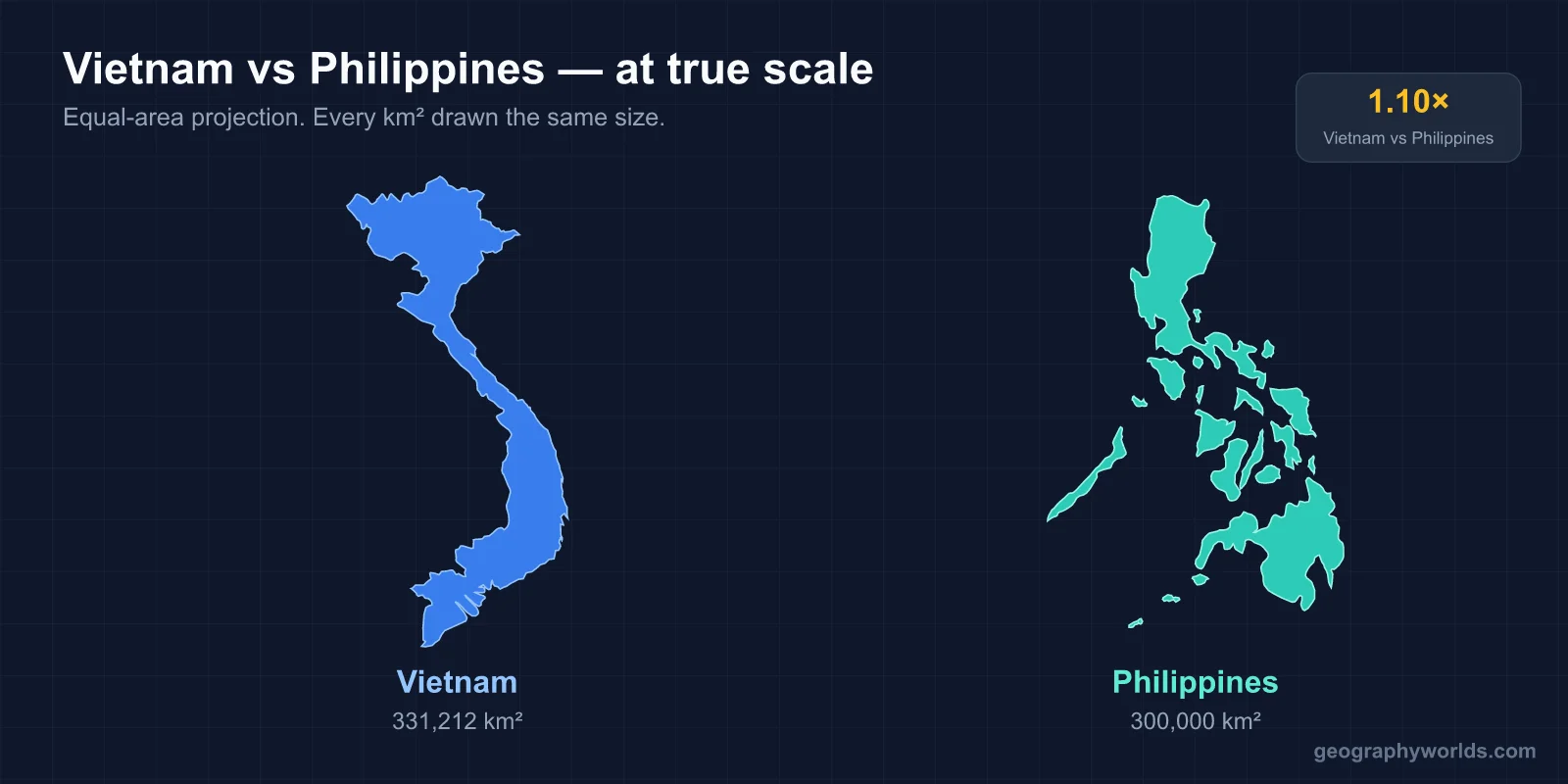
Vietnam and the Philippines are both major Southeast Asian nations with growing economies, complex histories, and significant cultural influence. They sit at similar latitudes and have similar populations. So which is actually bigger?
The Short Answer
Yes, Vietnam is slightly bigger than the Philippines. Vietnam covers 331,212 km². The Philippines covers 300,000 km². Vietnam is approximately 10.4% larger than the Philippines. They are very close in size.
Side-by-Side Numbers
- Vietnam area: 331,212 km² (127,882 sq mi)
- Philippines area: 300,000 km² (115,831 sq mi)
- Difference: Vietnam is ~31,000 km² larger
- Ratio: Vietnam is ~1.10× the size of the Philippines
- Vietnam population: ~99 million
- Philippines population: ~115 million
Vietnam
Vietnam is a long, S-shaped country in mainland Southeast Asia, bordered by China to the north, Laos and Cambodia to the west, and the South China Sea to the east. The country is roughly 1,650 km long from north to south, but in the narrowest part, near Đồng Hới, it is only about 50 km wide. This extreme north-south orientation gives Vietnam its distinctive shape.
Vietnam is divided into three main regions: the Red River Delta in the north (centered on Hanoi, the capital), the long narrow central coast, and the Mekong Delta in the south (centered on Ho Chi Minh City, formerly Saigon). The Truong Son Mountains (Annamite Range) run along the western border. Vietnam's highest peak is Fansipan at 3,143 m in the far northwest. The country has 3,260 km of coastline.
The Philippines
The Philippines is a Southeast Asian archipelago consisting of about 7,641 islands. The country is located between the Philippine Sea (east), the South China Sea (west), the Celebes Sea (south), and the Luzon Strait (north). The Philippines is divided into three major island groups: Luzon in the north (the largest island, containing Manila), Visayas in the central region, and Mindanao in the south.
Manila, the capital, has about 13 million in its metro area, making it one of the most densely populated cities in the world. The Philippines has a population of about 115 million people, making it the 12th most populous country in the world. The country gained independence from the United States in 1946.
Geography Comparison
The two countries' geographies could hardly be more different despite their similar sizes. Vietnam is essentially a long, narrow strip of land along the eastern coast of Indochina. Mountains dominate the western and northern regions, with the great river deltas (Red River, Mekong) supporting most of the population and agriculture. The Philippines is an archipelago of thousands of islands — every Filipino lives on an island, and inter-island ferry connections are essential infrastructure. The Philippines is also more volcanically active (about 24 active volcanoes) and sits within the Pacific Ring of Fire.
Population
The Philippines has about 115 million people; Vietnam has about 99 million. The Philippines is more populous despite being smaller — about 16% more people. Population density: the Philippines has about 383 per km², Vietnam about 300 per km². Both countries have young populations with median ages around 24–32 years.
Climate
Both countries have tropical climates but with regional variations. Vietnam's climate varies dramatically with latitude. The far north has a subtropical climate with cool winters that can occasionally see frost in mountain regions. The center has a tropical monsoon climate with distinct wet and dry seasons. The south has a tropical savanna climate, hot year-round. Typhoons regularly strike the central coast from August to November.
The Philippines has a tropical climate. The country experiences three seasons: hot dry (March–May), rainy (June–October), and cool dry (November–February). The Philippines is one of the most typhoon-prone countries on Earth, with an average of 20 typhoons making landfall each year. Climate change is making typhoons stronger and increasing rainfall extremes.
Economy
Both have growing economies. Vietnam has a GDP of about $430 billion, growing rapidly — among Asia's fastest-growing economies. Major industries include manufacturing (Samsung produces most of its phones in Vietnam), textiles, footwear, furniture, seafood, and increasingly electronics and assembly. Vietnam has emerged as a major manufacturing alternative to China for many global brands. The Philippines has a GDP of about $440 billion, growing steadily. The economy is dominated by services (especially business process outsourcing, the second-largest BPO industry in the world), agriculture, manufacturing, and remittances from the about 10 million Filipinos working overseas.
History
Vietnam's history stretches back thousands of years. The Bronze Age Đông Sơn culture flourished from around 1000 BCE. Vietnam was under Chinese control for about 1,000 years before gaining independence. Successive Vietnamese dynasties built a country that resisted Chinese influence even while adopting its writing and Confucian institutions. The French colonized Vietnam in the 19th century. Independence wars (against the French, then the Americans) culminated in unification under communist rule in 1975. The Philippines was inhabited by various Austronesian peoples before Spanish colonization in 1565. Spanish rule lasted until 1898, when the US took over after the Spanish-American War. American rule lasted until 1946 (with Japanese occupation 1942–1945). The country has been an independent republic since.
Religion
Vietnam is predominantly secular or Buddhist (about 16% Buddhist, with most Vietnamese practicing folk religion or no religion). The country has small Christian (about 8%, mostly Catholic) and Cao Dai/Hoa Hao communities. Communist-era policies discouraged religious practice, though tolerance has increased significantly since the 1990s. The Philippines is the only majority-Catholic country in Asia (along with East Timor), with about 80% identifying as Roman Catholic. The country also has significant Muslim minorities (about 6%), especially in Mindanao and the southwest, where Islam has been present for centuries.
Cuisine
Both have culinary traditions with growing global influence. Vietnamese cuisine — pho, bánh mì, spring rolls, rice paper rolls — has spread worldwide via diaspora communities and the rise of Vietnamese restaurants globally. The food emphasizes fresh herbs, balance of flavors, light broths, and clever use of rice in all its forms. Filipino cuisine is gaining international recognition more recently — adobo, sinigang, lechon, pancit, lumpia, halo-halo. Filipino food is generally less famous than other Southeast Asian cuisines but is increasingly celebrated for its unique blend of Spanish, Chinese, American, and indigenous influences.
Strategic Position
Both occupy strategically important positions in Southeast Asia. Vietnam is a major actor in the South China Sea disputes, with overlapping claims with China, the Philippines, and other neighbors. Vietnam has been deepening defense and economic ties with the US, Japan, and India in recent years. The Philippines is a key US ally with the Mutual Defense Treaty of 1951 and increasing military cooperation under the Enhanced Defense Cooperation Agreement (EDCA). The South China Sea disputes are a major focus, with the Philippines having won a 2016 international tribunal ruling against Chinese claims.
Languages
Vietnam's primary language is Vietnamese, spoken by about 95 million native speakers and one of the most-spoken languages in Southeast Asia. The country also has dozens of minority languages spoken by ethnic minorities. Vietnamese uses a Latin-based alphabet (with diacritics) called chữ Quốc ngữ, developed by Portuguese missionaries in the 17th century. The Philippines has two official languages: Filipino (a standardized version of Tagalog) and English. The country also has about 120–175 living languages, including major regional languages like Cebuano, Ilocano, Hiligaynon, Bikol, and Waray. The widespread use of English (a legacy of US colonial rule) makes the Philippines one of the largest English-speaking countries in the world.
Tourism
Both countries attract significant tourism. Vietnam welcomes about 18 million international visitors per year. Top destinations include Hạ Long Bay (a UNESCO World Heritage Site), Hội An, Hue, Sapa, the Mekong Delta, Phu Quoc, Da Nang, and the Cu Chi Tunnels. The Philippines welcomes about 6 million international visitors per year. Top destinations include Boracay, Palawan (consistently ranked among the world's best islands), Cebu and Bohol, El Nido, the Banaue Rice Terraces, and Manila's historic Intramuros district.
Key Facts
- Vietnam is about 10% larger than the Philippines by area.
- The Philippines has 16% more people than Vietnam.
- Vietnam is mainland; the Philippines is an archipelago of 7,641 islands.
- The Philippines is majority Catholic; Vietnam is majority secular/Buddhist.
- Both are dispute claimants in the South China Sea.
Fun Facts
- Vietnam is shaped like a long dragon; the Philippines is a scattered archipelago.
- About 10 million Filipinos work abroad.
- Vietnam has 8 UNESCO World Heritage Sites; the Philippines has 6.
- The Philippines is the world's top karaoke market.
- Vietnam's coffee culture is unique — Vietnam is the world's 2nd-largest coffee producer.
The Bottom Line
Vietnam is slightly larger than the Philippines — by about 10%. The two are similar-sized Southeast Asian nations with growing economies, young populations, and significant strategic importance. Vietnam is one elongated mainland country with three river deltas; the Philippines is a sprawling archipelago of thousands of islands. Both will continue to be central to Southeast Asia's growth and geopolitical importance in the decades ahead.
Quiz Southeast Asia!
Test your knowledge of Vietnam, the Philippines, and Southeast Asian nations.
Play Geography Games →