
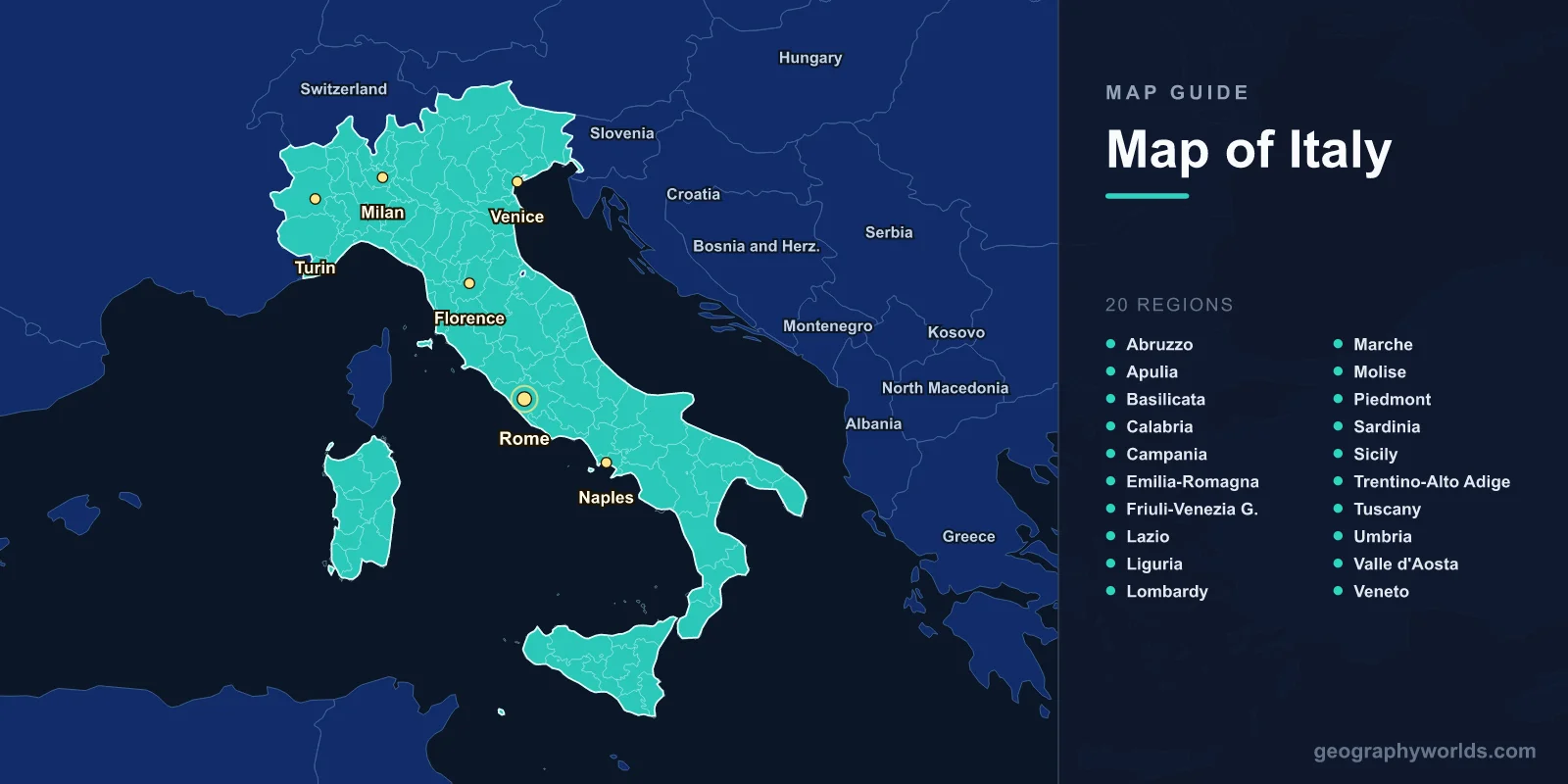
Italy is located in southern Europe, extending as a boot-shaped peninsula into the Mediterranean Sea, covering 301,340 km2 (116,348 sq mi) with a population of approximately 58.9 million. The capital is Rome (41.9028°N, 12.4964°E). A map of Italy shows 20 regions, two major islands (Sicily and Sardinia), the Alpine border in the north, and the Apennine mountain chain running the length of the peninsula.
Introduction
Italy is bordered by France to the northwest, Switzerland and Austria to the north, and Slovenia to the northeast. The country’s coastline stretches 7,600 km along the Ligurian, Tyrrhenian, Ionian, and Adriatic seas. Two independent microstates—Vatican City and San Marino—are entirely enclosed within Italian territory.

Geographic Overview
- Area: 301,340 km2 (116,348 sq mi)
- Population: 58.9 million (2024)
- Capital: Rome
- Coordinates: 41.8719°N, 12.5674°E
- Highest Point: Mont Blanc/Monte Bianco, 4,808 m (shared with France)
- Coastline: 7,600 km
Italy’s geography is dominated by mountains. The Alps form an arc along the northern border, while the Apennines run 1,200 km down the peninsula’s spine. The Po Valley in the north is Italy’s largest and most fertile plain. Volcanic activity has shaped much of the landscape, from Mount Etna in Sicily to the Phlegraean Fields near Naples.
Major Regions
- Lombardy: Milan; most populous region; 10 million; Po Valley
- Lazio: Rome; 5.7 million; central Italy
- Campania: Naples; 5.6 million; Vesuvius; Amalfi Coast
- Sicily: Largest Mediterranean island; 25,711 km2; Mount Etna
- Veneto: Venice; 4.9 million; northeastern plain and Dolomites
- Tuscany: Florence; 3.7 million; rolling hills; Renaissance art
- Sardinia: Second-largest Mediterranean island; 24,090 km2
Italy’s 20 regions have varying degrees of autonomy. Five—Sicily, Sardinia, Trentino-Alto Adige, Friuli-Venezia Giulia, and Valle d’Aosta—have special statutes granting greater self-governance. The north-south economic divide is one of Italy’s most significant geographic themes, with the industrialized north generating about 56% of national GDP.
Major Cities
- Rome: 2.7 million (city), 4.3 million (metro); capital on the Tiber
- Milan: 1.4 million; financial and fashion capital; Lombardy
- Naples: 910,000; third-largest city; bay overlooked by Vesuvius
- Turin: 850,000; northwest; automotive industry (FIAT)
- Florence: 380,000; Arno River; Renaissance heritage
- Venice: 260,000; lagoon city; 118 islands connected by bridges
Rome has been continuously inhabited for over 2,800 years and served as the capital of the Roman Empire. Milan is Italy’s economic engine and a global center for fashion and design. Naples sits on the Bay of Naples beneath Vesuvius, whose eruption in 79 AD buried Pompeii and Herculaneum. Venice’s lagoon setting makes it one of the most geographically unique cities in the world.
Bodies of Water & Natural Features
- Po: 652 km; Italy’s longest river; drains the Po Valley to the Adriatic
- Tiber: 405 km; flows through Rome to the Tyrrhenian Sea
- Lake Garda: 370 km2; Italy’s largest lake; southern Alps
- Mount Etna: 3,357 m; Europe’s most active volcano; Sicily
- Vesuvius: 1,281 m; overlooking Naples; erupted 79 AD
- Dolomites: UNESCO World Heritage; limestone peaks up to 3,343 m
Italy’s volcanic geography includes Etna (continuously active), Vesuvius (dormant but dangerous), and Stromboli (active with regular eruptions). The Po Valley, Italy’s breadbasket, produces 40% of the country’s agricultural output. Italy’s Alpine lakes—Garda, Como, and Maggiore—are popular tourist destinations set against dramatic mountain backdrops.
Bordering Countries
- France: 515 km border; Alps and Riviera coast
- Switzerland: 698 km; Alpine border; Lake Lugano region
- Austria: 404 km; Tyrol and Dolomites region
- Slovenia: 218 km; northeastern border; Trieste area
- Vatican City: 3.4 km; enclosed within Rome
- San Marino: 39 km; enclosed within Emilia-Romagna
Italy’s position in the central Mediterranean has made it a bridge between Europe and North Africa throughout history. The Strait of Messina, just 3.1 km wide, separates Sicily from the mainland. Italy’s Alpine borders with France, Switzerland, Austria, and Slovenia follow some of Europe’s highest and most dramatic mountain passes.
Key Facts
- Italy has more UNESCO World Heritage Sites (59) than any other country in the world.
- Mount Etna on Sicily is Europe’s tallest and most active volcano at 3,357 m.
- The Po Valley produces 40% of Italy’s agricultural output.
- Italy’s coastline stretches 7,600 km along four named seas.
- Vatican City, enclosed within Rome, is the world’s smallest independent state at 0.44 km2.
Fun Facts
- Italy is home to over 1,500 lakes, many formed in glacial or volcanic craters.
- The city of Matera in Basilicata has cave dwellings continuously inhabited for over 9,000 years.
- Stromboli volcano has been erupting almost continuously for 2,000 years, earning it the nickname "Lighthouse of the Mediterranean."
- The Dolomites’ distinctive pale color comes from ancient coral reef limestone.
Final Thoughts
Italy’s map reveals a geographically extraordinary country shaped by mountains, volcanoes, and the sea. From the Alpine peaks of the north to the volcanic islands of the south, and from the industrial Po Valley to the sun-drenched Mezzogiorno, Italy’s 20 regions encompass landscapes of astonishing variety. Understanding its geography is essential to appreciating Europe’s cultural and natural heritage.
Test Your Geography Knowledge!
Think you know your maps? Try our interactive geography games!
Play Geography Games →