
Introduction
Italy 🇮🇹 and Spain 🇪🇸 are the two great peninsulas of the western Mediterranean, and the comparison practically writes itself: sun, coastline, football, deep Catholic and Roman roots, and a shared reputation for living well. They are friendly rivals in tourism and on the pitch, yet a closer look shows two countries with quite different shapes, climates, and balances of land and people.
Below, Italy and Spain go head to head across size, population, capitals, language, climate, and the things each is best known for, with the key figures laid out plainly.
Size & Geography
| Feature | Italy 🇮🇹 | Spain 🇪🇸 |
|---|---|---|
| Area | 301,340 km² | 505,992 km² |
| Continent | Europe | Europe |
| Region | Southern Europe | Southern Europe |
| Land Borders | France, Switzerland, Austria, Slovenia, San Marino, Vatican City | France, Portugal, Andorra, Morocco (Ceuta), Gibraltar |
| Landscape | boot-shaped peninsula; Alps in north, Apennines central spine | large central plateau (Meseta), mountains, coastal plains |
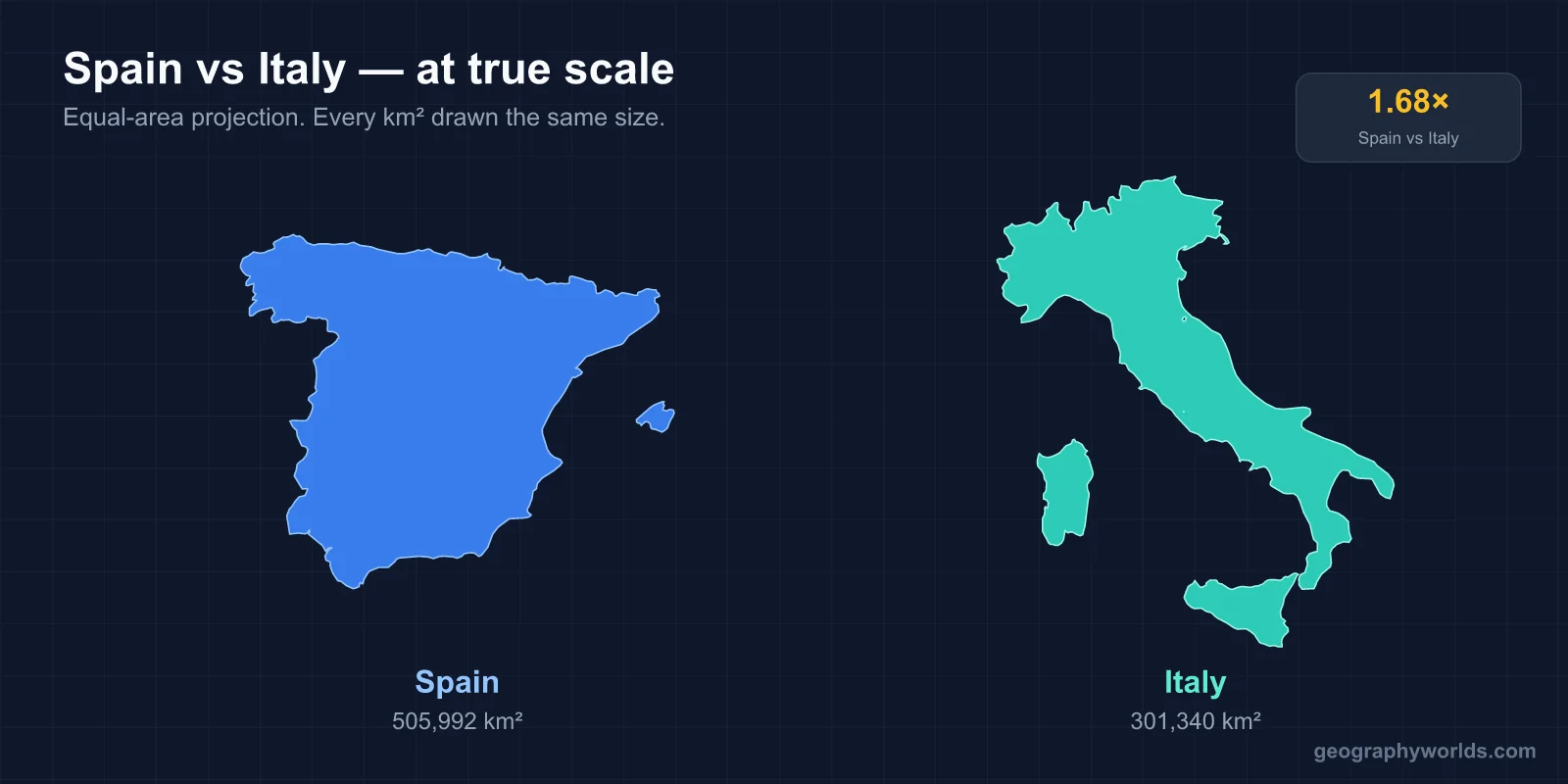
Both sit in Southern Europe, but Spain is the larger of the two at 505,992 km², about 1.7 times Italy's 301,340 km². Their forms differ as much as their sizes. Italy is the familiar boot, a long peninsula with the Alps along its northern rim and the Apennines forming a central ridge from top to bottom. Spain is built around the Meseta, a high central plateau ringed by mountain ranges and edged with coastal plains. The two share a border with France, and Spain's border list reaches across cultures, touching Portugal, tiny Andorra, the Moroccan frontier at Ceuta, and Gibraltar.
Population & Demographics
| Metric | Italy 🇮🇹 | Spain 🇪🇸 |
|---|---|---|
| Population | 58.9 million | 47.9 million |
| Population Density | 195.5 per km² | 94.6 per km² |
Here the larger country has fewer people. Italy holds 58.9 million residents to Spain's 47.9 million, about 1.2 times as many, but it fits them into less than two-thirds of the land. The result is a sharp density contrast: 195.5 people per km² in Italy versus 94.6 in Spain, a difference of roughly 101 per km². Spain's interior, much of it dry Meseta, is thinly populated, with people clustered along the coasts and in Madrid.
Capital Cities
Rome is Italy's capital and Madrid is Spain's. Both are Southern European capitals, but their settings differ: Rome is a coastal-plain city steeped in ancient ruins, while Madrid sits high on the central Meseta, the highest major capital in Europe.
Language, Currency & Culture
| Aspect | Italy 🇮🇹 | Spain 🇪🇸 |
|---|---|---|
| Languages | Italian (official) | Spanish/Castilian (official), Catalan, Galician, Basque |
| Currency | Euro (EUR) | Euro (EUR) |
Italy runs on a single official language, Italian, while Spain is more linguistically layered: Spanish (Castilian) is official nationwide, alongside Catalan, Galician, and Basque, which hold co-official status in their regions. Both are Romance languages with shared Latin roots, and on currency the two are aligned, each using the Euro as members of the eurozone, which makes travel and trade between them seamless.
Climate & Natural Features
| Aspect | Italy 🇮🇹 | Spain 🇪🇸 |
|---|---|---|
| Climate | Mediterranean in south, alpine in far north | Mediterranean and oceanic; hot summers in interior |
| Key Features | Alps, Amalfi Coast, Mount Vesuvius, Dolomites, Po Valley | Pyrenees, Sierra Nevada, Canary Islands, Balearic Islands |
| Economy | manufacturing, fashion, tourism, agriculture, automotive | tourism, agriculture, automotive, renewable energy |
Climatically the two overlap but are not identical. Italy is Mediterranean in the south and alpine in the far north. Spain mixes Mediterranean and oceanic zones with notably hot summers across its interior plateau. Italy's landmarks read like a postcard set, the Alps, the Amalfi Coast, Mount Vesuvius, the Dolomites, and the Po Valley, while Spain spreads from the Pyrenees and the Sierra Nevada to two famous archipelagos, the Atlantic Canary Islands and the Mediterranean Balearics. Their economies share heavyweight tourism and automotive sectors and strong agriculture; Italy adds manufacturing and fashion, while Spain has leaned into renewable energy.
What Makes Each Country Unique
Italy is hard to beat for sheer cultural density, the Roman Colosseum, Renaissance art, and a cuisine of pasta and pizza that the world has adopted. It holds 59 UNESCO World Heritage Sites, more than any other country, a testament to its extraordinary legacy.
Spain is the land of flamenco, Gaudí's still-unfinished Sagrada Família, the social ritual of tapas, and football passion that borders on religion. It ranks second in the world for UNESCO World Heritage Sites and is Europe's most visited country after France, a tourism powerhouse in its own right.
Key Differences at a Glance
- Area: Italy (301,340 km²) vs Spain (505,992 km²) — Spain is 1.7x larger
- Population: Italy (58.9 million) vs Spain (47.9 million) — Italy is 1.2x more populous
- Capitals: Rome vs Madrid
- Currency: Euro (EUR) vs Euro (EUR)
- Continents: Europe vs Europe
- Density: Italy is more densely populated (difference of ~101.0 people per km²)
- Languages: Italian (official) vs Spanish/Castilian (official)
Verdict
Italy and Spain are Mediterranean siblings as much as rivals. Spain wins on land, 1.7 times the area, while Italy wins on people, 1.2 times the population squeezed into a smaller footprint, which gives it a markedly denser feel. They even share a currency, so the contrasts come down to shape, settlement, and culture rather than economics.
Italy leans on its Mediterranean-to-alpine landscapes and a tradition of manufacturing and design, with the Alps as a defining feature. Spain spans Mediterranean and oceanic climates with the Pyrenees among its signatures and an economy that pairs mass tourism with a push into renewable energy. Both are tourism titans, and between them they hold the top two spots for World Heritage Sites.
Each adds something irreplaceable to the map of Southern Europe. Whether you are choosing between them for a holiday, studying the region, or just curious, comparing the two side by side brings the western Mediterranean into sharper focus.
Test Your Knowledge!
Think you know your countries? Try our interactive geography quiz!
Play Geography Games →