
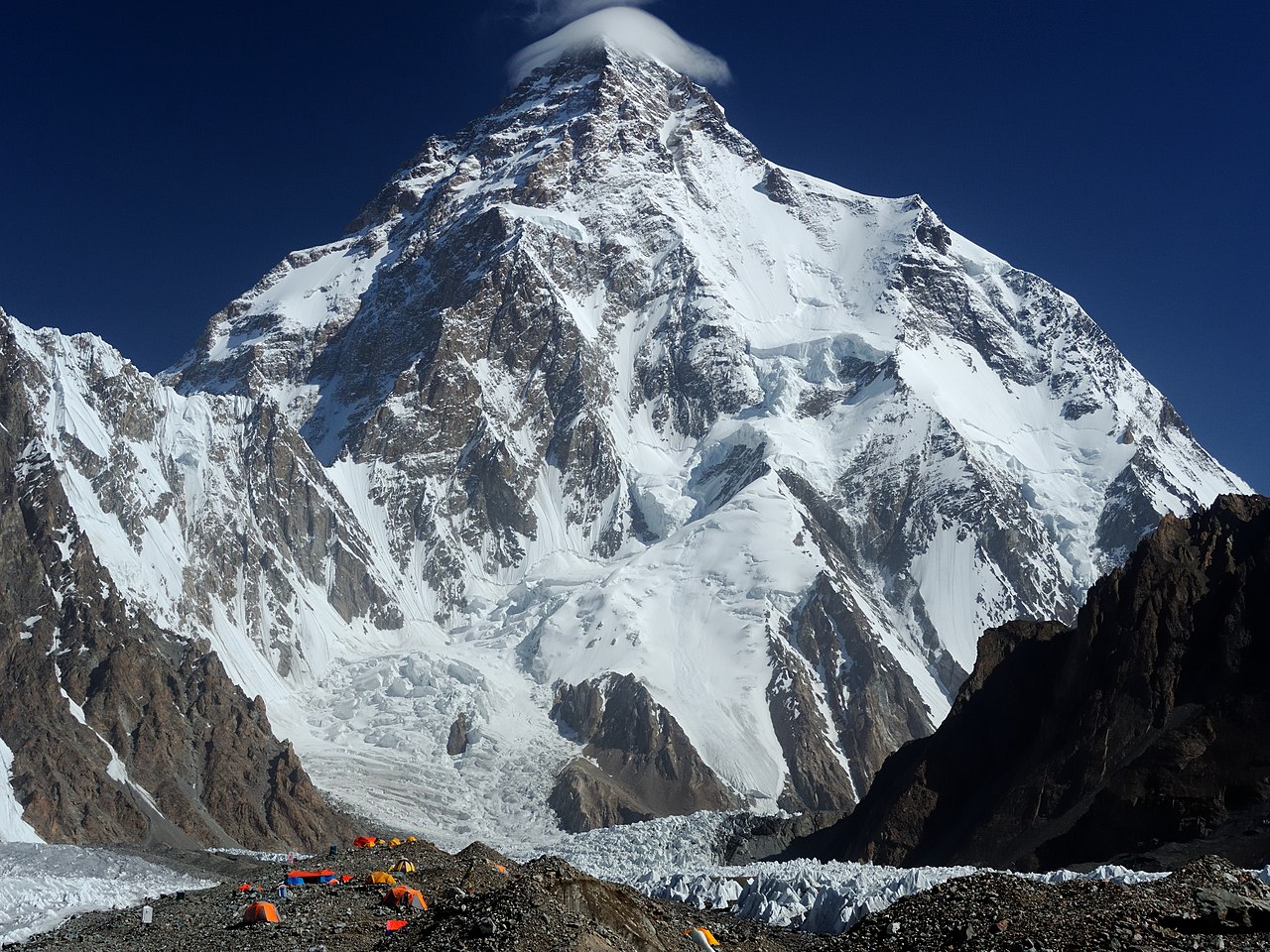
K2, standing at 8,611 meters in the Karakoram Range on the Pakistan-China border, is the second-highest mountain on Earth and arguably the most formidable. Known as the "Savage Mountain" for its extreme difficulty and high fatality rate, K2 has no easy route to the summit. Every path to the top involves sustained technical climbing at extreme altitude, exposed to avalanches, rockfall, and ferocious storms.
Introduction
While Mount Everest has been summited over 6,000 times, K2 has seen fewer than 700 successful ascents, with a fatality rate historically around one death for every four summits. The mountain's perfect pyramidal shape, rising dramatically above the Baltoro Glacier, is both stunningly beautiful and unforgivingly deadly — a peak that commands the deepest respect of the mountaineering world.
Geography & Dimensions
- Height: 8,611 m (28,251 ft)
- Prominence: 4,020 m
- Location: Baltoro Glacier, Karakoram Range
K2 is located in the Baltistan region of Gilgit-Baltistan, Pakistan, with its northern slopes extending into Xinjiang, China. The mountain anchors the central Karakoram, surrounded by a constellation of massive peaks including Broad Peak (8,051 m), the four Gasherbrum peaks, and Masherbrum. This concentration of high peaks makes the central Karakoram one of the most dramatic mountain landscapes on Earth.
The mountain's near-perfect pyramidal form features four major faces: the South (Abruzzi) Face, the North Face, the West Face, and the East Face. The Godwin-Austen Glacier flows along its eastern base, while the Savoia Glacier flanks the western side. K2's massive bulk has a base circumference of approximately 12 kilometers.
Geology & Formation
- Rock Type: Gneiss, granite, metamorphic rock
- Age: Uplift began ~50 million years ago
- Tectonic Setting: Indian-Eurasian plate collision zone
K2 is composed primarily of metamorphic and igneous rocks, including biotite-grade gneiss and granite intrusives. Unlike Everest's sedimentary summit, K2's peak is hard metamorphic rock, which contributes to its steep, angular profile. The rock quality varies considerably on different faces, with some routes plagued by loose and unstable rock.
The Karakoram Range formed through the same tectonic collision that created the Himalayas — the Indian plate pushing into the Eurasian plate. However, the Karakoram is geologically distinct, with higher average peak elevations and more extensive glaciation. The range continues to rise, though erosion counteracts much of the tectonic uplift.
Climate & Conditions
- Summit Temperature: Regularly below -40°C in winter
- Storm Duration: Multi-day storms common
- Climbing Season: June to August
K2's weather is notoriously unpredictable and severe. Located farther north and at a higher average elevation than the Nepal Himalayas, the Karakoram receives weather systems from multiple directions, making forecasting extremely difficult. Storms can materialize with little warning and persist for days, trapping climbers at high camps.
The climbing season is restricted to a narrow summer window, typically late June through early August. Even during this period, the mountain can experience blizzards, high winds, and extreme cold. The notorious Bottleneck — a steep couloir at 8,200 meters beneath a massive overhanging serac — is particularly dangerous during storm conditions, as falling ice and avalanches funnel through this constricted passage.
Climbing History
- First Ascent: July 31, 1954 — Achille Compagnoni & Lino Lacedelli (Italian expedition)
- First Winter Ascent: January 16, 2021 — Nepali team of 10
- Total Summits: ~700 (as of 2024)
K2 was first climbed on July 31, 1954, by Italians Achille Compagnoni and Lino Lacedelli as part of an expedition led by Ardito Desio. The ascent was mired in controversy, as Pakistani climber Amir Mahdi and Italian Walter Bonatti were left without shelter at extreme altitude in a decision that nearly cost their lives and sparked decades of bitter dispute.
The mountain resisted winter ascent attempts for decades, earning a reputation as the last great prize in high-altitude mountaineering. On January 16, 2021, a team of 10 Nepali climbers achieved the first winter summit, completing one of mountaineering's most coveted challenges. The 2008 K2 disaster, which killed 11 climbers in a single event at the Bottleneck, remains one of the deadliest days in mountaineering history.
Conservation & Challenges
- Approach Trek: 7-10 days from Askole
- Glacier Recession: Baltoro Glacier retreating
- Environmental Concerns: Waste accumulation at camps
K2's remoteness provides some natural protection from the overcrowding that plagues Everest. The approach trek alone takes 7-10 days from the village of Askole through the spectacular Baltoro Glacier corridor. However, increased climbing traffic in recent years has raised environmental concerns, with waste accumulation at base camp and high camps becoming a growing problem.
Climate change is affecting the Karakoram in complex ways. While some Karakoram glaciers have shown anomalous stability or even growth (the "Karakoram Anomaly"), the Baltoro Glacier has shown signs of thinning. Changes in snow and ice conditions affect route safety and climbing feasibility, creating new challenges for future expeditions.
Key Facts
- K2 has a historical fatality rate of roughly one death for every four successful summits.
- The mountain was not climbed in winter until January 2021, making it the last 8,000-meter peak to fall.
- K2 got its survey designation name because it was the second peak cataloged in the Karakoram range in 1856.
- Fewer than 700 people have summited K2, compared to over 6,000 on Everest.
- The Bottleneck at 8,200 m is considered one of the most dangerous passages in mountaineering.
Fun Facts
- K2 is also called "Chogori" by the local Balti people, meaning "King of Mountains."
- The mountain is so remote that it takes over a week of trekking just to reach base camp.
- Italian climber Walter Bonatti survived a forced bivouac at 8,100 m without oxygen or shelter during the 1954 first ascent.
- K2's summit is almost exactly on the Pakistan-China border — climbers literally stand in two countries at the top.
Final Thoughts
K2 stands apart in the mountaineering world as the ultimate test of skill, endurance, and courage. Its savage reputation is well earned — no other 8,000-meter peak demands such sustained technical climbing at extreme altitude with such merciless weather. For those who attempt it, K2 represents the purest expression of alpine ambition.
Test Your Knowledge!
Think you know your mountains? Try our interactive geography quiz!
Play Geographic Features Quiz →