
Introduction
Kenya 🇰🇪 and Uganda 🇺🇬 are next-door neighbors in the East African highlands, linked by trade routes, a shared lake, and centuries of movement back and forth across their common border. One faces the Indian Ocean; the other is landlocked at the headwaters of the Nile. This comparison breaks down how the two stack up geographically.
What follows is a side-by-side look at Kenya and Uganda across size, population, capitals, language, climate, and the features each is known for, with all the key figures included.
Size & Geography
| Feature | Kenya 🇰🇪 | Uganda 🇺🇬 |
|---|---|---|
| Area | 580,367 km² | 241,038 km² |
| Continent | Africa | Africa |
| Region | East Africa | East Africa |
| Land Borders | Ethiopia, Somalia, Tanzania, Uganda, South Sudan | DRC, Kenya, Tanzania, Rwanda, South Sudan |
| Landscape | savannas, Great Rift Valley, coastal lowlands, highlands | mostly plateau with rim of mountains |
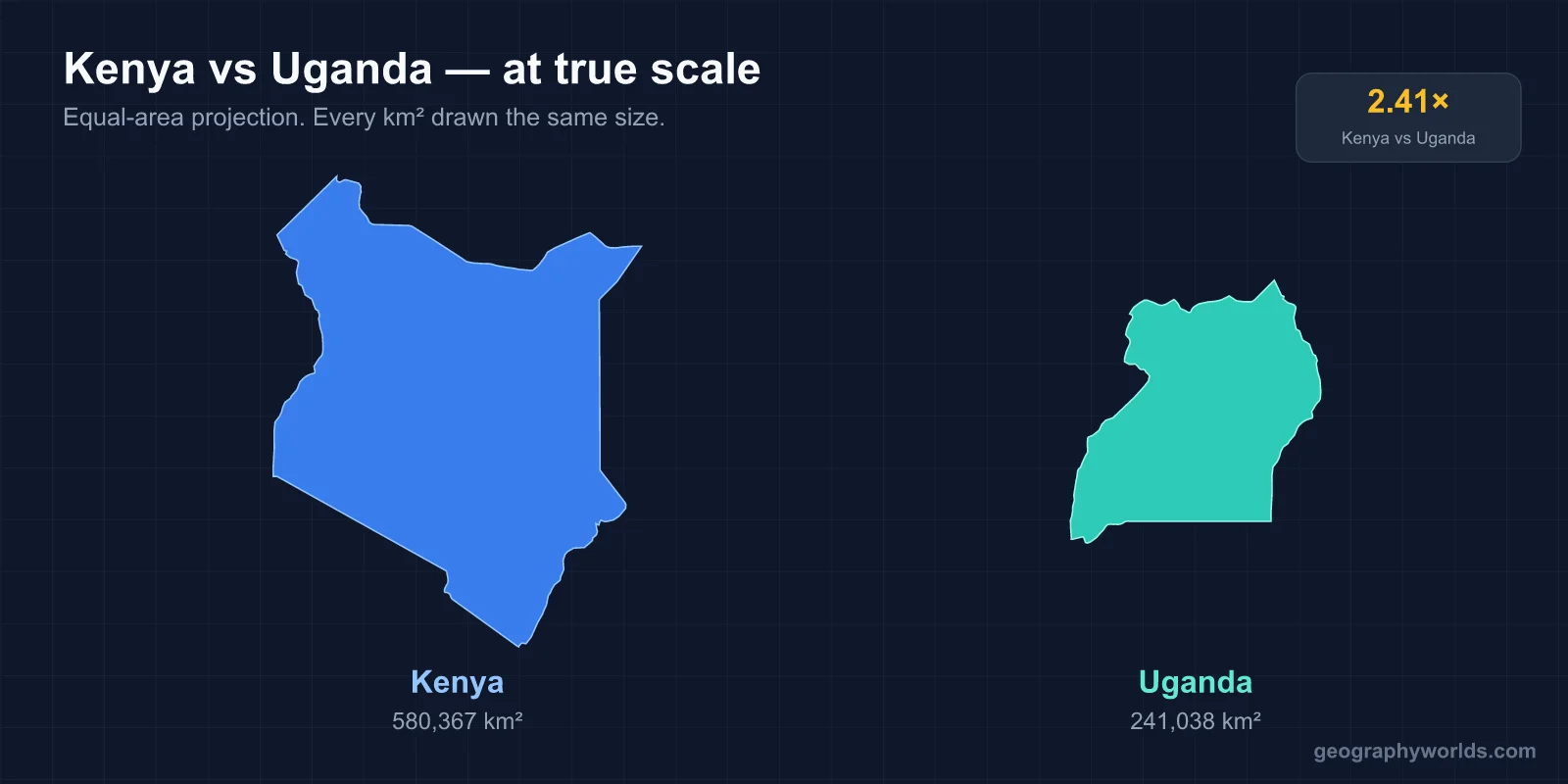
Kenya is the larger country by a clear margin, 580,367 km² against Uganda's 241,038 km², roughly 2.4 times the size. Both are East African and the two share a border. Their landscapes differ in character: Kenya runs from coastal lowlands up through savanna and highlands and is split by the Great Rift Valley, while Uganda is essentially one large plateau ringed by mountains. The key geographic difference is access to the sea, Kenya has an Indian Ocean coastline, whereas Uganda is landlocked and relies on its neighbors, including Kenya, for port access.
Population & Demographics
| Metric | Kenya 🇰🇪 | Uganda 🇺🇬 |
|---|---|---|
| Population | 58.6 million | 52.8 million |
| Population Density | 101.0 per km² | 218.9 per km² |
On headcount the two are surprisingly close: Kenya has 58.6 million people and Uganda 52.8 million, leaving Kenya only about 1.1 times more populous. Pack those similar populations into very different land areas, though, and the picture changes completely. Uganda, the smaller country, is far more crowded at 218.9 people per km², more than double Kenya's 101.0, a gap of about 117.9 per km². Uganda's fertile, well-watered plateau supports one of the denser rural populations in the region.
Capital Cities
Nairobi is the capital of Kenya and Kampala the capital of Uganda. Both sit in East Africa. Nairobi is a major regional commercial hub, while Kampala spreads across a series of hills near the shore of Lake Victoria.
Language, Currency & Culture
| Aspect | Kenya 🇰🇪 | Uganda 🇺🇬 |
|---|---|---|
| Languages | Swahili and English (both official) | English and Swahili (both official), Luganda |
| Currency | Kenyan Shilling (KES) | Ugandan Shilling (UGX) |
The two are closely aligned on language. Both make English and Swahili official, with Uganda also widely speaking Luganda, the language of the Buganda kingdom around Kampala. That overlap reflects their shared East African ties. On money each keeps its own shilling, the Kenyan Shilling and the Ugandan Shilling, distinct currencies that nonetheless echo a common regional naming tradition.
Climate & Natural Features
| Aspect | Kenya 🇰🇪 | Uganda 🇺🇬 |
|---|---|---|
| Climate | varies from tropical along the coast to arid inland | tropical; generally rainy with dry seasons |
| Key Features | Mount Kenya, Masai Mara, Lake Victoria, Great Rift Valley | Lake Victoria, Rwenzori Mountains, source of the Nile |
| Economy | agriculture (tea, coffee), tourism, tech (Silicon Savannah) | agriculture (coffee), fishing, mining |
Kenya's climate swings from tropical on the coast to arid in the interior, a wider range thanks to its sea-to-savanna spread. Uganda, landlocked and greener, is broadly tropical with reliable rains broken by dry seasons. Their landmarks reflect those settings: Kenya is home to Mount Kenya, the Masai Mara, and a stretch of the Great Rift Valley, while Uganda boasts the Rwenzori Mountains and the famous source of the Nile at Jinja. Crucially, both border Lake Victoria, the great inland sea they share with Tanzania. Economically, Kenya blends agriculture (tea and coffee), tourism, and a notable tech sector, the Silicon Savannah, while Uganda leans on coffee farming, fishing, and mining.
What Makes Each Country Unique
Kenya is world-famous for the Great Migration through the Masai Mara, its champion distance runners, and its safari tourism. Kenyan athletes count among the fastest marathon runners anywhere and consistently dominate global long-distance racing.
Uganda is best known for mountain gorilla trekking in Bwindi, the source of the Nile at Jinja, and an extraordinary variety of birdlife. It shelters more than half of the world's surviving mountain gorillas.
Key Differences at a Glance
- Area: Kenya (580,367 km²) vs Uganda (241,038 km²) — Kenya is 2.4x larger
- Population: Kenya (58.6 million) vs Uganda (52.8 million) — Kenya is 1.1x more populous
- Capitals: Nairobi vs Kampala
- Currency: Kenyan Shilling (KES) vs Ugandan Shilling (UGX)
- Continents: Africa vs Africa
- Density: Uganda is more densely populated (difference of ~117.9 people per km²)
- Languages: Swahili and English (both official) vs English and Swahili (both official)
Verdict
Kenya and Uganda are highland neighbors with closely matched populations but very different footprints. Kenya is 2.4 times the larger country and edges ahead on people too, just 1.1 times more populous, yet because Uganda fits almost as many residents into far less space, it is by far the more densely populated, with more than double Kenya's density.
Kenya's character comes from its coast-to-arid range, landmarks like Mount Kenya, and a diversified economy spanning tourism and technology. Uganda's draws are the gorillas of Bwindi, the source of the Nile, and the Rwenzori Mountains, set against a rainy tropical climate and an economy rooted in coffee and fishing. Both share Lake Victoria and both speak English and Swahili, the ties that keep them so closely linked.
Each tells its own East African story while sharing a great deal of common ground. Whether you are planning a visit, studying the region, or simply curious, holding the two up together draws the contrast, and the connection, into focus.
Test Your Knowledge!
Think you know your countries? Try our interactive geography quiz!
Play Geography Games →