
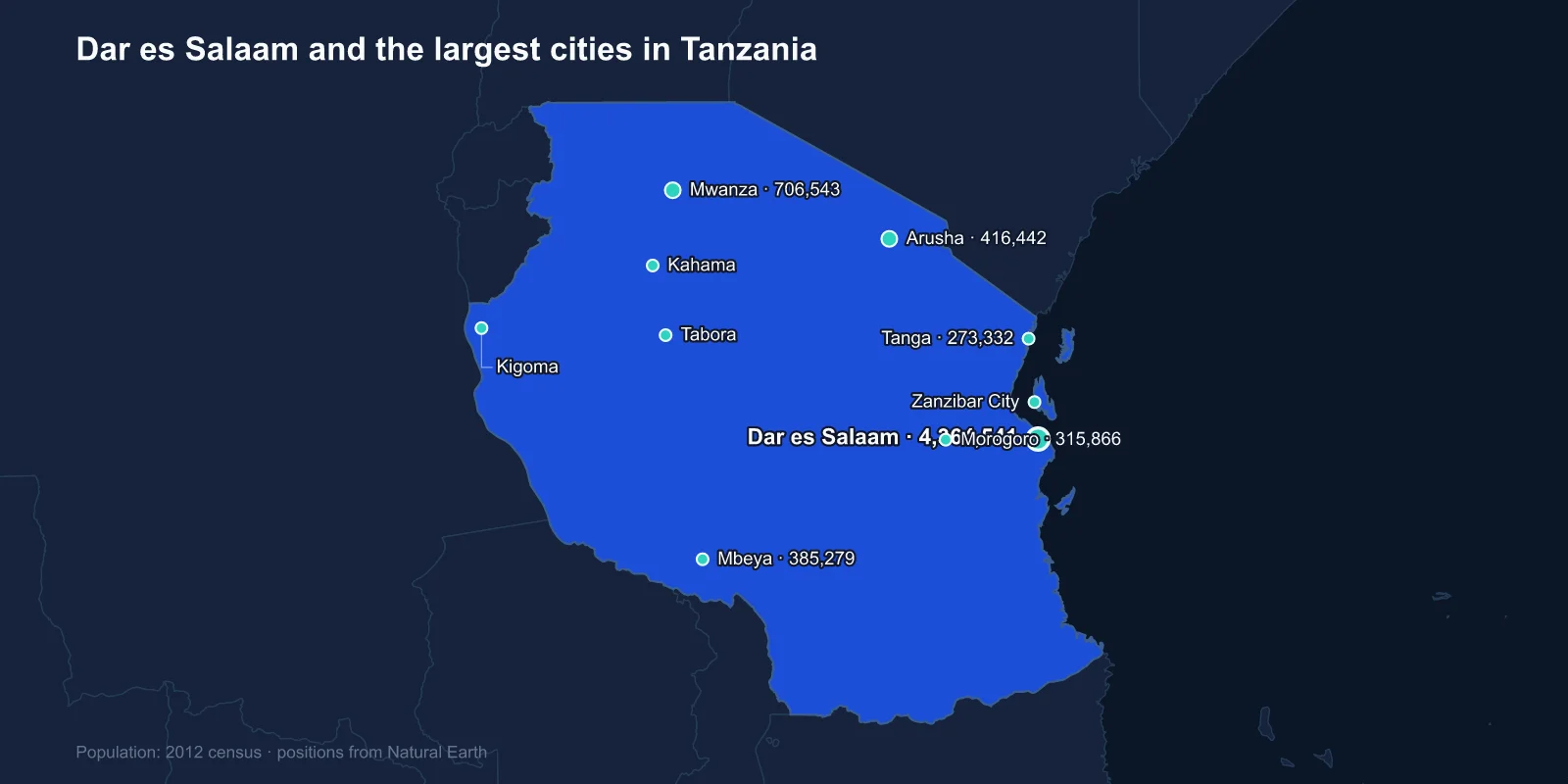
The largest cities in Tanzania are Dar es Salaam (4,364,541), Mwanza (706,543), Arusha (416,442), Mbeya (385,279), Morogoro (315,866), Tanga (273,332), Kahama (242,208), Tabora (226,999), Zanzibar City (223,033) and Kigoma (215,458). These are 2012 census figures; the 2022 census has since put the Dar es Salaam region above five million.
The striking entry is the one just outside the top ten. Dodoma, the designated national capital, recorded 213,636 in the same census — smaller than Kigoma, and roughly one twentieth the size of the city the government spent fifty years trying to leave.
A Capital Move That Took Forty-Six Years
In 1973 Julius Nyerere announced that the capital would move from Dar es Salaam on the coast to Dodoma in the centre of the country. The reasoning was deliberate: a central location would be more accessible to the whole nation, it fitted the decentralising logic of ujamaa, and it would pull investment away from a coastal city that was already dominating everything.
The move then took the better part of half a century. The National Assembly began sitting in Dodoma in 1996. The full relocation of government ministries was only declared complete in 2019, under John Magufuli, who pushed civil servants to actually move rather than commute.
Meanwhile Dar es Salaam did what primate cities do. It kept the port, the banks, the corporate headquarters, the main airport and the population. Tanzania now has a political capital that is small and quiet and a commercial capital that holds most of the country's urban economy — a split it shares with Ivory Coast, Myanmar and a handful of others.
The Haven of Peace
Dar es Salaam is not an ancient city. It was developed from the 1860s by Sultan Majid bin Said of Zanzibar as a mainland harbour, and the name he gave it is usually rendered from Arabic as the haven, or house, of peace. The Germans made it the capital of German East Africa in 1891, the British kept it as the capital of Tanganyika, and it remained the seat of government of independent Tanzania until the 1973 decision.
Its growth has been extremely fast even by African standards. Projections have repeatedly suggested that Dar es Salaam will pass ten million within a couple of decades and could become one of the largest cities in the world before the end of the century. The city responded to its traffic problem with a bus rapid transit system opened in 2016, the first of its kind in East Africa, running dedicated lanes along the main corridors.
Lake Victoria and the Fish That Changed Mwanza
Mwanza, second on the list, sits on the southern shore of Lake Victoria among enormous granite boulders that give it its local nickname, Rock City. Its modern economy was transformed by an ecological accident.
Nile perch were introduced to Lake Victoria in the 1950s and 1960s. The fish is a large predator, it devastated the lake's endemic cichlid species, and it also created an export industry: filleting and freezing plants around Mwanza ship perch to Europe and the Middle East. The trade brought foreign exchange and jobs and simultaneously contributed to what biologists describe as one of the largest vertebrate extinction events of modern times.
Mwanza is also the natural hub for a densely populated lakeside region, and its ferry links across the lake matter more than its road links to the rest of Tanzania.
Arusha Runs on Two Industries
Arusha, in the north beneath Mount Meru, is the staging point for Serengeti, Ngorongoro and Kilimanjaro, and safari tourism is the visible part of its economy. The less visible part is diplomacy.
Arusha is the headquarters of the East African Community, and it hosted the International Criminal Tribunal for Rwanda from 1994 until 2015. The Arusha Accords of 1993, negotiated there, were intended to end the Rwandan civil war. A conference city grew up around those functions, complete with a purpose-built international conference centre, and it gives Arusha an institutional weight out of proportion to its size.
Nearby Moshi, at the foot of Kilimanjaro, plays a similar role on a smaller scale and anchors the Chagga coffee-growing districts on the mountain's slopes.
The Caravan Towns and the Railway
Tabora and Kigoma are the surviving nodes of the nineteenth-century caravan route that ran inland from the coast to Lake Tanganyika, carrying ivory and enslaved people. Tabora, then Kazeh, was the central depot. Kigoma is the lake port at the far end.
Just outside Kigoma is Ujiji, where Henry Morton Stanley found David Livingstone in 1871 and delivered the greeting that became one of the most quoted sentences of the century. The German-built Central Line railway followed almost exactly the old caravan path, reaching Kigoma in 1914, and both towns have depended on it ever since.
Kigoma remains the Tanzanian gateway to Lake Tanganyika, and its harbour still sees the Liemba, a German steamer launched in 1913, scuttled during the First World War, raised in the 1920s and running ever since — probably the oldest passenger vessel in regular service anywhere.
The Crop That Built Tanga and Then Vanished
Tanga, sixth on the list, was the busiest port on the German East African coast and the centre of a sisal industry that at its height made Tanganyika the world's leading producer of the fibre. Sisal rope and twine came out of the plantations behind the town and left through its harbour.
Synthetic fibres destroyed that market from the 1960s onwards, and production collapsed to a fraction of its peak. Tanga did not disappear — it retains its port, a cement industry and a fishing fleet — but it is the clearest example in the country of a city whose growth curve was bent by a change in global manufacturing rather than anything local.
Stone Town, and the Other Half of the Union
Zanzibar City is the largest urban area of the semi-autonomous archipelago that joined Tanganyika in 1964 to form Tanzania. Its historic core, Stone Town, is a UNESCO World Heritage Site built of coral rag and mangrove poles, with the carved doors and narrow lanes of a city that was for centuries the commercial centre of the western Indian Ocean.
It was also the administrative heart of the East African slave trade, and the Anglican cathedral stands deliberately on the site of the former slave market. Zanzibar has its own president, its own parliament and its own immigration desk, and its inclusion in a Tanzanian city ranking is a reminder that the country is a union of two formerly separate states.
What Dodoma Got, and What It Did Not
Dodoma is worth looking at directly, because it is the clearest test of whether a government can create a city by decree. It sits on the central plateau, in a semi-arid region better known for its grapes than its rainfall, and it was chosen precisely because it was central and unimportant.
It now has the National Assembly, the ministries, a cathedral, a mosque and the University of Dodoma, one of the largest campuses in East Africa by student numbers. What it does not have is a port, an industrial base or a location on any major trade corridor, and those are the things that actually generate urban growth.
The 2022 census recorded substantial growth for Dodoma as the relocation finally took effect, but the ratio to Dar es Salaam has barely shifted. Compare it with Abuja, Brasilia or Naypyidaw and the pattern is familiar: a planned capital acquires the functions of government quickly and the population of a real city slowly, if ever.
What the 2022 Count Changed
Tanzania's 2022 census was the first since 2012 and recorded a national population above sixty-one million, up from roughly forty-five million a decade earlier. That is close to a third more people in ten years, and it means every figure in the 2012 ranking should be read as a floor rather than a current value.
The ordering, however, proved fairly stable. Dar es Salaam remains far ahead, Mwanza remains a distant second, and the northern and lakeside centres continue to grow faster than the old coastal towns. The clearest movers are the mining and junction towns of the interior, Kahama among them, which have expanded on the back of gold and the road network rather than any historic advantage.
Reading the Middle of the Table
Mbeya in the southern highlands, Morogoro at the foot of the Ulugurus, Tanga on the northern coast and Kahama in the west fill out the list, and each reflects a different economic base: highland agriculture and the road to Zambia, a university and agricultural processing, a sisal port whose crop collapsed with the rise of synthetic fibre, and gold mining respectively.
What none of them are is a rival to Dar es Salaam. The gap between first and second place is more than six to one, and the gap between Dar es Salaam and the designated capital is greater still.
The capital that was supposed to take over is examined in the Dodoma profile, while Tanzania’s position in East Africa explains the lakes and corridors these cities trade along. Our Tanzania country guide fills in the rest.
