
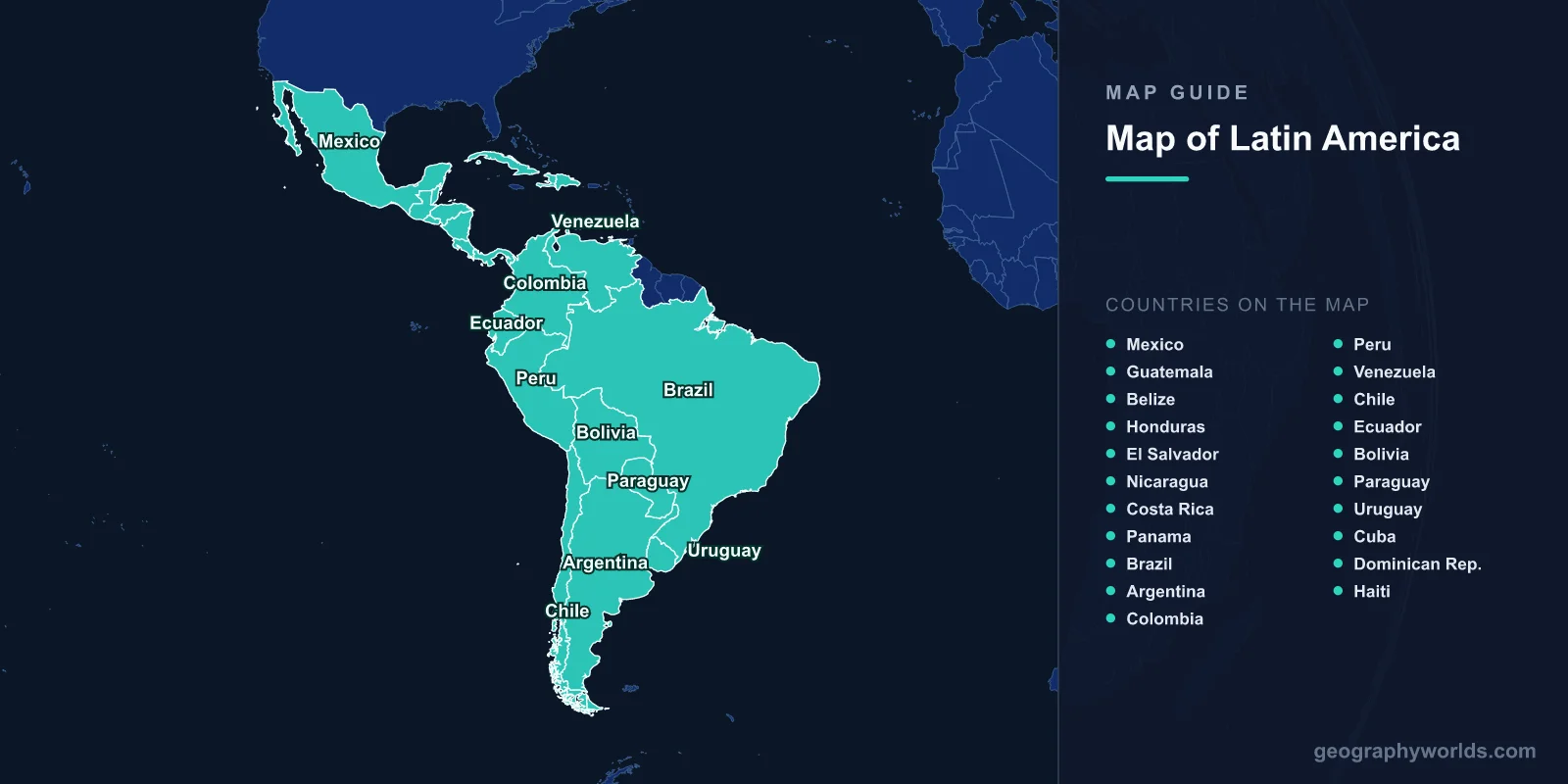
Latin America is a vast cultural and geographic region encompassing 20 countries where Romance languages (primarily Spanish and Portuguese) are spoken. It stretches from Mexico at approximately 32°N to Tierra del Fuego at 55°S, covering Central America, South America, and several Caribbean nations, with a combined area of roughly 20 million square kilometers and a population exceeding 650 million.
Introduction
The term "Latin America" refers to the nations of the Americas where Romance languages — descended from Latin — are the dominant tongues. This includes 18 Spanish-speaking countries, Portuguese-speaking Brazil, and French-speaking Haiti. The region spans nearly 90 degrees of latitude, from the deserts of northern Mexico to the glaciers of Patagonia, encompassing some of Earth's most dramatic landscapes.

Central America (7 Countries)
Central America is the narrow isthmus connecting North and South America, stretching approximately 1,800 km from Guatemala to Panama:
- Guatemala: 108,889 km². Capital: Guatemala City. The most populous Central American nation with strong Mayan heritage.
- Belize: 22,966 km². Capital: Belmopan. English-speaking but culturally Latin American, with the world's second-largest barrier reef.
- Honduras: 112,492 km². Capital: Tegucigalpa. Home to the ancient Mayan ruins of Copan.
- El Salvador: 21,041 km². Capital: San Salvador. The smallest and most densely populated Central American country.
- Nicaragua: 130,373 km². Capital: Managua. The largest Central American country, featuring Lake Nicaragua with its freshwater sharks.
- Costa Rica: 51,100 km². Capital: San Jose. Known for biodiversity, eco-tourism, and having no standing army since 1949.
- Panama: 75,417 km². Capital: Panama City. Home to the Panama Canal connecting the Atlantic and Pacific Oceans.
South America (12 Countries)
South America is the fourth-largest continent, dominated by Brazil in the east and the Andes in the west:
- Brazil: 8.5 million km². Capital: Brasilia. The largest Latin American country, home to the Amazon Rainforest and over 215 million people.
- Argentina: 2.8 million km². Capital: Buenos Aires. Stretches from subtropical Misiones to sub-Antarctic Tierra del Fuego.
- Colombia: 1.1 million km². Capital: Bogota. The only South American country with both Caribbean and Pacific coastlines.
- Peru: 1.3 million km². Capital: Lima. Home to Machu Picchu, Lake Titicaca, and the Inca heritage.
- Venezuela: 916,445 km². Capital: Caracas. Features Angel Falls, the world's highest uninterrupted waterfall.
- Chile: 756,102 km². Capital: Santiago. The world's longest north-south country at 4,300 km, yet averaging only 177 km wide.
- Ecuador: 283,561 km². Capital: Quito. Named for the equator that runs through it; includes the Galapagos Islands.
- Bolivia: 1.1 million km². Seat of government: La Paz (highest capital). Features the Salar de Uyuni salt flats and Lake Titicaca.
- Paraguay: 406,752 km². Capital: Asuncion. One of only two landlocked South American countries.
- Uruguay: 176,215 km². Capital: Montevideo. The smallest Spanish-speaking South American nation.
Caribbean Latin America
- Cuba: 109,884 km². Capital: Havana. The largest Caribbean island nation.
- Dominican Republic: 48,671 km². Capital: Santo Domingo. Shares the island of Hispaniola with Haiti.
- Haiti: 27,750 km². Capital: Port-au-Prince. French Creole-speaking, the first Black republic (independent since 1804).
Mexico (1.96 million km², capital: Mexico City) is often grouped with Latin America despite being geographically part of North America. It is the largest Spanish-speaking country by population with over 130 million people.
Major Geographic Features
- Andes Mountains: The world's longest continental mountain range at 7,000 km, running the length of South America's western coast.
- Amazon River & Rainforest: The world's largest river by discharge and largest tropical rainforest, covering 5.5 million km².
- Atacama Desert: The driest non-polar desert on Earth, in northern Chile and southern Peru.
- Patagonia: The vast steppe and glacier region at the southern tip of South America, shared by Argentina and Chile.
Latin America contains extraordinary biodiversity. Brazil alone is estimated to hold 15-20% of the world's biological diversity. The Galapagos Islands off Ecuador inspired Darwin's theory of evolution. The Pantanal in Brazil is the world's largest tropical wetland.
Key Facts
- Latin America encompasses 20 countries across Central America, South America, and the Caribbean.
- Brazil is the largest country at 8.5 million km², while El Salvador is the smallest mainland nation.
- The region spans from 32°N (Mexico) to 55°S (Tierra del Fuego).
- Over 650 million people live in Latin America, with Sao Paulo and Mexico City as the largest metros.
- The Andes and Amazon are the dominant geographic features of South America.
Fun Facts
- Bolivia has two capitals: Sucre (constitutional) and La Paz (seat of government), the latter being the world's highest capital at 3,640 m.
- Chile is so long that its climate ranges from the driest desert on Earth to glacial fjords resembling Norway.
- The Amazon River discharges more water than the next seven largest rivers combined.
- Costa Rica generates over 98% of its electricity from renewable sources, mostly hydroelectric and geothermal.
Final Thoughts
The map of Latin America reveals one of the most geographically diverse regions on Earth. From the Mesoamerican highlands to the Andean peaks, from the Amazon basin to the Patagonian steppe, these 20 countries encompass nearly every climate and landscape type. Understanding this map is key to appreciating the rich cultural tapestry, economic potential, and environmental significance of a region that is home to more than 650 million people.
Test Your Knowledge!
Think you know where things are on the map? Test your skills!
Play Geography Games →