
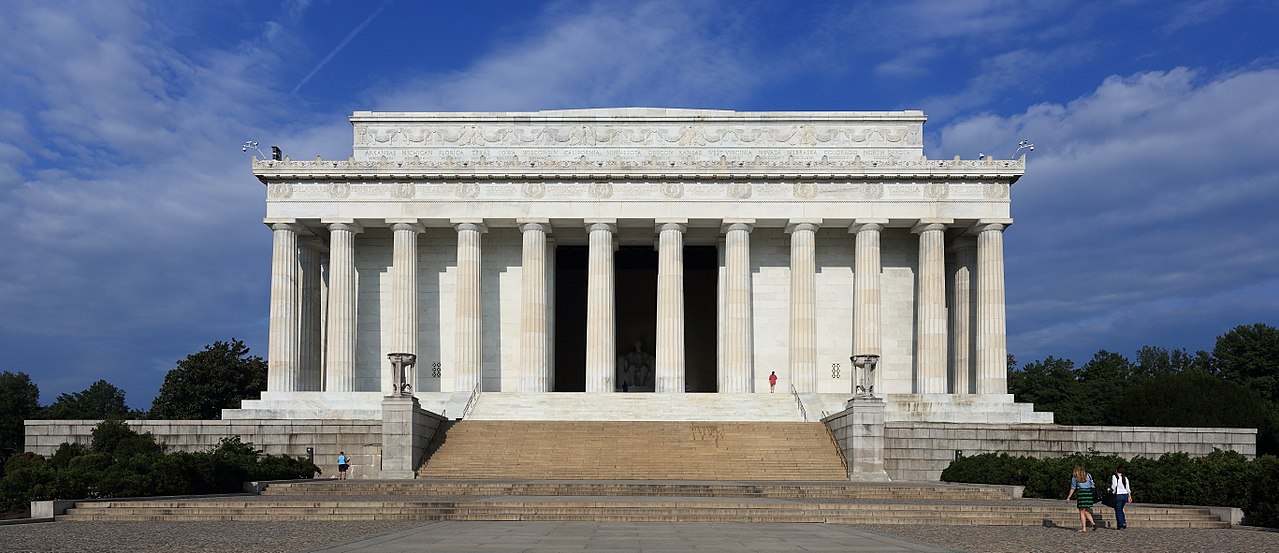
The Lincoln Memorial is a neoclassical monument on the western end of the National Mall in Washington, D.C., honoring Abraham Lincoln, the 16th President of the United States. The building stands 30 meters (99 feet) tall and 57.8 meters (189.7 feet) long, surrounded by 36 fluted Doric columns — one for each state in the Union at the time of Lincoln's assassination in 1865.
Introduction
Located at coordinates 38.8893°N, 77.0502°W, the memorial sits on the banks of the Potomac River at the end of the Reflecting Pool, directly aligned with the Washington Monument 0.9 kilometers to the east and the US Capitol 3.4 kilometers beyond. This axial placement makes it a defining anchor of Washington's monumental core, designed by architect Henry Bacon and dedicated on May 30, 1922.
Geography & Location
- Coordinates: 38.8893°N, 77.0502°W
- Elevation: ~5 m above sea level
- National Mall Position: Western terminus
- Reflecting Pool: 618 m long, directly east
The Lincoln Memorial occupies a site that was originally marshland along the Potomac River, reclaimed through an extensive landfill project completed in the early 1900s. The building sits on a concrete foundation that extends 13.4 meters below grade to reach bedrock, necessary because of the unstable former wetland soil. Engineers drove 122 concrete piers through the soft alluvial deposits.
The memorial commands a powerful east-west axis across the National Mall. Looking east from the memorial steps, the Reflecting Pool stretches 618 meters to the base of the Washington Monument, with the US Capitol dome visible beyond. To the south, the memorial aligns with the Martin Luther King Jr. Memorial and the Tidal Basin's famous cherry trees.
Architecture & Dimensions
- Height: 30 m (99 ft)
- Length: 57.8 m (189.7 ft)
- Width: 36.1 m (118.5 ft)
- Columns: 36 Doric columns, 13.4 m tall
The memorial's design was inspired by the Parthenon in Athens, reflecting the democratic ideals Lincoln fought to preserve. Each of the 36 exterior columns is 13.4 meters tall and 2.3 meters in diameter at the base, made from Colorado Yule marble. The attic frieze above the columns is inscribed with the names of the 36 states and their dates of admission.
Inside, Daniel Chester French's seated Lincoln statue is 5.8 meters (19 feet) tall and weighs 159 tonnes. It was carved from 28 blocks of white Georgia marble over four years. On the north and south interior walls, Lincoln's Second Inaugural Address and Gettysburg Address are carved in stone, with Jules Guerin murals above depicting themes of freedom and unity.
Historical Significance
- Dedicated: May 30, 1922
- Architect: Henry Bacon
- Sculptor: Daniel Chester French
- Cost: $2.96 million (1914–1922 dollars)
The Lincoln Memorial has served as the backdrop for some of the most significant moments in American civil rights history. On August 28, 1963, Martin Luther King Jr. delivered his "I Have a Dream" speech from the memorial steps before a crowd of approximately 250,000 people during the March on Washington. A stone inscription on the landing marks the exact spot where King stood.
The memorial's dedication ceremony in 1922 was itself a reflection of the racial tensions Lincoln's legacy represents. The audience was segregated, with Black attendees relegated to a separate section despite the memorial honoring the president who issued the Emancipation Proclamation. Robert Russa Moton, president of the Tuskegee Institute, delivered a keynote address but was required to sit in the segregated section.
Visitor Experience
- Annual Visitors: ~7.8 million
- Hours: Open 24 hours, staffed 9:30 AM–10 PM
- Admission: Free
- Nearest Metro: Foggy Bottom–GWU (0.9 km walk)
The Lincoln Memorial is the most visited memorial on the National Mall, attracting approximately 7.8 million visitors annually. It is open 24 hours a day, 365 days a year, with National Park Service rangers available during staffed hours to provide interpretive talks. The memorial is particularly striking at night, when dramatic uplighting illuminates the marble columns and Lincoln statue.
The memorial is accessible via the National Mall pathway system, with the nearest Metro station at Foggy Bottom–GWU approximately 0.9 kilometers to the northeast. The memorial steps descend to the Reflecting Pool, offering one of the most photographed views in Washington, D.C.
Key Facts
- The Lincoln Memorial stands 30 meters (99 feet) tall with 36 Doric columns.
- The seated Lincoln statue weighs 159 tonnes and is carved from 28 blocks of Georgia marble.
- Martin Luther King Jr. delivered his "I Have a Dream" speech from the memorial steps in 1963.
- Approximately 7.8 million people visit the memorial each year.
- The foundation extends 13.4 meters below grade to reach bedrock beneath former marshland.
Fun Facts
- A persistent myth claims that Lincoln's hands form the letters "A" and "L" in American Sign Language, but the sculptor Daniel Chester French never confirmed this.
- There is a typo on the north wall — the word "FUTURE" was originally carved as "EUTURE" and later corrected, but the patch is still visible.
- The Reflecting Pool holds approximately 25 million liters (6.75 million gallons) of water.
- Lincoln's memorial was built on land that was underwater marsh just 50 years before construction began.
Final Thoughts
The Lincoln Memorial is more than a tribute to a president — it is a geographic and symbolic anchor of American democracy. Its position on the National Mall, its architectural grandeur, and its role as a stage for historic moments of protest and progress make it one of the most meaningful places in the United States.
Test Your Knowledge!
Think you know American landmarks? Try our interactive geography games!
Play Geography Games →