
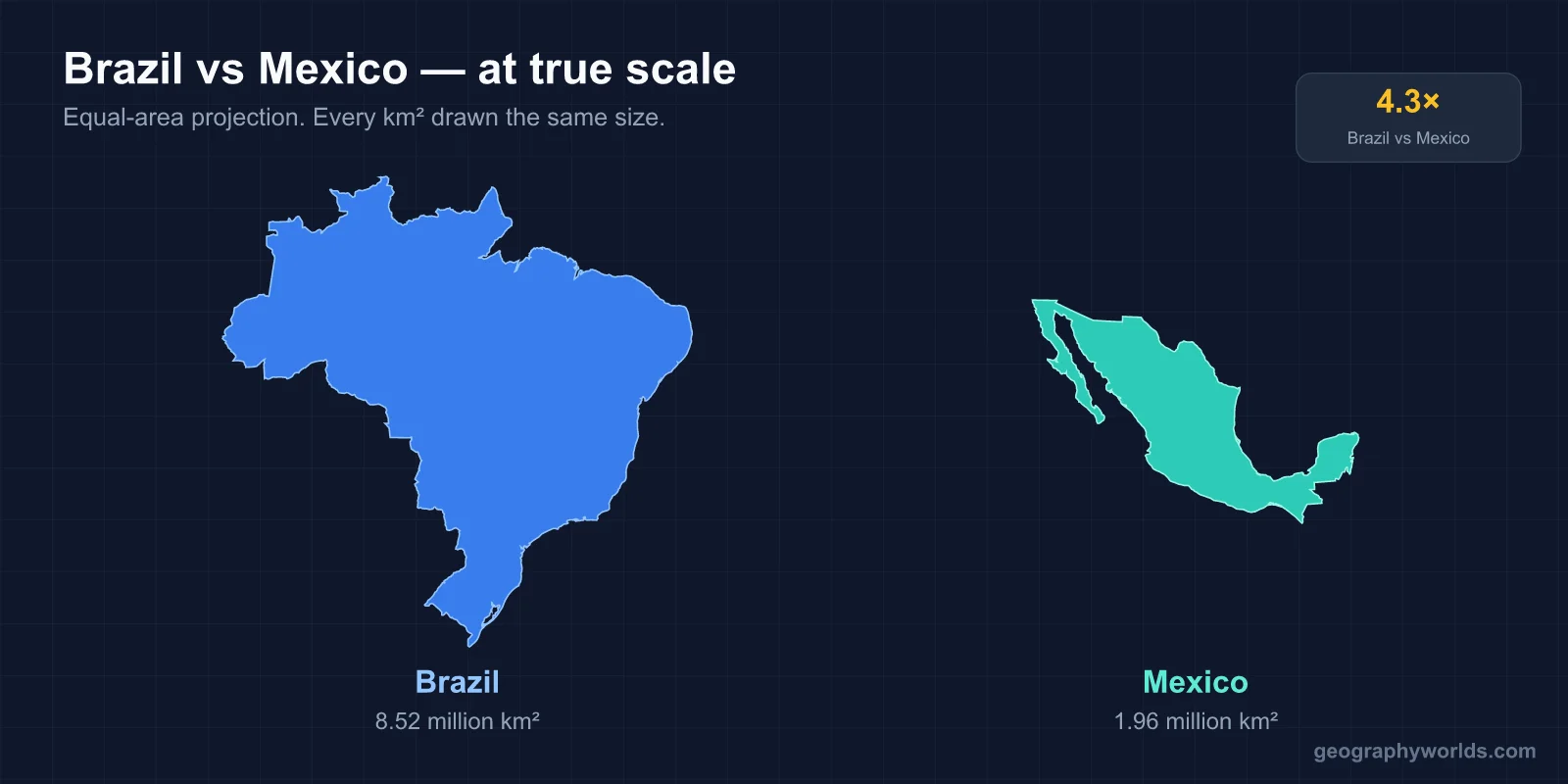
Mexico and Brazil are Latin America's two largest and most influential nations, but they differ dramatically in scale and setting. Brazil covers about 8,515,767 km² in South America, roughly 4.3 times the size of Mexico's 1,964,375 km² in North America, and it is home to around 213.6 million people compared with Mexico's 133.0 million. Mexico speaks Spanish and is more densely populated; Brazil speaks Portuguese and contains the bulk of the Amazon Rainforest. The two are neighbours in spirit and culture but separated by a continent.
How do Mexico 🇲🇽 and Brazil 🇧🇷 compare? Whether you are studying geography, planning travel, or simply curious about how countries stack up, this side-by-side comparison examines size, population, capitals, language, climate, economy, and the natural features that define each nation.
Size & Geography
| Feature | Mexico 🇲🇽 | Brazil 🇧🇷 |
|---|---|---|
| Area | 1,964,375 km² | 8,515,767 km² |
| Continent | North America | South America |
| Region | Central America | South America |
| Land Borders | United States, Guatemala, Belize | All South American countries except Chile and Ecuador |
| Landscape | high plateaus, mountains, lowlands, deserts, tropical coasts | Amazon basin, highlands, coastal mountains, wetlands |
The scale difference is the headline. At 8,515,767 km², Brazil is the fifth-largest country on Earth and occupies nearly half of South America, while Mexico ranks around 13th globally. Brazil shares borders with ten of South America's countries, missing only Chile and Ecuador, which gives it an extraordinary range of frontier ecosystems. Mexico, by contrast, has just three neighbours and acts as the land bridge between North and Central America.
Their physical geography is equally distinct. Mexico is a country of altitude: the Sierra Madre Occidental and Oriental ranges flank a vast central plateau (the Altiplano), and much of the population lives more than a kilometre above sea level. Brazil is dominated by the low, flat Amazon basin in the north and a broad central plateau (the planalto) in the south and east, with relatively modest mountains compared with the Andean nations to its west.
Population & Demographics
| Metric | Mexico 🇲🇽 | Brazil 🇧🇷 |
|---|---|---|
| Population | 133.0 million | 213.6 million |
| Population Density | 67.7 per km² | 25.1 per km² |
Brazil's population of roughly 213.6 million is about 1.6 times that of Mexico's 133.0 million, making Brazil the most populous country in Latin America and the seventh most populous in the world. Yet Mexico is the more crowded of the two, with about 67.7 people per km² against Brazil's 25.1. The reason lies in geography: huge stretches of Brazil's Amazon interior are sparsely settled, so most Brazilians cluster along the Atlantic coast in cities like São Paulo, Rio de Janeiro, and Salvador. Mexico's people concentrate in the temperate central highlands around Mexico City, Guadalajara, and Monterrey.
Capital Cities
Mexico City is the capital of Mexico, while Brasília is the capital of Brazil. The contrast between them tells a wider story. Mexico City is one of the oldest continuously inhabited capitals in the Americas, built directly on the ruins of the Aztec capital Tenochtitlán and home to more than 21 million people in its metropolitan area. Brasília, by comparison, is a planned city carved out of the central savannah and inaugurated in 1960 to pull development inland from the crowded coast. Its modernist layout earned it UNESCO World Heritage status. Notably, Brazil's largest cities, São Paulo and Rio de Janeiro, are not its capital.
Language, Currency & Culture
| Aspect | Mexico 🇲🇽 | Brazil 🇧🇷 |
|---|---|---|
| Languages | Spanish (de facto official), plus 68 recognized indigenous languages | Portuguese (official) |
| Currency | Mexican Peso (MXN) | Brazilian Real (BRL) |
Language is the single most defining cultural difference. Mexico is the world's largest Spanish-speaking country by population, a legacy of Spanish colonisation, while Brazil is the only major Portuguese-speaking nation in the Americas, reflecting its colonisation by Portugal. Mexico also constitutionally recognises 68 indigenous languages such as Nahuatl and Maya, a reminder of the Aztec and Mayan civilisations that flourished there. Both countries are overwhelmingly Roman Catholic, though Brazil has the largest Catholic population on the planet alongside a fast-growing Protestant minority.
Climate & Natural Features
| Aspect | Mexico 🇲🇽 | Brazil 🇧🇷 |
|---|---|---|
| Climate | varies from tropical to desert | mostly tropical; temperate in south |
| Key Features | Sierra Madre, Yucatán Peninsula, Copper Canyon, cenotes | Amazon Rainforest, Pantanal wetlands, Iguazu Falls, Sugarloaf |
| Economy | manufacturing, oil, agriculture, tourism, remittances | agriculture (soy, coffee), mining, aerospace, oil |
Mexico's climate runs the full gamut, from the arid Sonoran and Chihuahuan deserts in the north to the steamy tropical coasts of the Yucatán. Its landscape highlights include the dramatic Copper Canyon, a system larger than the Grand Canyon, and the Yucatán's cenotes, water-filled sinkholes left behind by the asteroid impact linked to the dinosaurs' extinction. Brazil is mostly tropical, turning temperate only in its far south, and its natural wonders are world-famous: the Amazon Rainforest, the Pantanal (the world's largest tropical wetland), the thundering Iguazu Falls on the Argentine border, and Rio's iconic Sugarloaf Mountain.
Economy
Economically, the two countries play to different strengths. Mexico is an industrial and trading powerhouse, deeply integrated with the United States and Canada through the USMCA agreement; manufacturing, automobiles, oil, tourism, and remittances drive its economy. Brazil is an agricultural and resource giant, ranking among the world's top exporters of soybeans, coffee, beef, and iron ore, with a notable aerospace sector led by aircraft maker Embraer. Both are members of the G20, and Brazil is a founding member of the BRICS group, underlining its ambitions as an emerging-market leader.
What Makes Each Country Unique
Mexico is internationally renowned for its ancient Mayan and Aztec civilizations, tacos, tequila, Day of the Dead celebrations, and vibrant art. Mexico City is built on the ruins of the Aztec capital Tenochtitlán and is sinking at a rate of about 50 cm per year due to groundwater extraction from the old lakebed beneath it.
Brazil is best known for Carnival, the Amazon Rainforest, samba and bossa nova, football, and the Christ the Redeemer statue overlooking Rio de Janeiro. Brazil contains roughly 60% of the Amazon Rainforest, often called the "lungs of the planet" for its vast role in absorbing carbon dioxide and cycling moisture across the continent.
Key Facts
- Larger country: Brazil (8,515,767 km²), about 4.3× the size of Mexico
- More populous: Brazil (213.6 million) vs Mexico (133.0 million)
- Denser: Mexico (67.7 per km²) vs Brazil (25.1 per km²)
- Capitals: Mexico City vs Brasília
- Languages: Spanish (Mexico) vs Portuguese (Brazil)
- Currencies: Mexican Peso (MXN) vs Brazilian Real (BRL)
- Continents: North America vs South America
Verdict
Mexico and Brazil are Latin America's two heavyweights, yet they prove that size and population do not always move together. Brazil wins on both land area (4.3×) and population (1.6×), but Mexico is the more densely settled and more industrialised of the two. Mexico's identity is built on its highland deserts, ancient pyramids, and tight links to North America; Brazil's is built on its tropical forests, Atlantic megacities, and resource wealth. Understanding their differences offers a richer picture of how geography shapes culture, economy, and daily life across the Americas.
Test Your Knowledge!
Think you know your countries? Try our interactive geography quiz!
Play Geography Games →Frequently Asked Questions
Is Brazil bigger than Mexico?
Yes. Brazil covers about 8,515,767 km² while Mexico covers about 1,964,375 km², making Brazil roughly 4.3 times larger. Brazil is the fifth-largest country in the world, whereas Mexico ranks around 13th.
Which country has more people, Mexico or Brazil?
Brazil has more people, with about 213.6 million compared with Mexico's 133.0 million. However, Mexico is more densely populated because so much of Brazil's land is sparse Amazon interior.
Do Mexico and Brazil speak the same language?
No. Mexico is the world's largest Spanish-speaking country, while Brazil is the largest Portuguese-speaking country. The difference stems from their colonial histories under Spain and Portugal respectively.
Are Mexico and Brazil on the same continent?
No. Mexico is in North America (within the Central America region), while Brazil is in South America. They are separated by the entire stretch of Central America and the Caribbean.
