
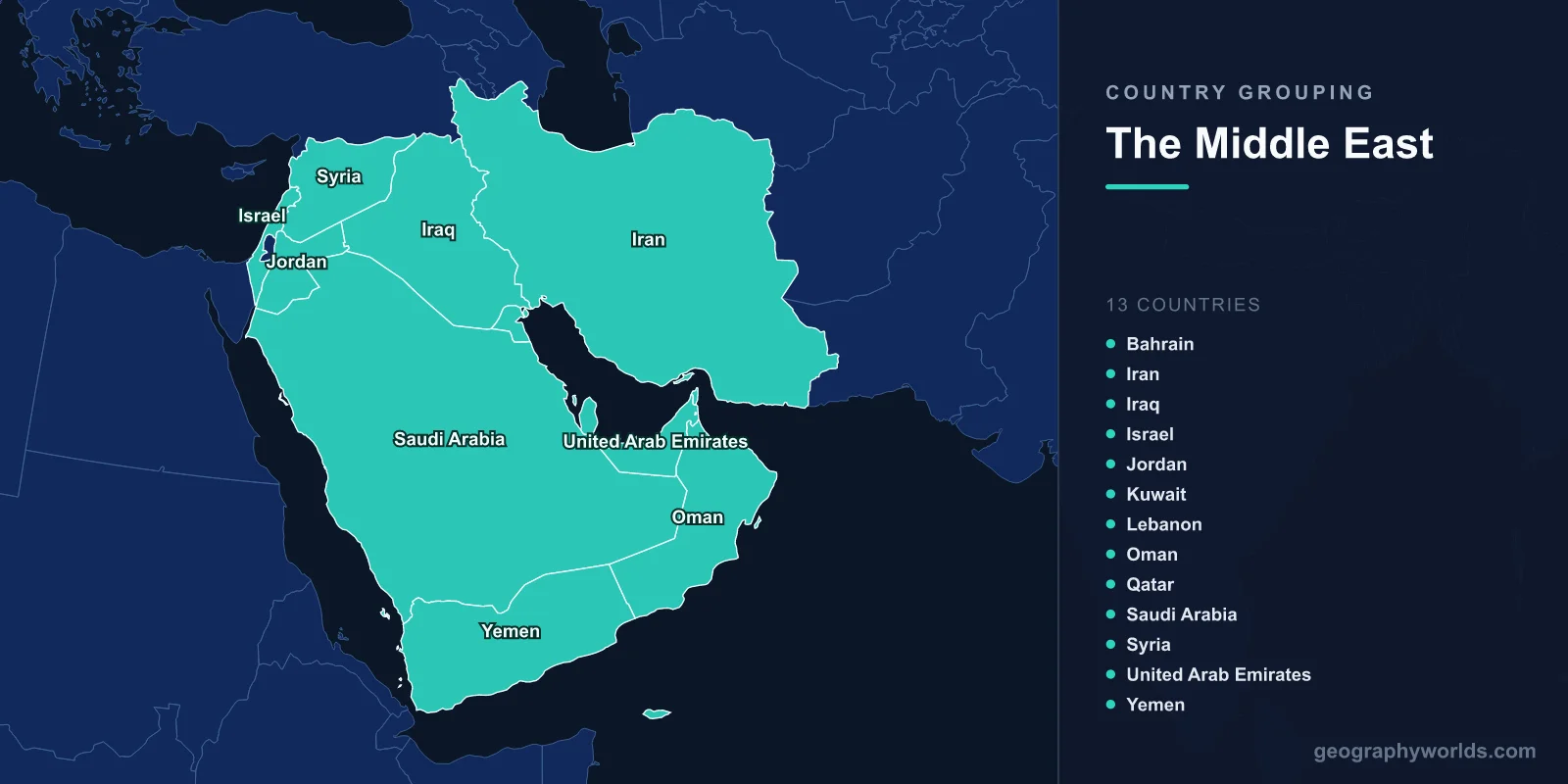
Introduction to The Middle East
The Middle East is one of the most historically significant and geopolitically complex regions on Earth. Spanning the lands between the eastern Mediterranean and the Persian Gulf, this region gave humanity its first cities, writing systems, legal codes, and three of the world's major monotheistic religions — Judaism, Christianity, and Islam. The 13 countries of the Middle East encompass enormous diversity: from the ultra-modern skylines of Dubai and Doha to the ancient ruins of Petra and Persepolis, from the oil wealth of the Gulf states to the ongoing conflicts in Syria and Yemen. Home to roughly 400 million people, the Middle East sits atop approximately half of the world's proven oil reserves, making it the engine room of the global energy economy and a permanent focus of international attention.
Geographically, the Middle East covers approximately 7.2 million square kilometers, stretching from Turkey's Anatolian plateau in the north to Yemen's Arabian Sea coast in the south, and from Egypt's Sinai Peninsula in the west to Iran's border with Afghanistan in the east. The region's terrain ranges from the vast Rub' al Khali (Empty Quarter) — the world's largest contiguous sand desert at 650,000 square kilometers — to the snow-capped Zagros and Alborz mountain ranges of Iran, the fertile Tigris-Euphrates river valley, and the coral-rich waters of the Red Sea. This geographic diversity, combined with its position at the junction of three continents, has made the Middle East a crossroads of human migration, trade, and cultural exchange for over 10,000 years.

Countries in The Middle East
- Bahrain
- Iran
- Iraq
- Israel
- Jordan
- Kuwait
- Lebanon
- Oman
- Qatar
- Saudi Arabia
- Syria
- United Arab Emirates
- Yemen
Location: Southwestern Asia, bridging Africa, Asia, and Europe
Shared Characteristics: Cradle of civilization, oil wealth, religious significance, geopolitical importance
History
The Middle East is often called the Cradle of Civilization, and with good reason. Mesopotamia, in modern-day Iraq, saw the rise of the Sumerian, Akkadian, Babylonian, and Assyrian civilizations, which invented writing, the wheel, and mathematics. Ancient Egypt, Persia, and the Phoenician city-states all flourished in or adjacent to the region. The Middle East is the birthplace of Judaism, Christianity, and Islam, and the holy cities of Jerusalem, Mecca, and Medina remain central to the faith of billions. The Islamic Golden Age (roughly 8th-14th centuries) saw the region lead the world in science, medicine, mathematics, and philosophy. The Ottoman Empire ruled much of the Middle East for four centuries until its collapse after World War I, when European powers drew new borders that created many of today's nations. The discovery of oil in the early 20th century, the creation of Israel in 1948, and the Iranian Revolution of 1979 reshaped the region's modern trajectory.
Geography & Climate
The Middle East's geography is dominated by vast deserts, including the Arabian Desert (the world's largest sand desert), the Syrian Desert, and Iran's Dasht-e Kavir. However, the region is far more geographically diverse than its desert reputation suggests. The Tigris and Euphrates rivers create fertile valleys in Iraq and Syria, the Lebanese mountains rise to over 3,000 meters, and the Iranian plateau is flanked by the Zagros and Alborz mountain ranges. The Persian Gulf, Red Sea, and eastern Mediterranean provide vital coastlines for trade and resources. The Dead Sea, shared by Israel and Jordan, is the lowest point on Earth's surface at roughly 430 meters below sea level. The region's climate ranges from Mediterranean along the coasts to hyper-arid in the interior, with summer temperatures exceeding 50 degrees Celsius in parts of Iraq and Kuwait.
Culture & Society
Middle Eastern culture is layered with thousands of years of tradition and remarkable diversity. Arabic is the most widely spoken language, but the region is also home to Persian (Farsi), Hebrew, Turkish, and Kurdish. Islamic architecture — from the mosques of Istanbul to the geometric patterns of Isfahan — represents some of humanity's greatest artistic achievements. Arabic calligraphy, Persian poetry (Rumi, Hafez, Omar Khayyam), and the tradition of storytelling embodied in One Thousand and One Nights have influenced world culture profoundly. Cuisine varies richly across the region: Lebanese mezze, Iranian kebabs, Gulf seafood dishes, and Yemeni honey-drizzled pastries each reflect local traditions. Hospitality is a deeply held cultural value across the Middle East, with elaborate customs around welcoming guests, serving coffee, and sharing meals.
Economy
The Middle East's modern economy is defined by oil and gas, with Saudi Arabia, Iran, Iraq, Kuwait, Qatar, and the UAE among the world's largest producers. The Gulf Cooperation Council (GCC) states — Saudi Arabia, UAE, Qatar, Kuwait, Bahrain, and Oman — have used oil wealth to build modern infrastructure and diversify their economies. The UAE, particularly Dubai, has become a global hub for finance, tourism, and logistics. Qatar has the highest GDP per capita in the world. Saudi Arabia's Vision 2030 plan aims to reduce oil dependence through mega-projects like the futuristic city of NEOM. However, non-oil economies in the region face greater challenges: Lebanon has experienced severe economic crisis, Yemen's economy has been devastated by war, and Iraq is rebuilding after decades of conflict. Israel stands apart with a high-tech economy often called the "Startup Nation."
The Region Today
The contemporary Middle East is defined by transformation and tension. The Abraham Accords of 2020 normalized relations between Israel and several Arab states, reshaping regional diplomacy. Saudi Arabia and the UAE are investing billions in economic diversification, entertainment, sports, and tourism. Iran's nuclear program and regional influence remain contentious issues. The humanitarian crises in Syria and Yemen have displaced millions. Meanwhile, a young and increasingly connected population — over 60% of the region's population is under 30 — is driving social change, entrepreneurship, and cultural innovation. Women's rights have advanced significantly in several Gulf states, with Saudi Arabia lifting its ban on women driving in 2018.
Interesting Facts About The Middle East
- Qatar has the highest GDP per capita in the world, thanks to its enormous natural gas reserves
- The Dead Sea between Israel and Jordan is so salty that people float effortlessly on its surface
- The UAE's Burj Khalifa in Dubai is the tallest building in the world at 828 meters
- Iran's civilization dates back over 7,000 years, making it one of the world's oldest continuous cultures
- Oman is one of the oldest independent states in the Arab world, with a history of seafaring and trade
- Lebanon's capital Beirut has been destroyed and rebuilt seven times throughout its history
Conclusion
The Middle East (Bahrain, Iran, Iraq, Israel, Jordan, Kuwait, Lebanon, Oman, Qatar, Saudi Arabia, Syria, United Arab Emirates, Yemen) represent a fascinating regional grouping with shared history, cultural ties, and common challenges. Whether you're studying world geography, planning travel, or simply curious about how the world's nations connect, understanding these regional groupings provides valuable context for making sense of our complex and interconnected world.