
Przewalski's horse (Equus ferus przewalskii), known as takhi in Mongolian, is the national animal of Mongolia and the world's last truly wild horse species. Unlike all other "wild" horses (which are descended from domestic horses that returned to the wild), Przewalski's horse has never been domesticated and represents a separate evolutionary lineage that split from the ancestor of domestic horses over 500,000 years ago.
Introduction
The takhi's story is one of the most remarkable in conservation history. After going extinct in the wild in the 1960s, with only 12 individuals surviving in zoos, the species has been painstakingly rebuilt through captive breeding and reintroduced to the Mongolian steppe. Today, over 700 Przewalski's horses roam free in Mongolia, and the species has been downlisted from Extinct in the Wild to Endangered on the IUCN Red List.
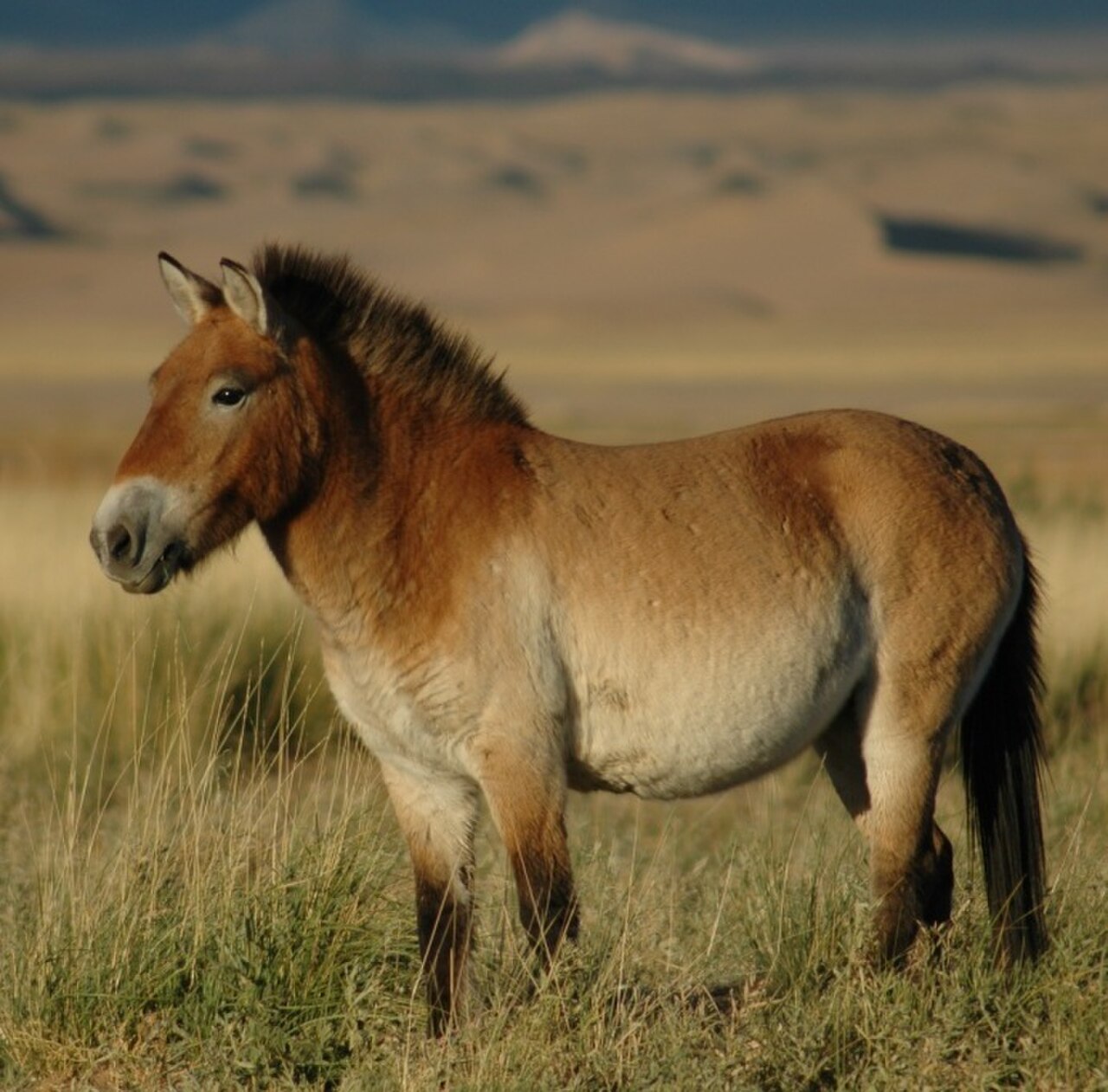
The Animal: Przewalski's Horse
- Scientific Name: Equus ferus przewalskii
- Mongolian Name: Takhi (spirit or worthy of worship)
- Height: 120-146 cm at the shoulder
- Weight: 250-360 kg
- Wild Population: Over 700 in Mongolia
Przewalski's horse is stocky and compact, with a dun-colored coat, dark mane that stands erect (unlike the flowing mane of domestic horses), a pale belly, and distinctive dark legs. It has 66 chromosomes compared to 64 in domestic horses, confirming its status as a separate species rather than a domestic ancestor. The horse is remarkably tough, adapted to survive the extreme temperatures of the Mongolian steppe, which can range from -40 degrees Celsius in winter to 40 degrees Celsius in summer.
Takhi live in small family groups of 5-15 individuals, led by a dominant stallion. They are grazers that feed primarily on grasses and shrubs of the steppe, and they can survive on vegetation that would be inadequate for domestic horses. Their social structure, foraging behavior, and ability to find water in arid landscapes have been largely unchanged for hundreds of thousands of years.
Historical & Cultural Significance
- Mongolian Horse Culture: Horses central to Mongolian identity for thousands of years
- Genghis Khan: Built empire on the back of Mongolian horses
- Cave Art: Horses resembling Przewalski's depicted in Lascaux caves (~17,000 years ago)
- Name Origin: Named after Russian explorer Nikolai Przewalski (1879)
Horses are the single most important animal in Mongolian culture. Mongolia is known as the "Land of the Horse," and the Mongolian saying goes, "A Mongol without a horse is like a bird without wings." Genghis Khan conquered the largest contiguous land empire in history largely through the superiority of Mongolian horsemanship and the endurance of Mongolian horses. While the takhi was never domesticated, it represents the wild spirit of the Mongolian steppe.
The takhi's Mongolian name means "spirit" or "worthy of worship," reflecting the deep reverence Mongolians hold for the animal. Images of horses closely resembling Przewalski's horse appear in cave paintings at Lascaux in France and other European sites dating back over 17,000 years, suggesting these horses once ranged across the entire Eurasian steppe. The species was first described for Western science by the Russian explorer Nikolai Przewalski in 1879.
Geographic Range & Habitat
- Historical Range: Steppe grasslands from Mongolia to eastern Europe
- Current Range: Hustai National Park, Great Gobi B, Khomiin Tal (Mongolia)
- Habitat: Semi-arid steppe grassland, 1,000-2,000 m elevation
- Reintroduction Sites: Mongolia, China, Russia, Kazakhstan
Przewalski's horses historically roamed the vast steppe grasslands of Central Asia, from Mongolia and China westward to Kazakhstan and possibly beyond. Their range contracted dramatically due to hunting, competition with domestic livestock, and habitat loss, until the last wild individual was sighted in Mongolia's Dzungarian Gobi in 1969.
Today, reintroduced populations are found at three main sites in Mongolia: Hustai National Park (about 100 km west of Ulaanbaatar), the Great Gobi B Strictly Protected Area in southwestern Mongolia, and the Khomiin Tal area in western Mongolia. Additional reintroduction programs exist in China (Xinjiang and Gansu provinces), Russia, and Kazakhstan. The Mongolian steppe, one of the largest intact grassland ecosystems on Earth, provides ideal habitat for the species' continued recovery.
Conservation: From Extinction to Recovery
- Extinct in Wild: 1969 (last wild sighting in Mongolia)
- Surviving Foundation Stock: 12 individuals in zoos (all today's horses descend from these)
- First Reintroduction: 1992 at Hustai National Park, Mongolia
- IUCN Status: Endangered (improved from Extinct in the Wild)
The rescue of Przewalski's horse from total extinction is one of the greatest achievements in conservation biology. When the last wild horses disappeared in the late 1960s, fewer than 20 individuals survived in zoos worldwide. A coordinated international breeding program, managed through studbooks and genetic analysis, slowly rebuilt the population from just 12 founding individuals (plus possibly 1-2 more that contributed genes).
The first reintroduction to Mongolia took place in 1992, when horses bred in European zoos were transported to Hustai National Park. Over the following decades, additional animals were released at Hustai, Great Gobi B, and Khomiin Tal. The reintroduced horses faced challenges including harsh winters, predation by wolves, and disease, but the population has grown steadily. In 2011, the species was downlisted from Extinct in the Wild to Endangered — a landmark moment in conservation history.
Other National Symbols of Mongolia
- National Emblem: Soyombo symbol (ancient Buddhist design)
- National Sport: Horse racing (part of Naadam festival)
- National Bird: Saker falcon
- Cultural Symbol: The ger (yurt) — traditional nomadic dwelling
Mongolia's national emblem, the Soyombo, is an ancient symbol combining elements of fire, sun, moon, earth, water, and the yin-yang principle. It appears on the Mongolian flag and represents Mongolian independence and sovereignty. The Naadam festival, held annually in July, features the "three games of men" — horse racing, wrestling, and archery — and is the most important cultural event in Mongolia.
The saker falcon is Mongolia's national bird and is central to the country's falconry tradition, which has been practiced by nomadic peoples of the steppe for thousands of years. The ger (known internationally as a yurt), a portable circular dwelling, remains the home of many Mongolian nomadic herders and is the most recognized symbol of Mongolian culture. Mongolia's vast, open steppe landscapes, with their extreme climate and nomadic traditions, define the national character.
Key Facts
- Przewalski's horse is the world's last truly wild horse, never domesticated.
- The species went extinct in the wild in 1969 and has been successfully reintroduced to Mongolia.
- All living Przewalski's horses descend from approximately 12 zoo animals.
- Over 700 Przewalski's horses now roam free in Mongolia.
- The Mongolian name "takhi" means "spirit" or "worthy of worship."
Fun Facts
- Przewalski's horse has 66 chromosomes — domestic horses have only 64.
- Horses resembling Przewalski's appear in 17,000-year-old cave paintings at Lascaux, France.
- The first Przewalski's horses were reintroduced to Mongolia from European zoos in 1992.
- The species was downlisted from Extinct in the Wild to Endangered in 2011 — one of conservation's greatest achievements.
Final Thoughts
Przewalski's horse represents both Mongolia's deep connection to the horse and one of the most inspiring conservation stories ever told. From the brink of total extinction to a growing wild population on the Mongolian steppe, the takhi embodies the resilience of nature and the power of dedicated international conservation effort.
Test Your Knowledge!
Think you know national animals and symbols? Try our geography quiz games!
Play Geography Games →