
The major natural resources of Russia include natural gas, oil, coal, timber, and gold. Russia is the world's largest producer of natural gas, accounting for approximately 17% of global production, and holds an estimated 38 trillion cubic meters in proven reserves. Spread across 17.1 million square kilometers, this resource wealth generates roughly 60% of the country's total export revenues.
Introduction
Russia's vast territory spanning 17.1 million square kilometers makes it the largest country on Earth, containing extraordinary mineral wealth beneath its Siberian plains, Ural Mountains, and Arctic regions. The country's resource sector contributes roughly 60% of total export revenues, anchoring an economy that ranks among the most commodity-dependent of any major industrial power.
What sets Russia apart is not merely the scale of any single resource but the sheer breadth of its endowment. Few nations can claim leadership in energy, metals, agriculture, freshwater, and forestry simultaneously. From the gas fields of the Yamal Peninsula to the Black Earth wheat belt and the boreal taiga that blankets Siberia, Russia's geography reads like a catalogue of the planet's most strategically important raw materials. For a fuller picture of the country itself, see our Russia country guide.
Major Mineral Resources
- Gold: Top 3 global producer, ~300 tonnes/year
- Diamonds: Yakutia region, 30% of global output
- Iron Ore: Kursk Magnetic Anomaly, 25 billion tonnes
- Nickel: Norilsk, world's largest producer
- Platinum: 40% of global supply
Russia is one of the world's most mineral-rich countries. The Ural Mountains form a mineral belt containing iron, copper, chromite, platinum, and gemstones — a geological corridor that has fed Russian industry since the time of Peter the Great, when the first ironworks transformed the region into the empire's metallurgical heartland. Siberia holds vast gold deposits, with the Bodaibo district in Irkutsk Oblast being one of the largest gold-producing regions globally. Russia mines roughly 300 tonnes of gold each year, placing it consistently among the top three producers worldwide.
The Norilsk mining complex in northern Siberia produces roughly 20% of the world's nickel and significant quantities of palladium and platinum, with Russia supplying about 40% of the world's platinum group metals overall. These metals are critical to catalytic converters, electronics, and increasingly to clean-energy technologies, giving Norilsk outsized influence over global supply chains. Russia's diamond mines in Yakutia (Sakha Republic) produce approximately 30% of the world's rough diamonds by value, rivaling Botswana and Canada, while the Kursk Magnetic Anomaly in western Russia holds an estimated 25 billion tonnes of iron ore — the largest known deposit of its kind on Earth.
Energy Resources
- Natural Gas: 38 trillion m³ proven reserves
- Oil: 80 billion barrels proven reserves, 3rd globally
- Coal: 162 billion tonnes, 2nd largest reserves
- Nuclear: 38 operating reactors, major uranium producer
- Hydropower: 5th largest hydroelectric capacity
Russia's energy resources are among the most significant on the planet. The country holds the world's largest proven natural gas reserves at 38 trillion cubic meters, centered in western Siberia at the massive Urengoy and Yamburg fields. Gazprom, the state-controlled gas company, operates the world's longest pipeline network spanning over 170,000 kilometers — enough pipe to circle the Earth more than four times. This infrastructure long underpinned Europe's energy supply, though shifting geopolitics since the 2020s has redirected much of that export flow toward China and other Asian markets.
Russia's oil reserves, concentrated in western Siberia and the Volga-Urals region, total around 80 billion barrels and make it the world's third-largest oil producer behind the United States and Saudi Arabia. The country also holds the second-largest coal reserves globally at 162 billion tonnes, with major deposits in the Kuznetsk Basin and the Siberian Tunguska Basin. Beyond fossil fuels, Russia operates 38 nuclear reactors, ranks as a major uranium producer, and commands the world's fifth-largest hydroelectric capacity, drawing on the colossal flow of Siberian rivers.
Agricultural Resources
- Wheat: World's largest exporter
- Arable Land: 123 million hectares
- Sunflower Seeds: Top global producer
- Barley: Major global producer
- Sugar Beets: Top 5 globally
Despite its harsh climate across much of the territory, Russia possesses 123 million hectares of arable land, concentrated in the fertile Black Earth (Chernozem) region stretching from Ukraine's border to western Siberia. This nutrient-rich soil, among the most productive on the planet, supports world-class wheat production and has made Russia the world's largest wheat exporter — a position that gives Moscow considerable leverage over global food prices, particularly across the Middle East and North Africa.
Russia is also the world's leading producer of sunflower seeds, a major producer of barley and oats, and a significant grower of sugar beets and potatoes. The agricultural sector employs approximately 6% of the workforce and has seen substantial modernization since the 2010s, transforming a country that imported grain during the Soviet era into a dominant exporter today.
Water & Forest Resources
- Freshwater: Over 2.5 million rivers; Lake Baikal holds 20% of the world's surface freshwater
- Forests: 815 million hectares, largest forested area globally
- Timber: World's largest timber reserves
- Fish: Major fisheries in the Pacific, Arctic, and Caspian
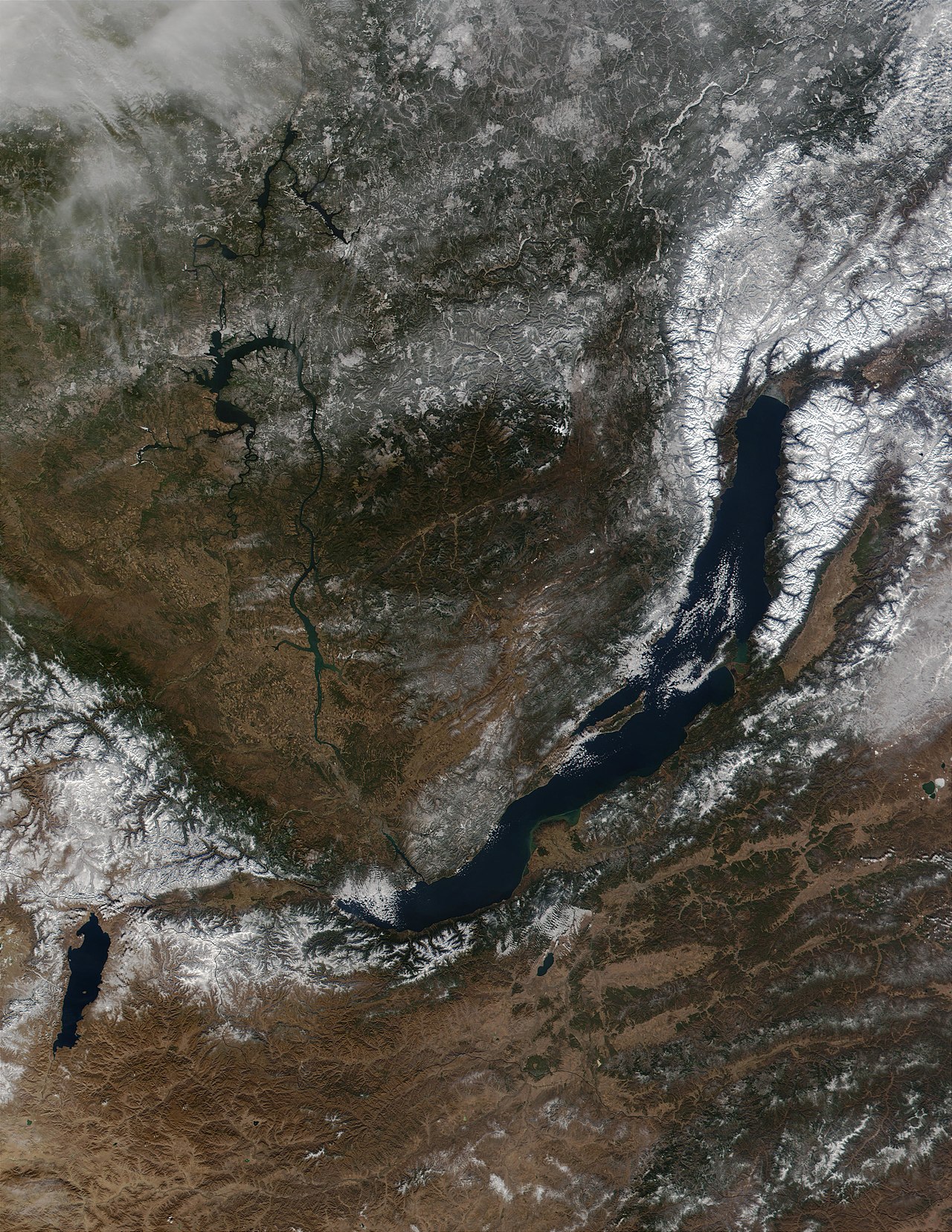
Russia contains roughly one-quarter of the world's freshwater resources. Lake Baikal alone holds approximately 20% of the world's unfrozen surface freshwater and is, at over 1,600 meters deep, the deepest lake on Earth. The country's 2.5 million rivers, including the Volga, Ob, Yenisei, and Lena, provide hydroelectric power, irrigation, and transportation routes across the vast territory, knitting together regions otherwise separated by thousands of kilometers of wilderness.
Russian forests cover 815 million hectares — about 20% of the world's total forest area and the single largest forested expanse on Earth. These boreal forests (taiga) represent an enormous carbon sink and timber reserve, producing approximately 220 million cubic meters of roundwood annually and making Russia the world's fourth-largest timber producer. The ecological stakes are immense: these forests, along with Siberia's permafrost, play a pivotal role in global climate regulation, and their management has become a growing focus of international environmental concern.
How Russia Compares to Similar Nations
Among the world's resource giants, Russia occupies a singular position. Compared with Saudi Arabia, whose wealth rests overwhelmingly on oil, Russia's portfolio is far more diversified — pairing hydrocarbons with metals, grain, freshwater, and timber. Against the United States, the world's top oil and gas producer, Russia trails in output but leads in proven gas reserves and dwarfs it in forested area and freshwater stores.
Canada and Australia make perhaps the most instructive comparisons. Like Russia, both are sprawling, sparsely populated nations rich in minerals, energy, and timber. Yet Russia exceeds both in natural gas reserves and forest cover, while rivaling Canada and Botswana in diamond output. Where Australia dominates iron ore exports, Russia's Kursk Magnetic Anomaly holds the largest single iron deposit known. The defining contrast is breadth: few countries match Russia's simultaneous leadership across energy, metals, and agriculture, a combination that magnifies its weight in global commodity markets.
Key Facts
- Largest gas reserves: Russia holds the world's largest proven natural gas reserves at 38 trillion cubic meters.
- Wheat & farmland: It is the world's largest wheat exporter and has 123 million hectares of arable land.
- Forests: Russian forests cover 815 million hectares, the largest forested area on Earth.
- Freshwater: Lake Baikal contains 20% of the world's unfrozen surface freshwater.
- Platinum metals: Russia produces 40% of the world's platinum group metals from Norilsk.
- Oil reserves: Around 80 billion barrels of proven reserves rank Russia third globally.
- Coal reserves: 162 billion tonnes give Russia the world's second-largest coal reserves.
Frequently Asked Questions
What is Russia's most valuable natural resource?
Natural gas is widely regarded as Russia's most valuable resource. The country holds the world's largest proven reserves at 38 trillion cubic meters and is the largest global producer, supplying roughly 17% of world output. Together with oil and coal, energy exports drive the bulk of Russia's foreign earnings.
Why is Russia so rich in natural resources?
Russia's resource wealth stems from its enormous size — 17.1 million square kilometers spanning multiple geological provinces. Its territory includes the mineral-laden Ural Mountains, the hydrocarbon-rich basins of western Siberia, the fertile Chernozem belt, and the vast boreal taiga, giving it a uniquely diverse endowment. To understand the geography behind this, explore our Russia country guide.
Is Russia self-sufficient in food?
Russia is not only self-sufficient in many staples but is the world's largest wheat exporter, thanks to 123 million hectares of arable land and the highly fertile Black Earth region. It also leads global sunflower seed production and is a major exporter of barley, sugar beets, and other crops.
How important are exports to Russia's economy?
Exports of natural resources are central to Russia's economy, generating roughly 60% of total export revenues. Energy, metals, grain, and timber form the backbone of its trade, giving Russia significant influence over global commodity markets and its trading partners.