

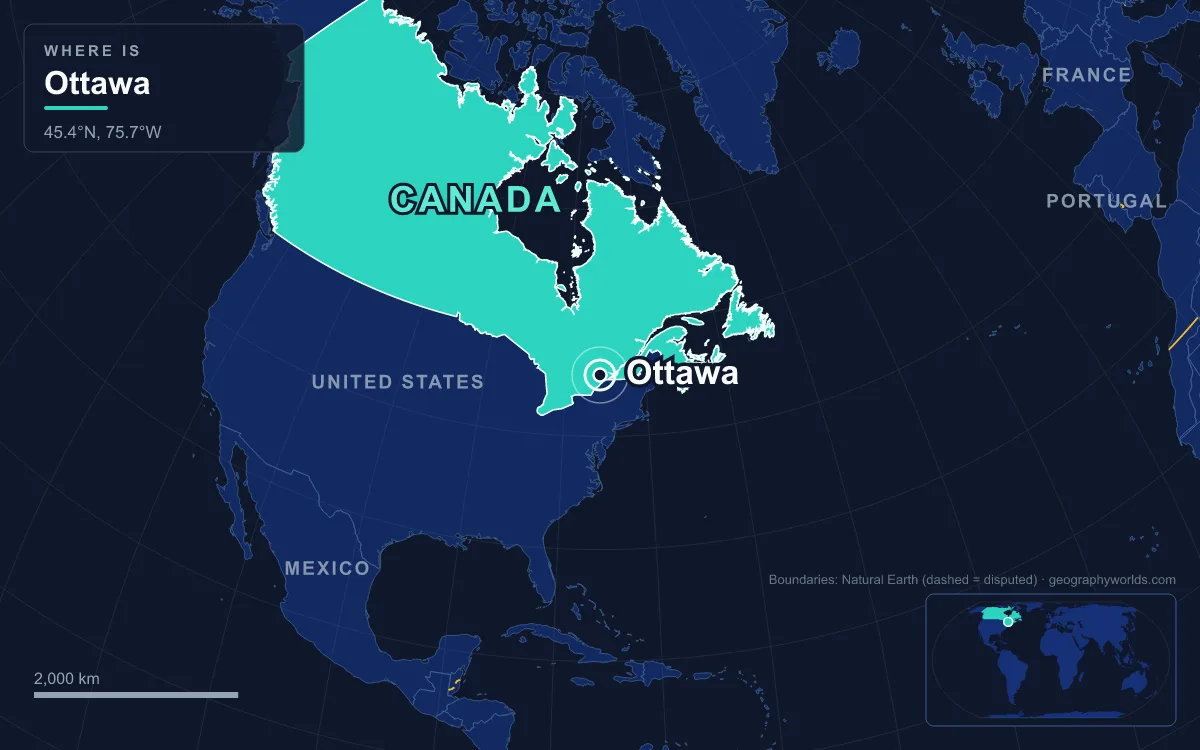
With 1,017,449 residents at the 2021 census, Ottawa is the capital of Canada but only the country’s fourth-largest city. It sits in southeastern Ontario on the south bank of the Ottawa River, where the Rideau River and the Rideau Canal meet it, and the river is also the provincial border: directly across lies Gatineau, Quebec, and the two together form a metropolitan area of 1,488,307 people. Ottawa was a compromise choice, picked by Queen Victoria on the advice of her governor general and made effective on 31 December 1857, after the Province of Canada’s legislature had spent years failing to choose between larger rivals. Nearly everything about the city is easiest to understand by comparison: with Toronto and Montreal, with its own past as a lumber town, and with winters that bury it under about 2.3 metres of snow a year.
2,788 Square Kilometres Against Toronto’s 631
On a map, the capital is bigger than the country’s largest city by a wide margin. Ottawa covers 2,788.2 square kilometres of land, more than four times Toronto’s 631 and more than seven times Montreal’s 364.74. The reason is a single decision: on 1 January 2001 Ontario merged all the municipalities of the Regional Municipality of Ottawa–Carleton into one city, sweeping in the suburbs of Kanata, Nepean, Gloucester and Cumberland along with farmland and villages such as Carp, Osgoode, Manotick and Constance Bay.
The result is a capital that is mostly countryside. Its 2021 density was 364.9 people per square kilometre, against 4,833.4 in the City of Montreal, and between the downtown core and the outer suburbs runs the National Capital Greenbelt, a band of forest, farmland and marsh managed by the federal National Capital Commission. That agency controls about 11 percent of all land in the National Capital Region, including most federal land in the City of Ottawa.
Fourth in Population, Built on Federal Jobs
Ottawa ranks behind three cities that are not the seat of the federal government, and only narrowly ahead of Edmonton.
What Ottawa lacks in size it makes up in employment. The federal government is its largest employer, with more than 128,000 people working for it across the National Capital Region in 2016. That concentration is recent: during the Second World War the federal public service roughly tripled, from 12,000 to 36,000, and new office buildings went up across the city to hold them. The workforce is also unusually educated, with the highest share of university graduates of any Canadian city, in a city that is home to the University of Ottawa, Carleton University, Algonquin College and the National Research Council, and median after-tax household income in 2021 was about $88,000, against a national median of $73,000.
The second contrast is technology. By the 1980s Bell Northern Research, later Nortel, employed thousands here, and firms such as Newbridge Networks, Mitel, Corel and later Shopify were founded in the city, earning it the nickname Silicon Valley North. In 2015 about 1,800 technology companies employed roughly 63,400 people, many of them in Kanata in the west end.
Kingston, Montreal, Quebec City, Toronto: The Capitals That Lost to Bytown
Ottawa became the capital because nobody could agree on anywhere else. After Upper and Lower Canada were united, the governor general made Kingston the capital in 1841. A vote in 1842 rejected it, and in 1844 the seat moved to Montreal. In 1849 an Orange mob burned the parliament building there, and the legislature settled on perambulation, alternating between Quebec City and Toronto. The same year, the Stony Monday Riot broke out in Bytown itself when Tories disrupted a Reformist reception promoting the town as capital. In all, the legislature held more than 200 votes over several decades on where to sit. An 1856 vote in the lower house to move permanently to Quebec City passed, but the move never happened because the upper house refused to fund it.
The legislature then asked Queen Victoria to decide. Governor General Edmund Head recommended Ottawa because it was acceptable to both English-speaking Upper Canada and French-speaking Lower Canada, lay far from the American border behind dense forest on a defensible cliff, and was small enough to be less prone to the political mob violence that had hit earlier capitals. The Crown already owned the land that became Parliament Hill. Parliament ratified the choice in 1859, Quebec City served as interim capital until 1865, and the first session in the new buildings was held in 1866, the year before Confederation. Of the losers, Toronto and Quebec City went on to become provincial capitals, a pattern traced in our guide to Canada’s province capitals.
From 1,000 People in 1832 to a Million in 2021
The town that beat them was new. Bytown was established in 1826 and named in 1827 after Colonel John By, the British military engineer building the Rideau Canal, a 202-kilometre waterway to Kingston on Lake Ontario designed after the War of 1812 to avoid the exposed stretch of the St Lawrence River along New York State. By laid out Upper Town west of the canal, largely English-speaking and Protestant, and Lower Town to the east, mostly French, Irish and Catholic. When the canal opened in 1832, Bytown had about 1,000 people. It became a town in 1850 and was renamed Ottawa, with city status, in 1855. The canal’s story is told in more detail in our article on the Rideau Canal.
Lumber, not government, drove the early growth. Sawmills run by lumber barons produced 39 million board feet of timber in 1855 alone, and by 1885 Ottawa was the only city in Canada whose downtown street lights ran entirely on electricity. Lumber also brought disaster: in 1900 a fire that started in Hull crossed the river and destroyed about 3,200 buildings across both cities, leaving an estimated 14 percent of Ottawans and 40 percent of Hull’s residents homeless.
Ottawa and Gatineau: One Capital Region, Two Provinces
Standing on Parliament Hill, a visitor looks across the river into another province. Gatineau, formed on 1 January 2002 by merging five Quebec municipalities including Hull, Aylmer and the old town of Gatineau, had 291,041 residents in 2021, and it began earlier than Ottawa: Philemon Wright, a New Englander, founded a settlement there on 7 March 1800 and in 1806 started the Ottawa River timber trade by floating a raft of timber down to Quebec City. Today several large federal office complexes, including Terrasses de la Chaudière and Place du Portage, stand on the Quebec side.

The river is also a language line. In Ottawa, 58.2 percent of residents gave English as their mother tongue in 2021 and 12.5 percent French, while 36.4 percent could speak both official languages. Across the river the balance shifts, and the metropolitan area as a whole has a larger share of French speakers than the city. Ottawa adopted official bilingualism for municipal business in 2002, making it the largest Canadian city with English and French as co-official languages. A further 23.1 percent of residents have another mother tongue, led by Arabic at 4.3 percent, and a quarter of the population in 2021 had been born outside Canada, most often in China, India or the United Kingdom.
Minus 14.3 in January, 27 in July
Ottawa’s climate is a study in extremes. January’s average low is −14.3 °C, most days from December to February stay below freezing, and there are on average 16 nights a year colder than −20 °C. July’s average high is 27.0 °C, with about 15 days a year above 30 °C and heat waves that can pass 35 °C. Snow is the defining feature: about 232 centimetres falls in an average year, and January, February and March each have snow on the ground for more than three weeks.
The city turns the cold into infrastructure. For part of each winter, the Ottawa section of the canal becomes a 7.8-kilometre skateway from Carleton University to the Senate of Canada Building, used for recreation and for commuting downtown. The Rideau Canal was listed as a UNESCO World Heritage Site on 29 June 2007.

The 92.2-Metre Peace Tower and the Height Rule
The original Parliament buildings, the Centre, East and West Blocks, went up between 1859 and 1866 in the Gothic Revival style, delayed by bedrock that lay closer to the surface than the architects expected. On 3 February 1916 the Centre Block burned down, and the House of Commons and Senate moved into the Victoria Memorial Museum until a new Centre Block was finished in 1927, crowned by the Peace Tower. For decades the skyline was shaped around it: height limits kept new buildings below 150 feet through at least the 1950s, and in the 1960s the cap was raised only to just under the tower’s height above sea level. A few buildings now stand slightly taller, the tallest being the 143-metre Claridge Icon.
Planning the capital as a showpiece came later still. In 1950 the French planner Jacques Gréber, hired by Prime Minister Mackenzie King, proposed the Greenbelt, moving Union Station out of downtown, removing the streetcars, and the Kichi Zibi Mikan parkway along the Ottawa River, and the 1958 National Capital Act created the commission that still carries much of that plan out. How those long, snowy winters compare with the rest of the country is covered in our overview of the climate of Canada.
Quick Facts About Ottawa
- Country: Canada
- Continent: North America
- Country population: approximately 40.5 million
- Capital city status: Ottawa is the capital of Canada, the seat of national government, and the location of foreign embassies, parliament, and the head of state's official residence.
Frequently Asked Questions
What is the capital of Canada?
The capital of Canada is Ottawa. Ottawa is the seat of national government, hosts most foreign embassies and consulates, and is typically where the head of state and parliament are located.
What continent is Ottawa in?
Ottawa, the capital of Canada, is located in North America. As Canada's capital, Ottawa serves as the country's primary connection to the broader North American political, economic, and cultural sphere.
Why is Ottawa the capital of Canada?
Ottawa was chosen as the capital of Canada for reasons that typically combine geography, history, and politics. Capital city selections often reflect a desire for centrality (being accessible from across the country), historical importance (being a longstanding seat of government or culture), or neutrality (being acceptable to multiple regions or ethnic groups within the country). The specific reasons for Ottawa's designation are detailed in the city's history above.
What is Ottawa known for?
As the capital of Canada, Ottawa is best known for housing the country's central government institutions — parliament, presidential or royal residences, supreme court, and key ministries. It is also typically a major cultural and economic center within Canada, hosting national museums, embassies, and signature monuments. The introduction and history sections above provide detailed coverage of the city's specific notable institutions and landmarks.
Related Pages
- Canada Country Guide — full geography, climate, economy, and culture overview
- Flag of Canada — meaning, history, and design of Canada's national flag