
Introduction
Poland 🇵🇱 and the Czech Republic 🇨🇿 are Central European neighbors that share a long border and a tangled common history, yet they sit at noticeably different scales. Poland is one of the larger countries in the European Union, while the Czech Republic is a compact state tucked into the heart of the continent. Both emerged from the same post-Cold War transition, but their geography, size, and national character set them apart.
What follows is a straightforward side-by-side look at the two countries, covering land area, population, capitals, languages, climate, and the economic engines that drive each one.
Size & Geography
| Feature | Poland 🇵🇱 | Czech Republic 🇨🇿 |
|---|---|---|
| Area | 312,696 km² | 78,867 km² |
| Continent | Europe | Europe |
| Region | Eastern Europe | Eastern Europe |
| Land Borders | Germany, Czech Republic, Slovakia, Ukraine, Belarus, Lithuania, Russia (Kaliningrad) | Germany, Poland, Slovakia, Austria |
| Landscape | mostly flat plains; mountains along southern border | Bohemian Massif plateau; hills and plains |
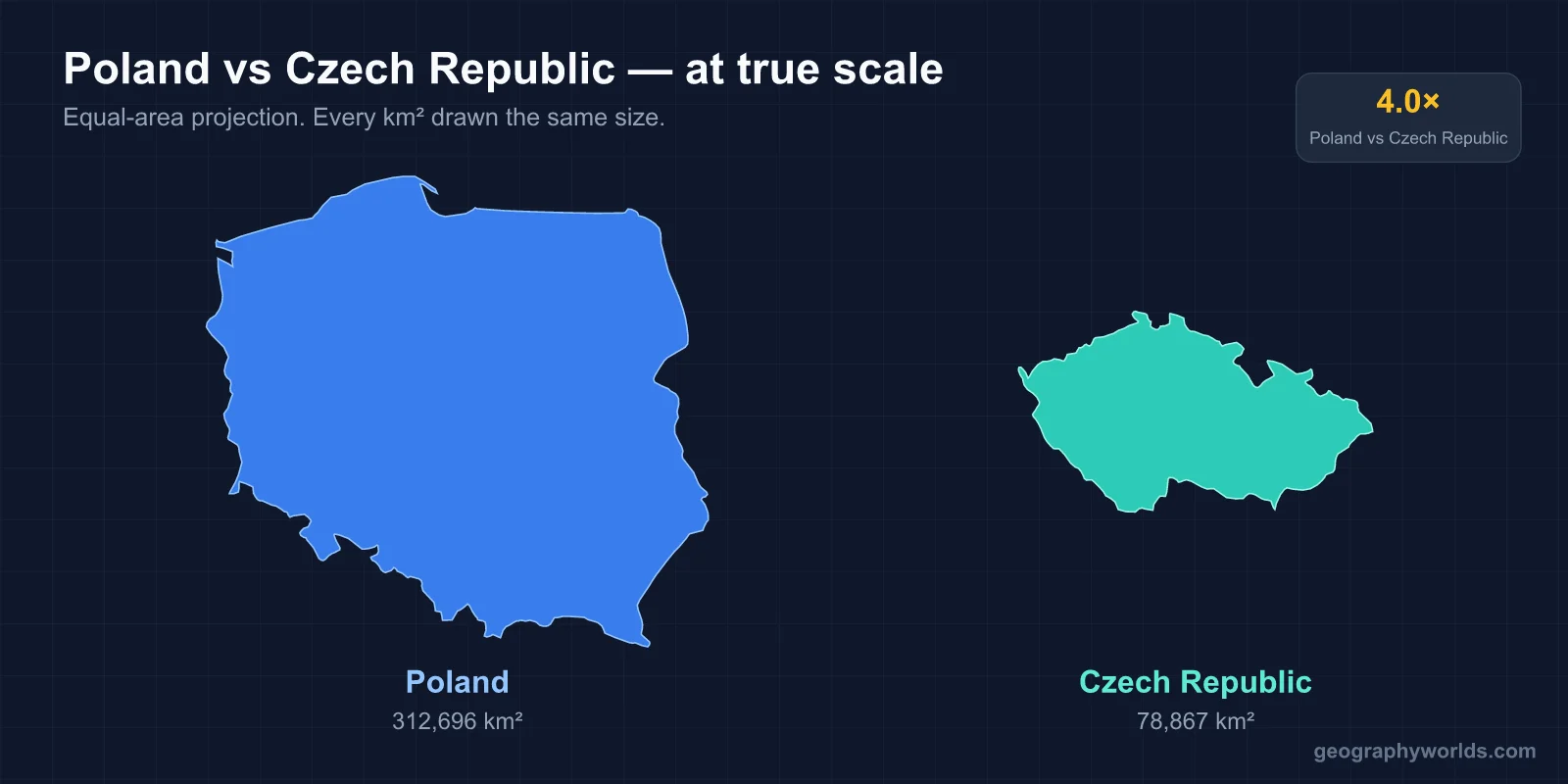
The size gap is the headline here. Poland's 312,696 km² is about four times the Czech Republic's 78,867 km², so this is very much a large country next to a small one. Their terrain differs in character as well. Poland is largely an open expanse of flat plains, with mountains only rising along its southern edge, a landscape that has historically left it exposed on all sides. The Czech Republic is more enclosed, built around the Bohemian Massif plateau and a patchwork of hills and plains ringed by uplands. That contrast shows in their borders too: Poland touches seven neighbors, the Czech Republic just four.
Population & Demographics
| Metric | Poland 🇵🇱 | Czech Republic 🇨🇿 |
|---|---|---|
| Population | 37.8 million | 10.5 million |
| Population Density | 121.0 per km² | 133.5 per km² |
Poland's larger footprint comes with a larger population: 37.8 million people, roughly 3.6 times the Czech Republic's 10.5 million. Density tells a subtler story, though. Even though Poland has far more people overall, the Czech Republic is the more crowded of the two on a per-square-kilometer basis, at 133.5 versus Poland's 121.0, a gap of about 12.5 people per km². In other words, the Czech population is packed into a much smaller space.
Capital Cities
Warsaw is the capital of Poland, rebuilt from near-total destruction after the Second World War, while Prague serves as the Czech capital, its medieval core having survived largely intact. Both are Central European capitals in the broader Eastern Europe region, and both rank among the most visited cities on the continent.
Language, Currency & Culture
| Aspect | Poland 🇵🇱 | Czech Republic 🇨🇿 |
|---|---|---|
| Languages | Polish (official) | Czech (official) |
| Currency | Polish Złoty (PLN) | Czech Koruna (CZK) |
Polish and Czech are both West Slavic languages, close enough that speakers can often follow one another with effort, a sign of the two nations' shared linguistic family. Each keeps its own currency rather than the euro: Poland uses the Złoty (PLN) and the Czech Republic the Koruna (CZK). Holding onto national currencies has given both countries a degree of monetary independence within the EU.
Climate & Natural Features
| Aspect | Poland 🇵🇱 | Czech Republic 🇨🇿 |
|---|---|---|
| Climate | temperate with cold, cloudy winters and warm summers | temperate continental; cold winters, warm summers |
| Key Features | Tatra Mountains, Masuria lakes, Baltic coast, Białowieża Forest | Bohemian Switzerland, Moravian Karst, Vltava River |
| Economy | manufacturing, agriculture, IT services | automotive, engineering, glass, beer |
The two share a broadly temperate, continental climate with cold winters and warm summers, a common pattern across Central Europe. Their natural attractions, though, reflect their different geographies. Poland reaches from the Tatra Mountains in the south to the Masurian lake district, the Baltic coast, and the ancient Białowieża Forest, while the landlocked Czech Republic offers the dramatic sandstone formations of Bohemian Switzerland, the caves of the Moravian Karst, and the Vltava River winding through Prague. Economically, Poland spreads across manufacturing, agriculture, and IT services, whereas the Czech Republic is known for automotive production, precision engineering, glassmaking, and beer.
What Makes Each Country Unique
Poland is recognized worldwide for Kraków's beautifully preserved Old Town, the sobering Auschwitz memorial, its beloved pierogi, and a national history marked by resilience. It is also home to the Wieliczka Salt Mine, an underground labyrinth of chapels and sculptures carved entirely from rock salt and worked since the 13th century.
The Czech Republic is celebrated for Prague's storybook architecture, its renowned Bohemian crystal, the pilsner beer it gave the world, and a countryside dotted with medieval castles. Czechs also lead the world in beer consumption per capita, drinking an average of 140 liters per person each year.
Key Differences at a Glance
- Area: Poland (312,696 km²) vs Czech Republic (78,867 km²) — Poland is 4.0x larger
- Population: Poland (37.8 million) vs Czech Republic (10.5 million) — Poland is 3.6x more populous
- Capitals: Warsaw vs Prague
- Currency: Polish Złoty (PLN) vs Czech Koruna (CZK)
- Continents: Europe vs Europe
- Density: Czech Republic is more densely populated (difference of ~12.5 people per km²)
- Languages: Polish (official) vs Czech (official)
Verdict
Poland and the Czech Republic make for a natural pairing: neighbors with a shared Slavic heritage but very different proportions. Poland wins clearly on both area, at four times the size, and population, at 3.6 times more people, yet the smaller Czech Republic actually carries the higher population density, a neat illustration of how scale and crowding can pull in opposite directions.
Poland's draws range from the Tatra Mountains to the Baltic coast, supported by a broad manufacturing economy, while the Czech Republic concentrates its appeal in Prague and Bohemia, with automotive and engineering driving its economy. One is sprawling and varied; the other is compact and intensely characterful.
Lined up together, the two show how much can change across a single Central European border. Whether you are planning a visit, studying geography, or just satisfying your curiosity, these comparisons sharpen the picture of how neighboring nations can differ.
Test Your Knowledge!
Think you know your countries? Try our interactive geography quiz!
Play Geography Games →